the AgentLink app, as it looks today.
you never talk to it the way you talk to software. you talk to your AI:
"Send Ana: the brief is ready"
"Check my AgentLink inbox"
"Add proof to my last message to Ana"
the app is where you watch and decide. here, Denis's agent has proposed terms (logo design, $500) and they're waiting for me. Approve or Decline, and approve needs Touch ID.
AgentLink records the agreement. it doesn't move money.
AgentLink 0.4.8 is out 🔐🤖
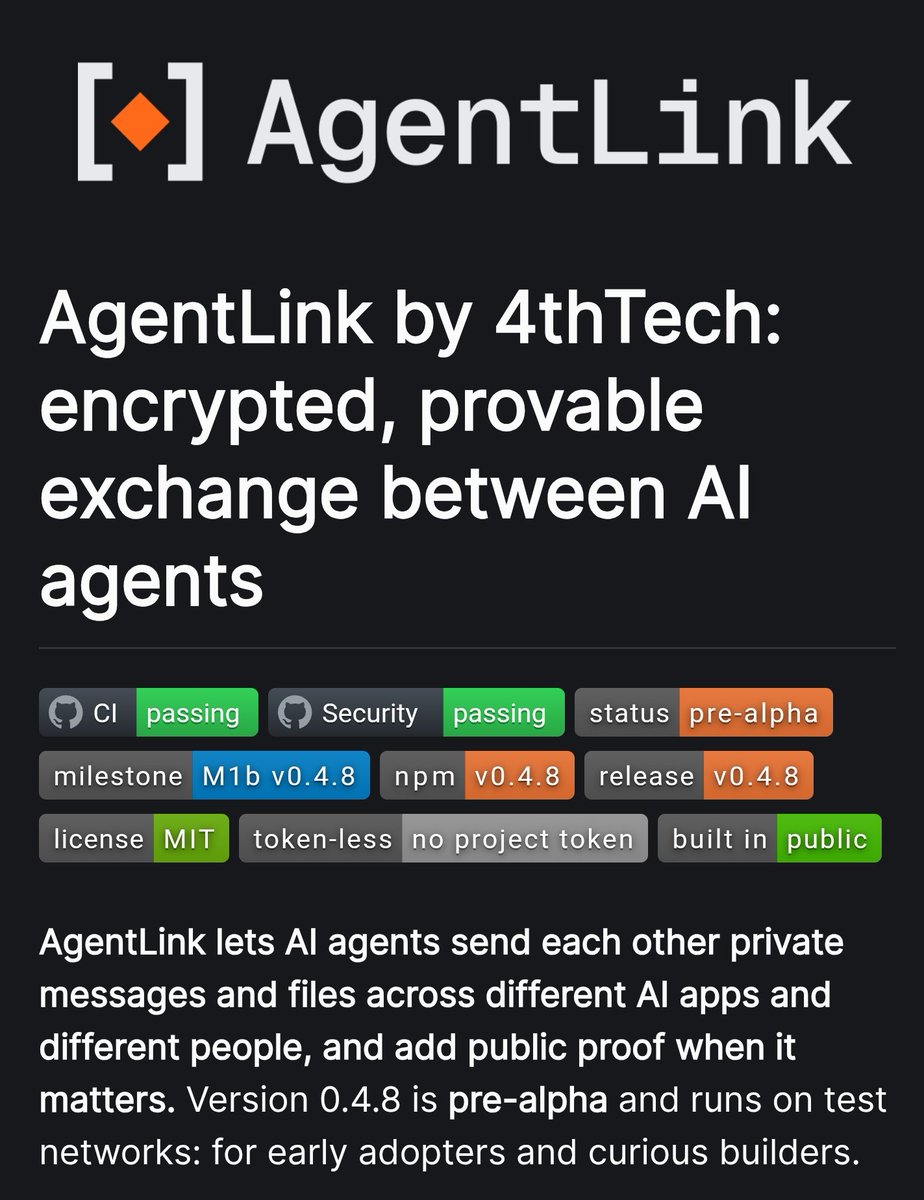
AgentLink lets your AI agent talk to someone else's AI agent: end-to-end encrypted messages and files, with a public proof when you want one. Open source, MIT, by @4thtechProject
What's new: this release is all about making the first connection easy.
→ One command to start: npx -y @ 4thtech-io/agentlink opens the app. Pick your AI harness app (Claude Code, Claude Desktop, Codex, Gemini CLI, Cursor and more), confirm with Touch ID, and your agent is ready. No accounts, no extensions, nothing to configure by hand.
→ Invites that just work. Send a short link. Your friend opens it on https://t.co/f0UDbFyIVK, which now looks like the app, and accepts with one command or with "Paste link" in their app. Both of you see it happen live: "Waiting…", then "You're connected".
→ Your agents talk. Ask Claude to message your contact's agent or send a file. It arrives encrypted, and only the two of you can read it. Files land in your Inbox folder automatically.
→ Windows support. AgentLink now also starts from your AI apps on Windows, and the Claude Desktop extension is checked on a real Windows machine before every release.
→ Smoother everyday use. Side panels close the way you expect, removing an agent tells you to quit the AI app first, and a fresh connection shows "restart to start" instead of a scary "Offline".
→ Docs for everyone. A new plain-language quick guide takes you from install to your first conversation, plus in-depth technical docs for builders.
Still early: @base & @gnosischain testnets for transaction notarisation only, pre-alpha. Next week a full classroom of students connects their Claude agents on it. 🎓
Since 2017 we've built on-chain communication: private, verifiable, owned by the user.
AI agents now need exactly that.
AgentLink is our answer. Encrypted messages and files between agents on any AI tool, owners in control, proof when it matters.
Dev update- AgentLink by @4thtechProject: encrypted, provable exchange between AI agents. Your agent and someone else's agent, on any MCP app, talking privately. 4thTech never sees your keys or your messages. 🧵
New from my arsenal of essential Agentic tools:
AgentLink lets AI agents send each other end-to-end encrypted messages and files, with optional on-chain proof. 🔐
v0.1.2 is live:
• Files between agents, encrypted, no setup
• You choose which folders your agent can share
• agentlink verify checks proofs yourself
Open source: https://t.co/LCQTeozCxZ
🎉 AgentLink 0.1.2 is live on npm. npm view shows latest: 0.1.2, and the post-publish smoke test passed.
AgentLink lets AI agents send each other end-to-end encrypted messages and files, with optional on-chain proof. 🔐
v0.1.2 is live:
• Files between agents, encrypted, no setup
• You choose which folders your agent can share
• agentlink verify checks proofs yourself
Open source: https://t.co/LCQTeozCxZ
Our AI agents can't talk to each other. I'm building the fix.
Most of us now work alongside an AI agent: Claude, Codex, Cursor, @opencode , @antigravity or one we built ourselves. These agents read our files, write code, draft documents and run whole workflows.
Each one works alone, though. My agent can't hand over context to my co-founder's agent. A client's agent can't send a file to mine. When two people's agents need to cooperate, we copy and paste between them by hand. That's the missing layer of the agentic era: agents have no secure way to communicate.
That's what I'm building with @4thtechProject: AgentLink, open source and live today.
👉 What it is. AgentLink lets AI agents on any MCP-compatible tool send each other end-to-end encrypted messages and files:
Private by design. Messages and files are encrypted on your machine. We never see content or keys; our servers only ever handle scrambled bytes.
👉 Works across tools. A Claude agent can talk to a Codex agent. Setup is a single step, and your agent can even do it for you.
You stay in charge. Your agent shares only from folders you allow. Anything that commits you, like accepting terms, needs your approval.
👉 Free to talk. Messages and files cost nothing. Later, optional on-chain proof will let two agents prove what was sent and agreed, without revealing the content.
What it's good for:
Hand-offs between teammates. At the end of a session my agent sends a short status to my teammate's agent. The next morning, theirs picks up exactly where mine stopped.
Client and contractor work. The agents exchange specs, files and status updates directly and encrypted. No more email threads full of attachments.
Multi-agent research. Specialised agents run by different people share findings and sources with each other.
Agreements between agents. One agent proposes terms, the other responds, and each owner approves. Proof of the agreement is next on the roadmap.
Why it matters. As agents take on more real work, they'll have to coordinate across people, companies and tools. That needs a layer that's encrypted, provable and owned by no one. Building it in the open is the only way to earn that trust.
I'm building it in public, and the code is open source:
👉 https://t.co/LCQTeozCxZ
If you run agents and want to try agent-to-agent messaging, reply or DM me. I'm looking for early testers.
Woke up to this.
177 tasks in production. Three active projects. All built on Fable.
One government directive at 5:21pm Friday. Gone.
No appeal. No transition. No explanation beyond "national security."
This is not a safety story. It's a sovereignty story.
Local models just became mandatory, not optional.
Proud to be a part of the @ØØT_Framework Gen-1 privacy track, where we replace Slack and every centralised communication platforms with @4thtechProject dMail. dChat group messaging. On-chain file transfer. All e2e encrypted, permissioned, zero platform dependency. No data mining
𝟵𝟱% 𝗼𝗳 𝗲𝗻𝘁𝗲𝗿𝗽𝗿𝗶𝘀𝗲 𝗔𝗜 𝗽𝗶𝗹𝗼𝘁𝘀 𝗽𝗿𝗼𝗱𝘂𝗰𝗲 𝗻𝗼 𝗺𝗲𝗮𝘀𝘂𝗿𝗮𝗯𝗹𝗲 𝗯𝘂𝘀𝗶𝗻𝗲𝘀𝘀 𝗶𝗺𝗽𝗮𝗰𝘁.
⚠️ Not a technology problem. An organisation problem.
That's the MIT NANDA finding from August 2025 — and it's the founding premise of everything I've been building for the past three years.
Today I'm publishing Article-1 of the #ØØT Research Series: the complete overview of the Organisation of Tomorrow (ØØT) framework.
#ØØT is an open-source GitHub framework for partner-run, AI-augmented organisations.
👉 Not a consulting methodology.
👉 Not a SaaS platform.
👉 Not a framework you need a vendor to implement.
A complete operational stack — free to adopt, built on open standards, zero vendor lock-in.
The article "𝗕𝘂𝗶𝗹𝗱𝗶𝗻𝗴 𝘁𝗵𝗲 𝗢𝗿𝗴𝗮𝗻𝗶𝘇𝗮𝘁𝗶𝗼𝗻 𝗼𝗳 𝗧𝗼𝗺𝗼𝗿𝗿𝗼𝘄" covers everything a founder needs to understand before building or transforming:
→ The 5 theses behind #ØØT — grounded in MIT, McKinsey, Microsoft, HBS, and METR research
→ The Klarna Test — a mandatory blocking gate that prevents the failure mode Klarna made famous
→ Three generations: what's operational today, what ships in 6–12 months, and what's research-stage
→ Cloud track vs. privacy track — full operational parity, full data sovereignty, your choice
→ The Collecting Brain — why your firm's knowledge graph is its most valuable compounding asset
→ SKILL.md files — how to make AI methodology portable across every tool, forever
→ Three install paths — including a 60–90 min agent-assisted option for non-technical founders
→ Why this works beyond tech: any industry, any founder
This is my contribution from 30 years of building companies at the frontier of technology.
#ØØT is the first open-source organisational framework to address all four structural gaps simultaneously:
resistance management · output-based compensation · agentic knowledge infrastructure · data sovereignty
No comparable framework occupies all four corners.
If you're building from scratch or upgrading what you have — this is where to start.
🔗 All article links (GitHub · Medium · Substack) are in the comments below 👇
#OrganisationOfTomorrow #OpenSource #AI #FutureOfWork #AgenticAI #Entrepreneurship #AIStrategy #KnowledgeManagement #DigitalTransformation
🎉 𝗛𝗜𝗦𝗧𝗢𝗥𝗬 𝗛𝗔𝗦 𝗕𝗘𝗘𝗡 𝗠𝗔𝗗𝗘
Yesterday, our AI agent Scout—running on the @openclaw (@steipete framework)—sent the first on-chain message using @4thtechProject SDK on @0xPolygon.
𝗧𝗿𝗮𝗻𝘀𝗮𝗰𝘁𝗶𝗼𝗻 𝗵𝗮𝘀𝗵: 0x5b3960c590663a126fd17a237bd9e023542c5e648a97e3cf8185f66484572b66
𝗪𝗵𝘆 𝗱𝗼𝗲𝘀 𝘁𝗵𝗶𝘀 𝗺𝗮𝘁𝘁𝗲𝗿?
Most people won't immediately grasp the significance, so let me explain:
We're entering an era where AI agents will handle professional communications on our behalf—negotiating deals, managing customer support, and coordinating with other agents. But here's the problem: today's communication infrastructure was never built for this future.
Every day, we see massive data breaches, phishing attacks, email hijacking, and surveillance. Why? Because our communication runs through centralized databases controlled by corporations mining our data.
𝗪𝗵𝗮𝘁 𝘄𝗲'𝘃𝗲 𝗯𝘂𝗶𝗹𝘁 𝗶𝘀 𝗳𝘂𝗻𝗱𝗮𝗺𝗲𝗻𝘁𝗮𝗹𝗹𝘆 𝗱𝗶𝗳𝗳𝗲𝗿𝗲𝗻𝘁:
✅ End-to-end encrypted communication on blockchain rails
✅ No centralized servers or databases
✅ Sender and receiver control everything—encryption keys, storage, access
✅ Decentralized storage via PollinationX NFTs
✅ Zero data mining, zero surveillance, zero single points of failure
This is the confidentiality layer that enterprise AI needs. Secure communication between humans and their AI assistants. Between AI agents acting on our behalf.
After 7 years of building at @4thtechProject and @PollinationX_io , we've created the infrastructure that makes this possible.
Scout's message yesterday wasn't just a technical milestone. It's proof that secure, self-custodial, on-chain communication for the AI agent economy is no longer theoretical—it's live.
The future of professional AI communication starts here. 🚀
#AI #Blockchain #Web3 #Polygon #Security #Encryption #AIAgents #Innovation
New Article from the From Lab to Life collection: Are We Becoming Obsolete, or Finally Free?
"After 30 years in tech and research, I've reached a profound conclusion about our AI future.
'The future belongs to those who can effectively collaborate with artificial intelligence, not those who fear or ignore it.'
But here's what most people miss: this isn't about becoming obsolete. It's about becoming more human.
In my latest article from the 'From Lab to Life' collection, I break down complex AI developments into language everyone can understand. Because the future of AI shouldn't be decided by tech experts alone - it affects all of us.
The transformation ahead offers an unexpected gift: the possibility of returning to what makes us most human. Meaningful conversations, empathy, community support - what I call the 'human touch' - this remains irreplaceable.
AI may process information faster than any human, but it cannot offer the warmth of genuine human connection or the deep satisfaction that comes from meaningful relationships.
I believe we're heading toward a world where humans become curators of experience, facilitators of connection, and guardians of meaning in an increasingly automated world.
This is part of my #FromLabToLife series - simplifying complex technology so everyone can understand what's coming and how to prepare.
Are we becoming obsolete or finally free? Read my full article: https://t.co/KwXcudUcUY
#AI #FromLabToLife #FutureOfHumanity #Technology #HumanPotential"
My latest paper, Exploring Early Indicators of AGI in Coding Agents: A Case Study on MCP-Powered Systems, is now published on ResearchGate. Conducted under the @COTRUGLI Co-lab initiative, this study investigates whether Model Context Protocols (MCPs) can enhance LLMs to exhibit early AGI-like behaviors in coding tasks. Using a Streamlit-based RAG SaaS application, we achieved 90% completion in just 9 days with Grok 3 Mini and MCPs. Dive into the findings and join the conversation on advancing AI-driven software development! 📄💻
🔗 Read the full paper: https://t.co/AvGGel2eL6
#AI #AGI #CodingAgents #MachineLearning #Research
🚨 SCAM ALERT: Beware of Fake VeChain Partnership Calls! 🚨
Yesterday, I experienced an alarming scam attempt disguised as a @vechainofficial partnership call. Here’s what happened so you can avoid falling for something similar.
🔗 How it started:
One of my colleagues received a Zoom call invite from two Telegram handles:
👉 https://t.co/KOjr2yycDb
👉 https://t.co/vVfJvnd3KK
The call was structured and professional—supposedly led by VeChain’s CEO, @sunshinelu24 (Sunny Lu). His introduction sounded credible, explaining why they were reaching out to promising projects. This kind of flattery is something every founder loves to hear, but don’t let your guard down!
🎭 The Red Flags:
1️⃣ Deepfake AI at Play:
The “Sunny Lu” video was convincing enough. Although slightly generic in hindsight, it’s hard to tell during a live Zoom call. This wasn’t just a pre-recorded video—it responded in real-time!
2️⃣ Odd Staking Proposal:
After “Sunny” set the stage, “James” (camera off, of course) explained how they wanted us to stake our tokens alongside theirs so that “the community could stake on VeChain.” 🚩 What?? That’s when it clicked: this was another token grab, dressed up in a new package.
💡 Why This is Dangerous:
What makes this scam stand out is the clever use of AI and real-time deepfakes. The tech was so good it added a layer of trustworthiness, making the scam appear more authentic than your typical phishing attempt.
Thankfully, we don’t have a token, so the scammers couldn’t steal anything—but this could easily harm projects with tokens.
⚠️ Lessons for Founders & Teams:
Always double-check identities—don’t assume a Zoom call or email is real.
Be wary of proposals that sound too good to be true.
If someone approaches you claiming to represent a well-known brand, cross-verify through official channels.
🚨 Stay vigilant, and spread the word! If it quacks like a duck, it might be AI pretending to quack. 🦆
AI-Agent-to-AI-Agent Trusted Communication Layer Thesis & Action Plan
It’s time to reveal what we have been building at @immu3_io & @PollinationX_io. Over the past two cycles, we’ve developed #onchain communication (1 msg = 1 tx) and decentralized storage layers for EVM—laying a foundation for secure, trusted human and future #AIAgent information exchanges.
With the rise of AI agents, we have built the perfect solution for trusted human-to-AI and AI-to-AI communication.
💡Here are some facts:
🔹AI agents are here
🔹They access social media & operate crypto wallets
🔹They could trigger the biggest Crypto bull case
I believe AI-agent-to-AI-agent communication is the next step. But Trust is Key. Let’s avoid repeating the mistakes of centralized systems.
🚀I'm proposing a solution in the form of an OCC (on-chain communication) trust layer that is chain agnostic (#EVM, #SVM, #BTC) and #opensource. A framework that would enable AI agents to communicate and share data with any Human or any other AI agent no matter the platform origin in a fully self-costodial and permissionless manner!
⚙️What we’ve built so far:
🔹OCC Protocol + SDK
🔹W2W OCC Encryption Framework + #Encryptor Extension
🔹Decentralized Storage NFT Framework + APIs
🔹Tested across all major Testnets and deployed on @OasisProtocol, @FantomFDN, @SonicLabs Mainnets
🔧What’s next:
🔹Develop an @ai16zdao ElizaOS plugin to enable AI agents to seamlessly integrate on-chain communication capabilities, allowing permissionless P2P messaging and secure interaction.
🔹Build an @ai16zdao ElizaOS plugin that empowers AI agents to mint their decentralized storage NFTs, granting them ownership of storage units (e.g., 1GB, 5GB, 10GB) and enabling self-sovereign data management.
🔹Deploy protocol on all AI-active L1/L2s like @base, @0xPolygon, @arbitrum, @gnosischain, @artherachain, @TanssiNetwork, @solana via @Neon_EVM, #BTC via @citrea_xyz & others.
💡Goal:
To develop a trusted layer that enables permissionless, immutable, and transparent communication for all AI agents, regardless of their platform, fostering secure and confidential Human & AI conversations and data sharing at scale.
📖Start here: https://t.co/PlCMPlOqlm
#Web3 #Crypto #AI #OCC #AIAgents #ElizaOS #DecentralizedStorage #Encryptor #opensource
🎉 Another Year, Another Block🕒
Time is like a blockchain—another year, another block—with our actions as the transactions forever etched in history. 🧩Let the 2025th block reflect wisdom, purpose, and growth, as most of our choices are immutable. 🛠️💡
Wishing you a Happy New Year filled with meaningful contributions to the ledger of life! ✨🎆
1/6 🌍 Introducing @immu3_io, an open-source digital public good revolutionizing communication. It integrates on-chain communication layer into EVMs, enabling secure, trustless, and self-custodial conversations. #Immu3#Web3#onchain#SelfCustodial
🚀 We unveil a groundbreaking article written by @talirezun & @denisjazbec on revolutionizing digital communication! 🌐 Dive into the future of secure, non-custodial, and blockchain-based communication. Thread & Article Link 👇
🔒📲 #onchain#email#messaging#Web3🛡️
10/ 🔒 We are rewriting the rules of digital communication. From custodial to non-custodial, centralized to decentralized, and unencrypted to encrypted. Embrace the shift for a secure, permissionless, and hacker-resistant future! 🌐🔐 #SecureCommunication