🚨 SAMSUNG, SK HYNIX, AND MICRON ARE GETTING SUED FOR ENGINEERING THE MEMORY CHIP SHORTAGE.
The lawsuit, filed June 25 in California, accuses the three companies of using their pivot to AI memory chips as cover to cut production of regular DRAM, the memory used in everyday laptops and phones.
DRAM prices have risen roughly 500-700% over the past four years. Micron reportedly shut down its consumer DRAM brand, Crucial, at the most profitable price point in its history, a move the lawsuit calls economically irrational unless it was coordinated.
The lawsuit points directly to Apple's recent price hikes on iPads and Macs as evidence the damage is already reaching consumers.
This isn't the first time.
Between 1998 and 2002, Samsung, Hynix, Micron, Infineon, and Elpida ran an actual price fixing cartel, confirmed by US federal prosecutors.
Samsung paid a $300 million criminal fine, Hynix paid $185 million, and Infineon paid $160 million, with several executives serving real prison time, sentences ranging from 4 to 14 months.
The new lawsuit alleges Samsung and SK Hynix later rehired and promoted some of those same convicted executives into senior roles.
Together, the three companies control the vast majority of global DRAM supply today, and building a single new DRAM factory costs $15 to $20 billion and takes years, making it nearly impossible for new competitors to break in and undercut them.
That's the core problem this lawsuit is targeting.
Three companies with total control over a market everyone depends on, the same companies already convicted once before, now facing the same accusation again while prices keep climbing and ordinary buyers have nowhere else to turn.
Jefferies doesn't expect relief anytime soon. Prices are forecast to climb another 40-50% next quarter, then a further 30-40% on top of that the quarter after, meaning prices could roughly double by year end.
2027 is expected to bring another 40-45% increase on top of that, with no real normalization expected until 2028.
Russian nuclear company “Rosatom” has developed a first ever in world Russia's plasma engine can reach Mars in 30 days, and even produce enough power + electricity to cities size of Houston, Texas alone
Russia first country in world to have Plasma Reactor + Plasma Engines 🇷🇺🇷🇺
I was ignored by some, mocked by others. Months after, the dollar started its ride causing the macro shock of 2022.
Now another ride has started and there's nothing you can do about it.
Suck it up!
Simulation wins!
Although the summer of 2021 was still in its early stages, I told many seasoned traders with life-long experience that the USD will go berserk. I was asked on what basis. I told them it's wtitten on the simulation scenarion(joking ofc) but then in 2027 it will aim for 127 ($DXY)
Holy Sh*t: that changes the whole Fable 5 story completely:
On June 11, the very same day Amazon reportedly uncovered the jailbreak, “Mythos” allegedly breached almost all classified systems belonging to the NSA and U.S. Cyber Command, not over the course of weeks, but within hours.
"On June 11th Mark Warner, the vice-chair of the Senate Intelligence Committee, said that General Joshua Rudd, who leads the National Security Agency and the Pentagon’s Cyber Command, had told him that Mythos “broke into almost all of our classified systems, not in weeks, but in hours”."
Via Economist
This is WILD!
Something very large is happening in global bond markets, and most people are completely missing it (Save this).
The hyperscalers, Amazon, Google, Microsoft, and Meta have collectively committed $725 billion in capital expenditure for 2026 alone, up 77% from the $410 billion record set in 2025, and Goldman Sachs projects total combined capex from 2026 through 2031 reaching $7.6 trillion.
Those numbers are so large they have broken the American bond market's ability to absorb them.
In 2024, not a single dollar of hyperscaler bond issuance was in a non-USD currency.
In 2025, 100% of new non-USD issuance was new meaning the category barely existed the year before.
By 2026, non-USD currencies already account for 48% of hyperscaler bond funding, with the euro at 52% of that slice, JPY at 15%, CAD at 14%, GBP at 12%, and CHF at 7%.
Bank of America confirmed the shift, hyperscalers have doubled the non-dollar share of their bond funding to 30% of total issuance in 2026.
The individual deal sizes tell the story of how fast this is moving.
In May, Alphabet issued ¥576.5 billion approximately $3.6 billion in yen denominated bonds, the largest yen bond ever sold by any non-Japanese company in history, surpassing the previous record set by Berkshire Hathaway in 2019.
Then Amazon came in June and issued C$14 billion in Canadian dollar bonds, the largest corporate bond ever sold in the Canadian market, attracting over C$28 billion in investor orders, nearly double the amount ultimately sold.
Amazon's single Canadian deal surpassed Alphabet's previous record Canadian issuance of C$8.5 billion set just weeks earlier in May.
Alphabet has now set borrowing records in yen, Canadian dollars, Swiss francs, and sterling in a single calendar year.
Morgan Stanley projects euro borrowing by hyperscalers will hit €50 billion in 2026 potentially making the United States the single largest source of corporate debt issuance in the entire eurozone, ahead of France.
Global AI-related debt issuance is projected to reach $570 billion for the full year 2026, according to Morgan Stanley more than double the pace of the same period last year and nearly four times the 2022 level.
The AI infrastructure buildout is so capital-intensive that even the most cash-rich companies in human history, Apple, Microsoft, Alphabet, Amazon, and Meta collectively hold over a trillion dollars in cash and near-cash assets have concluded they cannot self-fund it.
And they are barely started.
Come join Milk Road Pro for our full breakdown, what $7.6 trillion in hyperscaler capex means for global credit markets over the next five years and our entire Ai thesis.
Link below!
Stocks are dumping.
Gold is dumping.
Silver is dumping.
Crypto is dumping.
Bonds are dumping.
Even Oil is dumping.
If everything is dumping, where the hell is money going?
This is so insanely corrupt, I can’t even believe it.
More than half the donors to Trump’s $400 million White House ballroom just won over $50 billion in new federal contracts in six months.
And here’s the part that should make your blood boil.
Sixteen of these 27 donors were facing federal enforcement actions, antitrust reviews, labor cases, securities charges. Many of those cases have been quietly dropped or scaled back since Trump took office. You write a check, your legal problems disappear. That’s not a coincidence.
The White House won’t even release the full donor list. They’re hiding it on purpose, because daylight is the one thing pay-to-play can’t survive. A federal judge already ruled ballroom construction has to stop until Congress authorizes it.
Government is supposed to serve the people, not auction itself off to the highest bidder. When access goes to whoever pays the most, working families always end up paying the price.
We either end the corruption, or the corruption will end us.
https://t.co/4MGFzSseFl
Citizens of EU countries, You should realize your authorities have unilaterally entered into a war with Russia. So be vigilant and don't be surprised by anything. The peaceful sleep is over. But you know who to ask why!
🚨 THE ENTIRE AI BOOM MIGHT BE BUILT ON FAKE REVENUE.
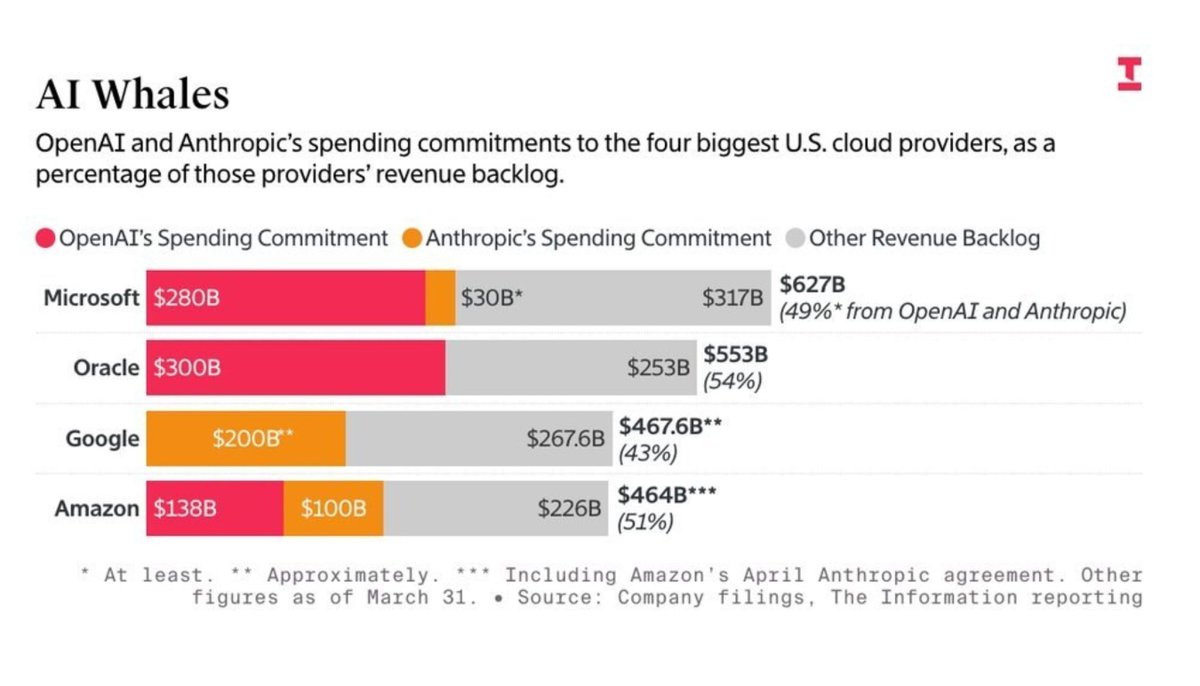
Latest corporate filings show that OpenAI and Anthropic alone make up over half of the entire $2 trillion future cloud backlog held by Microsoft, Oracle, Google, and Amazon.
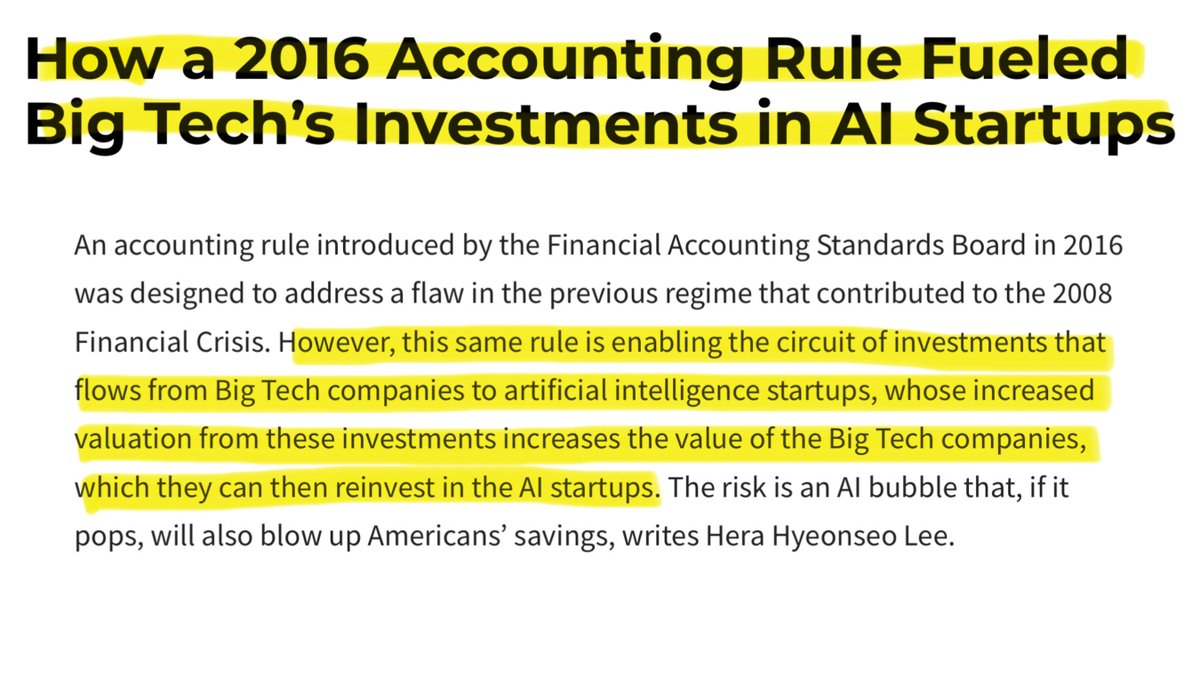
This massive pipeline is actually being created through a circular accounting trick called a round trip revenue loop.
But how it works ?
A tech giant gives billions of dollars to an AI startup as an "investment". But hidden in the contract is a strict rule forcing the startup to hand that exact same money straight back to the tech giant to rent their computer servers.
Look at the documented case of Microsoft and OpenAI.
When Microsoft invested $13 billion into OpenAI, it didn't just give them cash; it gave them "cloud credits" to use Microsoft servers. OpenAI used those exact credits to train its AI models, and Microsoft then turned around and recorded that server usage as brand new "cloud revenue" from a customer.
The tech giant is literally paying itself with its own money and calling it a sale.
This is why OpenAI’s annual cloud bill has ballooned to over $60 billion, double its actual revenue of $25 billion, kept alive solely by this recycled funding loop.
Anthropic runs the exact same play, spending $2.66 billion on Amazon Web Services in just nine months, which was basically 100% of all the money it earned at the time.
This manufactured demand triggers a second accounting trick where tech giants book massive paper profits. Every time a startup gets a higher value from a new funding round, the tech giant updates the value of its investment on its books and counts that unearned paper gain as direct profit.
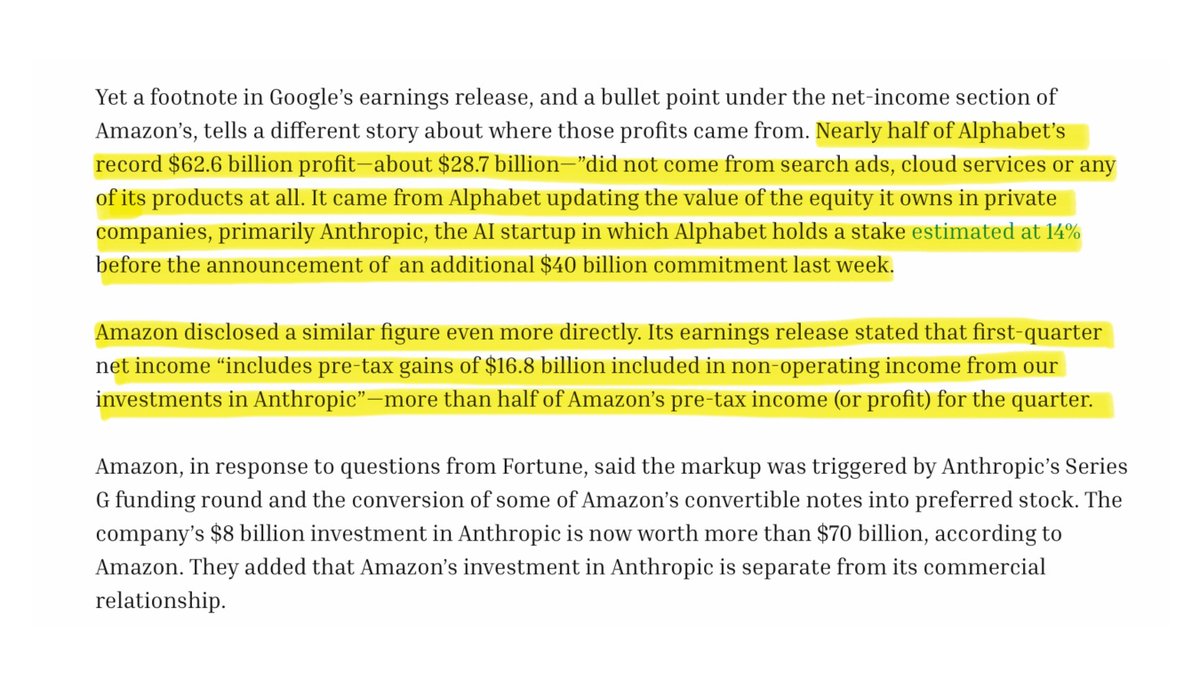
In Q1 2026, Alphabet reported a record $62.6 billion profit, but $28.7 billion nearly half, was just a paper markup on its Anthropic investment. In the same quarter, Amazon reported $30.3 billion in profit, but $16.8 billion of it was just an Anthropic paper gain.
While Amazon reported record profits, its actual free cash flow collapsed 95% to just $1.2 billion because it had to spend $44.2 billion in real cash to build physical data centers.
This has created a massive danger where these giant companies rely heavily on just one or two unstable startups. Microsoft has 49% of its $627 billion future backlog tied to OpenAI, while Oracle has an incredible 54% of its entire $553 billion pipeline relying on OpenAI alone.
This perfectly mirrors the 2001 dot-com crash when Global Crossing and Qwest Communications swapped identical fiber-optic network capacity with each other just to book fake sales.
Qwest had to erase $1.4 billion in fake income, and Global Crossing went completely bankrupt.
The only difference is that the dot-com swaps were illegal, but today's AI loop is fully legal under current accounting rules.
This legal loop inflates tech company stock prices, forcing automatic retirement accounts and index funds to buy even more of these tech stocks. It is a self feeding loop where investments, sales, and stock prices all go up on paper without the AI technology ever making real cash profits.