🚨 A SHOCKING RUMOR CLAIMS AI MAY HAVE CRACKED THE SECURITY BEHIND GLOBAL BANKING AND CRYPTO.
If you use the internet for anything, this affects you if it turns out to be true.
Here is what is really going on 🧵
BREAKING: JPMorgan and Citi are reportedly trying to sell off parts of their AI loan portfolios to cut their exposure to AI debt, per Semafor.
Some banks are using deals that keep the loans on their books but pass the risk of losses to outside investors.
The banks that funded the AI boom are now trying to cut their risk.
Gold's biggest historical crashes are flashing a terrifying warning.
Gold has crashed nearly 37% from its 2026 all-time high, after one of the biggest rallies in its history.
And something similar has happened after previous major gold bull markets.
• 1970–1980: Gold surged over 2,400%, then crashed around 71% and took 28 YEARS to recover.
• 2001–2011: Gold rallied over 600%, then plunged around 45% and took nearly 9 YEARS to reach a new high.
• 2016–2026: Gold surged over 400%, but has now suffered another massive correction.
The concerning part is how long investors were trapped after buying near previous peaks.
In 1980, it took until 2008 for gold to regain its record price.
After the 2011 peak, investors had to wait until 2020.
And now gold is facing renewed pressure from stubborn US inflation and expectations of further Federal Reserve rate hikes.
Higher interest rates make gold less attractive because it pays no interest, while a stronger dollar can put additional pressure on prices.
History doesn't guarantee another decade-long crash, but it shows how brutal gold's corrections can become after massive rallies.
Gold may be a safe haven asset, but buying it at the wrong time has historically cost investors YEARS of recovery.
Apple is outperforming every other Mag 7 stock this year by a huge margin.
It is up 31%, almost 4x more than Amazon, the next best.
1. $AAPL: +31.21%
2. $AMZN: +7.92%
3. $MSFT: +3.59%
4. $META: -6.23%
5. $TSLA: -13.22%
6. $GOOG: -14.06%
7. $NVDA: -20.94%
The company that spent the least on AI is beating every big AI spender.
🚨 Jensen Huang won't be able to save AI stocks from the next crash.
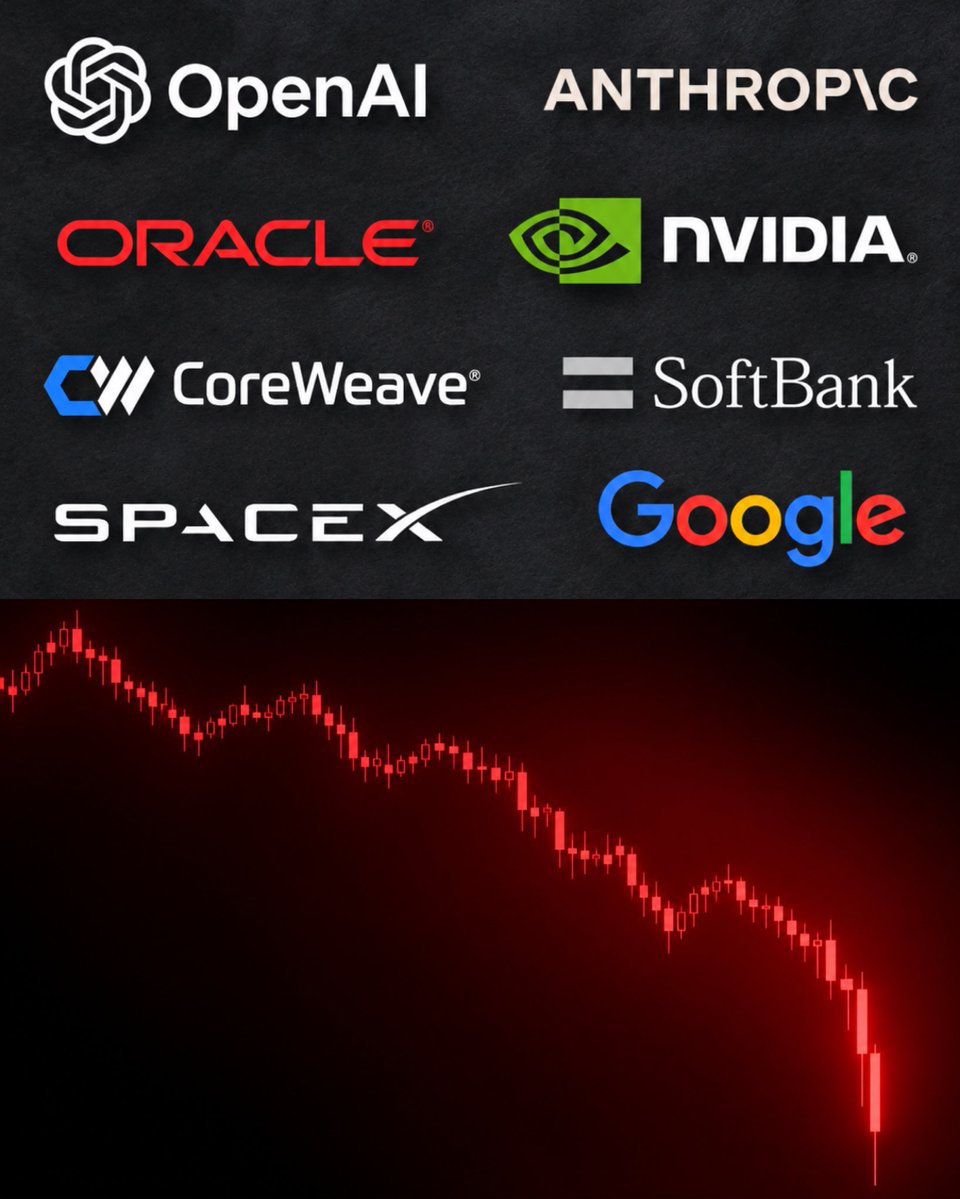
Just two days after he returned as Nvidia CEO, the cost of insuring AI companies' debt hit new highs:
- CoreWeave: 1,314 bps, more than double in 6 months
- Nvidia: 147 bps, nearly 4 times since January
- Oracle: 356 bps, double in 6 months
- SoftBank: 534.6 bps, 2.6 times in 12 months
Even Alphabet and SpaceX are at their highest levels ever.
In January, insuring $10 million of Nvidia's debt cost about $39,000 a year. Today, it costs about $147,000.
And this is happening at a time when the AI industry needs more borrowed money than ever.
Goldman Sachs expects nearly $1 TRILLION in AI-related debt financing in 2027 alone.
But as these companies take on more debt, investors are becoming increasingly worried about whether they will be able to pay it back.
As the risk of default rises, so does the demand for protection.
Weekly trading in AI-linked credit default swaps jumped from under $2 billion in July to over $9 billion in September, 4.5 times in just two months, per Morgan Stanley.
But investors aren't only using it to protect against bad debt.
They're also using it as a hedge against a stock crash, because it's cheaper than buying put options on volatile AI stocks.
Until now, the worries were about revenue, profits and debt.
After Jensen Huang's sudden exit and return, S&P Global Ratings has put Nvidia's AA credit rating on watch for a possible downgrade, citing concerns about board independence and governance.
A downgrade would put pressure on the entire AI trade.
Nvidia has signed up for about $670 billion in commitments and guarantees.
This means it is no longer just selling chips but also helping finance the companies that buy them.
That includes OpenAI, Anthropic, Coreweave, neoclouds and several other companies.
If its credit rating deteriorates, raising money could become more expensive for AI projects relying on its financial backing.
This could put the whole AI bet in trouble.
BREAKING: 🇬🇧 UK sends letters to 100,000 former military personnel telling them to be ready to return to service in case of a war.
This is the first time the UK has done this since the Cold War ended.
S&P 500 IS ON TRACK FOR ITS BEST THANKSGIVING WEEK SINCE 2008.
The index is up 3.94% this week, with only Black Friday left.
This is the 2nd strongest Monday to Wednesday start of a Thanksgiving week since 1950.
Only 2008 was stronger, with a 10.96% gain.
If Friday closes flat or higher, this week beats 2025 (+3.73%) and becomes the best Thanksgiving week since 2008.
Black Friday has closed higher in 71% of years since 1950.
🇺🇸 PRESIDENT TRUMP JUST NOW:
US Q3 GDP growth was actually 4.3%, not 3.4%, accusing officials of publishing false figures before the election.
He is demanding an immediate investigation.
BREAKING: President Trump and NATO Secretary General Mark Rutte issue a joint statement after their meeting at Mar-a-Lago:
1. Russia-Ukraine war and the Iran conflict were the main topics.
2. Both sides urged Russia and Ukraine to avoid any moves that expand the war.
3. President Trump pushed for a peaceful end to the war "as rapidly as possible"
4. Over 20 new US defense facilities are being built for Patriots, THAAD and Tomahawks.
5. New offensive and defensive weapons are being built "that have not yet been viewed by the Public"
6. The US is producing more military equipment than ever before.
So where does this leave things?
Aaronson believes labs have found something. He does not know what.
No paper. No demo. No word from OpenAI or Anthropic. The only real papers released break nothing.
Signs to watch:
1. A named paper with a real algorithm
2. Emergency guidance from security agencies
3. Old Bitcoin with exposed keys suddenly moving
Until then, these are just rumors.
🚨 A SHOCKING RUMOR CLAIMS AI MAY HAVE CRACKED THE SECURITY BEHIND GLOBAL BANKING AND CRYPTO.
If you use the internet for anything, this affects you if it turns out to be true.
Here is what is really going on 🧵
How long would a switch take?
The US already plans to drop RSA and elliptic curves after 2030 and ban them after 2035, per NIST.
A real break would squeeze 10 years of work into months.