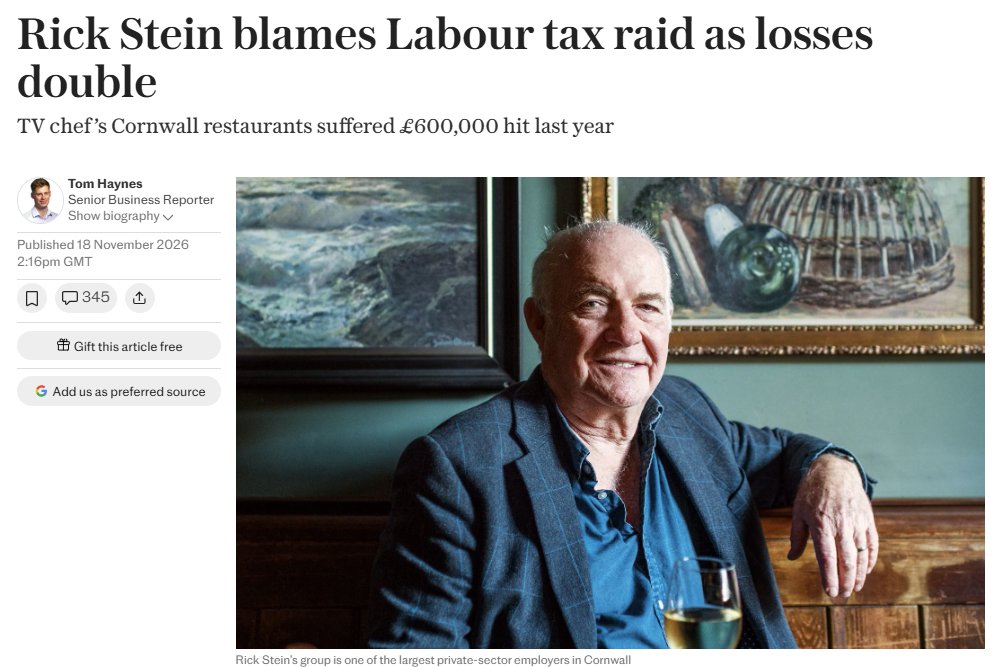
Even famous restaurateur Rick Stein can't make a profit after Labour's huge tax raid. His restaurants suffered a £600,000 hit as losses grew to £814,000.
“Despite disciplined action on pricing, menus, purchasing and labour management, we could not fully offset substantial government-led cost increases," his company said. 22 people were laid off.
Stein himself said that increasing National Insurance had “just stopped growth”.
He added: “You’re certainly not going to hire people unless you absolutely need to.”
Milburn Review is vintage government. Massively raise cost of employing marginal workers through minimum wages & employer taxes. Then propose huge bureaucracy & new schemes to deal with problems you've created.
Letter to the Times
Sir, I run an employment agency in East Anglia and have read and watched with interest the coverage of Alan Milburn's report into the Neets crisis.
Twenty-five years ago we employed many British young people, aged 16 to 24, and for many of them it was their first experience and introduction to work.
Today we employ just a handful. The reasons for this decline are fairly simple.
There has been a sharp increase in employment costs: the minimum wage has increased from £3.60 an hour in 1999 to £12.71 an hour today, an increase of 253 per cent.
Rachel Reeves further added to companies' costs when she increased employers' national insurance contributions last year.
Moreover, increasing health and safety regulations have made it prohibitive to employ 16 and 17-year-olds during school holidays, in an industrial/warehouse workplace.
Tens of thousands of young people leave university with degrees that are of little practical use to local employers, while tens of thousands of local skilled manual jobs remain unfilled.
Increasing employment rights legislation and the consequent threat of an employment tribunal have made employers wary of employing young people with no work record behind them.
It is politicians who have largely created this situation; why the current set of politicians have felt it necessary to have a large costly inquest, when most of the reasons (and thereby the solutions) are in plain sight, is a mystery to me.
Lionel Sheffield
Rapid Recruitment, Wisbech, Cambs
Andy Haldane interview:
**The financial situation is precarious - the penny hasn't dropped in No 10**
'The penny has not yet fully dropped, including in Downing Street. You see that in us having the highest borrowing costs in the G7, despite not having the highest debts and deficits
'It’s the old [Ernest] Hemingway thing, isn’t it? How do you go bankrupt? First slowly, then very quickly.
'Keir [Starmer] lost the dressing room. Andy’s biggest risk is that he loses the dealing room. And then that’s an even more painful way to go, as Liz Truss would tell you.'
**Britain is at or close to being taxed out**
'The truth is, as a nation, we are at or close to being taxed out,” he says. “And we are at or close to being maxed out in terms of borrowing.
'So for me, the economics of this are very straightforward. We have a public sector, a government sector with a balance sheet whose productivity has failed to rise this century. And we have a private sector which is actually primed, its balance sheet is in good shape.
'If you want good growth in every postcode — dear God, I want that as much as the next man, probably just as much as Andy in fact — the root is by unlocking those animal spirits and that means a smaller state, lower taxes and that means lower government spending and tough choices around that'
**The economy could 'crater' without spending cuts**
“This is not a hypothetical risk. Look across the Channel, not just to what’s happening in France, but what’s happening in Greece or Italy or Portugal or Spain a decade and a bit ago. Avoid that like the plague
'Because when you are forced involuntarily into making much more draconian cuts to appease financial markets and get them back on side that will, one, crater the economy. And, two, almost certainly crater your popularity
'That for me is the peril that comes from prevarication on this front. The peril that comes from not using up political capital and making hard choices'
**A 'mañana' Budget does not speak to the urgency of now**
'The public finances dimension is of course a real concern for me. I feel the time to get on top of that is now because who knows what might turn up tomorrow. And a mañana budget doesn’t speak to the urgency of now
'The mañana choices will not be easier tomorrow. They’re going to be much harder. So backloading them, crossing your fingers and hoping that the weather turns, for me would not be the preferred course, would not be the prudent course, and risks next year being even more of a heavy lift than would otherwise be the case'
**Banking taxes are 'penny wise, pound foolish'**
'The point that actually weighs with me most heavily is that this isn’t just about the banks. If you are felt to be a country that is in the business of doing windfall taxes — if you earn profits, the taxman cometh — that is not a hospitable environment for investors.
'It means you mark down the value of UK businesses and mark up the cost of lending money to those businesses. And that is not a good growth strategy over the medium term. Penny wise, pound foolish'
**What does ending 40 years of neoliberalism mean?**
'Have you been to Manchester? You know it’s the embodiment of neoliberalism done well. Success is founded on being a magnetic attractor of capital, or people, of business and culture. That’s what the UK should become'
**What does public control of utilities mean?**
'From kind of full fat nationalisation, which would cost an arm and a leg, right through to tinkering with the regulatory rules. If you’re in the water industry, the energy industry, parts of the transport industry, investors are saying, ‘Hang on a sec, I’m not putting money in here.'
https://t.co/wUWuFH80Hb
Maybe Torsten and his @UKLabour colleagues need to urgently take a long hard look at themselves. Taxing jobs was always going to result in jobs being cut and sadly Torsten’s constituents are now discovering that firsthand.
Why would anyone invest in Britain, when the govt is busy taxing and regulating businesses into extinction - while claiming that ‘growth’ is the priority?
Keir Starmer — ever a man of his word til the end.
In June 2023 he explicitly ruled out ever indulging in a resignation honours list (BBC Radio 4 Today).
Today he’s marked his resignation with 21 peerages, overwhelmingly public-sector/legal jobsworths. Barely a single wealth creator among them.
Classic line up of the New Establishment which has run the country under Labour and Tory governments for the past three decades and is now firmly in control. Largely (if not entirely) with the following characteristics:
*Career almost entirely in public sector, often taking salaries from several sinecures at once as they work up the greasy taxpayer-funded pole.
*Associated with various ‘right-on’ causes.
*Largely middle class, London chattering class, Oxbridge well represented (of course).
*Fashionable left but not too left. Good mainstream Labour links.
Thus is the antediluvian House of Lords perpetuated by the Left as well as the Right as a comfortable state-funded retirement home for the well-connected ‘good and great’ past their sell-by date — when it should simply be abolished.
It would be an act of total madness. It would drive out significant investment in the UK & without question instead of raising more tax it would see a material decline in revenues.
How can anyone in the UK plan with a Labour government constantly talking about more tax burden.
There is only one “change” that will work for Burnham. A genuine, relentless focus on growth.
Two decades without earnings growth. That’s why electorate is fed up.
Only growth will repair contract between generations and allow social ills to be tackled
https://t.co/2H68i2d0JG
Hospitality has so much potential - to create jobs, to drive high street regeneration and economic growth. But it is held back by tax - the most highly taxed sector of the economy
Now the sector is united that #VATsTheProblem. A new sector-wide campaign, spearheaded by Tom Kerridge, is calling for hospitality VAT to be reduced from 20% to 10% - the single biggest lever the Government can pull to unleash potential. So let’s make the Sunmer’s VAT cut the start. Sign the petition today 👇
https://t.co/IW5iwiWaFk
The glass bottle tax threatening to shatter Britain
https://t.co/ft9UPRzvgc
Everyone is talking about the “glass bottle tax”, but very few people have even heard of EPR – Extended Producer Responsibility.
For many businesses, particularly pubs, bars, restaurants and hospitality operators, EPR has already become a huge cost. In many cases, these businesses are effectively paying twice for waste collection and recycling.
And if you think that’s bad, wait until the Deposit Return Scheme (DRS) arrives.
Under DRS, consumers will pay a 20p deposit (plus VAT) on every eligible can and bottle purchased, regardless of the size of the container. To reclaim that deposit, containers must be returned through reverse vending machines or collection points.
Consumers will be pushed towards larger containers to minimise the number of deposits they pay.
Hospitality businesses will face additional administration, storage and handling costs.
We and other drinks manufacturers are already reconsidering their packaging formats
These policies were conceived under the Tories by figures such as Michael Gove, and have since been enthusiastically adopted by Labour
#Hospitality #Pubs #Restaurants #DRS #EPR #Recycling #FoodAndDrink #BusinessCosts #Packaging #UKBusiness