Okay I might not be the sharpest tool in the shed, but did I miss the punchline? How do you actually charge for this? Is your technology / sass a market place? You build the list and in the night nurse case - sell the service? And do you / your agent - contact buyers and match them up?
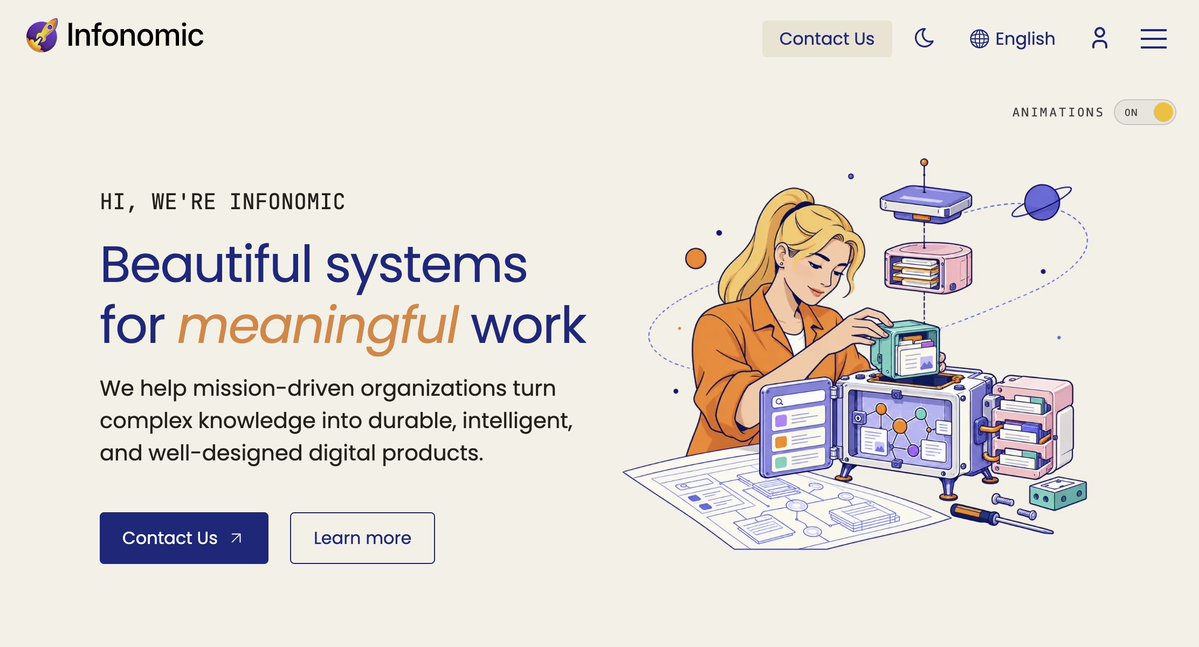
Pleased to present the new face of Infonomic: a long-overdue redesign of our website, with more on the way (not least of which will be our migration to TanStack Start)...
We'll soon be launching a new AI services area focused on AI-assisted data extraction and clean-up for repositories and other data sources. In our experience, any AI-assisted knowledge system is only as good as the data beneath it. Clean, well-structured and semantically correct data, with consistent metadata and vocabularies modelled in standards such as SKOS (Simple Knowledge Organization System), is the precondition for a Semantic Knowledge Management System (SKMS) whose discovery, retrieval and reasoning can be trusted. It is also the step most often skipped.
Some of the thinking behind this work appears in our paper, "Cheap First, Escalate on Evidence: Quality-Gated Extraction for Heterogeneous Research Collections", written with Assoc. Prof. Dr. Steve Elliott, Co-Founder and Research Director of FORRU-CMU, and David Lipsky. It will appear in Springer's Lecture Notes in Computer Science, and we will be presenting it at ICADL 2026 in Khon Kaen, 2 to 4 December.
We are also pleased to announce the latest stable release of Byline, our content and collections management platform. This release adds passkey support, making Byline more secure than ever. Byline is now battle-tested in production with our flagship repository at FORRU-CMU, which includes species and seedling identification collections.
Feel free to get in touch if you'd like to know more, or would be interested in a closer look or a quick demo. Links in the first comment below. Exciting times, and more soon...
@matteocollina@tannerlinsley@loige
#DigitalLibraries #DigitalCollections #SemanticWeb #LinkedData #ICADL2026
"Calculus" by Gilbert Strang is a free textbook from MIT that has become a true classic in mathematics education.
With nearly 700 pages, it provides an exceptionally clear and comprehensive introduction to calculus, covering limits, derivatives and their applications, integration techniques, the Fundamental Theorem of Calculus, differential equations, exponential and logarithmic functions, infinite series, polar coordinates, complex numbers, vectors and matrices, multivariable calculus, partial derivatives, multiple integrals, and vector calculus.
This book is an absolute must-have for anyone approaching calculus for the first time, but also an excellent reference for reviewing its fundamental concepts. I highly recommend adding it to your personal library as a valuable resource to consult whenever you need it.
https://t.co/ogv9fUj2rH
@james_clark Yes this is new and fortunately my wife had been warned about this before we left to visit family on the 27th Sept. We had our daughter's large A4 birth certificate with us in addition to her passports.
I wanted a charting library that was light and fast, but could also keep up when “a simple line chart” inevitably turns into way more. So that’s what I built!
Give it a try! (Or tell your agent to)
NAOMI KLIEIN to SAM ALTMAN:
"...you ingested the entire written output of human civilization without consent, without compensation and without credit to build a system whose primary commercial application is eliminating the jobs of the people whose work you consumed.
You are not 'liberating human creativity' -- you are strip-mining it and selling it back at a markup while calling the theft 'training data'."
The most ridiculous thing about the AI-coding age is that in the last 20 years programmers accepted otherwise all the kind of shit: terrible frameworks, languages, layers of complexity everywhere, everything super slow. Very very few protested, since destroying the field didn't involve their paycheck.
Excellent article diving deep into the two Thai-Cambodia border MOUs, their origins, and related issues. Well worth reading, kudos to the authors.
https://t.co/hDuwXihLcI
📚 Au Japon, des gens vont désormais en boîte de nuit… pour s’asseoir silencieusement et lire un livre pendant qu’un DJ joue de la musique d'ambience.
Le concept s’appelle JUCY BOOK RAVE et se déroule notamment dans un club souterrain de Shimokitazawa, à Tokyo. Ici, pas besoin de danser ni de hurler pour parler à la personne située à 30 centimètres de vous. Les participants viennent avec un livre, s’installent dans la pénombre et lisent pendant que la musique accompagne leur soirée.
Incredibly important talk from Terence Tao... YouTube link in the first comment.
In his keynote, Tao discusses several major developments regarding the intersection of AI and mathematics:
"Proof Indigestion": Tao highlighted a growing bottleneck where AI systems are generating and verifying formal mathematical proofs faster than researchers can explain, publish, teach, or absorb them into the broader body of mathematical knowledge.
A Severe Misalignment: During the summit, Tao announced that he and 24 fellow Fields Medalists published a declaration (available at https://t.co/hURcgsVXU4) warning that the goals of frontier AI companies and the mathematical community are diverging. While AI labs optimize for rapid, "gradable" problem-solving, mathematics values deep explanation, insight, and process.
The Pace of AI: He described the current speed of AI development as "insane," noting that there is no need to rush so heavily when capability growth outstrips our capacity to evaluate and govern the outputs.
The Open Math Model Initiative: As a solution, Tao detailed SAIR's efforts to build a community-driven, open math model—alongside competitions like the Distillation Challenge and Inverse Galois Challenge—designed to ensure AI outputs remain readable, reusable, and integrated with human understanding.
#ai #math #science #education