Dear readers from all over the world - thank you!
This year marks 10th anniversary of “How China Escaped the Poverty Trap.” It couldn’t have scaled walls and traveled without your support & sharing
The book is now FREE to download (link below)
https://t.co/OX87veC0RW
How should we fund R&D when AI accelerates some fields and not others? 🧵
@jddwor argues in a brilliant piece that slow fields become bottlenecks, so funding fast fields much more *reduces* long-term discovery!
It's super clear and gets into substance v quickly
Tadi sore saya ngobrol dg Richardo Hausmann Guru besar ekonomi di Harvard Kennedy School. Hausmann dikenal dg complexity index nya.
Kami mendiskusikan growth strategy di emerging economies. Hausmann selalu mencerahkan. Alih alih berdebat soal sektor mana yg memberikan value added tinggi vs rendah, manufaktur vs services, Hausmann menyampaikan yg penting bukan debate memilih sektor yg memberikan value added tinggi (downstreaming vs commodities) tapi bagaimana membangun capabilities. Dia cerita bagaimana Jepang mulai dg textile, yg akhirnya mesin utk membuat textile menghasilkan toyota. Kisah negara-negara Nordik menunjukkan bahwa teknologi tinggi sering lahir dari proses yang panjang dan tampak sederhana. Finland dan Sweden mula-mula bertumpu pada hutan, kayu, pulp, dan kertas. Tetapi dari industri itulah tumbuh kemampuan engineering, manufaktur, kimia, dan riset. Perusahaan seperti Nokia bahkan berawal dari industri pulp sebelum akhirnya menjadi raksasa telekomunikasi dunia. Intinya apakah mampu meningkatkan capabilities. Kapabilitas utk mampu mengubah industri berbasis sumber daya alam menjadi pijakan untuk membangun kemampuan teknologi yang lebih kompleks. Saya setuju dichotomy antara manufacturing dg services tidak sepenuhnya akurat, krn sektor manufaktur yg produktifitasnya tinggi justru yg service intensive, istilahnya servicification. Belajar banyak dari Hausmann.
My full talk on the future of AI & media is up!
I used @alexolegimas's prompt of "What will be scarce?" to propose 4 ways that media is changing, and how writers can still win in the AI age:
1) Secrets > summaries
Reporting is the act of taking private knowledge and making it public: when you get a source to tell you about corporate malfeasance, or venture to a remote town that few people have been to, or sneak your way into an underground party, you are working in a space where there is no training data.
2) Live interaction > static content
We’re not far from a world where AI can replicate any prose style. But readers want to know there's a real person generating the text—not just the final presentation, but the proof of work behind it. For creators, doing live events, podcasts, and meetups reveal the life behind the voice. And if I care about my ideas, I want people to know about them, no matter the format.
3) Founders > bureaucracies
AI is already allowing startups to run leaner by helping founders act as their own marketer, data scientist, engineer, etc. It's the same in media — AI is a boon to jacks-of-all-trades. There’s a lot of stuff AI does that I don't want to: verifying cites, reading contracts, negotiating speaking fees. It's an amazing time for independent creatives who want to direct their own vision.
4) Personal style > polish
The house style in most newsrooms is extremely LLMable. What stands out (besides reporting) is a distinct and authentic first-person voice, even if that means the occasional typo / provocation / admitting "I'm not really sure." After all, trust isn't about the perfect sentence: it’s about the track record of who says it. And the stronger your brand, the more trusted you’ll be.
I spend a lot of time covering the real disruptions AI brings. But I also believe, for those with the gumption to seize the opportunity, there's never been a better time to be a writer 🧡
First picture is Prof. Philippe Aghion’s (Economics Nobel Laureate) recent remark in an LSE event. It is relatable to data of recipients of Indonesia LPDP scholarships.
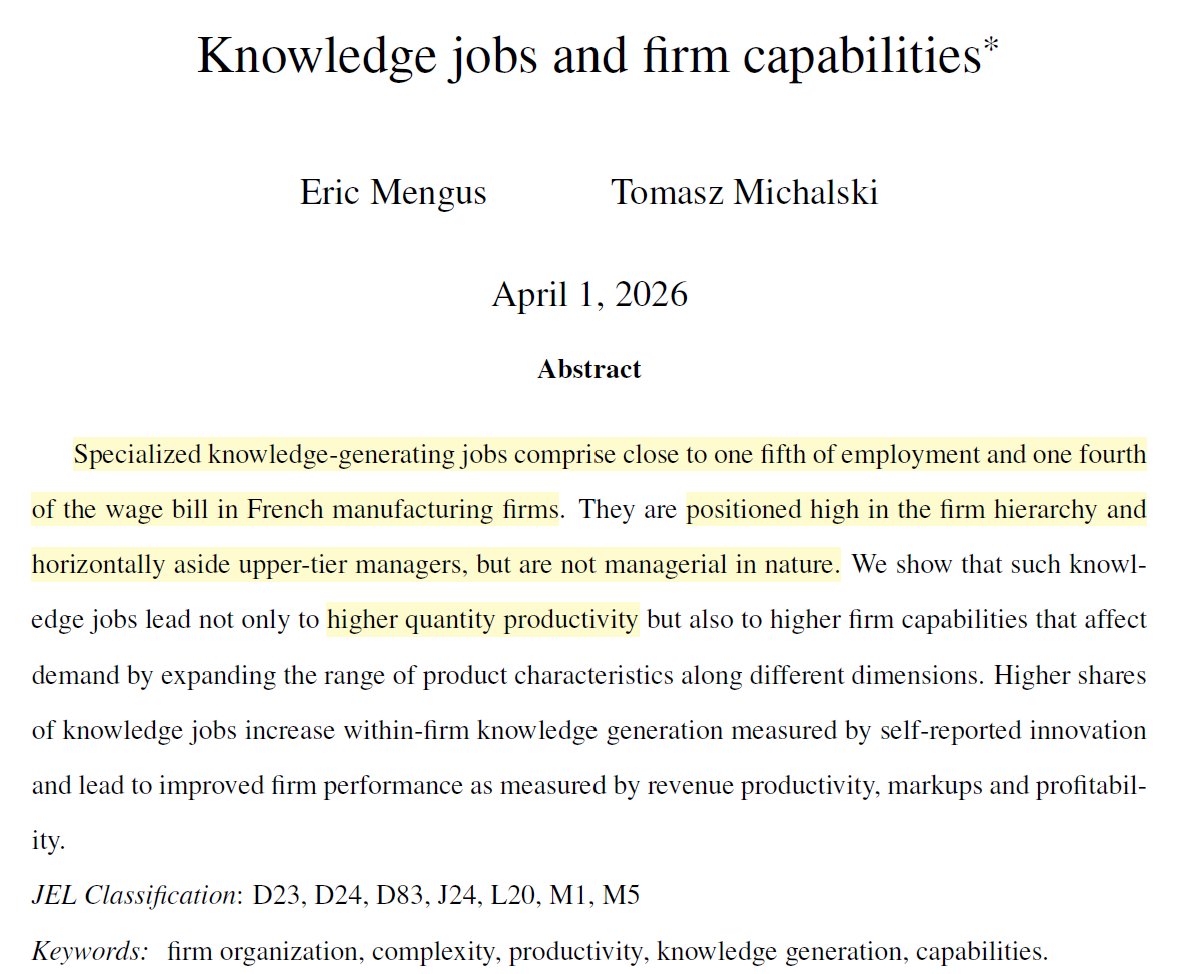
👇Very interesting paper on the Organization of Firms, by @EricMengus & Michalski @HECParis
It highlights the important role of specialized knowledge-generating jobs: think jobs in B2B or legal services, marketing, economic modeling, etc.
These jobs are arguably a bit neglected in economic theories of the firm.
The paper shows that they form a substantial share of 🇫🇷 mnfg. firms' employment, are non-managerial but high up in the firm hierarchy, and lead to improved firm performance in part by expanding demand.
Let me see….
I don’t see it as micro feminism aimed at Queen Mother but Seong Hui-Ji’s actions is more like a resistance aimed at the palace norms, more like rejecting the system, not really a personal thing with the Queen. Not woman to woman but Seong Huiju vs the system (which the QM represents). You could also see that when the QM questioned her outfit, her response was clear “I was told the custom wasn’t mandatory” she didn’t even break any rules there.
(Notice how the prince himself had told her that she loves breaking rules? Plus the edit we saw where she made him eat casually outside the dining hall? Where she asked him “royals don’t marry commoners, why are you marrying me then? So it wasn’t to disrespect the QM but to resist the strict rules, seeing how she has always questioned it.
Now the prince saving her is a common narrative we get in dramas, writers always try to portray the princess in distress thing. On the other hand, he didn’t necessarily saved her if you check, he was also building his confidence, his last statement. “ don’t bend to their will,…..just as you do” these are the words she has always said to him, he came to test himself.
Taiwan's Industrial Technology Research Institute might be the most underrated research lab in history. It spun out TSMC and made Taiwan the world's chipmaker. Coming out in Asterisk today – how did Taiwan implement one of the most successful industrial policies of all time?
🧵
To update my slide decks for my course “The Political Economy of Early America,” I picked up the latest edition of a mainstream U.S. college history textbook I had used before as source material. (I have no wish to start a fight, so no names; suffice it to say the book is as mainstream as mainstream gets.) I wanted to check whether I was missing any recent developments in scholarship or shifts in coverage.
I was struck by how much the prose and content had been dumbed down. In places, it truly read like a middle-school textbook. I went back to the older editions I had kept, and a side-by-side comparison from 2000 forward shows a clear deterioration with each revision. In 2000, students were reading a serious work. The current edition is not.
As an economist, I suppose I should not be surprised. Four rational agents shape the outcome, and not one of them has any reason to defend quality.
The publisher maximizes revenue per student, not learning. Simpler prose and lighter material may reduce what students learn, but they raise adoption rates: instructors find the book “easier to teach with” and students complain less. Learning outcomes are an externality.
The instructor worries about teaching evaluations and grade inflation. Assign an easy textbook, and students are content; you hand out A’s to most of them, and your workload drops. The instructor who assigns the harder book and earns lower evaluations bears a private cost for a public good. A textbook collective action problem.
The student, given limited information, optimizes for the grade rather than for human capital accumulation. If the exam tests recall from a simplified textbook, the simplified textbook is the rational choice. The cost of shallow learning surfaces only years later, too distant and diffuse to weigh much on today’s decision.
The university cares about retention and graduation rates, not about what anyone learns. A textbook that cuts the failure rate in introductory courses looks good on those metrics, even when it achieves the cut by lowering the bar.
The result is what one would predict: a steady decline in textbook quality that no rational agent in the chain has any motive to reverse.
The only way forward is to break the collective action problem: get universities to curb grade inflation (I am open to suggestions on how; caps on A’s bring their own troubles) and to care about what students learn, rather than about some inane comment on a teaching evaluation.
Four years ago, @nytimes published the essay that changed my life forever. Now that I’ve been out of college for as long as I was in it, I decided to write about what came next.
I’m incredibly grateful for the big break of a lifetime. But I also think it’s time to move on.