Du: Hvorfor er strømmen så dyr?
Statkraft: Den er ikke dyr.
Du: Men vannkraft er jo billig å produsere.
Statkraft: Du bor i et dyrt land. Ting skal ikke være billig i et dyrt land.
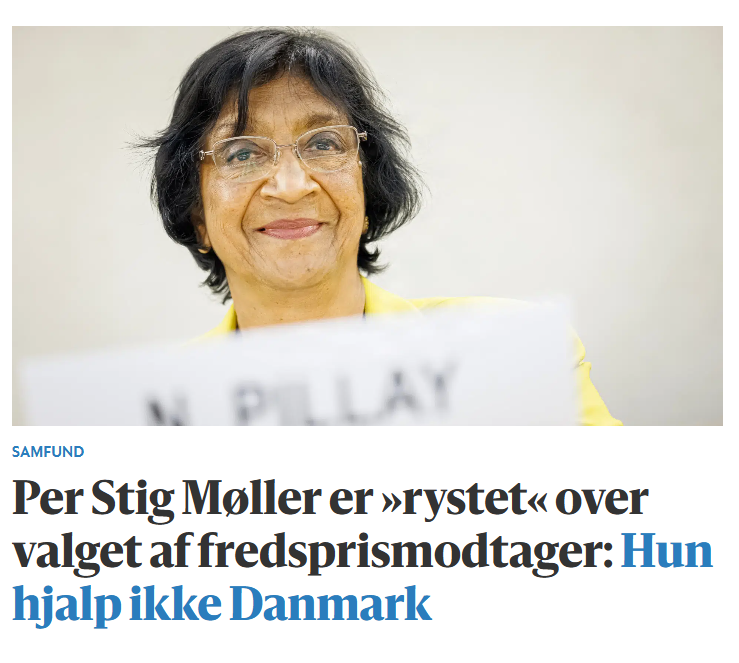
In an interview with the Danish newspaper Berlingske, Denmark’s former foreign minister Per Stig Møller recounts a highly compromising story about the recipient of the Nobel Peace Prize, Navi Pillay.
In 2008, when Denmark faced problems in Pakistan (a car bomb exploded outside the embassy) because of the Muhammad cartoons, Denmark turned to the UN - including the then High Commissioner for Human Rights, Navi Pillay.
On that occasion Pillay was completely dismissive of supporting Denmark. Her only recommendation to the foreign minister was to introduce censorship. That, she said, would prevent the problem in the future.
I find it shocking that an opponent of freedom of speech can be awarded the Nobel Peace Prize.
«Mens staten fikk inn 16,9 milliarder kroner fra vannkraftverkene i fjor, forventer de å hente inn 33,1 milliarder kroner i år. Det er mer enn nok til å betale for norgespris og strømstøtte. I år er det satt av 21,5 milliarder kroner til ordningene.»
https://t.co/FojUGeEsIG
Bare rundt 10 % av verdens land har egen CO₂-avgift på bensin og diesel.
Norge: 3,80 kr per liter
Japan: 5 øre per liter
Mexico: 9 øre per liter
Sør-Afrika: 11 øre per liter
Colombia: 16 øre per liter
Norge har altså rundt 40 ganger høyere CO₂-avgift enn Mexico og 35 ganger høyere enn Sør-Afrika.
I Sverige er den midlertidig nede i 0,87 svenske kroner.
Og norske bilister betaler både veibruksavgift og moms i tillegg.
Dette er symbolpolitikk på sitt verste, som rammer de svakaste i samfunnet hardest og begrenser folks frihet. Statlig overformynderi.
Bare ØKNINGEN i Navs budsjett fra 2026 til 2027 overstiger hele det samlede beløpet staten henter inn i formuesskatt.
Det viser galskapen til Ap og Stoltenberg.
Norge er et NAV-kontor. 35% av statsbudsjettet går til NAV, mens gründere og jobbskapere skattes ihjel og flykter.
For drøyt hundre år siden hadde vi politikere som vedtok konsesjonslovene og sørget for at vi alle beholdt eiendomsretten til naturkreftene og verdiene skapt av nedbør, fjell og elver.
Nå har vi folkevalgte som tilber markedskreftene og er mest opptatt av egne privilegier.
Mimir Kristjansson (R) på NRK:
Strømprisen gikk til himmels fordi politikerne knyttet Norge til det europeiske kraftmarkedet. Nå må folk subsidieres for å ha råd til strøm de eier selv, gjennom offentlig vannkraft. Og regjeringen svarer med å sette opp Norgespris 12,5 prosent. Arbeiderpartiet og alle som stemte for ACER, dette er deres regning. ⚡️📉
#Norgespris #ACER #Strømpris #Arbeiderpartiet #MimirKristjansson
Landet som hadde som mål å få veldig mye dyrere strøm enn Finland.
… og hadde en regjering som mente det gav «trygghet» å tilby husholdningene bare det dobbelte av strømprisene i Finland.
#Norgespris
This is a LIE.
The United Nations apparently does not read their own IPCC reports.
Globally, floods have not become more frequent or more intense, although there are regional variations within the bounds of internal variability.
There are two primary types of floods relevant to this discussion: fluvial (river) and flash (pluvial).
Long-term trends in river floods are usually evaluated by looking at river and streamflow from river / stream gauges. This can be evaluated by looking at the flux of water passing by a fixed point, and we measure this in units of cubic feet per second (ft³ / sec).
With respect to river flooding trends, IPCC AR6 WG1 states in Chapter 11 that,
🗨️ “Peak flow trends are characterized by high regional variability and lack overall statistical significance of a decrease or an increase over the globe as a whole. Of more than 3,500 streamflow stations in the USA, central and Northern Europe, Africa, Brazil, and Australia, 7.1% stations showed a significant increase, and 11.9% stations showed a significant decrease in annual maximum peak flow during 1961–2005.”
🔗https://t.co/rCcMMVHu5K (p. 1568)
With respect to attributing flooding trends to human influence, the IPCC states,
🗨️ “In summary there is low confidence in the human influence on the changes in high river flows on the global scale. In general, there is low confidence in attributing changes in the probability or magnitude of flood events to human influence...”
🔗https://t.co/rCcMMVHu5K (p. 1569)
More recent streamflow data from USGS gauges (and compiled by the U.S. EPA) affirm the IPCC’s synthesis in that river floods in the U.S. have neither increased nor decreased over the last 60+ years.
The map I made below on the left shows the change in the magnitude of river flooding in the Lower 48 since 1960. The triangle-shaped markers show the annual linear trend in peak river flows (ft³ / sec) from 1960 to 2025 for all 425 USGS river / stream gauges having at at least 95% completeness over the period examined.
Only ~5.2% of gauges show a statistically significant increase in river floods and ~5.9% show a significant decrease. The rest are not statistically significant in either direction, so overall the trend isn’t statistically different from zero.
With respect to flash flooding IPCC AR6 says,
🗨️ “[H]eavier rainfall does not always lead to greater flooding. This is because flooding also depends upon the type of river basin, the surface landscape, the extent and duration of the rainfall, and how wet the ground is before the rainfall event... A mix of both increases and decreases in [flash] flooding have been observed in some regions...”
🔗https://t.co/D4EPjLdiSg (p. 8)
Ahmadalipour & Moradkhani (2019) found no increase in flash flooding incidents in the U.S. between 1996 and 2017. I suspect that these trends have continued, but an update to this paper would be nice.
🔗https://t.co/TCrrtYFHxD
Norge har overskudd av strøm. Produksjonskost for offentlig eid norsk vannkraft er 12,5 øre/kwh. Norgespris er i dag 300 prosent over kostnaden. Det kaller regjeringen å subsidiere. Nå foreslår de å øke påslaget til 348 prosent. Det formuleres som en utgift på Statsbudsjettet.
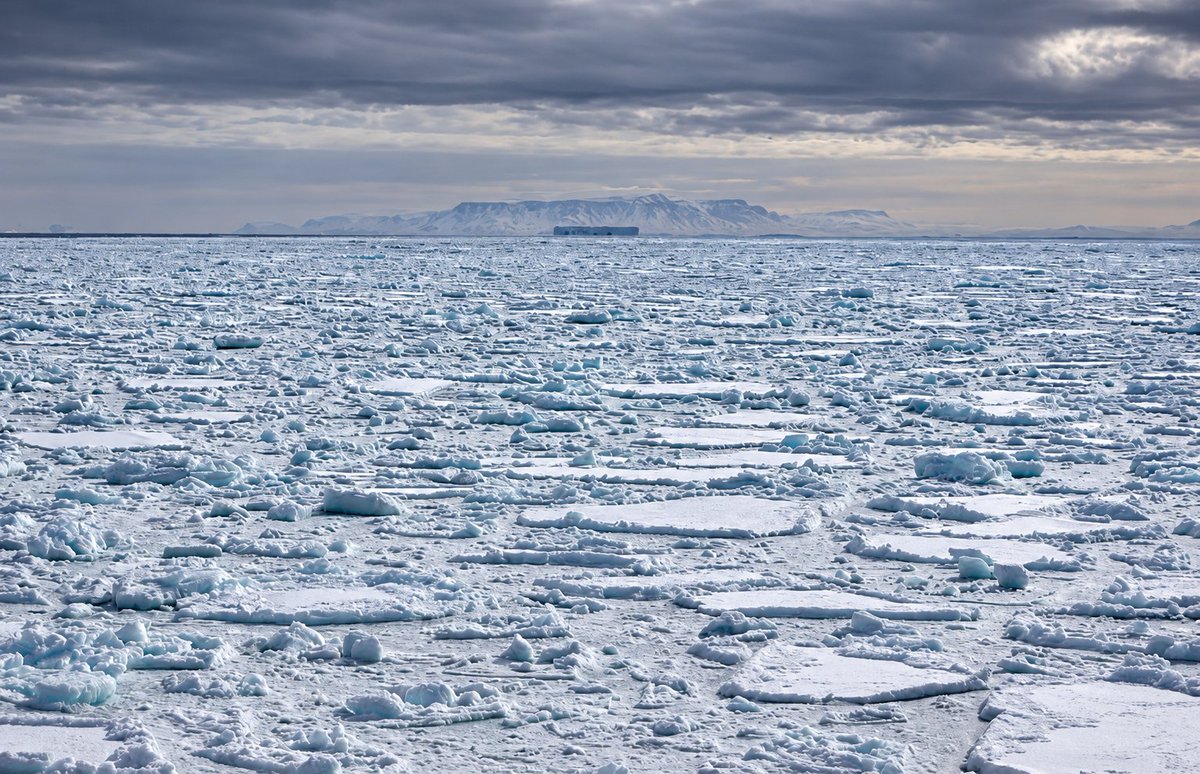
Arctic sea ice has surged into October, with 2026 now at the highest extent for the date in the past 20 years.
Full breakdown (and much more) in today's article: https://t.co/hOHlRhuX9H
@makroblogger Tull, absolutt ikke fornuftig i det hele tatt. Dette er bare en ekstraskatt for at regjeringen kan ødsle bort enda mer penger på tull og tøys utlandet.


![ChrisMartzWX's tweet photo. This is a LIE.
The United Nations apparently does not read their own IPCC reports.
Globally, floods have not become more frequent or more intense, although there are regional variations within the bounds of internal variability.
There are two primary types of floods relevant to this discussion: fluvial (river) and flash (pluvial).
Long-term trends in river floods are usually evaluated by looking at river and streamflow from river / stream gauges. This can be evaluated by looking at the flux of water passing by a fixed point, and we measure this in units of cubic feet per second (ft³ / sec).
With respect to river flooding trends, IPCC AR6 WG1 states in Chapter 11 that,
🗨️ “Peak flow trends are characterized by high regional variability and lack overall statistical significance of a decrease or an increase over the globe as a whole. Of more than 3,500 streamflow stations in the USA, central and Northern Europe, Africa, Brazil, and Australia, 7.1% stations showed a significant increase, and 11.9% stations showed a significant decrease in annual maximum peak flow during 1961–2005.”
🔗https://t.co/rCcMMVHu5K (p. 1568)
With respect to attributing flooding trends to human influence, the IPCC states,
🗨️ “In summary there is low confidence in the human influence on the changes in high river flows on the global scale. In general, there is low confidence in attributing changes in the probability or magnitude of flood events to human influence...”
🔗https://t.co/rCcMMVHu5K (p. 1569)
More recent streamflow data from USGS gauges (and compiled by the U.S. EPA) affirm the IPCC’s synthesis in that river floods in the U.S. have neither increased nor decreased over the last 60+ years.
The map I made below on the left shows the change in the magnitude of river flooding in the Lower 48 since 1960. The triangle-shaped markers show the annual linear trend in peak river flows (ft³ / sec) from 1960 to 2025 for all 425 USGS river / stream gauges having at at least 95% completeness over the period examined.
Only ~5.2% of gauges show a statistically significant increase in river floods and ~5.9% show a significant decrease. The rest are not statistically significant in either direction, so overall the trend isn’t statistically different from zero.
With respect to flash flooding IPCC AR6 says,
🗨️ “[H]eavier rainfall does not always lead to greater flooding. This is because flooding also depends upon the type of river basin, the surface landscape, the extent and duration of the rainfall, and how wet the ground is before the rainfall event... A mix of both increases and decreases in [flash] flooding have been observed in some regions...”
🔗https://t.co/D4EPjLdiSg (p. 8)
Ahmadalipour & Moradkhani (2019) found no increase in flash flooding incidents in the U.S. between 1996 and 2017. I suspect that these trends have continued, but an update to this paper would be nice.
🔗https://t.co/TCrrtYFHxD](https://pbs.twimg.com/media/HT-bwX-WkAAqE1O.jpg)







![ChrisMartzWX's tweet photo. This is a LIE.
The United Nations apparently does not read their own IPCC reports.
Globally, floods have not become more frequent or more intense, although there are regional variations within the bounds of internal variability.
There are two primary types of floods relevant to this discussion: fluvial (river) and flash (pluvial).
Long-term trends in river floods are usually evaluated by looking at river and streamflow from river / stream gauges. This can be evaluated by looking at the flux of water passing by a fixed point, and we measure this in units of cubic feet per second (ft³ / sec).
With respect to river flooding trends, IPCC AR6 WG1 states in Chapter 11 that,
🗨️ “Peak flow trends are characterized by high regional variability and lack overall statistical significance of a decrease or an increase over the globe as a whole. Of more than 3,500 streamflow stations in the USA, central and Northern Europe, Africa, Brazil, and Australia, 7.1% stations showed a significant increase, and 11.9% stations showed a significant decrease in annual maximum peak flow during 1961–2005.”
🔗https://t.co/rCcMMVHu5K (p. 1568)
With respect to attributing flooding trends to human influence, the IPCC states,
🗨️ “In summary there is low confidence in the human influence on the changes in high river flows on the global scale. In general, there is low confidence in attributing changes in the probability or magnitude of flood events to human influence...”
🔗https://t.co/rCcMMVHu5K (p. 1569)
More recent streamflow data from USGS gauges (and compiled by the U.S. EPA) affirm the IPCC’s synthesis in that river floods in the U.S. have neither increased nor decreased over the last 60+ years.
The map I made below on the left shows the change in the magnitude of river flooding in the Lower 48 since 1960. The triangle-shaped markers show the annual linear trend in peak river flows (ft³ / sec) from 1960 to 2025 for all 425 USGS river / stream gauges having at at least 95% completeness over the period examined.
Only ~5.2% of gauges show a statistically significant increase in river floods and ~5.9% show a significant decrease. The rest are not statistically significant in either direction, so overall the trend isn’t statistically different from zero.
With respect to flash flooding IPCC AR6 says,
🗨️ “[H]eavier rainfall does not always lead to greater flooding. This is because flooding also depends upon the type of river basin, the surface landscape, the extent and duration of the rainfall, and how wet the ground is before the rainfall event... A mix of both increases and decreases in [flash] flooding have been observed in some regions...”
🔗https://t.co/D4EPjLdiSg (p. 8)
Ahmadalipour & Moradkhani (2019) found no increase in flash flooding incidents in the U.S. between 1996 and 2017. I suspect that these trends have continued, but an update to this paper would be nice.
🔗https://t.co/TCrrtYFHxD](https://pbs.twimg.com/media/HT-cXIIXgAEiPNj.jpg)