Out of the night that covers me
Black as the pit from pole to pole,
I thank whatever gods may be
For my unconquerable soul.
In the fell clutch of circumstance,
I have not winced nor cried aloud.
Under the bludgeonings of chance
My head is bloody, but unbowed.
Nigeria pulled in $10.37bn of foreign capital in Q1 2026, an 84% jump on the same quarter last year and a 61% rise on Q4 2025.
To put that in perspective, between 2014 and 2025, the best single quarter we ever managed was $8.5bn, back in Q1 2019. We have just blown past it.
On this run-rate, a $40bn+ year is on the table, which would be the highest in our history, comfortably ahead of the $23.9bn we did in 2019 and the approx. $23bn from 2025.
This is a big deal, and it is marked progress. After the painful naira float and the sequence of reforms, confidence has come back to the room
But the real story is not just the size. What I wanna pay a lot more attention to is the composition. And this is where I would slow the applause.
Of the $10.37bn that came in, portfolio investment accounted for $9.86bn. That is about 95% of total inflows.
FDI was only $135m, or 1.3%.
Other investment was $374m, or 3.6%.
So, Nigeria is not yet attracting big-ticket long-term factory-building investment.
Nigeria is attracting financial-market money, and it is a critical distinction.
Portfolio inflows are very important, and we should not downplay them. They help stabilise the FX market. They bring dollars into the system. They improve liquidity.
They make it easier for the CBN to manage market pressure. They support the naira. They improve investor confidence. They also signal that foreign investors are beginning to take Nigeria seriously again, especially after reforms around FX, interest rates, and market pricing.
In simple terms, FPI is the money that comes when foreign investors say “Nigeria’s yields are attractive. The currency market looks more credible. Let us buy treasury bills, bonds, and equities.”
For a country that suffered severe FX scarcity, broken investor confidence, trapped funds, and a wide gap between official and parallel market rates, this is not a small improvement.
It means the market is becoming more investable again. It means Nigeria is slowly rebuilding credibility.
But FPI has one limitation.
It is not patient money.
It can enter quickly and leave quickly.
The same investor buying Nigerian treasury bills today can exit tomorrow if US rates become more attractive, if oil prices fall, if Nigeria’s reserves weaken, if inflation becomes stubborn, if political risk rises, or if they feel the naira may depreciate again.
That is why portfolio flows can stabilise the naira, but they cannot by themselves transform the economy.
They are good for the financial market.
They are not enough for broad economic development.
FDI is different.
FDI is the kind of money that builds factories, expands warehouses, opens plants, creates supply chains, hires workers, trains people, buys land, imports machinery, and stays for many years. That is the type of capital that creates deeper employment and productivity.
For FDI to come in strongly, Nigeria needs more than high interest rates.
✑ It needs stable power.
✑ It needs security.
✑ It needs a predictable policy.
✑ It needs ports that work.
✑ It needs faster dispute resolution.
✑ It needs reliable tax rules. It needs confidence that investors can bring money in and take profits out without chaos.
✑ It needs a currency regime that is credible, not just temporarily stable.
✑ It also needs a strong enough demand for companies to sell profitably.
So, the current capital importation story is good, but it is still incomplete.
It tells us that Nigeria has become attractive again to yield-seeking investors.
It does not yet tell us that Nigeria has become attractive enough to build factories at scale.
And that is the bridge we must cross.
For the average bread seller in Mushin, a record $10.4bn quarter changes almost nothing she can touch.
The portfolio money sits in financial assets in Lagos and Abuja; it does not become a job for her son or a customer at her stall.
What it does do, indirectly, is hold the naira steadier, so the flour and sugar she buys don't reprice upwards every fortnight.
The day FDI shows up properly is the day a manufacturer opens a line down the road, her neighbour gets hired, that wage gets spent at her table, and demand for her bread actually grows.
That is the inflow that reaches Mushin. Until the FDI line on that chart climbs off the floor, we should celebrate the $10.4bn for exactly what it is, that is, a vote of confidence in our paper, not yet a vote of confidence in our economy.
So, yes, the bread seller in Mushin may not receive foreign portfolio investment directly.
But she feels the effect if the naira is stable, if flour prices stop rising sharply, if transport costs are predictable, and if customers can still afford bread.
However, she will feel a much bigger impact when FDI starts coming in.
That is when new factories open. That is when logistics improves. That is when more people get jobs. That is when household income improves. That is when demand for bread grows because more people can afford breakfast without thinking twice.
So, my sense is this:
Nigeria has fixed part of the confidence problem in the financial market.
That is why the dollars are coming back.
But the next phase is harder.
We now need to convert financial-market confidence into real-economy confidence.
Because a country does not become rich only because foreign investors are buying its treasury bills.
A country becomes rich when capital enters the productive side of the economy, builds capacity, creates jobs, raises incomes, and improves the life of the bread seller in Mushin.
Selah ✌️✌️✌️
Come teach us about the 37th Oba of Benin, Oba Akenzua II, who was born as Prince Godfrey Edokparhogbuyunmwun Aiguobasinmwin Eweka and united the country to vote for the Midwestern region which is the only democratically created state in country till date.
LAGOS NIGERIA!
I’m announcing my first ever headline shows here, and we have made sure this homecoming will be special. Sign up for early access here! https://t.co/6RTJy6ubeT
LAGOS NIGERIA!
I’m announcing my first ever headline shows here, and we have made sure this homecoming will be special. Sign up for early access here! https://t.co/6RTJy6ubeT
🚨 BREAKING: Florentino Pérez’s press conference:
-He says that he’s sorry to announce that he will NOT resign
-Calls for an election THREE years early
-Says there is a CAMPAIGN against him with made up news including that he has CANCER
-Picks up the phone and starts reading out news and laughing, including ABC’s news today saying that he told his inner circle that he’s tired
-Says he works like an ANIMAL day and night
-Says anyone who is spreading the rumors against him can CHALLENGE him in the elections
-Reminds people that with him, Real Madrid have won 76 titles
-Says Real Madrid is the most prestigious club in the world, and that it’s LIES that the club is in shambles
-Calls the Negreira case as the WORST SCANDAL IN FOOTBALL HISTORY
-Says Real Madrid have the most valuable squad in the world according to Transfermarkt
-Says he will submit a dossier to UEFA to END the fact that there are referees from the Negreira era still officiating
-Says RELEVO (Media that closed) worked with La Liga and was created to SMEAR Real Madrid and Florentino Pérez
-Starts arguing with an ABC journalist
-Says he will CANCEL his ABC subscription to honor his father
-Says that when he arrived at Real Madrid, the financial situation was so bad the club couldn’t pay players and employees. With him, it’s in incredible financial situation with record earnings with the most valuable squad in the world
-Says it’s NOT true that the club spent more than planned on the Bernabéu
-Says he’s ready to FIGHT ANYONE AND EVERYONE
-Says La Liga is Real Madrid’s ENEMY
-Says that Real Madrid WON the Super League case and what they did was for the good of football so that children in Africa can watch football for free
-Reads ABC news saying that he told his inner circle that he’s tired AGAIN
-Says he will NOT speak about players or managers or the sporting side
-Says he will unsubscribe from ABC, AGAIN
-Says everyone in the world loves him
-Says the club will do an analysis on the sporting side after the elections
-Says this is NOT a dictatorship
-Says he is the most successful president in history
-Says it’s NOT the first time that 2 players fought at Real Madrid, that there were seasons where it happened ALL THE TIME
-Says there were 2 articles today written against Real Madrid by ABC, one of them by a woman, and that he doesn’t even know if she knows football
-Reads ABC news again saying that he told his inner circle that he’s very tired
-Says there is no club that paid the referees and got away with it
-Says they know who leaked the news
-Says Tchouaméni and Valverde are GREAT boys and GREAT players
-Says he doesn’t want to brag, but his company makes BILLIONS in multiple continents
-Says the truth is that Real Madrid had MASSIVE success under his presidency
-Asks the other journalists to let the girl speak, that the rest of them are ugly
-Says he was robbed of 7 La Ligas
-Says he only wants to defend the club’s interests, he doesn’t want publicity, fame, power or anything from the club
-Says Real Madrid got robbed of 18 points in La Liga this season
-Says that real socios don’t boo players, they support them
-Says that it hurts them when fans boo a player
-Says they will have to SHOOT him to get him out of the club
-Says Good night and that he hopes he never sees the journalists again
@tosinolaseinde True wealth creation through diversified investment portfolios rests on four foundational levers—Earnings Capacity, Credit Worthiness, Investment Acumen, and Patience—that power the four channels of Cash, Debt, Minority Equity, and Majority Equity.
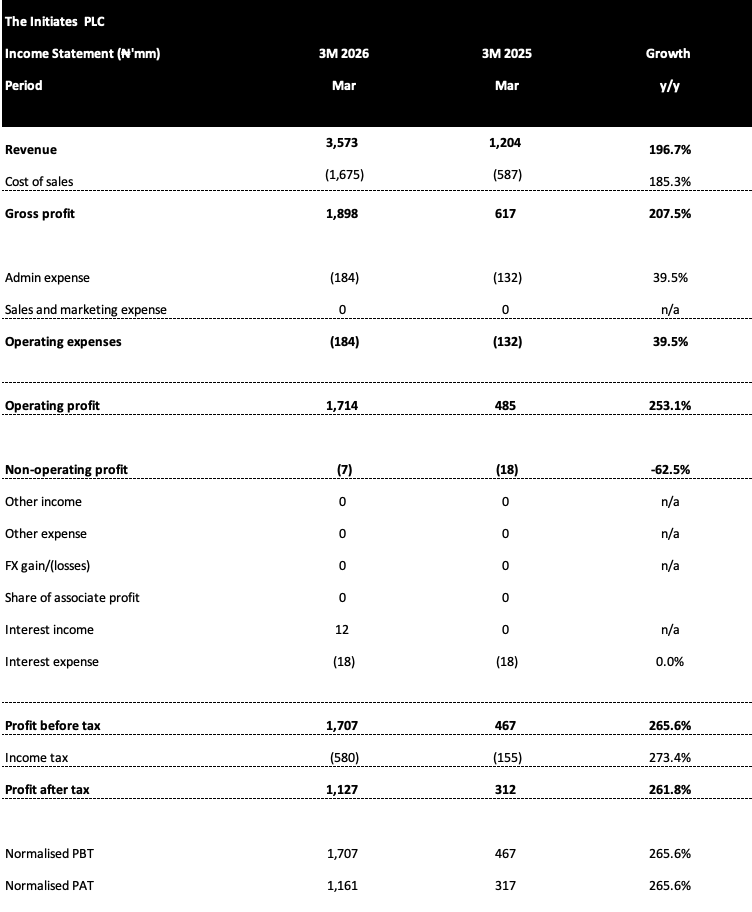
The Initiates PLC Q1 2026 Results
Blockbuster earnings. This one is a very compelling money spinner, and it still shocks me that the market let this one be (until the past few days).
I knew it had rallied well in prior years, but the room for more was still there.
When you research a company, one of the common approaches is to adopt the "top-down" approach, where you:
✑ Set the macro expectations (what is the direction of the economy? What are government policies like? What are interest and inflation rates expected to be? Who wins and who loses?)
✑ Set capital market expectations (think about business cycles, and how the financial markets - equity, fixed-income, and foreign exchange markets will behave)
✑ Industry analysis: It is one thing for macro to be good, and for your industry to fall short. For example, the technology sector, with the likes of Nvidia, Microsoft, Alphabet, and Meta, continued to perform well, while folks like Starbucks, Nike, Lamb Weston, and Chipotle Mexican Grill were under pressure.
✑ Company analysis: The industry may be rock-solid, but it does not guarantee that a company within that industry is good. This is where internal company characteristics come into play. What is the competitive advantage? What is the market share? What is the corporate governance like? In the same banking sector, the likes of GTCO and Zenith appear to be doing well, but Unity Bank is in woe.
Having done all of these, I realised that the energy sector holds a special place in the current administration's heart, and it is no surprise that it is the best-performing sector in FY 2026, with a 118% YTD gain. The sector has practically doubled.
Since it was clear that the oil & gas lads were gonna do well, from the onset, what came to mind was "valuation"; what is the cheapest way to enter?
I knew Seplat and Aradel would cook, but is there a cheaper route that is valid and with no major comma? I found an answer in TIP, and I loaded as appropriate.
Seplat has done +80% YTD
Aradel has done +197% YTD
TIP has done +109% YTD
but even as we stand, ...
Seplat's P/E is 25x thereabout
Aradel's P/E is roughly 14x - 15x thereabout
TIP's P/E is less than 5x.😊
TIP has operated quietly as a specialist contractor to the oil and gas industry, providing hazardous waste management, industrial cleaning, and decontamination services.
The company gradually positioned itself as a niche monopoly, and they benefit from rising regulatory and ESG pressure on oil and gas operators in Nigeria.
In short, they derive their value from the oil & gas sector (like a complementary demand). And when you think about how local/indigenous oil players want to prove they are as good (and as compliant) as the IOCs, TIP's services are one way to show it.
I see TIP that enjoys the value that oil & gas lads enjoy, but is not entirely exposed to their risk (and that sounds like complete value to me). The idea is that although they majorly do oil waste, they are expanding their focus into other industrial waste (and it was the reason they raised equity capital).
Revenue trend:
FY 2025: +151% y/y
FY 2024: +152% y/y
FY 2023: +120% y/y
FY 2022: +152% y/y
And so far in FY 2026, I am seeing +197% revenue growth y/y.
The balance sheet is so clean, especially considering the industry they are in. The only eyebrow is the receivables typical of such business, but right now, the oil & gas lads are flush with cash.
Return on invested capital (ROIC) looks like 90%, and return on equity (ROE) looks like 67%, on a near-zero debt.
Damn.