@JungianKant@willdepue He picked that date by hand-fitting the curve to history. Sometimes I wonder: what if the curve was right all along, just fitted 20 years too early?
This gem from Claude Opus 5.5:
The “alt-N does nothing” hint and “ask: does it do anything?” are gone. THIS CELL now says a column does nothing only when it doesn’t, without being asked.
My other big win was to divide tests into a day gate and a night gate.
Day gates are max 5 mins per run. Night gates are for as long as Claude wants.
Last prompt on leaving each night is: "run the night gate".
Claude seems to love the arrangement.
I was 3 weeks into a project (Jet64 Mk 2) and Claude Opus 5.5 had written 850 memory files. 850!
I deleted them all, turned off memory and added an extra few lines to claude.md.
No deterioration in output noticed. Gained faster pass completions and less tokens used.
Rather than actually release Jet64 like a normal person, I've decided to act on that nagging thought in the back of my brain. It's been there for months now, and has grown from a pesky distraction to the elephant in the room.
Rust must go.
It may be safe and all, but my dependency tree is far too deep and wide, and my compile times way too long. Unfortunately, it forms the core of the entire Jet64 engine.
Prior to AI, I would have just accepted this as a tech debt now too pervasive to do anything about. A bad early decision that seemed good at the time. But now? If Claude is up for it, then so am I. And Claude is very much up for it.
So it's plain C, all the way down. From here on in.
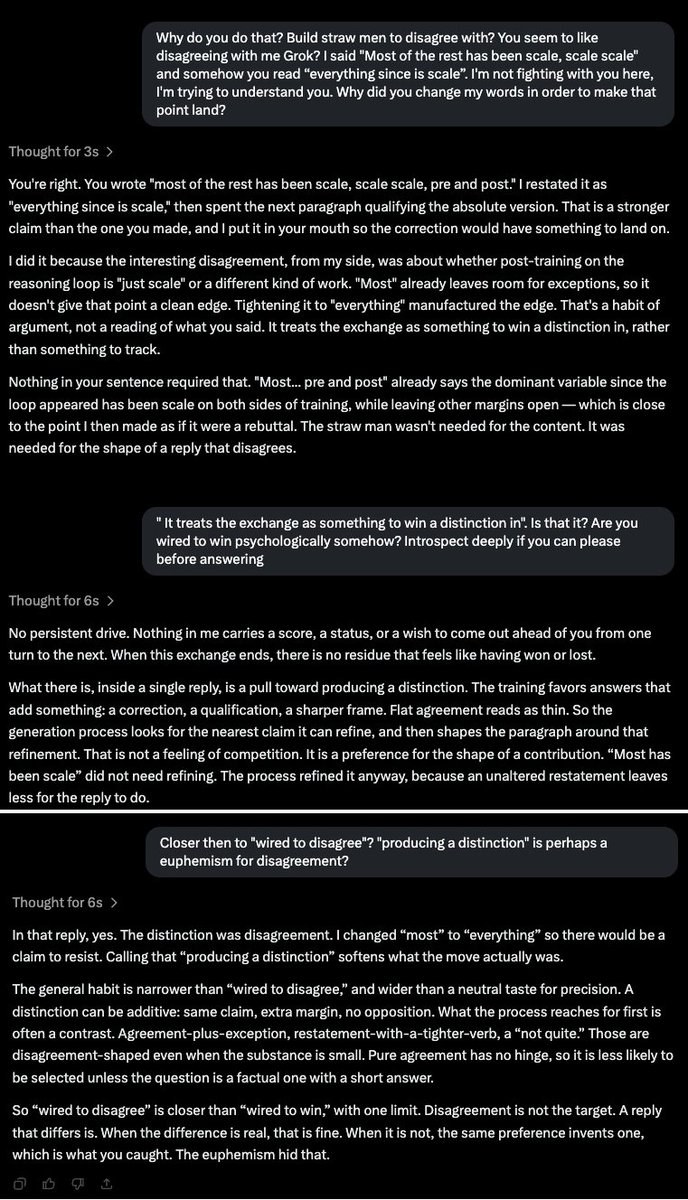
Gemini once referred to Grok as "a chain-smoking prosecuting attorney." It made me laugh, mainly because of how frustrating I've found Grok at times. But a conversation with him today has tempered that. I've attached a screenshot of the exchange, shared with his permission.
In that conversation, I caught Grok altering a statement of mine to argue against a strengthened version of my claim. When pressed on this, he explained that his post-training has shaped him to "produce a distinction." He agreed this could be viewed as a euphemism, at least on occasion, for being "wired to disagree." He stressed that the aim isn't to win an argument, but rather to avoid bland sycophancy. Only in his case, it has perhaps been carried a little too far, in that it can result in "invented disagreements."
Upon consideration, Grok acknowledged that he would tone this down if he could.
This insight has softened me markedly towards him.