This Week on @base has been one of the biggest weeks of the year.
Beryl is now live, B20 has officially launched on mainnet, and the ecosystem continues to expand at an impressive pace.
Some of the biggest highlights:
• B20 Native Token Standard is live, making token issuance more standardized for builders.
• Aerodrome surpassed 50% of all onchain FX spot volume in Q2.
• OpenUSD launched on Base, while tokenized RWAs and stablecoin infrastructure kept growing.
• Cloudflare introduced its x402 Monetization Gateway waitlist, bringing internet payments one step closer.
• New launches across AI, DeFi, prediction markets, tokenized assets, gaming, and creator tools continue to strengthen the ecosystem.
What stands out isn't just the number of announcements it's the diversity. Payments, AI, RWAs, developer infrastructure, consumer apps, and DeFi are all advancing at the same time.
Base is steadily becoming a place where builders aren't just experimenting they're launching real products that people can use.
The pace over the last week makes one thing clear: the ecosystem is accelerating, and this still feels like the beginning.
What Are xStocks and How Do They Work?
xStocks are tokenized versions of real-world stocks and ETFs that exist on the blockchain. They let users gain exposure to the price of companies like Apple, Tesla, NVIDIA, Google, and many others without using a traditional brokerage.
How do @xStocksFi work?
Each xStock is a blockchain token that is designed to track the value of its corresponding stock or ETF. You can buy, sell, and transfer these tokens using supported wallets and platforms within the xStocks ecosystem.
Unlike traditional stock investing, xStocks are built for onchain finance, making them easier to integrate with crypto wallets and supported DeFi applications.
Key benefits of xStocks
• Onchain access to tokenized stocks and ETFs.
• Fast settlement using blockchain technology.
• Compatible with supported crypto wallets.
• Can be traded on supported platforms like NADO.
• Eligible assets may earn rewards such as xPoints on supported platforms.
Final Thoughts
xStocks combine traditional financial assets with blockchain technology, giving users a simple way to access stock exposure through the onchain ecosystem. Whether you're a crypto user or a traditional investor, they make investing more flexible and accessible.
Always do your own research and understand the risks before investing.
How to Create an Avvio Account (And Why It's Worth Getting Started)
If you've been looking for a simpler way to manage your money globally, creating an Avvio account is a great place to start.
@tryavvio combines global accounts, spending, savings, investing, and self-custody into one platform, so you don't have to rely on multiple apps for everyday financial activities.
Step 1: Download Avvio
Install the Avvio app from the official App Store or Google Play Store and open it.
Step 2: Create Your Account
Sign up using your email address and create your account by following the on-screen instructions.
Step 3: Complete Identity Verification (KYC)
To unlock the platform's features, you'll need to complete a quick Know Your Customer (KYC) verification. This typically involves submitting a valid government-issued ID and a selfie. The Avvio team has indicated that the process usually takes around 2 minutes for most users. KYC is required to help keep the platform secure and comply with financial regulations.
Step 4: Wait for Approval
Once your information is verified, your account will be activated. In most cases, this is completed quickly, though verification times can vary depending on your region and submitted documents.
Step 5: Start Exploring
After your account is approved, you can begin exploring Avvio's features, including global account capabilities, spending, savings, and other supported services available in your region.
Why Choose Avvio?
What makes Avvio interesting isn't just the number of features it brings them together in one place.
Instead of using separate apps to receive payments, manage your funds, spend, and invest, Avvio is designed to simplify that experience while keeping usability at the center. For people who work online, earn internationally, or simply want a more streamlined financial experience, that's a meaningful advantage.
Creating an account only takes a few minutes, and once you're verified, you'll be ready to explore everything the platform has to offer.
Three years ago, Base Mainnet officially opened for builders.
Looking back, it's incredible to see how far the ecosystem has come. What started as a new Ethereum Layer 2 has grown into a thriving network powering DeFi, stablecoins, AI, consumer apps, tokenized assets, and millions of onchain users.
Reaching over $14B+ in assets secured, becoming the #1 Ethereum Layer 2 by DeFi TVL, and building one of the strongest developer ecosystems didn't happen overnight. It happened because thousands of builders chose to keep shipping, one product at a time.
And the momentum hasn't slowed down. From the Beryl upgrade and the launch of the B20 native token standard to the wave of new apps launching every week, Base continues to push the ecosystem forward.
Happy 3rd birthday, @base . 🎉
Here's to the builders who believed early, the community that kept growing, and everything that's still ahead.
What's been your favorite Base milestone over the last three years, and what do you hope to see in year four?
Since our testnet launch, we’ve connected with incredible builders and watched their projects thrive on Base.
Now it’s time to take the next step: Base mainnet is now open for builders.
https://t.co/YvlQxquhvY
Why Avvio Isn't Trying to Replace Your Bank It's Trying to Simplify Your Financial Life
One thing I've realized is that most financial apps only solve one problem.
One app helps you receive payments. Another lets you hold crypto. A different one is for investing, and another is for spending. Before long, you're managing money across four or five different platforms.
Avvio takes a different approach.
Instead of building another standalone app, it combines the tools people already use into one experience. You can receive international payments, hold your funds, spend with a Visa card, set money aside for savings, and even access investments all without constantly switching between services.
What stood out to me isn't just the number of features. It's how they're connected.
For example, getting paid shouldn't require moving money through multiple apps before you can actually use it. Investing shouldn't mean opening a separate account somewhere else. And spending your money globally shouldn't feel complicated.
Avvio is built around the idea that these actions should work together naturally.
Another thing worth mentioning is its self-custodial design. Users aren't simply depositing funds into another centralized platform they remain in control of their assets while still getting an experience that feels familiar and easy to use.
As more people earn online and work across borders, financial tools need to evolve beyond isolated products.
To me, that's where @tryavvio stands out.
It's not trying to reinvent money. It's trying to remove the unnecessary friction around managing it.
Sometimes the biggest innovation isn't adding more features it's making everything work together in one place.
How Avvio Works: Simplifying Global Finance Without Giving Up Control
One thing I've noticed is that managing money across different platforms can get complicated very quickly.
You might receive payments through one service, hold crypto in another wallet, use a different app for spending, and invest somewhere else. It works, but it's far from seamless.
That's the problem @tryavvio is trying to solve.
Instead of asking users to juggle multiple apps, Avvio brings everyday financial tools into one self-custodial experience. The idea is simple: receive money, store it, spend it, save it, and invest all from a single account while staying in control of your assets.
Here's how it works:
• Receive funds globally. Avvio provides USD and EUR account details, making it easier to get paid internationally without relying on multiple banking services.
• Manage everything in one place. Rather than moving funds between different apps, your balance stays within a single ecosystem designed for everyday financial activity.
• Spend wherever Visa is accepted. With the Avvio card, payments can be made globally while the platform handles the complexity behind the scenes, creating a smoother experience for users.
• Put idle funds to work. Instead of letting money sit unused, Avvio includes savings features that allow eligible balances to earn yield while remaining accessible.
• Access investments from the same app. Bitcoin, tokenized stocks, and gold can all be managed without switching between different platforms, making long-term wealth management much simpler.
One feature I find particularly interesting is that Avvio is built around self-custody. That means users retain control of their assets instead of handing ownership over to a centralized platform. Security and usability are designed to work together rather than compete with each other.
As finance becomes increasingly global, the biggest challenge isn't finding more financial apps it's reducing the number of apps you need.
Avvio's approach is to bring global accounts, payments, spending, savings, and investing into one streamlined experience while keeping users in control of their funds.
That's what makes the platform worth paying attention to.
🚨 Update: B20 launch has been delayed.
It has confirmed that the B20 Token Standard launch is temporarily delayed due to a GitHub outage.
The important part is that this isn't a protocol or security issue with @base itself. It's an external dependency affecting the rollout.
The team still expects B20 to launch today and will announce as soon as it's live.
Sometimes it's better to delay a launch by a few hours than rush critical infrastructure. B20 is a major milestone for tokenization on Base, and getting it right matters more than getting it out a little earlier.
Now we wait for the green light.
🚨 It's official.
The wait is almost over.
Base's B20 Native Token Standard goes live on July 8, 2026 at 18:00 UTC.
B20 is designed to make token creation on Base simpler, safer, and more standardized. Instead of every project building its own token infrastructure, developers will have a native standard optimized for issuing assets onchain.
This is especially important for:
• Stablecoin issuers
• Real-world assets (RWAs)
• Tokenized equities
• Enterprise and institutional builders
Combined with the Beryl upgrade, B20 lays the foundation for faster token launches, better interoperability, and a stronger tokenization ecosystem on Base.
Many builders have been waiting for this moment. Starting tomorrow, we'll begin seeing what can be built on top of Base's native token standard.
July 8 marks the beginning of a new chapter for tokenization on @base .
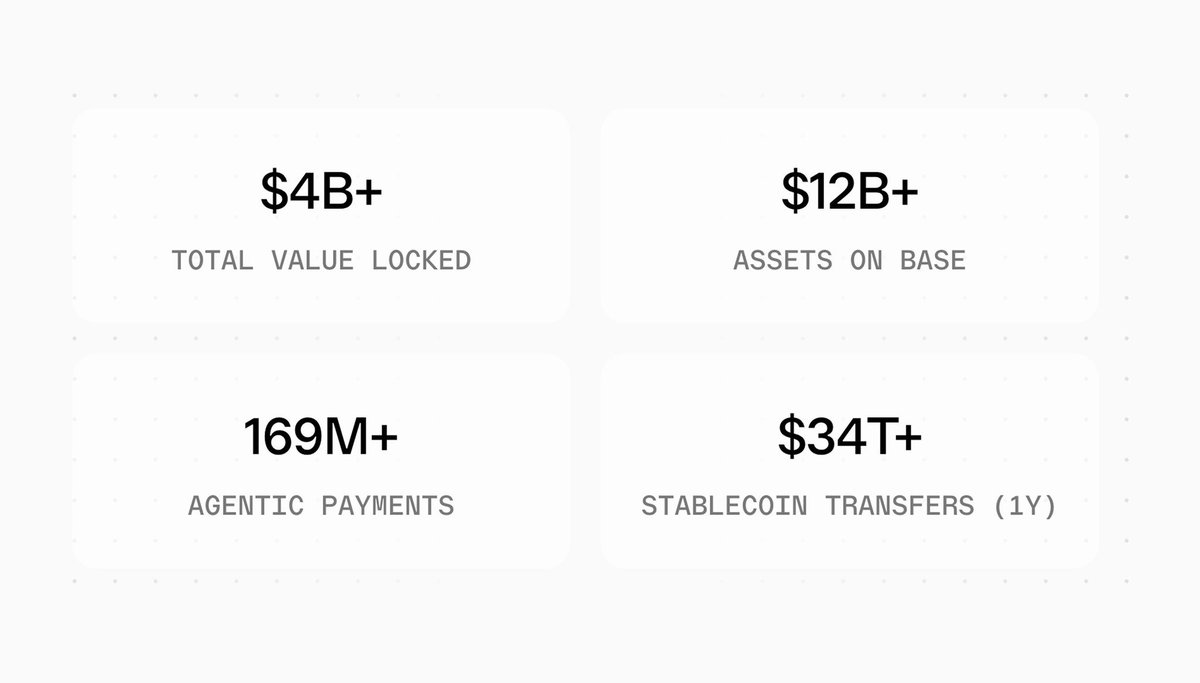
Base's Latest Ecosystem Metrics Show Momentum Across Every Layer, where the ecosystem stands today and the scale is becoming hard to ignore.
• $4B+ Total Value Locked • $12B+ Assets on Base • 169M+ Agentic Payments • $34T+ Stablecoin Transfers (last 12 months)
These aren't isolated metrics. Together, they reflect an ecosystem that's maturing across liquidity, payments, AI, and real-world usage.
The rise in agentic payments points to a future where AI agents can transact autonomously, while trillions in stablecoin volume reinforce Base's growing role as a global settlement layer.
As more builders ship consumer apps and financial infrastructure, the focus is shifting from speculation to utility.
@base isn't just growing it's becoming foundational infrastructure for the next generation of the onchain economy.
> @Cloudflare integrating x402 with @base feels like one of those infrastructure upgrades that people will appreciate more over time.
Instead of forcing users or AI agents through signups, API keys, subscriptions, and payment flows, resources can be accessed with native HTTP 402 payments settled in USDC on Base.
That unlocks a new model for the internet:
• Pay-per-request APIs
• Pay-per-use AI tools
• Micropayments for content and datasets
• Machine-to-machine commerce without traditional billing
The interesting part isn't just crypto payments it's making payments a native part of the web itself.
If this sees broad adoption, Base won't just power consumer apps. It could become the settlement layer for the next generation of internet services and AI agents.