Long before Ken Stabler reached the pinnacle of sporting fame in the Super Bowl and ultimately the Pro Football Hall of Fame, he was a Foley and Tuscaloosa, Alabama hero, legend and humble hometown boy.
Al Davis would have been proud on this one. The Mad Bomber, Daryle Lamoncia pass to Warren Wells. Throw it deep and let your speedster beat the defense.
The Autumn Wind is a pirate… Blustering in from the sea, swaggering boisterously, robbing the trees of their gold.
A villain big and bold — and a Raider through and through.
Written by Steve Sabol.
Voiced by the legendary John Facenda in 1974.
Still the most epic, spine-chilling battle hymn in football 50+ years later.
Follow @NFLHuddleUp to resurrect legendary moments like this.
#NFL #History #Raiders #Football #RaiderNation
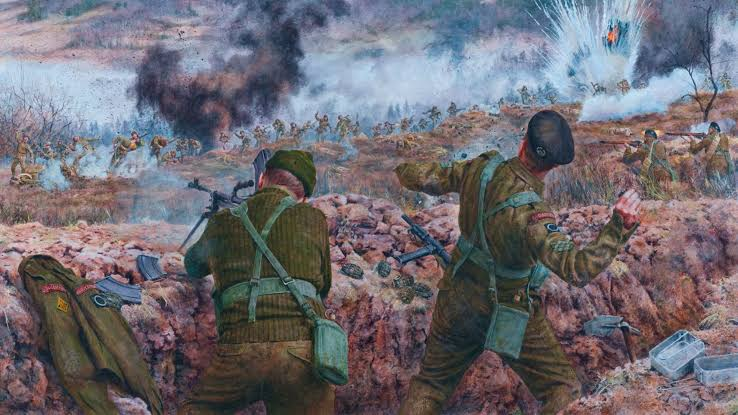
Seven hundred British soldiers, surrounded on a bare Korean hill by an entire Chinese army of some twenty seven thousand men, held out for three days, and when their ammunition was gone they answered the enemy's bugle calls with bugle calls of their own. It is one of the greatest last stands in modern military history, and most Americans have never heard of it.
In April 1951, the Chinese launched a massive spring offensive aimed straight at Seoul. Standing in the path, on the hills above the Imjin River, was a single British battalion, the Gloucestershire Regiment, the Glosters, about seven hundred men. Against them came three full divisions of the Chinese 63rd Army, roughly twenty seven thousand soldiers, determined to smash across the river and open the road to the capital.
The Glosters were told to hold. And they did. As the Chinese poured across the Imjin in human waves, the battalion was steadily surrounded and forced back onto a single hill, Hill 235, that would forever after be known as Gloster Hill. There, cut off, running low on food, water, and ammunition, outnumbered something like twenty five to one, they fought on for three days and nights.
And here is the detail people never forget. The Chinese coordinated their night attacks with bugle calls, using them to signal and to unnerve the defenders. So the Glosters answered. Their drum major took up his own bugle and, on the surrounded hilltop, blew back British Army bugle calls, every call in the book except retreat, answering the Chinese note for note. It steadied the exhausted men and rattled the enemy, this defiant British bugle ringing out over a hill that was about to fall.
By the third day it was hopeless. Out of ammunition and completely surrounded, the survivors were finally told it was every man for himself, to try to break out and escape. Only a small number made it, perhaps forty men, back to friendly lines. The rest, more than five hundred, were killed, wounded, or captured, including their commander, Lieutenant Colonel James Carne.
Carne won the Victoria Cross for the stand. And in the brutal prison camp where he spent the next two years, he did something quietly extraordinary. Using a couple of stones, he carved a simple Celtic cross, a small symbol of faith and defiance to hold his men together in captivity. That little stone cross survives to this day, kept in Gloucester Cathedral, one of the most moving relics of the entire war.
Their sacrifice was not in vain. The Glosters' stand on the Imjin, along with the rest of their brigade, so badly bled and delayed the Chinese offensive that the UN was able to stabilize the line and hold Seoul. To this day the fight is remembered as the battle that saved Seoul, and the Glorious Glosters as the men who bought it, seven hundred against an army, holding a hill with rifles and bugles until there was nothing left.