Evidence points the way.
Resources ✦ Updates ✦ Accountability
Unofficial fanbase and independent platform.
Not affiliated with ENHYPEN, BELIFT LAB or HYBE.
Breakdown for HYBE’s FY2026 Q2 Earnings Call is up on @7ENVOICE ! 🚨
Head over to their account to read the full summary on ENHYPEN’s tour achievements, Heeseung’s credits, and the complete financial analysis.
HYBE FY2026 Q2 EARNINGS CALL: WHAT WAS SAID
HYBE presented its Q2 results through a business update, financial report and investor Q&A.
The company reported approximately ₩1.45 trillion in revenue, ₩170.9 billion in operating profit and an 11.8% operating margin, describing both revenue and operating profit as record quarterly results.
★ WHAT DROVE THE RESULTS
Artist direct-involvement revenue reached approximately ₩1.0399 trillion, or 72% of total revenue, while indirect revenue reached ₩410.1 billion.
The main categories were:
⤷ Concerts: ₩647.7 billion
BTS’s world tour was the largest driver, alongside activities from SEVENTEEN, TXT, ENHYPEN and &TEAM.
⤷ Recorded music: ₩326.8 billion
Streaming accounted for approximately 30% of recorded-music revenue, not HYBE’s total revenue.
⤷ Merchandise and licensing: ₩310.6 billion
BTS tour merchandise was a major contributor, while SEVENTEEN, TXT and ENHYPEN also recorded continued tour and character-merchandise sales.
⤷ Content: ₩41.6 billion
This category declined compared with the previous year due to the absence of a major new publishing or agency event.
★ ARTIST AND BUSINESS UPDATES
HYBE presented BTS’s ARIRANG album and world tour as the quarter’s main driver, generating income through concerts, streaming, cinema screenings, merchandise, licensing and city-based projects.
CORTIS was highlighted as an example of HYBE’s faster rookie-growth model, while KATSEYE represented its global-localisation strategy. HYBE also discussed the cross-label collaboration “Iconic by Mistake,” involving LE SSERAFIM, ILLIT and KATSEYE.
★ ENHYPEN AND HEESEUNG
HYBE highlighted ENHYPEN’s tour of approximately 35 performances across 22 cities, including its first major Latin American expansion.
The company mentioned:
⤷ a sold-out São Paulo stadium concert with more than 40,000 seats
⤷ the group’s Mexico City appearance with Santos Bravos
⤷ ENHYPEN’s contribution to concert revenue
⤷ continued tour and character-merchandise sales
Heeseung was also mentioned for his participation in the songwriting, composition and production of “Ride or Die,” which HYBE described as demonstrating his "unique" individual musical identity and artistic direction.
However, no separate revenue, profitability, investment or long-term strategy was disclosed for ENHYPEN or Heeseung.
★ WEVERSE
Weverse reached approximately 14.43 million monthly active users, up 8% from Q1.
Total payments increased by 12%, while average revenue per paying user rose by 24%. HYBE said longer visits led to more memberships, paid-content purchases and merchandise transactions.
The platform was presented as an integrated system for communication, commerce, concert viewing, memberships and offline-event services.
★ INVESTOR QUESTIONS
Analysts questioned HYBE about:
⤷ declining gross-profit margins
⤷ concert costs and artist revenue sharing
⤷ rising labour expenses
⤷ risks involving non-core businesses such as Supertone
⤷ dependence on top-tier artists
⤷ future growth after the current BTS touring cycl
⤷ rookie profitability;
⤷ investment differences between markets
⤷ competition in North America
HYBE explained that margins declined mainly because concerts represented a larger portion of revenue. Concerts generate significant income but also carry high venue, production, touring and artist-settlement costs.
Labour costs increased because of performance incentives and the recruitment of global talent. HYBE also said some expenses expected later in the year had already been recognised in Q2.
★ HYBE’S LONG-TERM STRATEGY
CEO Lee Jae-sang described the company’s strategy as a balance between margin and volume.
HYBE said becoming a top-tier global entertainment company requires greater scale, even when expansion initially pressures margins.
Its strategy includes:
⤷ entering more markets;
⤷ increasing artist and concert activity;
⤷ improving negotiating power through scale;
⤷ generating revenue outside music-promotion periods;
⤷ helping rookies become profitable faster;
⤷ adjusting investments according to each market;
⤷ expanding shared services through HYBE Labels Service;
⤷ moving beyond traditional K-pop through a multi-home, multi-genre model.
HYBE also confirmed that it does not publicly disclose artist-by-artist profitability.
★ KEY TAKEAWAY
HYBE’s Q2 call presented record growth led primarily by BTS’s touring activity, while also crediting other artists, including ENHYPEN, for concert and merchandise results.
The meeting confirmed ENHYPEN’s Latin American expansion and Heeseung’s direct creative involvement in his solo project.
At the same time, investor questions raised concerns about declining margins, increasing costs, dependence on major artists and the long-term sustainability of HYBE’s expansion strategy.
🔗 Complete meeting explanation:
https://t.co/xHyq7UFeRH
📷 Official Meeting Recording:
https://t.co/HDuVEfCIgc
📢 — ENGENEs, it’s 12AM KST
Keep your voice strong Engenes, and let’s fight for our sevEN !!
Repeated "errors" are no longer accidents, they become a pattern. Excuses won't fix it. Silence won't erase it. ENGENEs will continue the financial boycott until our concerns are addressed.
ENHYPEN IS SEVEN
#BeliftTakeAccountability
#No_Revenue_For_HYBE
📢 — ENGENEs, second wave is live!
ENGENEs' demands remain unchanged. The boycott will continue until our concerns are addressed and meaningful action is taken. We stand for fairness, respect for all sevEN.
엔진은 책임 있는 경영을 요구합니다. #Demand_HYBE_Q2Compliance #BoycottHYBE_CeaseMisconduct
★ GUIDELINES FOR TAGS:
• Do NOT mix them with other hashtags or add extra tags, this might interfere with main ones.
• Include the tags at the end of your post.
• DO RT and QRT posts using the official tags to help the trend.
★ DISCLAIMER:
These hashtags are meant for X (Twitter) trending only.
Do NOT spam these tags on Instagram, TikTok, Weverse, YouTube, or any other platform.
Do NOT use them under official ENHYPEN, EVAN, BELIFT, or HYBE official posts.
📢 — ENGENEs, first wave is live!
Meeting is in two hours, so let's get as loud as we can!
As HYBE prepares to present its Q2 results to investors and stakeholders on August 28, we are introducing a coordinated tag reset to sharpen our message and increase its visibility. By aligning our tags, we aim to direct sustained attention toward corporate accountability, transparent management, and the company’s responsibility to protect artist welfare, not only among fans, but also before the investors and stakeholders evaluating its performance.
ENGENEs' demands remain unchanged. The boycott will continue until our concerns are addressed and meaningful action is taken. We stand for fairness, respect for all sevEN.
엔진은 책임 있는 경영을 요구합니다. #Demand_HYBE_Q2Compliance #BoycottHYBE_CeaseMisconduct
★ GUIDELINES FOR TAGS:
• Do NOT mix them with other hashtags or add extra tags, this might interfere with main ones.
• Include the tags at the end of your post.
• DO RT and QRT posts using the official tags to help the trend.
★ DISCLAIMER:
These hashtags are meant for X (Twitter) trending only.
Do NOT spam these tags on Instagram, TikTok, Weverse, YouTube, or any other platform.
Do NOT use them under official ENHYPEN, EVAN, BELIFT, or HYBE official posts.
✦︎ — ENVOICE BRIEFING 008
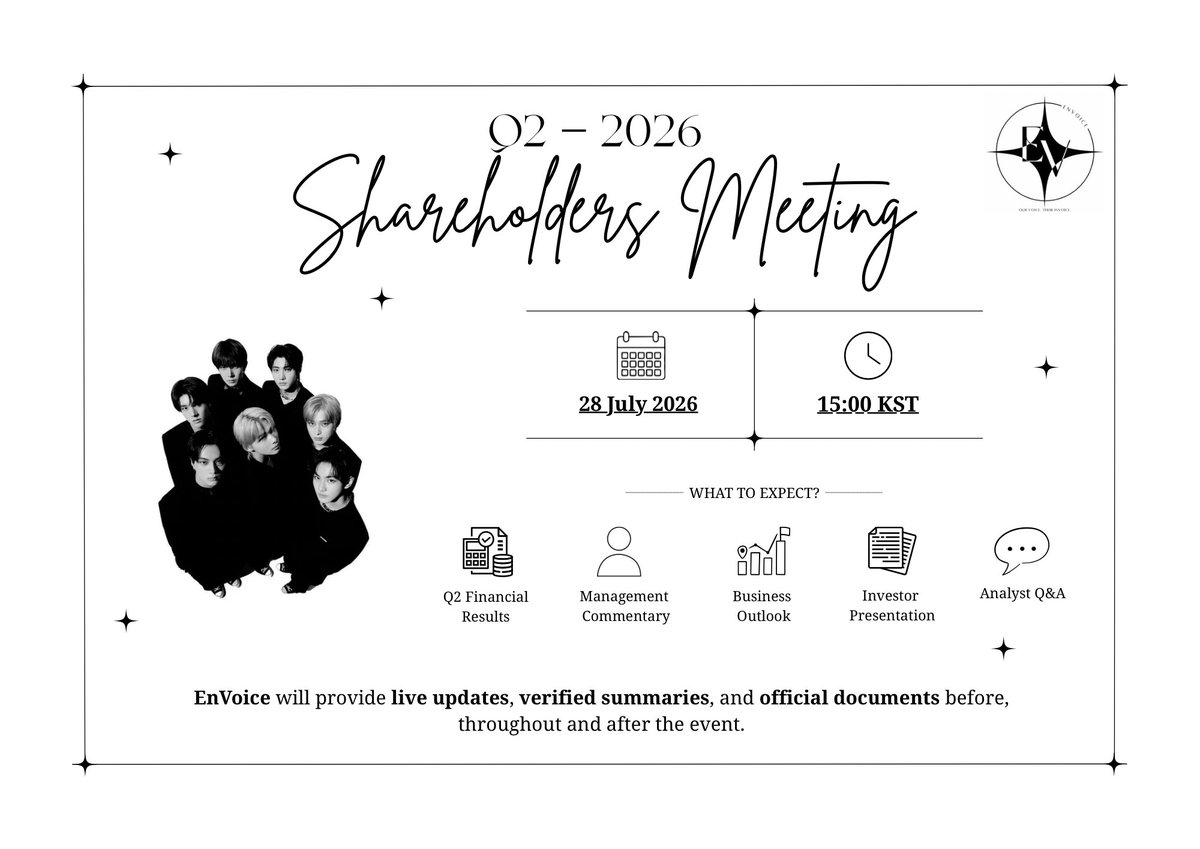
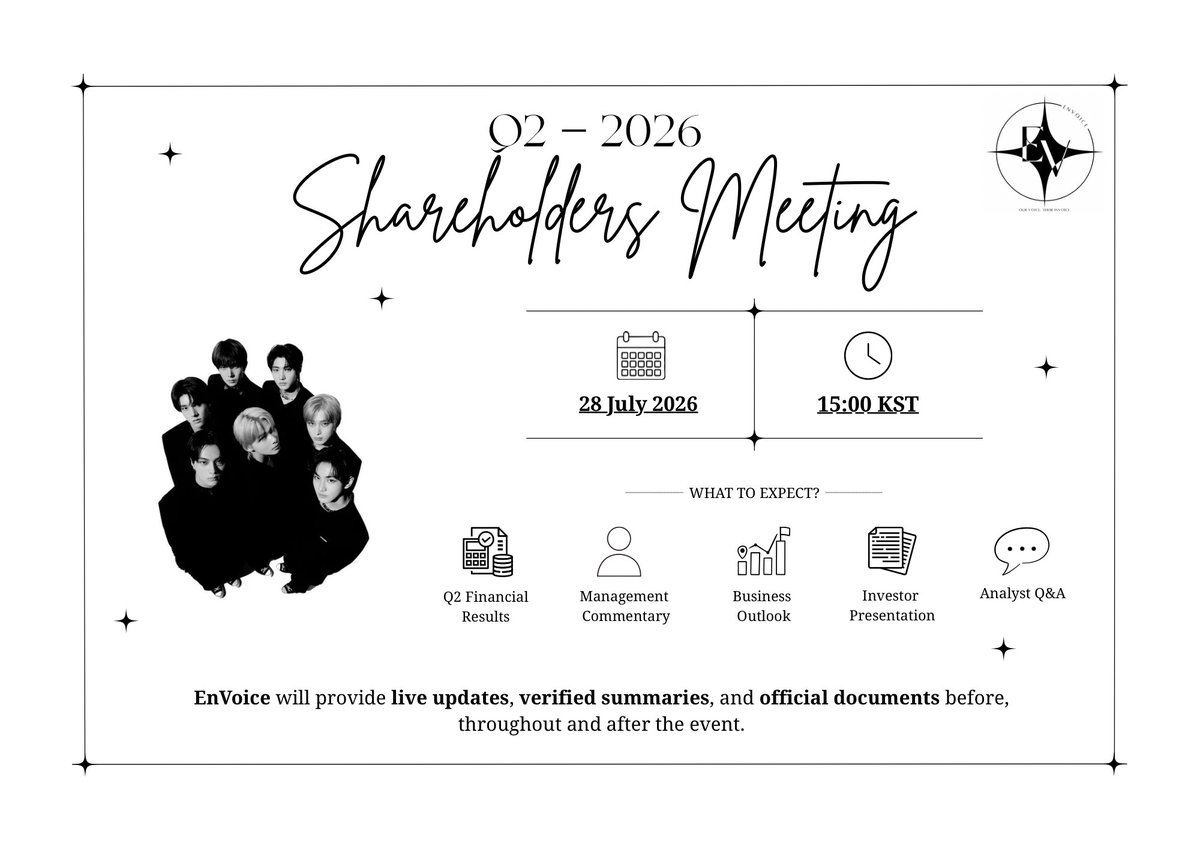
D-DAY — Q2 2026 Shareholders Meeting
Today is the day of HYBE’s shareholders’ meeting.
Throughout this reminder series, we have continued to highlight the importance of corporate accountability, transparency and the protection of artist welfare. Today, our demands must remain visible and directed toward those responsible for the company’s decisions.
Keep amplifying the campaign, use the designated tags responsibly and stay focused on the purpose behind our collective action.
Our voices have reached this moment. Let’s make them impossible to ignore.
📢— ENGENEs,
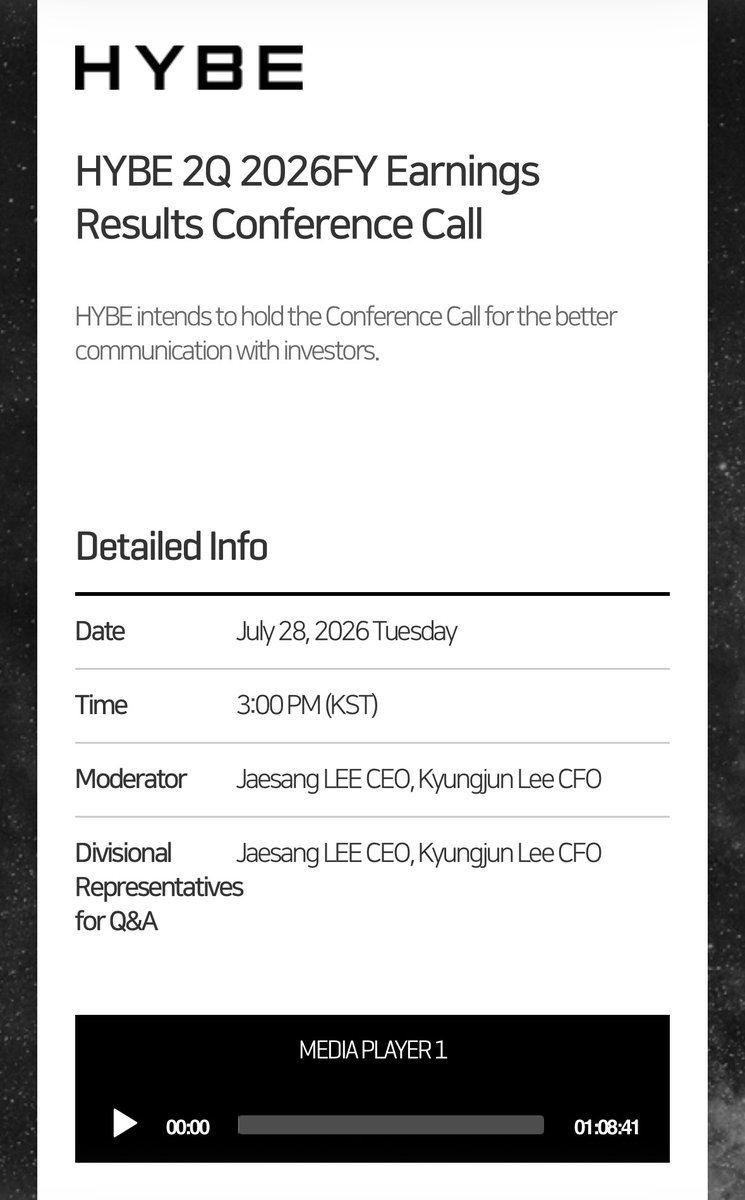
HYBE’s Q2 2026 Earnings Call will take place today.
The presentation can be followed through a live audio broadcast on HYBE’s corporate website.
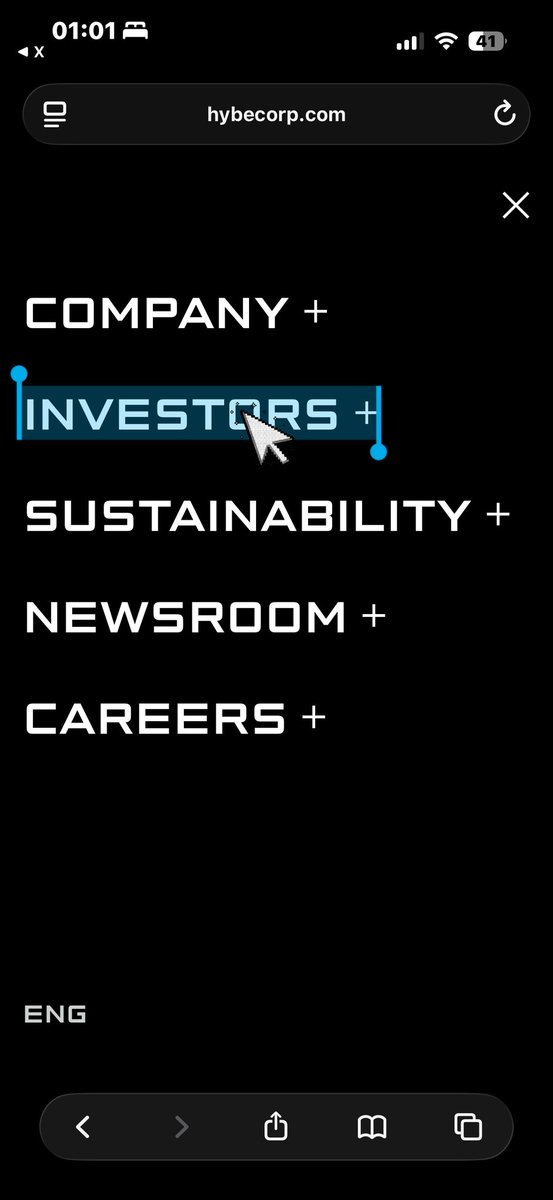
Access guide:
1. Open https://t.co/WsIhbyPBXQ.
2. Click the three lines on the top right corner of the page.
3. Choose the “Investor” menu.
4. Enter the “IR Event Schedule” page.
5. Open the latest notice for the Q2 2026 earnings presentation.
The webcast will be audio-only, with Korean and English available. For easier reference, download the accompanying earnings materials beforehand and use them to follow the financial figures and graphs during the call.
✦︎ — ENVOICE CASE 011
HYBE 2025 ANNUAL REPORT
FINAL SECTIONS: CHAPTERS IX–XII
The final sections of HYBE’s Annual Report shift the focus from financial performance to the corporate structure surrounding it: affiliated companies, internal transactions, executive incentives, legal and regulatory risks, subsidiary guarantees and the detailed tables supporting the company’s disclosures.
Together, these sections show how HYBE’s operations extend across a large and highly interconnected international network, and why evaluating the company requires looking beyond consolidated revenue and profit.
★ AFFILIATED COMPANIES AND CORPORATE STRUCTURE
HYBE operates through an extensive network of domestic and international subsidiaries across music, platforms, gaming, technology and regional operations.
As of the end of 2025, HYBE reported 85 consolidated subsidiaries, including 12 major subsidiaries, alongside affiliated companies operating across South Korea, Japan, the United States, Latin America, China and India.
The report also discloses several executives holding simultaneous positions across multiple affiliated companies. These appointments are not inherently improper, but the concentration of responsibilities raises important questions regarding oversight, independence and accountability across the group.
★ TRANSACTIONS WITH SUBSIDIARIES AND RELATED PARTIES
HYBE disclosed loans, sales, purchases and other transactions involving affiliated companies.
Among the most notable was a loan of approximately KRW 14.35 billion to HYBE Latin America for operating and related purposes, which remained outstanding at the end of 2025.
HYBE also reported significant transactions with major subsidiaries such as BigHit Music, PLEDIS Entertainment and HYBE Japan. These are internal group transactions rather than independent third-party sales, but they remain relevant for understanding how revenue, expenses and resources move across HYBE’s corporate structure.
★ EXECUTIVE EQUITY COMPENSATION
The report details HYBE’s restricted stock unit, or RSU, compensation system for directors and executives across the parent company and its subsidiaries.
Some awards depend mainly on continued employment, while others include operating-profit, share-price or additional performance conditions.
Equity-based compensation can align executives with long-term company performance, but its effectiveness depends on whether targets are measurable, transparent and connected to sustainable results rather than short-term outcomes.
★ LITIGATION, GUARANTEES AND INVESTOR RISK
At the end of 2025, HYBE and its subsidiaries were involved in multiple ongoing legal cases as both plaintiffs and defendants.
HYBE stated that the outcomes could not be reasonably predicted and that the expected financial impact was not considered material. However, this remains management’s accounting assessment rather than a guarantee that the cases will have no financial, operational or reputational consequences.
The company also disclosed guarantees for several subsidiaries, including Source Music, KOZ Entertainment, PLEDIS Entertainment, DreamAge, HYBE Latin America and HYBE Japan.
These guarantees do not mean HYBE has already paid the subsidiaries’ obligations, but they represent potential exposure should the guaranteed entities become unable to meet them independently.
★ REGULATORY SANCTIONS AND COMPLIANCE
The report identifies sanctions involving disclosure failures and consumer-protection requirements.
DreamAge, Weverse Company and BigHit Music received fines related to omitted or delayed corporate disclosures. Weverse Company also received corrective measures and an administrative fine concerning order-cancellation practices and insufficient transaction information on Weverse Shop.
The monetary penalties were limited, but the repeated nature of disclosure and consumer-protection issues remains relevant when evaluating the effectiveness of HYBE’s internal compliance systems.
★ EVENTS AFTER THE REPORTING PERIOD
Several material developments occurred after December 31, 2025.
These included:
⤷ HYBE’s acquisition of 546,120 donated shares from the largest shareholder for future employee performance compensation
⤷ the separation of part of PLEDIS Entertainment’s business into a newly established company
⤷ conversion claims involving approximately KRW 99.99 billion of HYBE’s convertible bonds, resulting in 458,650 newly issued or scheduled shares.
The bond conversions reduce outstanding debt obligations but also increase the number of shares, creating potential dilution for existing shareholders.
★ DETAILED SUBSIDIARY AND INVESTMENT TABLES
The final detailed tables provide the supporting data behind HYBE’s corporate structure and investment portfolio.
At the end of 2025, HYBE reported investments in 40 corporations, with a total ending book value of approximately KRW 2.55 trillion.
The tables also record major developments including:
⤷ a substantial valuation decrease involving HYBE America
⤷ the disposal of HYBE’s remaining holdings in SM Entertainment and YG Plus
⤷ continued investment in HYBE Latin America
⤷ the creation or expansion of entities in China, India, Japan and Latin America
These figures come from different accounting categories and should not automatically be treated as directly comparable measures of performance.
★ KEY TAKEAWAY
The final sections reveal that HYBE’s financial position cannot be assessed only through revenue, operating profit or net income.
Its wider risk structure also depends on how the company manages its subsidiaries, internal transactions, executive incentives, corporate guarantees, legal disputes, regulatory compliance and international investments.
As HYBE’s corporate network continues to expand, stronger group-wide transparency, clearer accountability and effective oversight become increasingly important, not only for investors, but for every artist, employee and stakeholder whose work supports the company’s value.
$KOSPI
🔗 Full Chapter IX-XII analysis:
https://t.co/2p30grsSOa
📷 Official Annual Report:
https://t.co/JNYiY6h9uJ
For a quick overview, refer to the poster. For the complete analysis and further context, read our Telegraph article.
Questions and requests for clarification are welcome through replies or direct messages. We will do our best to address them based on the information publicly disclosed in the Annual Report.
Stay tuned as we continue examining the information relevant to the upcoming shareholders’ meeting.
✦︎ — ENVOICE CASE 010
$HYBE 2025 ANNUAL REPORT
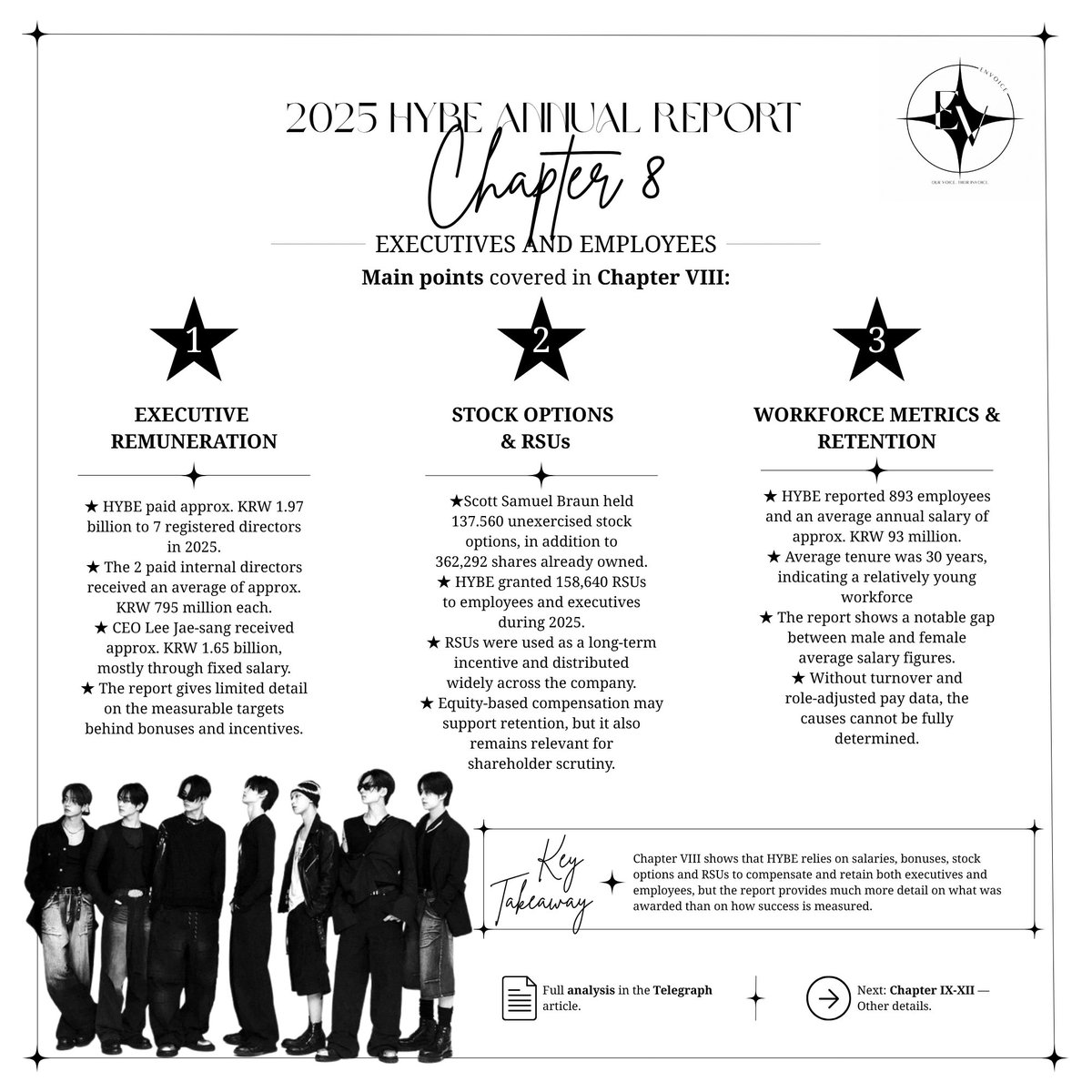
CHAPTER VIII: EXECUTIVES AND EMPLOYEES
A company’s performance cannot be assessed through revenue and profit alone. How it compensates executives, retains employees and connects leadership rewards to corporate results also provides insight into its governance and long-term stability.
Chapter VIII examines HYBE’s executive remuneration, stock options, Restricted Stock Units and workforce metrics during a year in which the company achieved record revenue, while operating profit declined by approximately 73% and the group recorded a consolidated net loss of approximately ₩254.4 billion.
★ EXECUTIVE REMUNERATION
HYBE paid approximately ₩1.97 billion in total remuneration to seven registered directors, remaining below the ₩5 billion limit approved by shareholders.
The two paid internal directors received an average of approximately ₩795 million each. CEO Lee Jae-sang received approximately ₩1.65 billion, primarily through fixed salary rather than a separate performance bonus.
Several senior executives also received substantial compensation through salaries, performance incentives, RSU-related income and retirement payments. Some bonuses paid in 2025 were based on achievements assessed for 2024, meaning they should not be presented as direct rewards for HYBE’s 2025 financial results.
However, the report provides limited information on the specific numerical targets, weightings and thresholds used to determine these awards.
★ STOCK OPTIONS AND ACCOUNTABILITY
Scott Samuel Braun held 137,560 unexercised HYBE stock options across three grants, in addition to 362,292 shares already owned.
Unexercised options are not realised income, and his existing shareholding gives him direct exposure to HYBE’s market performance. Nevertheless, the scale of these incentives remains relevant when considered alongside the losses and valuation decline associated with HYBE America.
The disclosure raises a broader governance question: are executive equity incentives sufficiently connected to the performance and capital efficiency of the operations managed or advised by their recipients?
★ RSUs AND SHAREHOLDER IMPACT
HYBE granted RSUs corresponding to 158,640 shares to 2,122 employees and executives during 2025, including a company-wide grant of 20 RSUs per employee.
These awards were not all immediately distributed. RSUs only become transferable after vesting conditions are met, and HYBE states that they are satisfied through treasury shares rather than necessarily issuing new shares.
While RSUs can support employee retention and align compensation with long-term share performance, distributing treasury shares increases the number of shares circulating outside the company and may gradually reduce existing shareholders’ proportional ownership.
★ WORKFORCE METRICS
HYBE reported:
⤷ 893 employees
⤷ an average annual salary of approximately ₩93 million
⤷ an average tenure of three years
⤷ a workforce that was approximately 68% female
Male employees received an average of approximately ₩122 million, compared with approximately ₩80 million for female employees.
This difference does not, by itself, prove unequal pay for equal work because the report does not provide salary data adjusted for position, seniority or department. However, the scale of the gap warrants greater transparency regarding representation, advancement and compensation across the organisation.
An average tenure of three years also does not confirm high turnover. It may reflect rapid hiring, expansion, restructuring or employee departures. Without voluntary-turnover and retention data, the cause cannot be determined.
★ KEY TAKEAWAY
Chapter VIII shows that HYBE relies on a combination of fixed salaries, performance incentives, stock options and RSUs to compensate and retain its leadership and workforce.
The report provides considerable detail on how much was awarded, but substantially less information on the measurable performance conditions used to justify those rewards.
During a year of record revenue but sharply declining profitability, shareholders should be able to evaluate how executive remuneration reflects sustainable value creation, how investment losses affect compensation decisions and whether equity-based incentives are producing measurable improvements in retention and corporate performance.
$KOSPI
🔗 Full Chapter VIII analysis:
https://t.co/ZdXGIsksF3
📷 Official Annual Report:
https://t.co/JNYiY6h9uJ
For a quick overview, refer to the poster. For the complete analysis and further context, read our Telegraph article.
Questions and requests for clarification are welcome through replies or direct messages. We will do our best to address them based on the information publicly disclosed in the Annual Report.
Stay tuned as we continue examining the information relevant to the upcoming shareholders’ meeting.
A summary thread breaking down the series on HYBE’s 2025 Annual Report & corporate structure.
Refer to @7ENVOICE original posts for full details & Telegraph links!
엔진은 책임 있는 경영을 요구합니다.
#Demand_HYBE_Q2Compliance#BoycottHYBE_CeaseMisconduct
📢 — ENGENEs, it’s 12AM KST
We’re officially entering DAY 3 of our Mass Tag project! Meeting day is here so let's be as loud as we can!
As HYBE prepares to present its Q2 results to investors and stakeholders on August 28, we are introducing a coordinated tag reset to sharpen our message and increase its visibility. By aligning our tags, we aim to direct sustained attention toward corporate accountability, transparent management, and the company’s responsibility to protect artist welfare, not only among fans, but also before the investors and stakeholders evaluating its performance.
ENGENEs' demands remain unchanged. The boycott will continue until our concerns are addressed and meaningful action is taken. We stand for fairness, respect for all sevEN.
엔진은 책임 있는 경영을 요구합니다.
#Demand_HYBE_Q2Compliance
#BoycottHYBE_CeaseMisconduct
★ GUIDELINES FOR TAGS:
• Do NOT mix them with other hashtags or add extra tags, this might interfere with main ones.
• Include the tags at the end of your post.
• DO RT and QRT posts using the official tags to help the trend.
★ DISCLAIMER:
These hashtags are meant for X (Twitter) trending only.
Do NOT spam these tags on Instagram, TikTok, Weverse, YouTube, or any other platform.
Do NOT use them under official ENHYPEN, EVAN, BELIFT, or HYBE official posts.
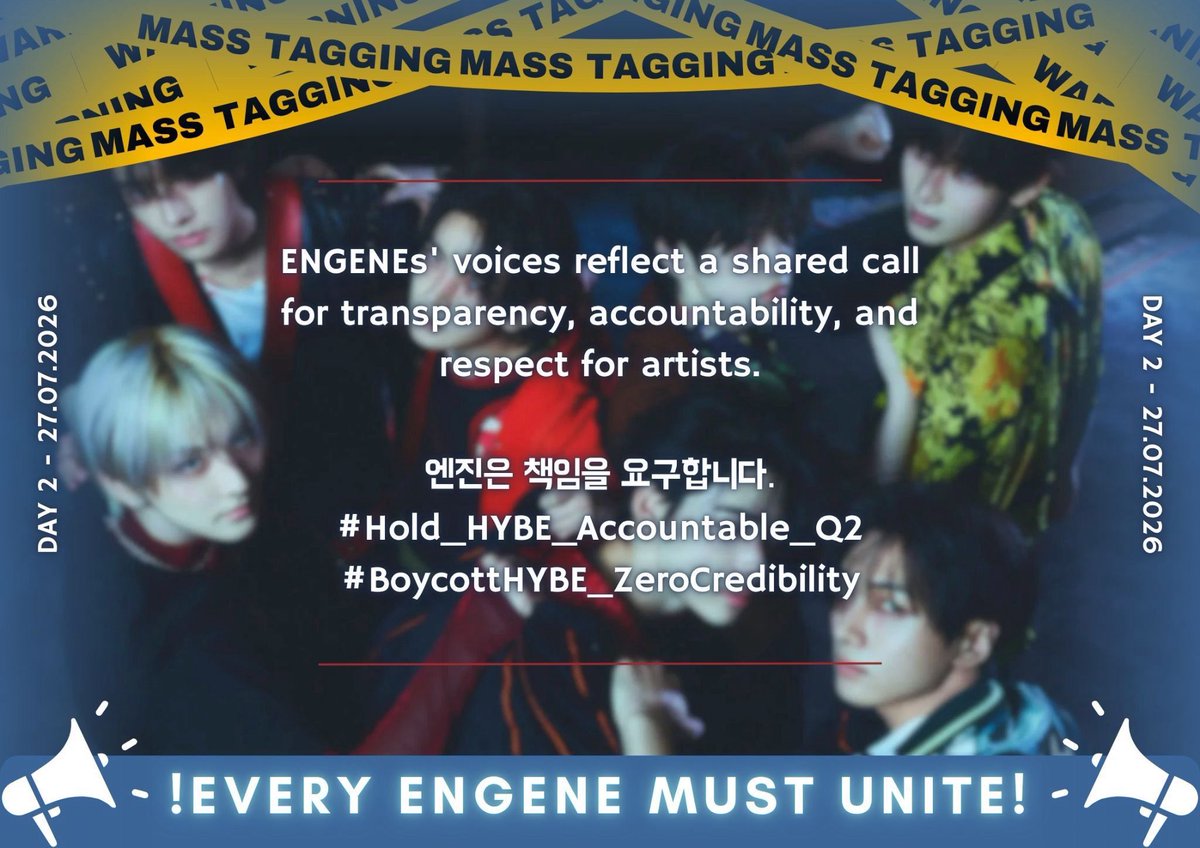
📢: ENGENEs, it’s 8PM KST
DAY 2 SECOND WAVE is now live!
Let's make one last rally with these tags, before tags reset!
As HYBE prepares to present its Q2 results to investors and stakeholders on August 28, we are introducing a coordinated tag reset to sharpen our message and increase its visibility. By aligning our tags, we aim to direct sustained attention toward corporate accountability, transparent management, and the company’s responsibility to protect artist welfare, not only among fans, but also before the investors and stakeholders evaluating its performance.
ENGENEs' voices reflect a shared call for transparency, accountability, and respect for artists.
엔진은 책임을 요구합니다.
#Hold_HYBE_Accountable_Q2 #BoycottHYBE_ZeroCredibility
★ GUIDELINES FOR TAGS:
• Do NOT mix them with other hashtags or add extra tags, this might interfere with main ones.
• Include the tags at the end of your post.
• DO RT and QRT posts using the official tags to help the trend.
★ DISCLAIMER:
These hashtags are meant for X (Twitter) trending only.
Do NOT spam these tags on Instagram, TikTok, Weverse, YouTube, or any other platform.
Do NOT use them under official ENHYPEN, EVAN, BELIFT, or HYBE official posts.
✦︎ — ENVOICE CASE 009
$HYBE 2025 ANNUAL REPORT
CHAPTER VII: SHAREHOLDERS
Chapter VII examines HYBE’s ownership structure, the influence of its largest and strategic shareholders, the agreements governing certain investments and the company’s stock-market performance during the second half of 2025.
Ownership percentages are important, but they do not provide the complete picture. Voting influence may also depend on board-nomination rights, contractual protections and how widely the remaining shares are distributed.
★ LARGEST SHAREHOLDER AND RELATED PARTIES
As of December 31, 2025, HYBE had issued 42,609,196 common shares.
Bang Si-hyuk remained the company’s largest shareholder, holding 13,151,394 shares, or 30.86%. Together with parties classified as related to him, the group held 13,529,672 shares, representing 31.75% of HYBE.
Bang’s number of shares remained unchanged during the year. However, his ownership percentage declined from 31.57% to 30.86% because HYBE’s total issued shares increased following the conversion of convertible bonds.
This means his position remained stable in absolute terms but was slightly diluted as a percentage of the company.
His stake gives him substantial influence as HYBE’s founder, Chairman, director and largest individual shareholder. However, it remains below an absolute majority and does not prove that he can independently approve every shareholder or board decision.
The report also records small share movements among executives and related parties, including shares received through Restricted Stock Units and shares purchased or sold on the market. These transactions should not automatically be interpreted as evidence of either confidence or concern, as the report does not explain the personal reasons behind them.
★ SHAREHOLDER AGREEMENTS
HYBE disclosed agreements involving several strategic investors whose influence extends beyond their ownership percentages.
Netmarble held 3,930,813 shares, or 9.23% of HYBE. Its agreement allows it to nominate a director while it continues to hold at least 7% of the company’s voting shares.
Dunamu held 2,302,570 shares, or 5.40%. Its agreement includes rights connected to the nomination of an outside director, the appointment of a board observer and access to certain board information, subject to ownership conditions.
The report also describes an agreement concerning Levvels Inc., in which the HYBE investor group holds 25% and the Dunamu group holds 75%.
The agreement includes board representation, rights of first refusal, Tag-Along protections and Drag-Along obligations. These provisions regulate how both majority and minority investors are treated if shares are transferred or control of the company is sold.
These agreements demonstrate that governance influence cannot be measured through ownership percentages alone. Some strategic investors also hold contractual rights affecting board representation and access to corporate information.
★ MAJOR SHAREHOLDERS AND OWNERSHIP CONCENTRATION
The four shareholders holding at least 5% of HYBE were:
⤷ Bang Si-hyuk: 30.86%
⤷ Netmarble: 9.23%
⤷ National Pension Service: 8.63%
⤷ Dunamu: 5.40%
Together, their holdings represented 54.12% of HYBE’s issued shares.
However, this does not mean they form a coordinated voting group. The report provides no evidence that these shareholders vote together or pursue the same corporate objectives.
The National Pension Service also held a larger stake than Dunamu, but Chapter VII does not disclose equivalent contractual board-nomination rights for the institution. This further shows that the size of a shareholding and the governance rights attached to it are separate considerations.
★ MINORITY SHAREHOLDERS
HYBE reported 183,627 minority shareholders holding 20,244,649 shares, equivalent to 47.53% of the company’s issued shares.
Minority shareholders represented almost all shareholders by number, but collectively held slightly less than half of HYBE’s shares.
This indicates that a substantial portion of the company’s ownership is widely dispersed. However, these shareholders should not automatically be described as individual retail investors, as the report does not provide a detailed breakdown of the category.
Their combined percentage also does not mean they act as a unified voting bloc. Their shares are distributed among more than 183,000 holders, while Bang Si-hyuk’s ownership is concentrated in a single position.
HYBE therefore combines a broad shareholder base with a concentrated founder stake and strategic investors holding additional contractual rights.
★ STOCK PRICE AND TRADING ACTIVITY
Between July and December 2025, HYBE’s monthly average closing price increased from ₩272,391 to ₩304,857.
The highest closing price recorded during the period was ₩343,000, reached in both October and November.
Trading activity also increased considerably during those months. November recorded the highest monthly volume of the six-month period, with approximately 10.03 million shares traded.
The figures show an overall upward price trend and stronger market activity during the latter part of 2025.
However, they do not establish why the share price moved or why investors traded more heavily. Higher prices and trading volumes do not automatically prove improved profitability, stronger management or increased confidence in HYBE’s long-term performance.
★ KEY TAKEAWAY
Chapter VII reveals that HYBE’s ownership structure remained stable at its centre but continued to evolve around it.
Bang Si-hyuk remained the dominant individual shareholder, although his ownership percentage was slightly diluted by the issuance of additional shares. At the same time, Netmarble and Dunamu retained strategic influence through contractual governance rights, including board-nomination and information-related provisions.
Nearly half of HYBE’s issued shares were held by minority shareholders, creating a broad ownership base. However, those shares are widely dispersed, while founder ownership and certain strategic-investor rights remain concentrated.
The chapter therefore presents HYBE as a company with extensive public ownership, but with significant governance influence still centred around its founder and a small number of major investors.
$KOSPI
🔗 Full Chapter VII analysis:
https://t.co/uY9wJbIGa2
📷 Official Annual Report:
https://t.co/JNYiY6h9uJ
For a quick overview, refer to the poster. For the complete analysis and further context, read our Telegraph article.
Questions and requests for clarification are welcome through replies or direct messages. We will do our best to address them based on the information publicly disclosed in the Annual Report.
Stay tuned as we continue examining the information relevant to the upcoming shareholders’ meeting.
✦︎ — ENVOICE BRIEFING 008
D-1 — Q2 2026 Shareholders Meeting
With only one day remaining, we encourage everyone to continue supporting the campaign and amplifying our demands for transparency, corporate accountability and the protection of artists’ welfare.
Our ongoing analysis of HYBE’s 2025 Annual Report has provided important context on the company’s structure, operations, financial position and governance. Now is the time to ensure that these concerns remain visible as the meeting approaches.
Please continue using the designated tags and cashtag responsibly, engage with informative posts and help us reach a wider audience.
ONE DAY LEFT.
LET OUR CONCERNS BE SEEN AND HEARD.
$HYBE
✦︎ — ENVOICE CASE 008
$HYBE 2025 ANNUAL REPORT
CHAPTER VI: HYBE'S CORPORATE GOVERNANCE
Corporate governance determines who supervises management, how major financial decisions are reviewed and what mechanisms exist to protect shareholders.
Chapter VI examines HYBE’s Board of Directors, its specialised committees, the audit and compliance systems supporting them, and the procedures surrounding shareholder participation.
The chapter presents a governance structure that is formally developed. However, the disclosed voting records and meeting information also raise questions about how actively that structure challenges management and oversees capital allocation.
★ BOARD COMPOSITION AND INDEPENDENCE
At the time of the report, HYBE’s board consisted of nine directors:
⤷ three internal directors
⤷ five outside directors
⤷ one other non-executive director
Because outside directors held five of the nine seats, they represented a numerical majority.
HYBE also operated five specialised board committees covering outside-director nominations, internal transactions, sustainability, compensation and auditing.
This creates formal separation between management and the bodies responsible for supervising sensitive matters. However, numerical independence does not automatically demonstrate effective oversight. What matters is whether directors meaningfully question proposals, request additional evidence and impose conditions before corporate resources are committed.
★ BOARD VOTING AND SUBSIDIARY FINANCING
HYBE held 15 board meetings during 2025 and considered approximately 61 resolution items. Every disclosed resolution was approved, and the public voting record does not show a single opposing vote from an attending director.
Unanimity does not necessarily mean that no discussion occurred. Directors may raise concerns or request changes before the final vote. However, the Annual Report only records the proposal, its outcome and each director’s vote. It does not disclose the substance of the discussion or whether alternatives were considered.
A substantial portion of the board’s agenda concerned subsidiary financing.
At least 25 disclosed resolutions involved matters such as:
⤷ loans to subsidiaries;
⤷ working-capital credit arrangements;
⤷ extensions of intercompany lending;
⤷ capital increases;
⤷ conversions or extensions of existing financing;
⤷ guarantees for subsidiary borrowing.
These transactions may be necessary within a large corporate group. Nevertheless, their frequency makes capital-allocation oversight one of the board’s most important responsibilities.
The report confirms that the financing was approved, but it does not explain the criteria used to assess repayment capacity, expected returns, subsidiary performance or the risk of further losses and impairments.
★ DIRECTOR ATTENDANCE
Attendance varied among HYBE’s directors.
CEO Lee Jae-sang and several outside directors recorded full attendance during their respective terms.
Scott Samuel Braun recorded an attendance rate of 87%. Contrary to an earlier interpretation, he attended the major financing meetings held on March 31 and June 24 and voted in favour of the proposals considered.
Board Chairman Bang Si-hyuk recorded a 73% attendance rate, the lowest among HYBE’s internal directors. His absences included the June 24 meeting, during which the board considered 11 resolutions involving subsidiary loans, credit arrangements and a loan guarantee.
Missing individual meetings does not prove that a director failed to perform their duties. However, attendance is especially relevant when the director holds a central leadership position and the meeting concerns numerous capital-allocation decisions.
★ SPECIALISED COMMITTEES
HYBE’s Internal Transactions Committee, Compensation Committee and Audit Committee were composed entirely of outside directors.
The Internal Transactions Committee reviewed transactions involving affiliates, related parties and companies under the same controlling shareholder. All disclosed resolutions were approved unanimously.
The Compensation Committee reviewed the CEO compensation system, executive remuneration limits and salary and incentive arrangements.
The Audit Committee held nine meetings and examined financial reporting, internal accounting controls, ethics-management assessments, external-auditor findings and an audit of Weverse Company.
These committees provide important procedural safeguards. However, most disclosures only identify the titles and outcomes of the matters reviewed.
The report does not provide enough information to determine:
⤷ the conditions imposed on transactions
⤷ whether proposals were modified or rejected before formal voting
⤷ the detailed findings of internal audits
⤷ the measurable targets used to calculate executive incentives
⤷ how financial losses and impairments affected compensation
★ COMPLIANCE AND SHAREHOLDER PARTICIPATION
HYBE maintained dedicated audit, ethics and compliance teams and had introduced electronic voting for shareholders.
However, cumulative voting, which can strengthen minority shareholders’ ability to support a specific board candidate, was excluded under HYBE’s articles during the reporting period. The company stated that it planned to propose removing this exclusion at the 2026 shareholders’ meeting.
The 2025 General Shareholders’ Meeting approved the financial statements, director appointments, Audit Committee appointments, the director-remuneration limit and previously granted stock options.
The report records each proposal as having passed, but does not show the percentage of votes supporting or opposing each item. This limits the ability to evaluate the level of shareholder dissent behind the final results.
★ KEY TAKEAWAY
HYBE’s governance framework is formally extensive, but the public disclosures provide significantly more information about the existence and outcomes of its oversight mechanisms than about their practical effectiveness.
The central question is not whether HYBE has a board, committees and compliance teams. It is whether those bodies consistently impose meaningful financial discipline, challenge management decisions and connect executive accountability to the long-term consequences of corporate strategy.
$KOSPI
🔗 Full Chapter VI analysis:
https://t.co/F3n1pLhhI7
📷 Official Annual Report:
https://t.co/JNYiY6h9uJ
For a quick overview, refer to the poster. For the complete analysis and further context, read our Telegraph article.
Questions and requests for clarification are welcome through replies or direct messages. We will do our best to address them based on the information publicly disclosed in the Annual Report.
Stay tuned as we continue examining the information relevant to the upcoming shareholders’ meeting.
✦︎ — ENVOICE BRIEFING 007
A QUICK GUIDE TO USING CASHTAGS CORRECTLY
A cashtag is mainly used to group public discussions concerning a listed company, including its business activity, financial performance, governance, decisions and reputation.
Using $/HYBE does not mean simply adding it to every post. The post itself should clearly concern HYBE as a company. The cashtag should appear naturally within a complete and relevant statement, allowing people following the company’s ticker to understand why the post is connected to it.
For example:
✅ HYBE’s corporate decisions and their long-term impact on artist management deserve greater scrutiny. $/HYBE
❌ $/HYBE, $/HYBE, $/HYBE
To use the cashtag properly:
Write a complete sentence that explains your point. Do not post the cashtag alone.
★ Keep the discussion focused on HYBE’s corporate conduct, governance, finances, disclosures, management decisions, public communications or reputation.
★ Make each post or reply different. Avoid repeatedly copying and pasting the same wording.
★ Add your own observation, question or conclusion instead of only attaching the cashtag to someone else’s words.
★ When referring to a specific claim, support it with a credible source whenever possible. This may include an official report, company statement, financial disclosure or reliable article.
★ Use $/HYBE in relevant replies and quote posts as well as original posts. Cashtags are intended to organize genuine conversations, not only isolated posts.
★ Engage naturally by replying to other users, discussing their points and adding useful context. Do not leave identical comments under multiple posts.
★ Space out your activity. Posting the same cashtag continuously within a very short period may look repetitive and could cause the activity to be treated as spam.
★ Screenshots, links and articles may be included when they are directly relevant, but the written text should still explain what the reader is looking at and why it matters.
Please avoid:
☆ posting $/HYBE on its own;
☆ placing it under content unrelated to HYBE as a company;
☆ repeating an identical sentence across several posts;
☆ filling replies with only the cashtag or a generic phrase;
☆ making unsupported claims or presenting speculation as confirmed fact;
☆ tagging unrelated people or accounts solely to gain visibility.
The purpose is not to post the cashtag as many times as possible. It is to build a clear, relevant and credible public discussion that can be found by people following conversations about the company, including shareholders, investors, analysts, journalists and the wider public.
Before posting, ask yourself:
- Does my post clearly concern HYBE?
- Does it explain my point?
- Would someone unfamiliar with the issue understand why $/HYBE is included?
When the answer is yes, the cashtag is being used meaningfully.
✦︎ — ENVOICE CASE 007
$HYBE 2025 ANNUAL REPORT
CHAPTER V: ACCOUNTING AUDITOR’S AUDIT OPINION AND INTERNAL CONTROL
Financial statements are prepared by management, but their reliability is assessed by an independent external auditor. Chapter V examines whether HYBE’s reported financial information was considered materially reliable, which areas required the greatest audit attention and whether the company’s internal accounting controls were assessed as effective.
★ EXTERNAL AUDIT OPINION
Samil Accounting Corporation issued unqualified opinions on both HYBE’s separate and consolidated financial statements for 2025.
This means the auditor concluded that the statements were fairly presented, in all material respects, under the applicable accounting standards.
However, an unqualified opinion is not proof that the company is free from every error, risk or governance concern. It does not evaluate whether management decisions were successful, ethical or fair, nor does it assess non-financial matters such as artist or employee treatment.
★ KEY AUDIT MATTERS
The auditor identified two recurring areas requiring significant attention:
- the impairment assessment of investments in subsidiaries in HYBE’s separate financial statements;
- the impairment assessment of goodwill in its consolidated financial statements.
Both valuations depend heavily on forecasts concerning future revenue, profitability, cash flows, growth and discount rates.
Their identification as key audit matters does not prove that the assets were incorrectly valued. It shows that these balances involve substantial judgment and remain among the most complex areas of HYBE’s financial reporting.
★ AUDIT FEES AND NON-AUDIT SERVICES
HYBE’s 2025 external-audit engagement carried remuneration of ₩838 million and involved 8,698 actual audit hours.
The Annual Report also lists 12 non-audit engagements with Samil, with total disclosed contractual remuneration of approximately ₩1.414 billion. These included tax advisory, sustainability-report support, annual-report digitalisation and financial-information analysis.
The existence of these services does not prove that auditor independence was compromised. However, their scale makes transparency regarding approval procedures, conflict assessments and independence safeguards especially important.
★ AUDIT COMMITTEE OVERSIGHT
Five communications between the external auditor and HYBE’s Audit Committee were disclosed across the audit cycle.
The discussions covered the annual audit plan, quarterly and half-year reviews, proposed key audit matters, changes to internal controls and controls addressing the risk of fraudulent use of company funds.
These meetings confirm that communication occurred throughout the year. However, the report does not disclose the full questions raised, disagreements discussed or actions requested by the Audit Committee.
★ INTERNAL ACCOUNTING CONTROL
Management, the Audit Committee and the external auditor all concluded that HYBE’s internal accounting control systems were effectively designed and operated from a materiality perspective.
No significant weaknesses requiring disclosure were reported.
The 2025 fiscal year was also the first year in which HYBE’s consolidated internal accounting control system was fully assessed and externally audited following a two-year deferral.
This expanded formal oversight from the parent company to the wider group, which consisted of 85 consolidated subsidiaries at year-end.
★ KEY TAKEAWAYS
Chapter V presents a generally favourable assessment of HYBE’s financial reporting and internal accounting controls.
At the same time, the repeated focus on goodwill and subsidiary investments shows that important parts of the company’s balance sheet continue to depend on future-performance assumptions.
The increase in non-audit engagements also deserves continued shareholder attention, not because it proves a conflict, but because auditor independence must remain both real and clearly demonstrated.
An unqualified audit opinion confirms that the financial statements passed the applicable materiality-based audit standards. It should not be interpreted as a complete endorsement of HYBE’s broader corporate conduct.
$KOSPI
🔗 Full Chapter V analysis:
https://t.co/GEKLB2miRI
📷 Official Annual Report:
https://t.co/JNYiY6h9uJ
For a quick overview, refer to the poster. For the complete analysis and further context, read our Telegraph article.
Questions and requests for clarification are welcome through replies or direct messages. We will do our best to address them based on the information publicly disclosed in the Annual Report.
Stay tuned as we continue examining the information relevant to the upcoming shareholders’ meeting.