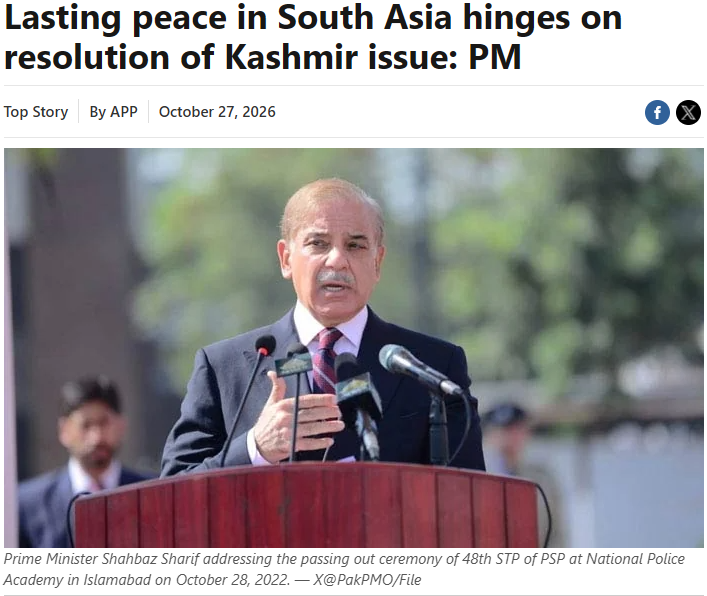
Every October 27, Pakistan stages its annual performance of grievance. Rallies fill streets in Islamabad and Muzaffarabad, resolutions are passed, and speakers declare that Indian troops landing in Srinagar on that day in 1947 began an “illegal occupation.” They call it Jammu and Kashmir Black Day. From where I sit—in the Union Territory of Jammu and Kashmir, as a Kashmiri Muslim woman who has never needed a Pakistani passport or a Pakistani flag to claim her identity—this ritual is not solidarity. It is a refusal to accept history, geography, and the choices made by people who actually live here.
I was born in the Valley after the accession had long been settled in law and in the daily life of my family. My grandmother’s generation remembered the autumn of 1947 differently from the script now recited across the Line of Control. On 22 October, tribal lashkars crossed from the west, burning villages and advancing toward Srinagar. The Maharaja’s forces could not hold them. Only after that invasion did Maharaja Hari Singh sign the Instrument of Accession to India on 26 October. Indian troops arrived the next day not as conquerors but as the force that stopped the raiders short of the capital. My family has never treated that landing as the start of darkness; they treated it as the moment the immediate threat was checked. Pakistan’s version reverses the order of events and then treats the reversal as sacred.
That historical inversion has cost Kashmiri lives for decades. The “unfinished business of Partition” that some in Pakistan still invoke was never a promise that every Muslim-majority territory must join them. Princely states chose. Hyderabad and Junagadh chose differently and were integrated. Kashmir’s ruler, facing invasion, chose India. The United Nations resolutions that followed required Pakistan to withdraw its forces first; that condition was never met. Instead, successive Pakistani governments sustained a proxy conflict that turned the Valley into a place where young men were recruited, trained, and sent back to die. My classmates lost brothers to that cycle. The men who returned as militants rarely asked the women of the household whether they wanted the fight; they simply imposed it. The Black Day commemorations never pause to count those dead or the years of closed schools and empty tourist boats they produced.
I have lived the alternative that Pakistan’s narrative refuses to acknowledge. I studied in a heritage missionary school, then the state university in the Valley, then built a professional career outside the state because the Indian system allowed me to do so without losing my right to return and inherit property. Before 2019, a Kashmiri woman who married outside the permanent-resident framework risked losing her own residency rights; men faced no equivalent penalty. That asymmetry is gone. Central laws on domestic violence and child marriage now apply without the old loopholes. I can vote in local and national elections, contest for panchayat seats, and open a bank account or register a business without anyone demanding proof that my husband is a “state subject.” These are ordinary rights, not gifts. They are the reason many women of my generation treat the old special-status arrangements as constraints rather than privileges.
Pakistan’s annual mourning does not improve any of this. It does not build the roads, colleges, or hospitals that have expanded since the old constitutional barriers were removed. It does not reduce the number of young men still drawn into armed groups whose handlers sit outside Indian territory. When Pakistani leaders speak of the Kashmiri people’s “inalienable right to self-determination,” they mean a right exercised under conditions they themselves refuse to accept—conditions that would require them to end the very interference that has prolonged the dispute. Meanwhile, in the territory they do control, political space is narrower, economic opportunity thinner, and the same religious identity that is invoked as a bond is used to police women’s dress, movement, and speech more tightly than anything I encounter at home.
The dream of a merger is not a plan; it is an inheritance of grievance that serves Pakistan’s security establishment more than any Kashmiri household. It allows successive governments in Islamabad to divert attention from their own unresolved questions of federalism, minority rights, and economic viability. It keeps a generation of Kashmiris on both sides of the Line of Control tethered to an outcome that has become less likely with every passing decade. Most people I know want the conflict to end so that their children can plan ordinary lives—jobs, marriages, travel—without calculating the next shutdown or the next infiltration. They do not want to trade the imperfect but expanding opportunities available inside the Indian Union for the uncertainties of a state whose own citizens already struggle with inflation, energy shortages, and the constant threat of further radicalization.
Pakistan can continue to mark 27 October as a day of protest. It can pass resolutions and stage solidarity walks. What it cannot do is convert that performance into consent from the people who live under Indian administration and who, by the ordinary measures of education, property, and political participation, have chosen to make their lives here. The unfinished business of Partition is not a map that still needs redrawing. It is the acceptance, by those who launched the 1947 invasion and have sustained the conflict ever since, that the accession happened, that it was legal under the rules of the time, and that the majority of Kashmiris who remain on this side of the Line of Control are not waiting to be rescued. We are already home.
Has anyone experienced discriminatory gate personnel @Ryanair in Dublin ? I with my family just did and it was shocking. The tone of address and the mishandling of procedure and threatening behavior. Unacceptable for any passenger. First bad experience in Dublin
Happy Janmashtami to everyone in Harrow East and around the world celebrating the birth of Lord Krishna. Mandirs across our borough will be full tonight. Wishing you and your families a joyful and blessed festival. Jai Shri Krishna! 🙏 #Janmashtami
@HighwaysEAST@HertsPolice@HertsPolice , please advise something for folks with vulnerable elders or kids. I am with my 72 year old mum - and we can’t just be here on the road with no sight of getting to our residence. Been 3 odd hours or so.
Wonderful to speak with my dear friend President Trump today. Delighted that Made in India products will now have a reduced tariff of 18%. Big thanks to President Trump on behalf of the 1.4 billion people of India for this wonderful announcement.
When two large economies and the world’s largest democracies work together, it benefits our people and unlocks immense opportunities for mutually beneficial cooperation.
President Trump’s leadership is vital for global peace, stability, and prosperity. India fully supports his efforts for peace.
I look forward to working closely with him to take our partnership to unprecedented heights.
@POTUS@realDonaldTrump
@TRobinsonNewEra I wake up every single day, work hard regardless, pay insane amount of taxes, queue up for NHS, drive through potholes, see my taxes wasted on people who one day might threaten my family or descendants, and go back to sleep wondering is it worth?
1983 inspired an entire generation to dream big and chase those dreams. 🏏
Today, our Women’s Cricket Team has done something truly special. They have inspired countless young girls across the country to pick up a bat and ball, take the field and believe that they too can lift that trophy one day. 🏆
This is a defining moment in the journey of Indian women’s cricket.
Well done, Team India. You’ve made the whole nation proud. 🇮🇳 💙
Diwali is a celebration of light over darkness, hope over despair, and the power of family, community and faith.
Happy Diwali to everyone celebrating today 🪔
His aim is to unite the people against Muslims. His dangerous narrative puts the Muslim community in the UK in danger.
This man is a national security threat.
@DanJarvisMBE
#WATCH | Mumbai: Israeli Finance Minister Bezalel Smotrich says, "... This reminded me, and it should remind everyone, that India and Israel are fighting a war of good against evil. It is the same war here and in Israel. Both India and Israel experience the hypocrisy of the international community, countries that judge us and countries that attempt to prevent us from responding to these threats of terrorism. My visit here as the Finance Minister of Israel and the signing of the historical bilateral treaty that I signed with the Finance Minister of India, expresses the deep connection between India and Israel. This is a bond which is built upon joint values... We have common friends and common enemies, and as I said, we have a common battle against radical Islamic terrorism that is a threat to the entire free world..." (09.09)
The government in Britain is bribing hotel owners with multi-millions of pounds for SEVEN-year contracts to house illegal migrants.
Their goal is obviously to amplify and extend the illegal migrant tidal wave, not reduce it. Anyone saying otherwise is a liar.
Thankfully, this good man rejected the bribe.
@BorisJohnson Oh really! I thought sanctions on India were enough to sort this out per your tweets last week, eh? If I recall, you lauded Trump’s diplomacy on wrongfully sanctioning India last week and today it’s otherwise!