$META sentiment is extremely negative, even though it's one of the strongest and stickiest core businesses among big tech companies.
AI and GenAI are big unlocks for the core business, both on engagement as well as ad targeting, as we have seen from the recent quarter where revenue grew 28% YoY despite $META's scale. AI agents are also finally a big revenue driver for monetizing WA, one of the most-used and least-monetized online surfaces in the world.
In an AI agent-driven world, social media becomes one of the few surfaces where you can actually reach real humans, which makes it more valuable, as advertisers will be willing to pay more.
The market has issues with $META spending hundreds of billions on AI compute, yet so far, from the deals that both hyperscalers and, more specifically, neoclouds are doing right now in terms of revenue per GW, $META's decisions so far in being aggressive on compute spend over the last years have fundamentally been good decisions, as the compute they have build over the years is exteremly valuable in this environment and the ROI for that spend is high if $META would sell that compute on the market today.
At the same time, the progress and trajectory $META's internal AI lab has made recently is worth keeping a close eye on, especially as they are nearing the release of their larger Watermelon model.
The issues that the market sees in $META right now are resolvable internally, and I believe $META will do so in the short term. Either they release a Pareto frontier model and rerate as their internal AI lab gets assigned positive instead of negative value, or/and they announce lucrative outside compute deals to rent out their compute.
Zuck is not stupid; from studying his persona over the years, he is far from stupid. He's aggressive when he sees big opportunities, but he also knows when it's time to shift or make big moves in either direction (even when it's time to pivot or cut costs).
Given $META 's position, I have no doubt they will be a big AI beneficiary; the question remains whether they will become a frontier AI model lab (and we will see that soon), but even if that doesn't happen, I have no doubt they will monetize their compute extremely well and deliver great returns for shareholders while their core business continues to grow at a fast pace and is becoming only more valuable over the years.
I added to $META.
Still interesting how the market discounts $META as it trades at an 18.5x forward P/E, even as earnings are suppressed by aggressive AI and AR spending, while top line is growing 28% YoY.
$META is one "Watermelon" model and/or outside compute deal away from a significant rerate IMO.
Doble beat, castigo igual. Vale la pena entender bien qué está pasando adentro de $MELI antes de sacar conclusiones apuradas.
Antes del reporte dije que la facturación iba a cumplir, sin descartar sorpresa positiva, y que el margen no iba a tener sorpresa positiva porque el envío gratis en Brasil todavía no terminó de jugar. Se cumplieron las dos cosas, casi calcadas, y el mercado responde con -4% en el after.
La línea de arriba, la que no falló: ingresos y ganancia financiera de US$10.169M, +50% YoY, +43% FX neutral, la aceleración más fuerte en cuatro años. GMV de US$21,9bn, +44% YoY. TPV de US$101bn, +56% YoY. Fintech y comercio empujando parejo, con Brasil por encima del 55% YoY en ingresos consolidados y Argentina desacelerando a 20% YoY en un contexto de consumo débil.
La línea de abajo, la que pesa hoy: resultado operativo de US$683M, -17% YoY, margen de 6,7% contra 12,2% en Q2'25. Son 550 puntos básicos de compresión, y la propia empresa lo desglosa así: costo de ventas resta 470pb, principalmente por los descuentos PIX y de take rate que lanzaron en Brasil este trimestre, y por mayores costos de shipping no compensados con más ingreso. Provisión por incobrables resta 240pb, por el crecimiento de 75% YoY de la cartera de crédito. Eso se compensa apenas con eficiencias de estructura y desarrollo, que suman 170pb entre G&A y Product Development, esto último gracias a las ganancias de productividad por IA, que bajaron ese gasto de 8,4% a 7,2% de los ingresos. La utilidad neta cerró en US$466M, -11% YoY, margen de 4,6%.
Un punto que se puede malinterpretar si uno mira el titular: la suba de provisiones no es deterioro de cartera, es matemática de escala. El NPL de 15 a 90 días está en 7,0%, cerca de mínimos históricos, y el de tarjeta de crédito en 4,6%. El NIMAL de tarjeta se fue a -2,5% contra breakeven el año pasado, pero es dilución de cohortes nuevas, emitieron 2,6M de tarjetas este trimestre contra 1,6M hace un año, y maduran con el tiempo como vienen mostrando siempre. El ingreso crediticio neto de provisiones, como porcentaje del ingreso consolidado, fue levemente mejor que hace un año. Es crecimiento, no riesgo.
Por país, la foto es dispar. Brasil, que es más de la mitad del negocio, mostró GMV FX neutral acelerando a 39% YoY y márgenes de contribución directa mejorando trimestre contra trimestre, con usuarios ecosistémicos creciendo casi al 50% YoY contra 35% antes de bajar el umbral de envío gratis. La apuesta está funcionando en el número que a management más le importa: engagement. México comprimió margen unos 4pp secuencial, mitad por menor rentabilidad en Acquiring por mayor costo de dispositivos, mitad por iniciativas comerciales para sostener demanda en un contexto de reforma tributaria. Argentina también comprimió, en menor magnitud, por costos de POS y menor dilución de fijos.
El cash flow es el otro capítulo que hay que mirar. Flujo de caja libre ajustado de apenas US$214M en el trimestre, contra US$454M hace un año, golpeado por US$441M de capex y US$2,1bn de expansión de cartera de crédito, parcialmente compensado por fondeo fintech. La deuda neta subió a US$6.425M contra US$4.682M a fin de 2025, pero excluyendo deuda fintech, que tiene contrapartida directa en cuentas por cobrar, la posición real es de caja neta de US$1.844M. No es un problema de solvencia, es negocio de crédito creciendo rápido que consume caja mientras escala.
Mi lectura honesta: no encuentro sorpresa negativa escondida en la letra chica. Encuentro una decisión estratégica que sigue costando exactamente lo que dijo que iba a costar, con evidencia consistente de que el engagement resultante es durable y no promocional. La pregunta que se hace el mercado hoy no es si el negocio anda bien, porque en volumen anda mejor de lo esperado. Es cuánta paciencia le va a dar a una compañía que decidió priorizar foso competitivo sobre rentabilidad inmediata, justo cuando la tasa de descuento importa.
¿Vos cómo lo ves? ¿Brasil vale la pena aunque siga pesando en margen unos trimestres más, o el mercado tiene razón en empezar a exigir que ya se vea la otra cara de la moneda?
Hoy temprano achiqué un poco mi posición. Pero sigo long en $MELI
I made the mistake of not buying $META because I don’t like the core products several times in the past. I’m not going to make that same mistake again. META is currently sitting at 15% of my portfolio.
We could debate back and forth about Zuckerberg and his history of capital allocation. But I’m not going to make my investment thesis more complicated than it needs to be.
META has an accelerating topline, the core business is clearly firing on all cylinders. Meanwhile, the valuation multiples are compressing to historically low levels. The moat runs wide and deep, and it clearly has one of the strongest distribution networks in the world.
In the age of AI, having the distribution and the proprietary data is a moat in itself, and combining that with endless operating cash flow and a hard lock on small and medium businesses gives them almost endless optionality.
META is still founder-led, and Zuckerberg has shown time and time again that he is ruthless when he needs to be and, meanwhile, flexible enough to shift, and to shift very fast. I do trust him to do the best for his business empire long-term.
You’re getting the core business at an exceptional price right now, with several call options for new products, WhatsApp monetisation, subscription services, and many more. It’s imo one of the best buys in the market on a risk/reward basis - if you can weather the storm and the sentiment swings.
People will look back at $1200 and ask themselves why they didn’t load the boat in the 500s. Buying the lagging MAG7 name was a strategy that would have made you very rich in the last few years. I am continuing to do it.
$PLTR
PALANTIR Q2 2026 EARNINGS:
- Revenue of $1.94B, +93% YoY
- U.S. Revenue of $1.573B, +115% YoY
- GAAP net income of $1.062B, +324% YoY
- Rule of 40 at 155%
- GAAP Net Income of +$1.062B, 55% margin
- Adjusted Free Cash Flow +$1.220B, 63% margin
- $9.2B in cash
- Raised FY guide to $8.15B, +82% YoY
This was, once again, the best quarter in Palantir's history.
These numbers are not just mind blowing, the execution to achieve these results is fundamentally separating Palantir from every single other company on Planet Earth.
The market wants to know AI will change the world, not just pump tokens for the sake of it.
Palantir is the company bridging the gap between the value that AI promises and the infrastructure needed to unlock it and these results highlight how seriously Palantir embraces the burden of value creation.
Congrats to all investors who have been on the journey and a big thank you to all the employees who have worked so hard to deliver the results needed to make AI meaningful in the real world.
Some thoughts on $MELI before earnings on Wednesday 8/5/26.
1/7
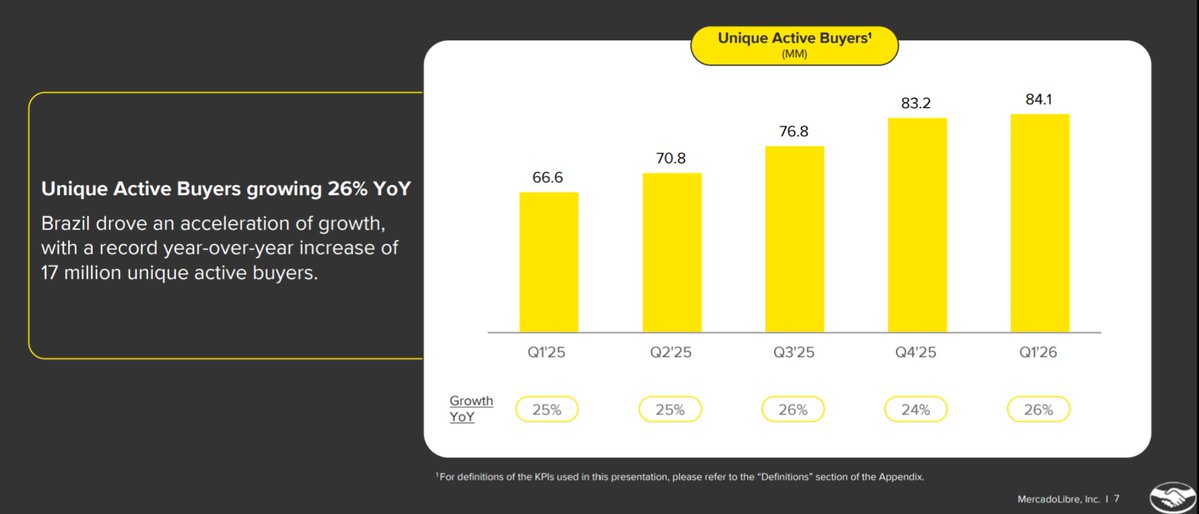
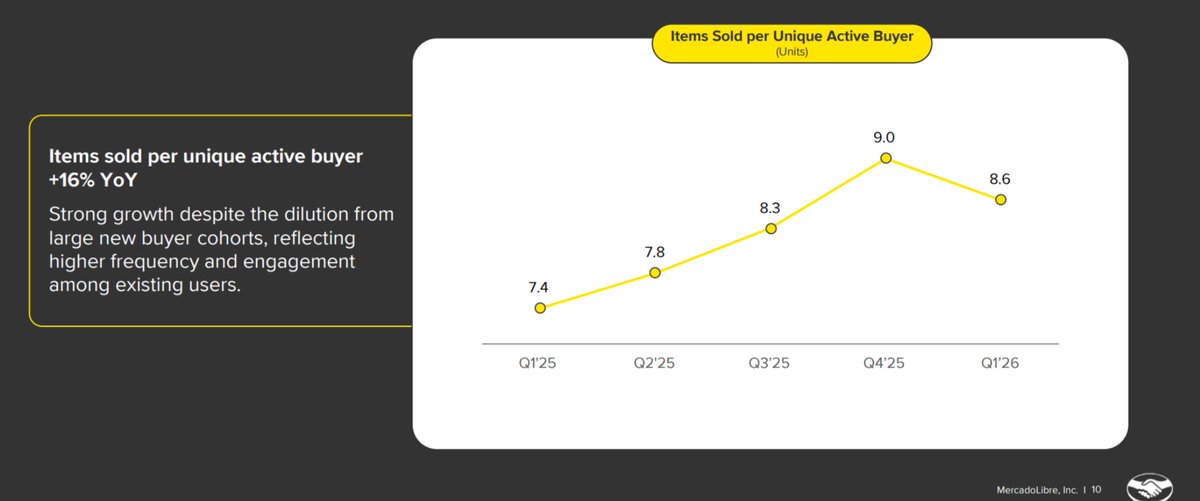
Unique Active Buyers is very important for obvious reasons. It shows us that MercadoLibre is attracting more overall customers and unlocking more of the total addressable market. But it is far more telling to view it in combination with Items Sold per Unique Active Buyer. If more overall customers are coming on board and every single unique customer is spending more money, that is growth within growth. And it is exactly what I want to see as a shareholder because it implies growth that is non-linear.
$AMZN
This is an extraordinary report. The headline is not $AMZN 20% revenue growth. The real story is that AWS has reaccelerated while margins expanded at the same time!!!
AWS revenue grew 37% its fastest growth in 18 quarters, after growing 28% last quarter. AWS operating income grew 64%, and the operating margin reached 40%. $AMZN is not sacrificing profitability to generate this growth. AWS revenue accelerated by 9% while its margin expanded by 650bps. $AMZN said its chips business exceeded $25b, growing at triple digit rates (wow!).
Advertising was also excellent. Revenue grew 26% to $20b, accelerating from 22%. Very impressive…
My overall view is that this is one of the best $AMZN quarters I can remember. AWS is accelerating, AWS margins are expanding, advertising is accelerating, retail remains profitable, and the chips have become a business that would already be considered enormous as an independent company.
🌹
The FOMO in semis is palpable, and investor positioning is now heavily crowded in that space.
At the same time, the sentiment is negative on hyperscalers, because of concerns regarding their CapEx spend on semis and questions on the ROI of that spend.
But the catch is that if hyperscalers don't see good returns on their AI CapEx (semi spend), there won't be sustainable demand for semis, like the valuations and margins of many of these stocks are now pricing. So both can't be true. Either semis valuations have gone too far, or hyperscalers are too low.
$MELI's CFO just brought even more clarity to the Q1 results on the investor relations podcast. This team is so honest and upfront about what they are doing. Really don't know any other team like them.
The market is likely worried over a drop in profit margins for the consumer credit business in Brazil for $MELI. To some this looks like a warning sign of bad debt. Mercado Libre is experiencing accounting effects from strategic growth. They accelerated loan originations by 25% QoQ in the first quarter. Accounting rules require them to record all estimated future losses on day one before the revenue arrives. They also extended loan terms from 5 to 8 months for their best borrowers. This is just for the consumer loans. This has nothing to do with the credit cards. They also lowered interest rates to activate safe users who had never used their credit lines. The actual bad debt levels, or non-performing loans, remain stable. The margin compression is a temporary accounting reality of rapid growth, not a fundamental credit problem. The key message from the perspectives is that MELI is not seeking out riskier folks to offer lower spreads. They are reaching out to folks they deemed worthy of credit in the past and did not bite. The lower spreads along with the high duration are there to entice those that did not bite in the past.
Investors often worry when a company lowers prices or gives away shipping. Mercado Libre lowered its free shipping minimum from 79 reais to 19 reais last year in Brazil. On the surface, this looks like a direct hit to profit margins. Instead, it created immense scale. The growth rate of items sold jumped from 26% to 56%. Because the company is shipping significantly more items, their cost to ship each individual unit dropped by 17%. The profitability of cheaper items actually improved. The company traded a small amount of short-term margin for massive volume, which permanently lowered their fixed fulfillment costs per item.
Traditional banks in Argentina are seeing high default rates. Mercado Libre is seeing the exact opposite. Their non-performing loans in Argentina are stable YoY and improved in the first quarter during a time of wide-spread credit stress. Their NIMAL improved by 6%. This happens because users treat Mercado Pago as their primary financial tool. People protect their Mercado Libre credit line and prioritize paying it back over other debts. The company also purposely slowed down loan growth in Argentina to 13% to maintain this high portfolio quality. They demonstrate a structural collection advantage over traditional banks in difficult macroeconomic environments.
MELI is also spending heavily to issue new credit cards in Brazil, Mexico, and Argentina. The market often views credit card expansion as an expensive, high-risk customer acquisition cost. But folks miss that it is an ecosystem multiplier. The oldest groups of credit card users in Brazil are already profitable. The credit card users in Mexico are performing even better than Brazil after two years! Once a user gets a Mercado Pago credit card, they buy more items on the e-commerce marketplace. They also use more fintech products. The initial investment to issue the card creates a much more permanent, highly engaged user across both the commerce and financial halves of the business.
Martin also confirmed that both the cross-border business and the 1P operations are currently unprofitable and acting as a drag on overall profit margins. The market may view these depressed margins as a permanent structural flaw or a sign of inefficiency. However, he noted they are seeing clear progress and explicitly stated both segments will eventually become profitable. As the 1P and cross-border divisions continue to scale and cross their break-even points, they will transition from actively hurting margins to potentially expanding them, creating a built-in catalyst for future profitability without requiring broader cost-cutting measures. The other aspect is that as cross-border operations and 1P operations scale they will have a very similar multiplier effect like the credit cards. In fact, they could likely remain a loss-leader forever and probably still have a net-positive effect on the entire ecosystem. That is largely MELI's biggest structural strength. It is optimizing the ecosystem rather than any particular segment of operations.
Cerebrus IPO
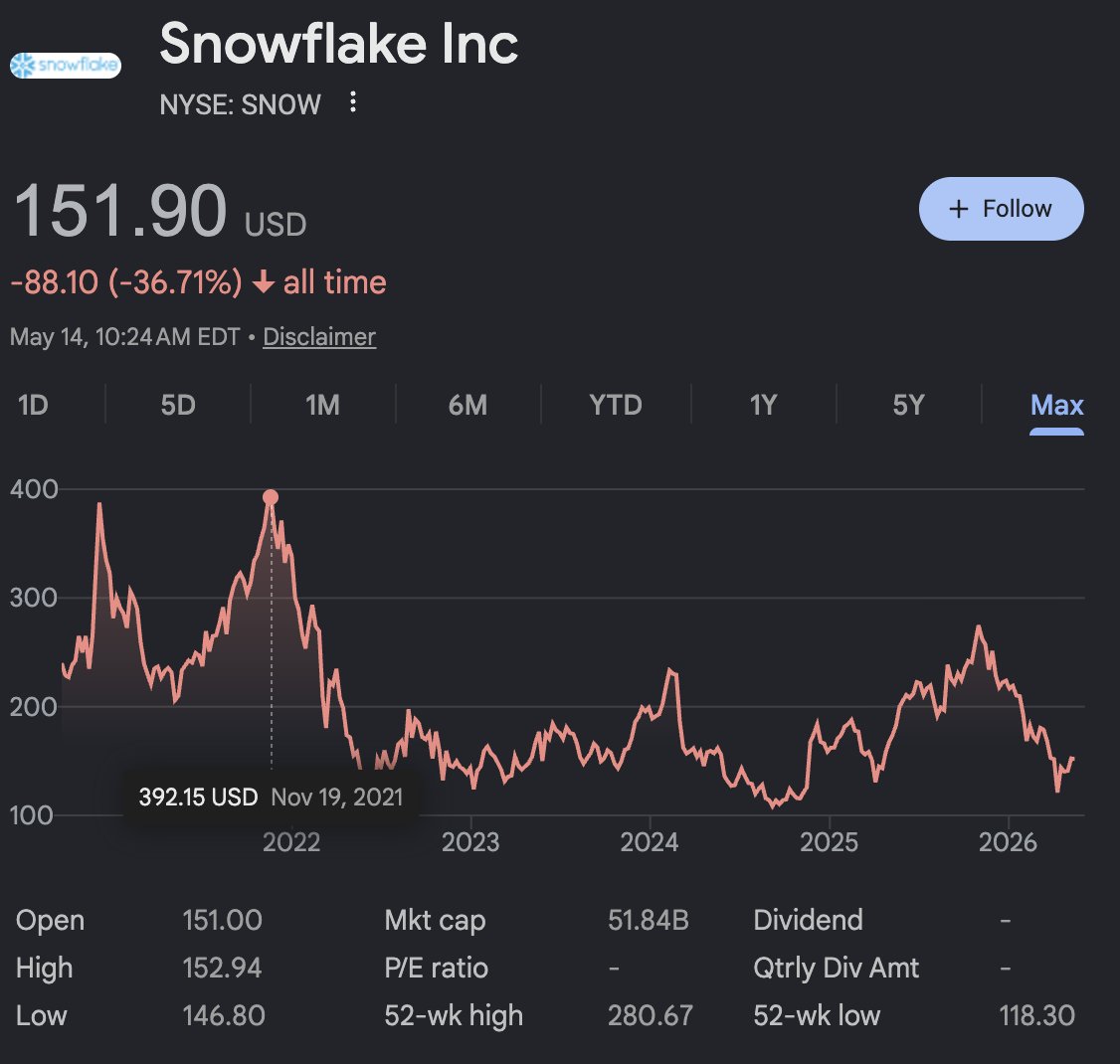
Just remember the last time Brad G was involved in IPO's and SPAC's ... it was $SNOW and $GRAB. This doesn't mean that we're at the absolute top but we might be getting closer...
Since then...
$GRAB went to $15/share and now is $3.50/share
$SNOW went to $400/share and is now $150/share
When these private investors bring these companies to the public market... it isnt because they want you to share in their gains.
They are looking to use you as exit liquidity because of the companies want to sell their stock for the highest price possible. When the overall market is booming, they rush to go public to cash in on those sky-high prices.
An IPO is how a company's early investors and founders take their profits. When you see all the "smart money" rushing to sell their shares to the public, it’s a clue they think the market won't get any higher.
At market tops, investors are overly excited and afraid of missing out. They will blindly buy into new companies, making it the perfect time for investment banks to push new stocks onto eager buyers.
Early in a bull market, only great companies go public. Near the end, lower-quality companies with zero profits or bad ideas rush in because they know it's their only chance to get funded by careless investors.
Every new IPO dumps a massive amount of new stock into the market. Eventually, all these new shares soak up the available cash from buyers. When the buyers run out of money, the market stops going up and starts to fall.
Summary:
DONT BECOME SOMEONE ELSES LIQUIDITY
The semi-space is extremely crowded both from retail and institutional investors right now.
AI is not stopping, and as you know, I am a big believer in AI and had a significant part of my portfolio in semis, but I have lowered my semi exposure substantially across the board, as excitement is outpacing reality right now.
Yes, we will need more chips to power AI. At the same time, enormous optimizations are and will continue to happen on all levels of token consumption, from end clients on how they use these models more efficiently to AI model companies and hyperscalers optimizing hardware with software to squeeze significantly more from existing compute and pricing their services accordingly. The amount of spending that the main compute buyers can do on an annual basis is also reaching its limits, and that growth won't accelerate indefinitely, especially as the market is not rewarding many of these higher CapEx decisions.
I also don't believe that, in the long run, most economic tasks will be handled by the top frontier model. Companies hiring human workers, for example, in customer service, don't look for PhDs — they're overqualified and too expensive for work with limited economic value. The same logic applies to model deployment. And because frontier progress is moving so fast, the capability overhang on older models keeps widening, leaving them more than capable for an ever-larger share of tasks.
The valuations of many of the semiconductor companies on paper don't look expensive, but the real catch is in the margins, which are historically high and in the long-term will normalize, especially as we can see that competition/alternatives are heating up in a lot of places down the chain. Sales volumes can and will go up, but that doesn't mean profits will go up; keep that in mind.
I am getting a lot of messages from folks that are confused about $MELI's strategy still so I will try to explain further why the bad debt that is dragging their earnings is not as scary as what meets the eye.
Let me make it crystal clear if you aren't familiar with the mechanics here. That 3.9 ppts margin drop “bad debt” is the cost of upfront accounting. Under IFRS 9 standards, they are required to provision for expected bad debt the exact moment new loans are originated. No actual cash has been lost at that point in time. It is strictly a non-cash estimate of future risk. To be clear this is something to keep in mind. It should be somewhat representative of what is to come but they are also showcasing with their NIMAL it has been very effective so far.
The reason the hit looks so massive comes down to a couple of factors. First, the credit portfolio is growing at a rapid clip, which automatically triggers higher day 1 provision expenses. Second, they extended the duration of the loans. Longer terms carry a higher lifetime probability of default, meaning accounting rules force them to provision even more upfront compared to their shorter-term loans.
But this isn't a red flag. This is a deliberate strategy. Yes, there is inherent credit risk involved, but MELI is aggressively expanding their credit book downmarket. They are directly targeting the exact consumer demographic that shops on Shopee and other low-end consumers. MELI is playing the disruptor here. They are executing a strategic land grab against their downmarket competition, and it's kind of brilliant. Obviously, these cohorts are riskier with higher historical default probabilities, but the long-term payoff is massive. They are effectively neutralizing any upmarket move from Shopee by capturing and controlling those customers' purchasing power through Pago.
Then there is the bottom-line reality that gets ignored. Despite this aggressive expansion, their NIMAL (this stands for Net Interest Margin After Losses) remains extremely robust, tracking above 17%. Even after absorbing these massive, upfront non-cash provisioning hits, the credit business is still highly profitable. They aren't losing money at all. They are making the conscious choice to reinvest that credit profit directly back into the business to acquire market share. It’s exactly that. Reinvesting internally to own the market.
One other crucial aspect to understand: the margin drag from these longer-duration loans is largely an accounting hit. Because of IFRS rules, they have to book massive provisions upfront based on conservative lifetime risk models. But the reality? The actual repayment data shows these cohorts are outperforming those models. So, while they take a short-term margin hit on paper to fund these provisions, they are successfully capturing a customer base that is fundamentally less risky than the upfront accounting suggests. You heard that right, part or the drag is that they provisioned are larger amount and some folks paid off their loan faster. So they earner less interest on the loan. They are taking a paper penalty today to lock in high-quality, sticky users for tomorrow. 🍻
I have been investing in $MELI for almost 15 years. That is almost 2/3 of the company’s existence. I have watched this business go from a small few billion dollar company into one of the most important platforms in Latin America, and through all those years the narrative was almost always the same. Competition was coming. Some new heavily funded company was going to destroy them. Some giant was going to overpower them. Yet somehow through discipline, execution, frugality, and an elite culture, $MELI just kept winning.
What always stood out to me was that they rarely behaved like a reckless growth company. They did not constantly dilute shareholders. They did not load the balance sheet with insane debt. They did not chase every shiny object or light billions on fire with dumb experiments that never worked. They executed carefully, maintained an incredibly stable leadership culture, and kept building piece by piece while other companies constantly changed direction or management teams.
Then around 2018 they made one of the boldest transitions I have ever seen from a large public company. They realized the old marketplace and auction style model was not enough and they essentially rebuilt the company around logistics, fulfillment, payments, and infrastructure. Think about how crazy that really was. Latin America is an incredibly difficult region logistically, financially, politically, and operationally. Most companies would fail attempting something like that even with unlimited capital.
What amazes me is they completely repositioned the business from a relatively asset light marketplace model into a much more infrastructure heavy ecosystem without missing a beat. Most companies cannot reinvent themselves like that once they reach scale. $MELI did it while continuing to grow rapidly. That tells you something important about the culture and management quality behind this business.
I also think many people still misunderstand what $MELI actually is. They still think of it primarily as an ecommerce company. I increasingly think ecommerce is almost the bait. Underneath it they are quietly building the infrastructure of commerce and financial services across Latin America.
The flywheel is beautiful, Pago increases checkout conversion and trust. Logistics improves delivery speed and reliability. Credit helps merchants buy inventory and helps consumers spend more inside the ecosystem. Advertising monetizes attention. Fulfillment improves consistency and customer satisfaction. Scale lowers shipping costs. Lower shipping costs improve frequency and conversion. More buyers attract more sellers. More sellers improve selection. The entire ecosystem reinforces itself.
People still debate Pago, ecommerce, credit, logistics, and ads as if they are separate businesses. I increasingly think that misses the point entirely. The value comes from how every layer strengthens every other layer. The ecosystem itself is becoming the moat.
That is what makes the business so dangerous competitively. The moat is no longer one thing. It is the interaction between all the things. Every year the ecosystem becomes more integrated, more efficient, and more embedded into the daily economic life of consumers and merchants across Latin America.
And what makes this even harder to replicate is that Latin America is not an easy region to operate in. Payments are fragmented, infrastructure is weaker, fraud risks are higher. Inflation and currency volatility exist, regulations vary country by country and logistics are far more difficult than most American investors realize. Ironically, those difficulties become advantages for $MELI that successfully builds the network first because the operational complexity itself becomes part of the moat.
1/👇
It’s interesting how the market interprets this. As if we didn’t see $AMZN run this playbook for the last two decades. But I don’t think the margins are spooking wall street. Its very clear from the analysts questions during the call that they are concerned about $MELI experimenting with the credit portfolio. But at the end of the day its experimenting. They are not playing it safe because the r/r is extremely strong. If the longer duration loans prove to not be effective to the ecosystem they can pull back as needed but what market is missing is we are already seeing a benefit to the ecosystem. The bear narrative against MELI has shifted from struggling to keep up with competition to being too greedy with their land grab. They just became investment grade last year so this is a new era for the company. The best is yet to come.
MercadoLibre $MELI 1Q26 Earnings
- Rev $8.8b +49% ↗️🟢
- GP $3.9b +39% ↗️🟢 margin 43.7% -303 bps ↘️🔴
- Adj EBITDA $857m -8% ↘️🔴 margin 9.7% -606 bps ↘️🔴
- EBIT $611m -20% ↘️🔴 margin 6.9% -595 bps ↘️🔴
- Net Inc $417m -16% ↘️🔴 margin 4.7% -361 bps ↘️🔴
- OCF $2.1b +101% ⤴️🟢 margin 23.5% +609 bps ✅
- FCF $1.8b +138% ⤴️🟢 margin 20.4% +761 bps ✅
Total
- Service Rev $7.7b +45% ↗️🟢
- Product Rev $1.1b +84% ⤴️🟢
- Commerce $4.9b +47% ↗️🟢
- Fintech $4.0b +51% ↗️🟢
Brazil
- GMV +30% FXN ↗️🟢
- Sold Items +45% ↗️🟢
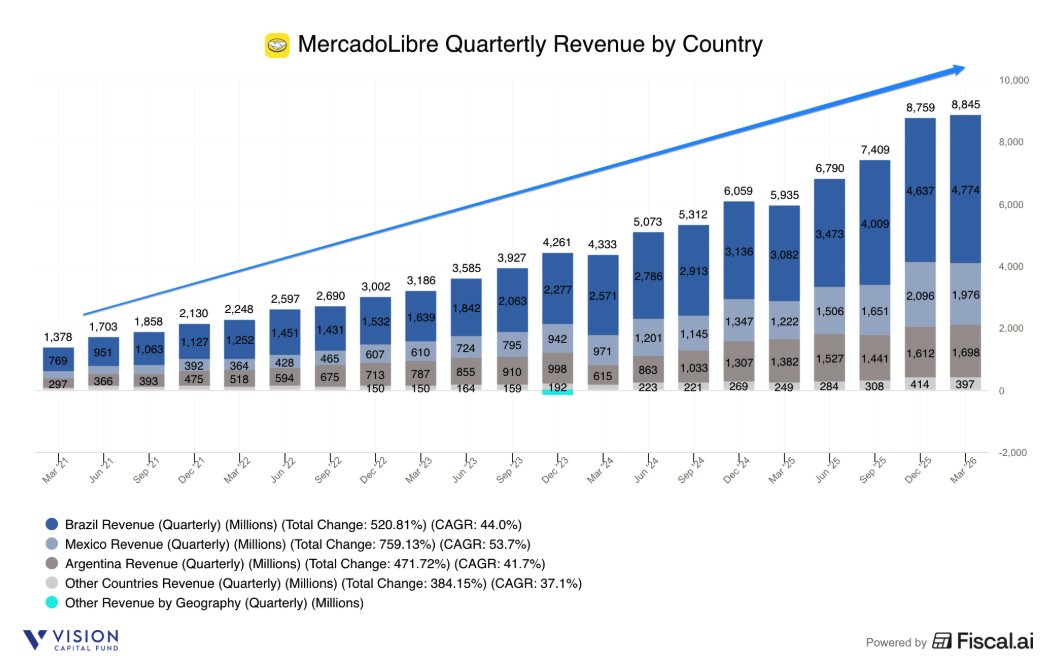
- Total Rev $4.8b +55% ↗️🟢
- Service Rev $4.0b +49% ↗️🟢
- Product Rev $787m +92% ⤴️🟢
- Commerce $2.8b +51% ↗️🟢
- Fintech $1.9b +61% ↗️🟢
- Contribution $389m -28% ↘️🔴 margin 8.1% -944 bps ↘️🔴
Mexico
- GMV +23% FXN ↗️🟢
- Total Rev $2.0n +62% ↗️🟢
- Service Rev $1.8b +60% ↗️🟢
- Product Rev $202m +76% ⤴️🟢
- Commerce $1.2b +54% ↗️🟢
- Fintech $781m +76% ⤴️🟢
- Contribution $344m +59% ↗️🟢 margin 17.4% -35 bps ✅
Argentina
- GMV +126% FXN ↗️🟢
- Total Rev $1.7b +23% ↗️🟢
- Service Rev $1.6b +22% ↗️🟢
- Product Rev $91m +32% ↗️🟢
- Commerce $573m +21% ↗️🟢
- Fintech $1.1b +24% ↗️🟢
- Contribution $607m -6% ↘️🔴 margin 36% -1114 bps ↘️🔴
Others
- Total Rev $397m +59% ↗️🟢
- Service Rev $347m +53% ↗️🟢
- Product Rev $50m +127% ⤴️🟢
Commerce $274m +54% ↗️🟢
- Fintech $123m +73% ⤴️🟢
- Contribution $64m +42% ↗️🟢 margin 16% -195 bps ↘️🔴
Biz Metrics
- Unique Active Buyers 84.1m +26% ↗️🟢
- Fintech MAU 82.9m +29% ↗️🟢
- GMV $19b +42% ↗️🟢
- Items Sold 722m +47% ↗️🟢
- Items Sold per Unique Active Buyer 8.6 units +16% ↗️🟢
- Live Listings 773m +62% ↗️🟢
- Managed Network Penetration 95.5% +70bps ↗️🟢
- Same & Next Shipments 199m +39% ↗️🟢
- TPV $87.2b +50% ↗️🟢
- TPV Acquiring $56b +39% ↗️🟢
- TPV Acquiring (off) $36.2b +39% ↗️🟢
- TPV Acquiring (on) $19.8b +39% ↗️🟢
- TPV Fintech Svcs $31.2b +73% ⤴️🟢
- TPN 4.6b +39% ↗️🟢
- Monthly Active Sellers with Credit 36.0% total ↗️🟢
- AUM $19.9b +77% ⤴️🟢
- Credit Portfolio (CP) $14.6b +87% ⤴️🟢
- CP (Credit Card) $6.6b +104% ⤴️🟢
- CP (Consumer) $5.3b +79% ⤴️🟢
- CP (Merchant) $2.3b +64% ↗️🟢
- CP (Asset Backed) $0.3b +85% ⤴️🟢
- NIMAL 17.8% -980bps ↘️🔴
- Past Due 15-90 days 8.0% of NPLs/Total Portfolio ➡️🟢
- Past Due 90+ days 17.6% of NPLs/Total Portfolio ➡️🟢
- % Allowance of Doubtful Accts / NPLs >15 days past due 103% ➡️🟢
- % Allowance of Doubtful Accts / NPLs >90 days past due 149% ➡️🟢
1 | Q1 saw very strong growth as MELI heavily reinvested in its commerce and fintech business.
I'm pleased to report that we ended 2025 with robust operating trends that reinforce the strength of the MercadoLibre ecosystem. Our relentless focus on customer experience translated directly into strong financial performance with fourth quarter net revenues growth of 45% year-over-year. Our performance is supported by 2 primary growth drivers: the acceleration of our commerce business, and the rapid adoption and structural expansion of our fintech services.
2 | Near-term investments in Brazil lowering of shipping threshold, credit card in Brazil, Mexico, and Argentina, 1P commerce and cross-border trade (CBT) with China and US, pressured margins by 500-600bps.
We talked a lot about the results of those investments, but we wanted to give a sense of what those investments were in terms of margin compression….lowering of the shipping threshold that we did last year in Brazil. The credit card, we are investing in Brazil, Mexico and now Argentina, and the 1P, which is continuous its path to profitability, but still not profitable on its own. The same thing with CBT, which we are expanding now to the China and the U.S. corridor and then we also added the smaller countries where we continue to invest as we reach scale in those countries. So when we put all that together, we wanted to give you a sense of the pressure that, that generated on our margins and that gives you a range of between 5 and 6 points.
3 | Continued to enhanced the free shipping value proposition in Brazil commerce, lower free shipping thresholds, driving higher purchase frequency, new buyers, larger volumes, higher revenues, and improving efficiency.
Turning to commerce. In Brazil, our largest market, GMV grew an impressive 35% YoY alongside a 45% increase in sold items. This acceleration is the result of our strategic investments to enhance the value proposition, most notably the decision to lower the free shipping threshold. More free shipping is driving higher purchase frequency and bringing new buyers into the ecosystem. This volume is translating directly into efficiency. Our logistics network absorbed the increase in volumes while driving productivity gains, proving our ability to scale effectively.
4 | Confident of strong underlying unit economics that CBT, 1P and credit card when scaled will be profitable.
In terms of the trajectory, I think it's in line with what we have been talking about this in the past. CBT is a business that when it's locally fulfilled, is profitable, international fulfillment needs to continue scaling and moving in the right direction, but it will continue to scale and it will put some pressure on margins because of that.
When you look at our 1P, I think we talked a lot about 1P. It continues to be profitable on a variable basis level before allocating central cost, direct indirect cost is profitable. So the scale will play in our favor in terms of continuing to improve profitability.
I think the credit card, Osvaldo will talk about this, I'm sure, in some of the questions, but the credit card continues to improve its profitability, in particular in Brazil, where we're seeing already a significant part of the portfolio, the other cohorts being profitable….if you look at Brazil, which is the oldest cohort we have been issued credit cards in Brazil since 2021, cohorts that are older than 2 years are already profitable at a NIMAL level. So that gives us a lot of encouragement to continue expanding the user base.
5 | While NPLs decline slightly QoQ, NIMALs actually improved, more important to focus on what the risk was priced
regarding NPLs and the impact of a little bit -- a slight deterioration in NPLs from the third quarter to the fourth quarter. And that is -- so that is -- I would say that in general, NPLs of the credit card book fell to an all-time low of 4.4% in Q4. Nonetheless, the increase in NPL was mostly related to the consumer and merchant books. But having said that, I think that more important than NPLs are NIMALs and those improve, meaning we are more profitable than we were a quarter before. Therefore, what we did was we increased the number of people and the riskier number of people we give credit to, but we price that risk accordingly. And therefore, we ended up having a significant -- a larger spread than we did on the prior quarter. So I think this was a calculated risk and it worked out well.
6 | MELI remains focused to grow the credit book only if it stays healthy, confident about the quality and health of the credit portfolio with their models and collection.
I think the philosophy on credit has always been that we will grow our credit books as long as we have a healthy book. And as Osvaldo mentioned, you're seeing only part of it -- part of the equation on the NPLs. But obviously, we are pricing those ahead of time. And the margins in Argentina and Mexico are extremely high.
So we feel very, very comfortable about the quality and the health of our portfolio. And that's the reason why you see our credit book growing at 90% because we are confident in our models and our collection.
7 | However in the near-term given the mix of different growth rates and profitability, it is more unclear but confident of the long-term path.
So I think a lot of moving parts, right? The individual businesses are growing and moving in the right direction. Then you have a shift issue because some of these are growing at a faster pace. But the bottom line is that we're very confident that the investments that we're making in our platform and addressing the long-term opportunities that we see ahead of us, and we're also improving user experience in our platform.
This particular quarter, we mentioned that we have the highest NPS level in commerce and fintech in Argentina, Brazil and Mexico. So that's a consequence of investments that we have been doing, and we're very comfortable with these levels of investments in our ecosystem.
8 | Argentina saw margin compression largely due to the opening of new fulfilment centers, and higher bad debt provisions from the credit card launch last year, combined with higher funding costs.
We see, as you mentioned, some compression in Argentina. Keep in mind, Argentina continues to be the highest profitability market in terms of margins. But we did see some compression mostly coming from fulfillment. As you know, we opened couple of new fulfillment centers recently, so that generated some year-on-year compression on COGS. Also, provisions for bad debt because of the credit card. We launched the credit card in the middle of last year. So we're still -- we're seeing some compression because of that. As you know, the credit card requires investments upfront. And there is some year-on-year increase on funding costs. It's true what you said. Sequentially, QoQ, the funding cost of our credit portfolio was lower in Q4 relative to Q3, but it still was higher relative to a year ago. So those are the main reasons for the compression that we saw in this quarter.
9 | In agentic commerce, focusing most of efforts of developing with MELI instead, because they have the first-party data to create the best search, recommendation, discovery.
to complement this comment, I would say that the part where we're putting most of our efforts is in developing our own agentic experience inside MercadoLibre. We think and we are convinced that we have the first-party data to create the best search, best recommendation, best discovery engine on which we can personalize and lay over the agentic experience that the new technology drives.
So -- and by the way, if you believe that there is a world of agentic commerce, that could mean that retail will move even faster from the offline to the online world. So all this to say that I do think that we are well-positioned to actually capturing ad revenues in the future because we still think that MercadoLibre will be go-to place for demand to do shopping online.
10 | Because they don’t know which hardware, which model people will use, and customers look for value and for the best end-to-end experience, it makes sense to take the risk and focus all of their efforts to build their own agents and shopping assistant within MELI instead.
Let me try to rephrase what I meant earlier as I try to address your point. I think there are things that we know and there are things that we don't know. So we don't know which hardware people will use in 10 years to buy. We don't know whether the winning model will be X, Y or Z and so on. We do know that consumers do value or do look for the best end-to-end experience. We do know -- and that means not only searching for products, but also getting products fast, having the widest selection, pricing, the best financing alternatives, post-purchase support and so on.
We also know there's a technology today that can dramatically improve the product discovery process. And for that reason, we are putting all of our efforts and deploying lots of engineers in building our own agents and our own shopping assistant within MercadoLibre. It's early to know what will happen with other shopping assistant. I take your point that it might present a risk. I understand where you're coming from. But we are confident that we are playing this one from a position of strength that we have the relationship with consumers. We have a brand that Latin America loves.
11 | Advertising should benefit if MELI can capture more agentic commerce traffic.
So we eventually what I'm trying to convey is that on the one hand, we are confident on MercadoLibre's own ability to capture traffic through its own agentic experience. And on top of that, we do think that advertising represents an additional revenue opportunity in a world in which there is agentic commerce.
And by the way, the agentic world can also imply a faster shift of advertising dollars moving from traditional offline channels into digital advertising, which generates the opportunity to be even bigger. So we remain positive, we remain focused. The only thing that we know for sure is that we need to put our developers to work to have the best tech stack for advertising and the best agentic experience inside MercadoLibre.
12 | Advertising revenue grew 67% in 1Q26 on broad base strength, driven by higher adoption and tech-stack improvement, excited about the long-term opportunity.
we are very pleased with the performance we had in ads this quarter. Revenue accelerated to 67% on an FX neutral with higher adoption and spend basically driven by improvements in our tech stack. It's broad-based. So there's no one silver bullet driving that growth.
But basically, we are attaching our product in the different parts of the value chain, right, auction bidding, placement optimization, demand generating initiatives and all that powered by an improved an easy-to-use platform in terms of front end for our customers. So extremely, extremely satisfied with that.
So penetration of ads with revenues as a percentage of GMV is still small compared to its potential. So very happy with the results so far, but even more encouraged with the potential looking ahead.
13 | Mercado Pago's AI assistant is solving 87% of interactions without the need for human support, right now it is largely servicing, but excited with it cross-selling and recommending services.
We are very excited by Mercado Pago's AI assistant it is already helping mostly with solving questions and concerns from our users. We have built a lot of functionality into our agent. Basically you can do pretty much everything you do with Mercado Pago with the agent.
Our Mercado Pago AI assistant is solving 87% of interactions without the need of human support. Millions of users already adopt this conversational tool to manage their credit card, make transfers and understand their credit offerings.
And beyond cross-sell, it will also become more proactive in terms of acting like a personal banker. So helping you, I don't know, allocate your portfolio or make the recommendations of what kind of credit is better for you. So we believe here that the opportunity is significant.
14 | AI seller assistant is currently already helping sellers with 20% of GMV
Just to complement Osvaldo here on the marketplace side, while we have many, many features that are powered by AI, starting with our search algorithm, our recommendation and so on, I think it's worth highlighting the fact that we have a seller assistant today running in our platform, basically 20% of our GMV is somehow advised by our assistant. It's actually proving to be pretty successful in helping sellers improve their live listing, reduce their lead times to get better reputation in our platform, capture some of their questions and requirements in terms of customer support.
15 | MELI’s lower margins comes not from weakness but from deliberate decisions to pursue growth opportunities that will gradually become more profitable over time. It is already showing up in improved customer metrics, NPS, higher revenue growth.
first, it's important to put in context when we talk about margins, the growth that we're delivering. Most of the margin pressure comes from deliberate decisions that we're making in terms of pursuing investments that are generating tremendous growth and improving user experience. As you mentioned, in Brazil, in particular, we have been growing our GMV and gaining market share, mainly because of these investments. Our top line grew by 45% year-on-year. As I mentioned earlier, our NPS is at record levels, and that's because of the investments that we have been doing. You mentioned CBT, 1P, the lower shipping presold, expanding more free shipping, increasing booking capacity. So we feel very comfortable with these investments and the current margin levels because we are seeing the results in terms of growth, market share gains and improvements in user experience and engagement.
16 | MELI will not hesitate to invest to capture these opportunities even if there will be short-term margin pressure, because they are not optimising for short-term profitability, but seeking to grow the business for the long-term.
As I said in the past, our main focus is on capturing the large opportunities in front of us in commerce, fintech and advertising. And we will not hesitate to invest and to order to capture those opportunities as we have done in the past, even if that puts some short-term margin pressure, we're not trying to optimize short-term margin. We manage the business for long term -- from a long-term perspective, we believe these investments are creating a foundation for future growth, and we remain confident in our long-term margin trajectory.
➡️ Key takeaways for MercadoLibre $MELI
MELI continues to grow as LATAM’s dominant e-commerce and fintech platform with a long growth runway with still low penetration. Unsurprisingly, the market in the near term often does not like companies who reinvest heavily and profitability falls. The difference is that the reinvestment is already showing up in strong growth and the underlying profitable unit economics are there, all MELI needs is time to grow and scale each opportunity. Confident in management taking the long-term to grow the business rather than to manage short-term profitability which is what we are not interested in.
Will dive even further over the weekend. $MELI had a stunning quarter. The consensus has now fully shifted from "can growth sustain?" to "does growth have to be so high?". There are definitely risks. And the market may punish the stock from here. And a macro shock will surely reset timelines. But the biggest risk in Mercado Libre's current position is execution risk and execution is their biggest strength. Excellent quarter. Shared my thoughts below 👇
$PLTR Q1 2026: Ontology + AIP Delivers “NVIDIA Moment” — 85% Growth Accelerates
At Convequity, we’ve been telling clients since early 2021: it’s all about the ontology. The ability to create custom ontologies for customers is what enables effective business decisions and rapid iteration. Q1 results show this thesis firing on all cylinders.
Key Highlights:
Revenue: $1.633B (+85% Y/Y)
U.S. Revenue: $1.282B (+104% Y/Y)
U.S. Commercial: $595M (+133% Y/Y)
U.S. Government: $687M (+84% Y/Y)
GAAP Income from Operations: $754M (46% margin)
Our calculated FCF margin (Cash from Ops minus capex / Revenue) hit ~54%.
Adjusted FCF margin: 57%.
Rule of 40 score: 145%.
Cash generation remains exceptional.
They raised FY 2026 revenue guidance to ~$7.65–7.66B — that’s ~71% Y/Y growth, up from the prior ~61% guide.
When ChatGPT launched in late 2022, it soon dawned on us that PLTR would experience substantial demand: if enterprises want a ChatGPT-like AI in their own environment, you need an ontology first.
ChatGPT for consumers works because it was trained on the internet’s select ontologies. Enterprises don’t have that — data silos and non-standard formats kill it. AIP in essence married AI models to PLTR’s customers’ ontologies, and clearly tremendous value — almost unprecedented value — is being generated.
Early 2024 when PLTR was growing ~40% Y/Y, we said it is very possible they will eventually have their " $NVDA moment" and accelerate toward triple-digit growth — that is firmly materializing.
Market penetration is still small — just over 1,000 customers total. Enterprise AI remains largely experimental. Yet PLTR can ignite more growth whenever it wants thanks to its deep first-principles understanding of software and now AI, so it can easily expand into almost any market.
It’s becoming increasingly vital amid the geopolitical climate (governments like the UK and NHS), and it will be vital in the future space economy. So many growth drivers.
As we said in Jan-21, PLTR will be the next Microsoft — just a matter of time but will be a better version, hopefully.
Palantir down 5% on a solid 6% revenue beat? Agentic AI fears are misplaced.
$PLTR reported $1.633B revenue in Q1 — beating consensus of ~$1.54B by about $93M / 6% — while raising full-year guidance. Yet the stock is selling off. The market appears worried that agentic AI from OpenAI, Anthropic and others will disrupt SaaS, and Palantir isn't immune.
I think this concern is dead wrong. Here’s why.
Picture a major hospital network deploying autonomous agents across procurement, scheduling, billing, and clinical workflows. One agent cuts costs by switching suppliers — but unknowingly chooses ones that violate FDA rules. Another maximizes operating room usage but overrides patient consent protocols. A billing agent boosts revenue through aggressive upcoding — triggering fraud investigations.
None are malicious. They’re simply optimizing their narrow objectives without understanding the broader institutional, legal, or safety boundaries.
This is the governance gap in agentic AI.
For AI agents to function effectively and safely inside enterprises, they generally need four key foundational pillars:
1. Trusted System of Record (SoR) data — Palantir is the ultimate SoR vendor, trusted with the U.S. government’s most classified data and operations. No other commercial software company has that level of clearance (IL-6, the highest granted).
2. Unified data infused into an ontology — agents need a shared vocabulary, just like humans. Without it, they can’t understand relationships, internal terminology, or context — like new employees dropped in with zero onboarding.
3. Strong governance — so agents clearly know what they can and cannot do.
4. Strong privacy controls — so they handle confidential data with extreme care.
These four pillars are exactly what Palantir has spent two decades building.
On top of that, Palantir just outlined plans for a true Agentic Native Platform — native agent tooling with full coordination, governance, and controls across third-party systems and databases.
Frontier labs can build impressive agents. But the institutional knowledge, battle-tested controls, and ontological frameworks needed to govern them in the highest-stakes environments? That can’t be scraped from public data. It’s internal to Palantir.
Agentic AI doesn’t disrupt $PLTR. It makes the company more essential than ever.