6/ This work demonstrates that for sequential long-context systems, chunk order is a core component of the reasoning process itself.
Read the full paper here: https://t.co/TjTozo7DX9
Work co-led with @namak_kun
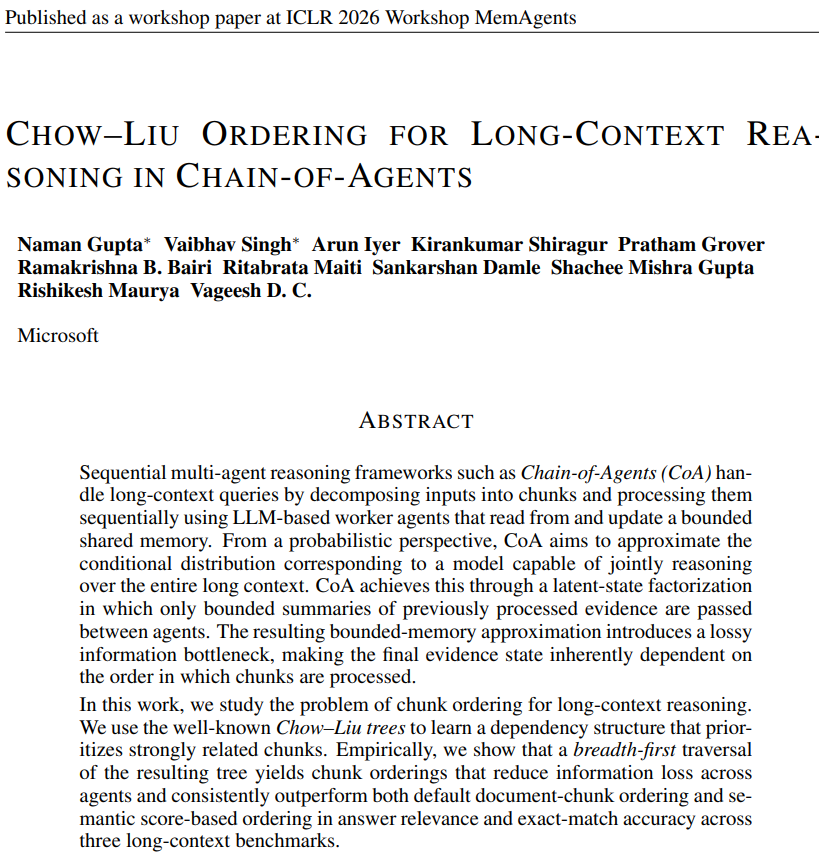
Our paper "Chow–Liu Ordering for Long-Context Reasoning in Chain-of-Agents" will be presented as oral at #MemAgents @ #ICLR2026
In this work, we study chunk ordering in sequential multi-agent reasoning where lossy memory makes the processing order a key driver of answer quality🧵
5/ The Results:
Our approach consistently outperforms default and dense-ranking baselines across GPT-4.1, GPT-4.1-mini, and Qwen-3.
📈 +10.68pp relative to default order.
📈 +6.89pp relative to dense-ranking (w.r.t. query).
Validated across LongQA, LongQA-MC, and NarrativeQA.
5/
One of the solutions: Hybrid Approach
1. Select from existing data resources
2. Synthesize persona-driven data (https://t.co/wLd3rQ13Cz)
Why persona-driven data generation?
Boost diversity & scalability—helping models generalize better across downstream tasks.
🧵 I recently completed the Advanced LLM Agents course 👉 https://t.co/8aKZLlIowj
The course covers advanced topics in LLM agents including reasoning, post-training strategies, LLMs for math, code generation, and program verification.
4/
Role of Data in SFT
Want reasoning? Use CoT data
Why CoT?
- helps LM handle complex multi-step problems
- improves reasoning transperancy
- resembles how humans break down problems
Downside: Substantial effort in data curation and data mixing towards targeted capabilities.
3/
Key stages in building a modern LLM:
1. Pre-training – Predict the next token across diverse contexts
2. Post-training – Follow instructions, reason, use tools/ execute code, avoid harmful outputs
Core ingredients?
📊 Data
🧠 Models
⚙️ Algorithms
2/
Research is still needed in key areas:
– Real-world deployment (Health, Science, ...)
– Mitigating risks & biases
– Efficient, deployable models
– Planning & reasoning
And to enable that, we need models that are:
🔓 Fully open
🌐 Accessible
🔁 Reproducible—from data to eval.
1/
In this thread, I’m summarizing key insights from one of the lectures - "Open Training Recipes for Reasoning in Language Models" by Hanna Hajishirzi.
Looking at today’s powerful LLMs, a natural question arises - Are we done with scientific innovation in LMs?
Definitely not.