Institutional tokenization is starting to look a lot more real on @injective . ⚡
Over $1.5B in tokenized real estate mortgages, a $10B target, and institutions actively building on its infrastructure.
Here's what's happening:
→ Pentiv (NYSE: PTIV) added $524.8M in prime mortgage records in one day, pushing its onchain registry past $1.5B.
→ Its mortgage registry records are verifiable onchain, while borrower information remains private.
→ Institutional Rail is now live, giving banks and enterprises a direct connection to Injective's block production.
→ Injective became the first Layer 1 to have a SEC-registered transfer agent.
→ POSCO International and LG CNS selected Injective for a tokenization pilot.
→ BDACS is bringing Korea's first won-backed stablecoin to Injective.
These aren't isolated announcements. They're pieces of a financial system being built around tokenized assets, institutional access, stablecoins and onchain settlement.
Pentiv alone is targeting more than $10B in mortgage originations on Injective.
If this growth continues, Injective could become a major settlement layer for assets that traditionally never touched a blockchain.
The institutional side of Injective is getting harder to ignore.
$INJ 🥷
Another big week for Injective. 🥷
$1.5B+ in tokenized mortgages, stablecoin liquidity accelerating, institutional developments, and Veyra officially passing governance.
A lot happened last week, so here's what you shouldn't miss.
🏠 RWA EXPANSION
• Tokenized mortgage records surpassed $1.5B on Injective.
• @PentivHQ added $524.8M in mortgage records in a single day.
• Pentiv is targeting $10B+ in mortgage originations on Injective.
⚡ VEYRA UPGRADE
• Passed governance with 99.51% approval from $INJ stakers.
• Mainnet launch scheduled for November 24.
• Bringing new capabilities for RWAs, privacy, RFQ perps and institutional finance.
🏛️ INSTITUTIONAL PROGRESS
• Injective partnered with the University of Tokyo for RWA research, lectures, workshops and potential student hackathons.
• Wells Fargo ($WFC) is now tradable onchain 24/7 with leverage.
📈 STABLECOIN & NETWORK GROWTH
• USDC supply grew 425% in a week.
• USDC supply crossed $58M.
• Injective became the fastest-growing L1 for stablecoin liquidity.
• Average active addresses jumped from 187K to 286K in just four days, according to @tokenterminal.
🔗 ECOSYSTEM UPDATES
• @dYdX v9.9 went live on November 17.
• Deposits now route through Injective.
• Withdrawals arrive as USDC on Injective.
• USDC migration continues to gain momentum.
RWAs are growing, liquidity is expanding, institutions are getting involved, and the network continues to evolve.
Veyra is already live.
Another week of progress. The work doesn't stop. $INJ 🔥
Stablecoin liquidity on Injective is growing faster than many people realize. 👀
Injective's stablecoin supply has now surpassed the total USDC supply on several major blockchain networks, including @Cardano, @trondao, @hedera and @CantonNetwork.
That's worth paying attention to.
Stablecoins are the backbone of onchain finance. They power trading, payments, settlement, lending and liquidity across an ecosystem.
As stablecoin supply grows, it creates more room for capital to move, financial applications to operate and new markets to develop.
Injective is building for exactly that kind of environment, with infrastructure designed for trading, tokenization, institutional finance and the next generation of onchain financial applications.
The more liquidity enters the ecosystem, the greater the potential for activity across the network.
Injective isn't just building the rails. The liquidity flowing through those rails is growing too.
Now it's time to accelerate.
$INJ 🥷
$INJ is now supported on @base in @BitgetWallet, a global crypto wallet serving 100M+ users.
Hold, send, receive, and swap INJ directly in the app.
Injective is reaching more wallets worldwide 🥷
Injective has submitted a new policy letter to the SEC advocating for regulatory changes to accelerate the adoption of tokenized equities and RWAs in the United States 🇺🇸
The comprehensive 22-page letter calls for expanding the SEC’s exemptive framework for tokenized stock trading to include onchain orderbooks, opening new avenues for American financial innovation.
The SEC’s current framework only covers a limited set of venues built on AMM liquidity pools, excluding the orderbook model that underpins traditional global capital markets.
Injective’s submission outlines why this framework should extend to onchain orderbooks:
🔹 The SEC’s findings on public interest and investor protection apply to orderbooks as well as AMMs.
🔹 Orderbooks can enable 24/7 trading, self-custody, near-instant settlement and publicly verifiable transactions.
🔹 Orderbooks can help keep tokenized equity prices closely aligned with traditional markets while producing comparable market data.
🔹 Orderbooks remove the need for a separate liquidity pooling layer, potentially simplifying the risk profile for retail liquidity providers.
🔹 Innovations such as Injective’s frequent batch auction mechanism can mitigate front-running and MEV risks.
🔹 Additional investor protections can be introduced through market surveillance, price limits, self-trade prevention and protocol-level trading halts.
🔹 A technology-neutral regulatory framework would allow multiple onchain market structures to compete and innovate in the United States.
This marks Injective’s third formal submission to the SEC, building on earlier policy recommendations on DeFi protocols and onchain lending, as well as recent discussions with the SEC’s Crypto Task Force.
As the US establishes its regulatory framework for digital assets and RWAs, Injective continues to work directly with regulators to advance American financial innovation while pioneering the infrastructure needed to bring global capital markets onchain with $INJ
Injective isn't slowing down. Its final major upgrade of the year is now live, and there's more coming. ⚡
The Veyra Mainnet Upgrade is officially live, bringing another important step forward for the @injective ecosystem.
This upgrade isn't just about improving the network. It also introduces new infrastructure designed to push Injective further into institutional finance, enterprise adoption and privacy-preserving applications.
Here's what makes this upgrade worth paying attention to:
→ Institutional RWA Infrastructure: Expanding the infrastructure needed to bring real-world financial assets onchain and support more institutional use cases.
→ Enterprise Gateways: Further expanding gateways for enterprises to connect with Injective's financial infrastructure and onchain markets.
→ CypherOS: Laying the groundwork for the next-generation privacy platform, bringing confidential financial activity and privacy-focused capabilities closer to the ecosystem.
These developments align with the bigger direction Injective has been moving toward: building a blockchain where institutions, users, developers and AI agents can interact with financial markets and tokenized assets.
The interesting part is that this isn't the finish line.
Veyra is the final major mainnet upgrade planned for this year, but the developments it enables are part of a much bigger roadmap, especially with CypherOS still ahead.
Injective continues to build, upgrade and expand its financial infrastructure while the industry is still figuring out what the next generation of onchain markets will look like.🥷
$INJ | @injective
🔥 Injective is expanding beyond its own ecosystem. $INJ is now making its way into Base.
@injective has integrated across the @base ecosystem, opening new access to Injective liquidity through @AerodromeFi and swaps via platforms like @1inch.
This is important because liquidity shouldn't be trapped on one chain.
The easier it becomes for users to access Injective from other ecosystems, the fewer barriers there are to interacting with its markets, assets and financial infrastructure.
Base users can now access Injective liquidity without having to stay confined to Injective's native ecosystem.
And this expansion adds another connection to an ecosystem that continues to grow across tokenized assets, derivatives, institutional finance and DeFi.
From Nasdaq exposure through $INJC to now expanding into Base, Injective is pushing its reach beyond its own network.
cross-chain expansion alone doesn't guarantee adoption. Liquidity, volume and real user activity will ultimately determine how successful these integrations become.
but making $INJ accessible in more places is a meaningful step. more connections. Fewer barriers. A bigger market for Injective.
The ecosystem keeps expanding. 🥷
Institutional tokenization is starting to look a lot more real on @injective . ⚡
Over $1.5B in tokenized real estate mortgages, a $10B target, and institutions actively building on its infrastructure.
Here's what's happening:
→ Pentiv (NYSE: PTIV) added $524.8M in prime mortgage records in one day, pushing its onchain registry past $1.5B.
→ Its mortgage registry records are verifiable onchain, while borrower information remains private.
→ Institutional Rail is now live, giving banks and enterprises a direct connection to Injective's block production.
→ Injective became the first Layer 1 to have a SEC-registered transfer agent.
→ POSCO International and LG CNS selected Injective for a tokenization pilot.
→ BDACS is bringing Korea's first won-backed stablecoin to Injective.
These aren't isolated announcements. They're pieces of a financial system being built around tokenized assets, institutional access, stablecoins and onchain settlement.
Pentiv alone is targeting more than $10B in mortgage originations on Injective.
If this growth continues, Injective could become a major settlement layer for assets that traditionally never touched a blockchain.
The institutional side of Injective is getting harder to ignore.
$INJ 🥷
The $INJ ecosystem is quietly getting more liquid.
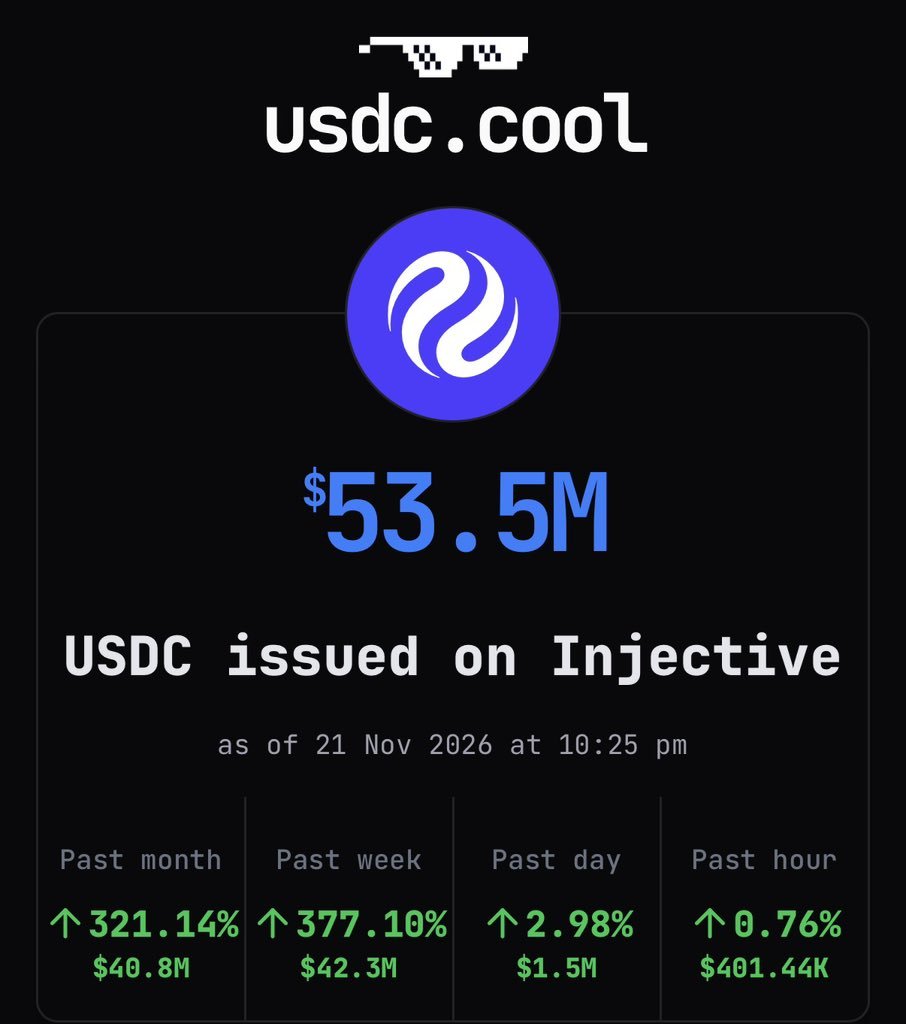
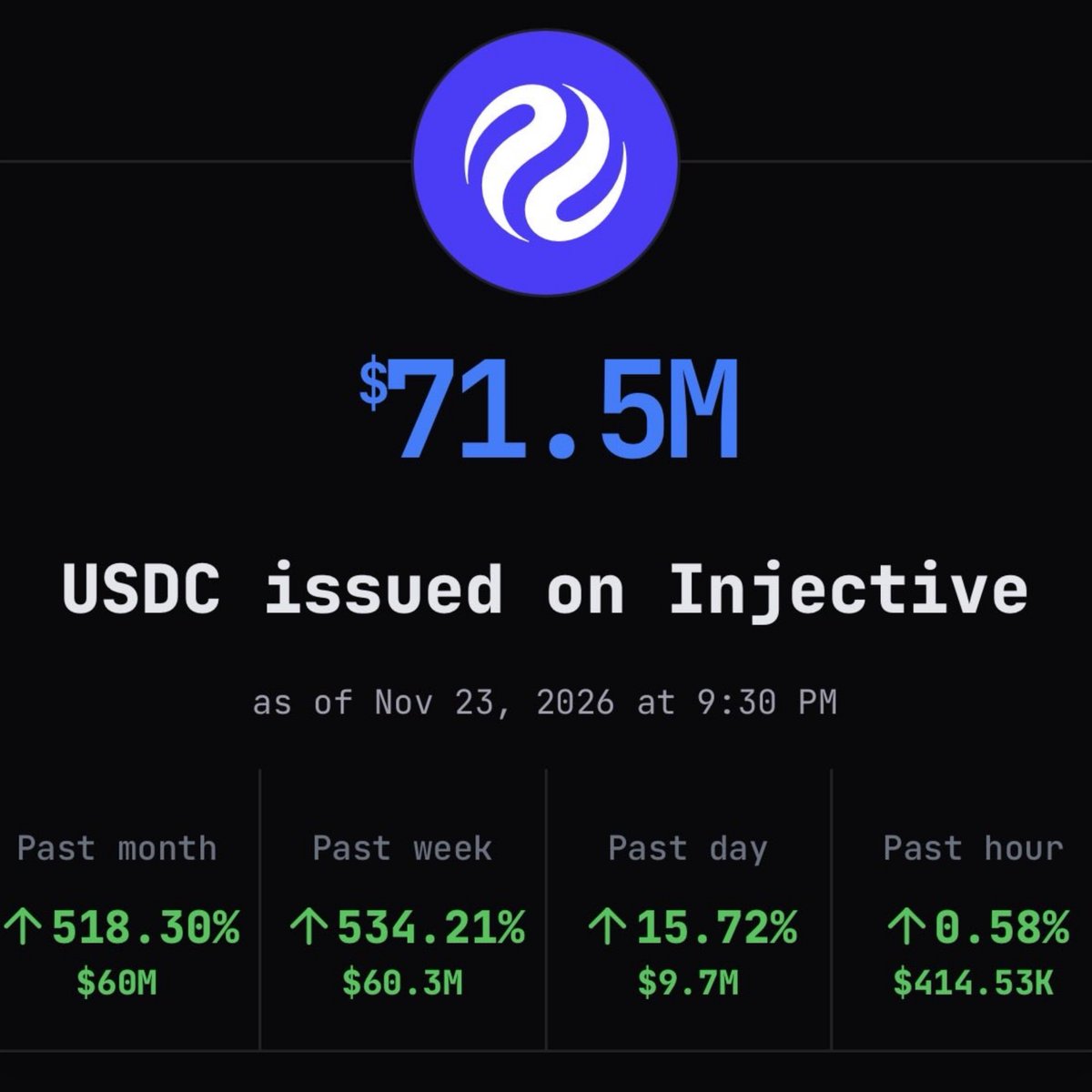
USDC on @injective has climbed from $15M to $32M+, then $58M+ following a 425% weekly increase, and now $71.5M.
That's a lot of stablecoin growth in a short period.
With Circle ending USDC support on Noble, liquidity is shifting. Cosmos Hub has moved, and dYdX's USDC now routes through Injective.
USDC issued on Injective has already grown more than 3x in days.
Why does this matter?
Stablecoins are the fuel behind most onchain financial activity. More USDC means more capital available to trade, deploy into DeFi, build new applications and access tokenized markets.
Injective has the infrastructure to make that capital useful:
• EVM and WASM running natively
• Shared state across both environments
• Onchain orderbook infrastructure
• Fast execution and low transaction costs
• Financial primitives for DeFi and RWAs
The advantage is that applications aren't operating in completely separate liquidity silos. They can build on a common financial infrastructure.
Growing USDC supply is a good signal, but the next thing I want to see is how much activity, products and demand this liquidity generates.
Capital is arriving.
Now watch what gets built around it.
$INJ 🥷
Tokenizing an asset is easy to talk about.
Making it compliant, transferable under the right conditions, and usable across financial markets is the harder part.
That's the problem @injective is looking to solve with Injective Mint.
Mint will allow issuers to tokenize stocks, bonds and other real-world assets in one click, without needing to build their own token infrastructure from scratch.
Using Injective's native Tokenfactory and Permissions modules, issuers can configure controls around asset ownership, transfers, issuance, redemption and restrictions.
This matters because institutional assets cannot operate like unrestricted tokens. Compliance has to be part of the infrastructure, not an afterthought.
But Injective Mint isn't stopping at issuance.
Assets created through Mint are designed to have access to Injective's wider financial ecosystem, including trading, lending and derivatives, depending on permissions and integrations.
$INJC opened another route for traditional investors to gain exposure to $INJ.
Now, Injective Mint is working toward making it easier for real-world assets to enter the onchain economy.
Mint is still in private beta, and the public launch details haven't been announced yet.
Issuance is the beginning. Utility is what makes it matter. ⚡
Injective Mint enables anyone to tokenize limitless institutional-grade assets.
Issuers can tokenize any stock, bond or RWA in one click with immediate utility from day one.
$INJC brought the $INJ ETF to Wall Street. The upcoming Injective Mint launch will bring Wall Street's assets onchain.