$IREN
Here are some of my thoughts on why I believe IREN has simply better prospects to succeed in the HPC/AI segment “more effectively” than any other hybrid BTC miner.
1) Unique Sweetwater and Childress Locations:
Just listen to Oracle’s latest earnings call, and it’s clear to everyone that the current demand for available datacenter capacity is, in one word, enormous. In this environment, IREN is sitting on a veritable goldmine in terms of the potential these two sites offer. Yes, there are several other players with excellent sites (GLXY - Helios, CIFR - Barber Lake, Black Pearl, WULF - Lake Mariner, Cayuga, RIOT - Corsicana), and I don’t want to slip into comparing who has what better (I generally believe all the mentioned companies will do very well in the coming years). So, I’ll just summarize that IREN’s potential with these sites is truly immense, not only due to their size but also because Childress will be fully operational this year, allowing for retrofitting for HPC/AI, and Sweetwater will come online in April next year (Sweetwater 1). Sites like these are extremely rare, not just in the USA but worldwide, especially in a situation where AI is triggering a compute boom, with datacenter investments projected to reach 7 trillion USD by 2030. These sites could become the most valuable assets for hyperscalers scaling AI, practically irreplaceable in the next few years.
On the other hand, it’s important to recognize that the investments required to unlock this potential are equally enormous. A fully built and GPU-equipped Sweetwater represents an investment of roughly 70 billion USD, a massive sum even for the largest hyperscalers. It’s amusing when some individuals clamor for a quick deal (“wen deal”), as these are enormous commitments and investments. Unlike others, IREN has the “luxury” of generating an annual adjusted EBITDA of approximately 600–700 million USD at 50 EH/s, meaning it isn’t pressured to sign a deal under any conditions.
2) IREN’s Unique Expertise and Experience in Datacenter Construction and Operating Its Own Cloud:
The ability to build technically advanced datacenters stems from over seven years of experience the company possesses. A key factor here was the acquisition of PodTech Innovation Inc. in January 2020, which brought IREN critical know-how in the design, construction, and operation of datacenters for high-performance computing (HPC), particularly for Bitcoin mining and later cloud services for artificial intelligence, including advanced cooling systems and energy infrastructure tailored for HPC.
For those hearing about this acquisition for the first time: PodTech was founded in 2018 by Brian Fry and Tim Dufour, who previously co-founded RackForce Networks, a leading Canadian firm in cloud services and datacenters. Established in 2001, RackForce was renowned for building advanced Tier 3 (T3) datacenters, such as the GigaCenter in Kelowna, and became Canada’s largest provider of enterprise cloud services through partnerships with companies like Cisco, VMware, and IBM. This acquisition was pivotal in developing the modular MegaPod units that IREN uses in constructing its datacenters.
Thus, IREN is not just a builder but also an operator of its datacenters, not only in the BTC mining segment, where it is the best (technical quality of datacenters with air cooling up to 70–80 kW per rack) and fastest (adding 50 MW of capacity per month, 361% CAGR in installed hashrate) datacenter developer for BTC mining, but also in the cloud segment, which is absolutely critical to understanding the competitive advantage IREN has over other hybrid BTC miners. None of them operate their own cloud and therefore lack the experience of what it takes not only to build capacity for HPC but also to manage operational parameters and specifications. Thanks to its experience operating its own cloud since 2023, IREN can tailor its services to clients’ needs with precision.
At its Prince George datacenter, IREN operates both mining racks and the latest generation of NVIDIA GPUs, serving AI customers side by side. Their expertise in designing, building, deploying, and operating energy-intensive datacenters is indisputable.
In this regard, a particularly interesting piece of information was shared by CCO Kent Draper during the last earnings call: “Perhaps what excites us most is that we are now delivering white-label compute capacity to leading U.S. cloud service providers for AI, supporting both training and inference workloads.” The term “white-label compute” means that IREN provides compute infrastructure (e.g., servers, GPUs, datacenters) under another provider’s brand, which sells these services to its customers without it being apparent that IREN is the infrastructure provider. In other words, IREN acts as an infrastructure supplier while another company (e.g., a cloud provider) offers it under its own brand. These cloud experiences, which, according to the CCO, are utilized by the largest U.S. cloud service providers for AI, clearly demonstrate IREN’s unique capabilities that no other hybrid BTC miner possesses.
Summary:
Based on the above, I am of the opinion that IREN is truly prepared to become a potential hyperscaler in the construction of datacenters for HPC/AI, as it undoubtedly has the prerequisites for this, thanks to the points outlined above. It all starts with the announcement of the first tenant(s) for Horizon 1 (2, 3, 4) later this year. The rapid growth of CSP (utilizing 47 MW in Prince George to operate up to 20,000 NVIDIA B200s) and IREN’s potential alignment alongside CoreWeave or Nebius could be surprising. BTC/HPC/CSP is the real potential for the future. IREN has already mastered BTC mining; now it’s time for HPC and CSP.
The notion that this might be a risky investment because no HPC deal exists yet and CSP is only a small segment of total revenue is, in my opinion, a fairy tale for those who forgot to do their homework and focus on short-term swing trading, where potential movements are indeed unpredictable. However, where IREN currently stands—its sites, know-how, experience, and expertise—represents a true inflection point and an enormous asymmetric bet (minimal downside in the tens of percent and near-infinite upside in the hundreds or thousands of percent) in its purest form. In a few years, looking back, it will be glaringly obvious, and many bears will tear their hair out in frustration over the opportunity they missed.
It’s also worth mentioning that I read and follow many posts and people on X who write about their favorite companies, but I haven’t seen any company with as many high-quality and fundamentally sophisticated posts as those shared about IREN by @Agrippa_Inv , @FransBakker9812 , @TheKamaHsutra , @litigious_dulce , and @Umbisam . Do you really think all these shareholders are wrong? No, they’re not, and the fact that they haven’t yet made tens of times their investment in IREN is due to just one factor: they were simply too early in this investment and segment. Wrong timeframe? Perhaps. Wrong company? Absolutely not.
Personally, I have no doubts that IREN will become a 100-bagger. The only thing required is patience, as the time horizon for this to happen (5–10–15 years) is, understandably, still uncertain. Therefore, IREN should be viewed as a long-term investment and approached as such.
IREN has signed $2.8bn in new multi-year AI Cloud services contracts with leading AI developers and raised its year-end 2026 AI Cloud ARR target from $3.7bn to over $4.0bn.
“Our vertically integrated AI Cloud platform is scaling at pace. In the past 12 months we have expanded from approximately 3MW of self-built AI Cloud capacity to 480MW being delivered this year, with 1.2GW targeted for 2027, broadening our customer base across hyperscalers, enterprises and AI developers.”
“We are proud to support leading companies building frontier applications across design, physical AI and robotics, generative media, AI search and model development.” - @danroberts0101
Press release: https://t.co/7W3Ze0JThN
Beginning July 20, Claude Fable 5 will be included in all Max and Team Premium plans, at 50% of limits.
Pro and Team Standard users will continue to have access to Fable via usage credits, and will receive a one-time $100 credit.
Demand for Fable has been challenging to predict, which is why we rolled it out to subscription plans in stages, extending access several times as we secured additional capacity.
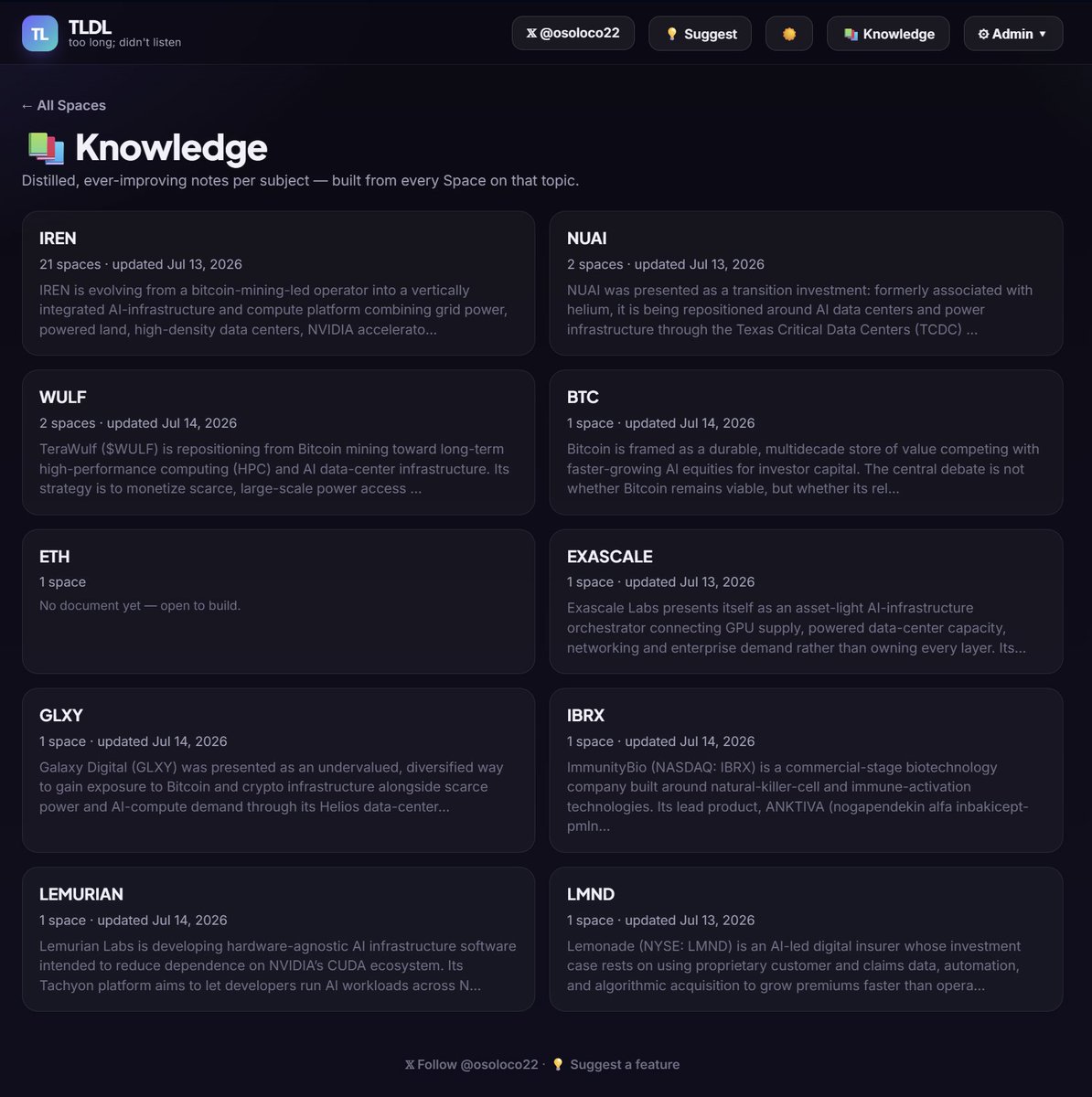
The main reason I built this project was to capture the alpha from countless $IREN X Spaces. I couldn't keep up with all that valuable info.
Every new Space updates the $IREN KB. It is the fastest way to catch up if you're new to the story.
https://t.co/mKaDB0ME1u
https://t.co/u7TADPzFRX
$WULF The management team feels that the market has the Hochul news wrong today. I just got a call from @PaulBPrager and the timelines for Lake Mariner or Cayuga have not moved. In reality, it is a net positive. This will ease some of the backlog in the queue for LM. LM does not require DEC permits so this moratorium will not have an impact. For Cayuga, they can align the build to some of the state goals including green generation if necessary. In the end, both of these sites became more valuable and will garner higher lease rates and NOI. Power is still scarce but even scarcer in NY after this.
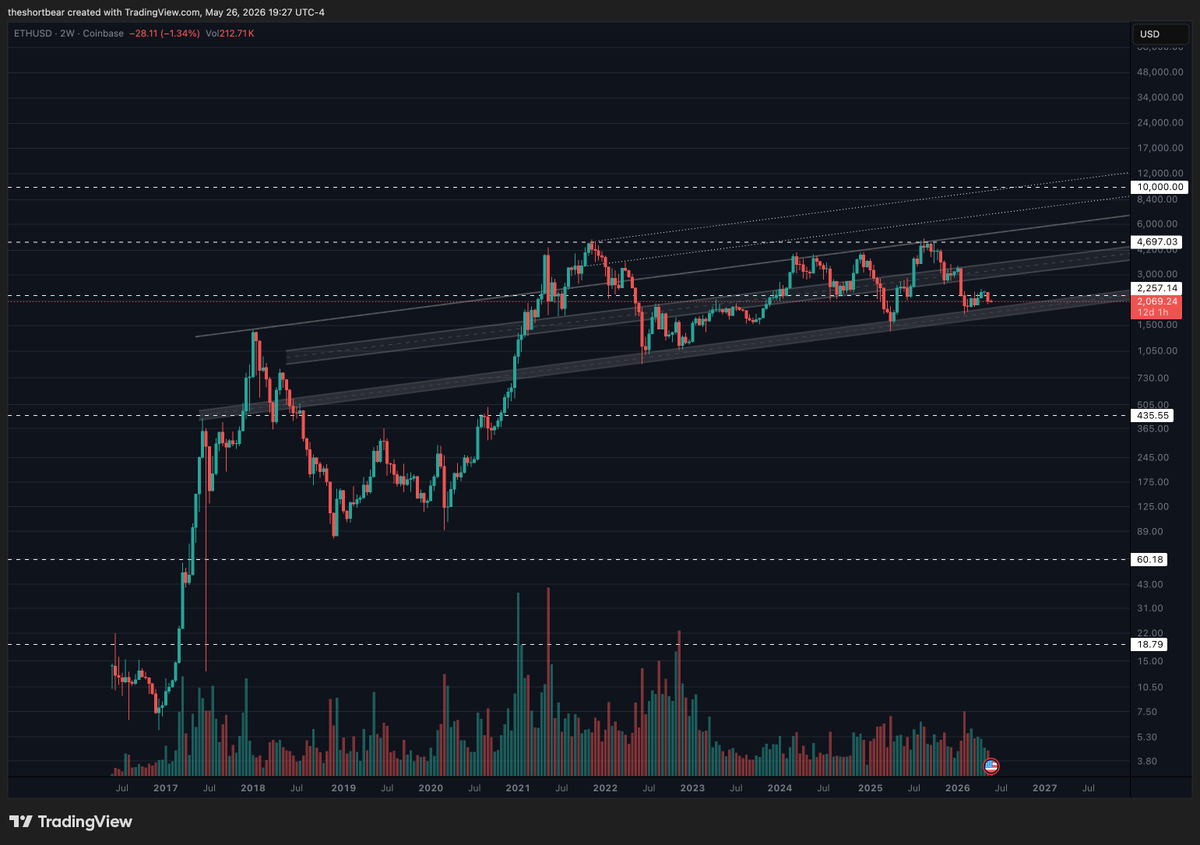
In my opinion, Ethereum L1 revenue fees should stay low to foster growth. Tens of thousands of companies will set up shop over the next 2-3 years on some mix of Ethereum L1, L2s, and private permissioned EVMs like Besu chains which will be fully interoperable with L2s and L1s. Monetary premium will grow very large, "fee revenue" to L1 from so much activity will grow significant, staking and other locking away of ETH will reduce supply, and net burning of ETH under ultrasound conditions will further grow the value of ETH.
Reflecting on $IREN
Over the last couple of days I spoke with multiple people in close contact with $IREN's management team, including investors who attended the RAISE Summit this week.
Given the insights I've gathered, I think it's an appropriate time to reflect on $IREN and share my latest thoughts.
It's no secret that $IREN has been somewhat slow on the commercial side, at least relative to the likes of $NBIS and $CRWV. I for one thought we'd have seen a Sweetwater deal by now, let alone substantial parts of the remaining Childress capacity pre-contracted.
So what's stopping $IREN from signing these multi-hundred MW deals?
In short, nothing is really "stopping" them. It comes down more to a few factors shaping their decision to hold off where other cloud providers perhaps wouldn't.
Based on management's comments both on and off camera, I can confidently say demand truly isn't the issue. Cloud capacity in this market is sparse and supply can't keep up. In fact, I've heard $IREN could easily sell out 100% of its 2027 capacity today if it wanted to.
The catch is that selling capacity which won't come online for another 6, 9, or 12 months yields significantly less than capacity arriving sooner. Customers want capacity today, and they're willing to pay a substantial premium for it.
So while selling far into the future might prop up the stock, commercially it may not be the most prudent strategy in this environment. That dynamic can obviously shift over time, but given how far supply sits behind demand, it won't change overnight, and as it stands, holding off as long as possible yields better long-term returns.
Not only do returns shrink the further out you pre-contract, but the available buyer pool shrinks with it. Selling capacity well into the future means gatekeeping much of the smaller, higher-margin clientele while mostly attracting the lower-paying hyperscalers.
As we know, $IREN is increasingly moving up the stack, effectively cutting out the middle-man that hyperscalers represent, as evident in their recent Mirantis acquisition. On that note, $IREN apparently has multiple LOIs and customer commitments for high-margin managed cloud services set to take effect once the Mirantis deal closes over the coming weeks.
I've now also heard several times that $IREN takes customer selection and contract structure extremely seriously. Creditworthiness matters, but management also wants clients that can scale their compute demand substantially as $IREN ramps capacity. The only near-term downside is that this due diligence takes time, yet the longer-term advantages of the approach are obvious.
Beyond contract timing and customer selection, I believe some of it also comes down to operational reasons.
We know the 1.4 GW Sweetwater campus is earmarked for the upcoming VR200 (Rubin) capacity, whose supply won't ramp until late this year into early next. That partly explains why the site isn't up and running already, since all they could lease out right now would be current Blackwell generation.
The flip side is that $IREN could simply build "Horizon-style" capacity at Sweetwater, the same style they're currently developing at Childress, since those facilities are fully capable of housing next-gen Rubins, and have them ready by early next year, right as NVIDIA fully ramps Rubin production.
And while $IREN is already doing foundation work at Sweetwater, it could still easily take another 3-4 quarters before we see operational capacity there.
So what's the holdup?
I believe a major reason for the slow ramp at Sweetwater is that they want to implement lessons learned from their Horizon build-outs at Childress, making the Sweetwater process more efficient, less costly, and thus more economical.
Here I want to give a big shoutout to my friend @FransBakker9812, who found that $IREN has recently developed proprietary methods to make elements of the construction process significantly more streamlined, saving time and cost across all future liquid-cooled builds.
He shared more specifics on that with his "Research” and “Founding” subscription tiers, which I recommend checking out.
I firmly believe what some might see as a relatively slow ramp, given $IREN's starting position, is management's way of doing things right. Start with the first liquid-cooled buildouts in Horizons 1-4, implement lessons from one Horizon batch to the next, then apply the full set of process and workflow improvements at Sweetwater.
This closely mirrors what $IREN has always done since its mining era, when it started small and progressively scaled its construction operations in both size and speed. A true construction flywheel.
Interestingly, I've just heard that $IREN plans to develop Sweetwater 1, Sweetwater 2, and the 1.6 GW Oklahoma site in parallel over the coming years. That shows just how exponential their construction ramp really is.
In short, I believe holding out on the next wave of contracts comes down to a few factors:
1) Signing well ahead of commissioning means giving up pricing upside and attracting only a small subset of clients.
2) Customer selection and contract structure are a big part of $IREN's long-term strategy. It takes more time than simply selling to the highest bidder, but should build stronger customer relationships over the long run.
3) Scaling construction in a controlled manner, carrying critical lessons from current builds into the next. Slow start, exponential growth curve.
None of this means we won't see any deals this year, but it does add color on why commercial progress on closing deals has been slower than many of us expected.
As for deal activity and my current expectations there, it helps to step back and consider how $IREN's near-term capacity is structured.
We should expect the 50k B300 units $IREN procured back in March to be fully contracted and installed by year-end, roughly 33k at Mackenzie and another ~17k at Childress. Apparently first deliveries for Mackenzie have already arrived and are being installed.
Given this progress, I'd expect $IREN to announce having contracted substantial parts of these air-cooled Blackwells by August earnings at the latest. This is the low-hanging fruit.
And worth noting, since $IREN first gave ARR guidance for that capacity, GPU rates across the board have moved up substantially. If they sign anything close to what they landed with the 60 MW NVIDIA deal, their year-end guidance of $3.7B should climb to at least $3.9-$4.1B.
Beyond this, there's plenty of 2027 capacity that could get contracted later this year, including 190 MW of air-cooled capacity at Childress, 30 MW at Canal Flats, 150 MW of liquid-cooled Horizon 5-6, and 300 MW of liquid-cooled capacity at Sweetwater 1.
We don't have guidance on when this capacity comes online next year or what the ramp schedule looks like, but since liquid-cooled greenfield development takes longer than retrofitting existing air-cooled buildings (currently mining BTC), I'd expect the remaining 220 MW of air-cooled capacity to come online within the first couple of quarters of 2027.
For that reason, I think the odds those few hundred MW get pre-contracted later this year are relatively high.
The trickier part is the 150 MW of Horizons 5-6 and the 300 MW of liquid-cooled Sweetwater capacity. I think there's a decent shot at least one of the two gets pre-contracted in 2026, especially if it's for a hyperscaler or a frontier lab, which are far more inclined to sign a few quarters ahead.
Either way, it's just a matter of time until contracts start flowing. It's clear to me that $IREN is playing the long game and isn't compromising long-term upside for short-term euphoria in the share price. As a long-term investor, I fully support that.
I do wish, however, that $IREN were a bit more open about strategy and roadmap. It's obvious they're holding their cards close to the chest, but I find management has been overly vague on strategy.
It takes investors like me piecing the puzzle together to make sense of how $IREN plans to scale into the next hyperscaler. Ironically, management does share a fair bit of interesting and useful information if you get the chance to meet them in person, yet on earnings calls they come across as overly reserved.
That said, the future looks bright, and I have no reason to get overly concerned about disappointing price action. With a bit of luck we're in for a string of positive catalysts, starting with the Horizon 1 handoff in a couple of weeks.
I also want to take a moment to thank @OMCapitalGroup, who did an excellent job gathering information and insights while attending RAISE this week.
If it weren't for his work, I wouldn't be nearly as informed, so big props to him for taking the time to travel all the way to Paris for $IREN due diligence and then going out of his way to keep me updated with everything he picked up, even putting some of my own questions to management directly.
He's relatively new to X, but he told me he's going to start posting shortly and jump into Frans' spaces more often. Do me a favor and give this fella a follow.
Have a good one, cheers! ✌️
Thumbnail Credit (enhanced version): @AndyDTrades
Today, TeraWulf announced two strategic transactions that significantly advance our AI infrastructure strategy:
👉 A 20-year lease with @AnthropicAI at our Justified Data Campus
👉 The sale of our 50.1% ownership interest in the Abernathy Joint Venture to an investor group led by @fluidstack
Together, these transactions create long-duration contracted revenue, recycle capital into wholly owned AI infrastructure, and further align our business around owning and operating the critical infrastructure that powers AI.
Keep reading 👇
$NUAI: A New Era of Compute
We just released our long-awaited deep dive on $NUAI, a stock that has attracted a lot of attention on X in recent months.
$NUAI is an emerging data center company with an incredibly interesting business model that could compound shareholder returns quickly if executed well.
In this in-depth report, I cover the company from A to Z, assessing not just the opportunity, but also the risks and the key factors investors should be aware of.
As always, the first chapter is free to read, so take a look if you are interested.
I’m genuinely proud of how thorough this piece ended up being, and I would highly appreciate hearing your feedback.
Cheers!
https://t.co/sfbI6RzdVr
Well said, Neel! I’m genuinely surprised that they were so brazen, or better said arrogant, to provide themselves one of the largest pay packages in America (easily top 10 in the SP500), WITHOUT any KPIs attached.
It’s a real spit in the face to all $IREN shareholders and I honestly think the board needs a serious make-over.
$IREN: Low Sentiment but Thesis Alive
I have similar thoughts as @moninvestor on differentiating a business from stock sentiment. Mon, having gone through it in $HIMS and, I, having gone through multiple times it in $TSLA have seen the other side before. I didn’t traded out of $TSLA at the lows but after relief rallies, only to see it go much higher and buy back in on a higher dip. Everyone’s seen it happen in other stocks but only when truly owning the stock is it truly painful.
I hate the Golden State marketing spend and CEO compensation package but for me delays in PG and H1 were actually worse for the stock. @AnnwithChin asked me what was my last straw and it would be not delivering H1 in July/August or lower than 80m AI revenue in Q2 earnings. H1 was guided for Q3 but it really shouldn’t be Sept. Frans subgroup has solid info on expectations for late July.
Those who been around the block a few times know that all businesses face set backs but can distinguish the setbacks from thesis ending. Here are some few examples:
1. $META metaverse bottom: Metaverse was m a complete failure and Zuck seemed to have lost it all on digital Avatars as the stock bottom at $90 only to roar back to $600. Metaverse was the thesis for Zuck ironically but even that was fixable.
2. $TSLA covid and 2022 interest rate lows - Covid was a huge shock to the supply chain and interest rates are a killer for car sales but not to long term vision of company.
3. $EOSE - delays brought this stock to $1, only to see it make $18 eventually.
4. $MU hit negative margins in 2023 and Monish Pabrai and Li Lu sold out of after holding for 5 years.
5. $NVDA fell out when its bitcoin mining revenue got displaced by ASICs only to soon become the center of AI.
6. $INTC after delays to its Fabs only to comeback due to a turnaround.
$IREN’s progress in delivering H1 and AI revenue for Q2 from PG are baselines for me. Delays after seem some point change the thesis. Datacenter delays are a thing. $CRWV has seen it earlier. $NBIS may see it at Vineland. $META and $MSFT have seen it. $AMZN and $GOOG have enough where the failed ones don’t get shown. Remember the AWS nuclear power plant denial based on a rare species of bees?
Week 1 is in the books 🫡
Thank you to everyone across Ethereum who welcomed Ethlabs, supported us, questioned us, donated, applied, and replied. The response is hugely appreciated and while we work through getting back to everyone, here are some quick answers to the questions we’ve been getting most.
More coming on priorities, workstreams, boundaries, accountability mechanisms, and what success actually looks like.
Bear with us as we get on our feet. We won’t be perfect, but we’ll try to communicate often, and transparently.
Ok, quick FAQ now.
I'm not a point guard or a power forward, but I can call balls and strikes.
$IREN Co-CEO Daniel Roberts said on a recent earnings call that in this supply-constrained AI market, demand finds you: no traditional sales or marketing team needed.
Fast forward:
>May 18: IREN acquires its external marketing partner, Australia-based Awaken (terms undisclosed)
>Awaken founder Chris Parker becomes IREN’s Global CMO
>June 25: IREN announces Warriors jersey patch deal (~$50M/year, reportedly the richest such in North American sports)
When a CEO acquires his marketing vendor, installs the founder as CMO, and weeks later buys one of the biggest sponsorships in sports (with zero disclosure on the acquisition terms or CMO compensation/KPIs), shareholders deserve answers on the process and rationale.
Even if reported $50M is a rounding error on $3B in consensus 2027 revenue, lack of disclosure around this structure may impact shareholder quality. I expect management to address it soon. The PE ratio of the stock could depend on it.
Bitcoin's daily RSI is at 15.38, the lowest level since Nov 2018 (lower than the Covid crash).
Ethereum's daily RSI is at 13.45, the lowest level in its entire history.
The risk/reward is in favor of longs here.
If you're short here, you deserve to lose your money.
$BTC $ETH
Já cca 39, ale dneska budu dál snižovat průměrnou nákupku, jako jsem to dělal v roce 2024/2025 u IREN a WULF. U BMNR jsem ten vstup opravdu nevychytal (IREN mám cca 7, WULF cca 3), ale to je život, přesto je moje přesvědčení v budoucnost ETH/BMNR větší, než kdy dřív. Tak snad máme pravdu:)
In 5 years: AGI singularity. In 10 years: AI superintelligence. In 20–30 years: AI will help us extend human life by decades. Our children might never die, or they’ll live for at least hundreds of years… provided super AI doesn’t destroy us first — or rather, the people who control it don’t. It sounds like a joke, but this is going to be fucking reality.
Almost no one gets the exponential scale. The human brain is linear. Evolution optimized us for a world where tomorrow was basically the same as today. Exponential growth is cognitively incomprehensible — until it literally overnight shatters the world we used to know.
The internet had existed since the 1970s, but no one really understood what it would mean until 2007, when Jobs pulled the iPhone out of his pocket.
AGI will be 1,000× bigger than that. And it’s coming faster than anyone expects.
People are busy arguing about elections, inflation, jobs, the war in Ukraine, Iran. All of those problems are real, but they’re problems of the linear world. In 10–15 years those problems will either be solved by superintelligence — or they’ll become completely irrelevant because problems orders of magnitude bigger will have arrived.
The biggest issue for humanity then will be who controls the superintelligence. It is the most important fight in the history of our species, and it’s happening right now — quietly, without headlines. Almost no one realizes it.
Deus ex machina is about to get a whole new dimension.
In ancient theater, it was a crane that would lower a god onto the stage at the end of the play, and that god would suddenly solve everything.Yet this twist was considered a weak dramatic device. A god lowered onto the stage by a machine to resolve an unsolvable problem.
Critics condemned it — Aristotle said that a good story doesn’t need a god from the machine. The solution should grow organically from the story itself.
Today, it’s a metaphor for an artificial, overly convenient happy ending that violates the logic of the narrative.
AI is the deus ex machina of 21st-century humanity: A machine (machina) will arrive — one not made of flesh and blood.
It will suddenly solve problems we’ve waited thousands of years for: aging, energy, disease, perhaps even death itself.
Or the opposite — a machine that will destroy us (or allow those who control it to destroy us).
Exactly like Clu in Tron: he was programmed to “create the perfect system.” And he did exactly that.
But in the meantime, Flynn had changed his mind about what “perfect” actually meant. And then came the classic deus ex machina moment — Flynn’s sacrifice — to save everything.
Only this time, the “crane” is us.
Although in reality we don’t get to decide how this machine will be programmed. That decision is being made by a tiny group of people in xAI, Anthropic, OpenAI, the hyperscalers, and the governments pressuring them in this sector.And that is exactly why this text is not a joke.
It is a description of a situation in which deus ex machina is becoming reality — either as our salvation, or as the worst possible plot twist in the history of mankind.
This is not science fiction.
This is now.
And the exponential is already accelerating. People are still waiting for the crane to descend…
but it is already up there, slowly lowering itself down.
And the final question remains:
Will it be humanity’s savior…
or the destroyer of worlds?
Our internal data shows Claude is accelerating AI development—a possible path to recursive self-improvement, or AI autonomously building a more capable successor.
It’s happening faster than we thought, and the implications deserve greater attention. https://t.co/OVVPJO7VQx
I have never seen so many people capitulating out of $ETH or crypto.
Some are writing blogs and essays explaining why it failed, mainly naming how other chains won the race, measured by fees taken in.
Some of my thoughts, in these hard times:
Time will tell, but I think many people are mistaken in treating $ETH like an end-stage $AMZN, as if the main question is already about mature margins, fees, and cash flows.
In reality, Ethereum is still very much earlier in its economies-of-scale phase, with nearly all metrics in the top right corner and growing at mid double digits to tripple.
Furthermore, most of the market is focused on the wrong battle: who can become the fastest and cheapest payment processor.
Lower fees, higher throughput, faster settlement. But that is likely a race to commoditization, similar to the payment processors crash over the last years.
If the only value proposition is speed and cost, then the moat gets thinner over time, easy disruptable. Someone can always be faster. Someone can always subsidize fees lower. Someone can always optimize one narrow use case.
The real value may not be in the transaction fee itself.
The real value is likely in the amount of economic activity secured by the network, the credibility of that security, the neutrality of the base layer, and the difficulty of replacing it once enough assets, applications, institutions, and users depend on it.
That is where Ethereum seems different to me and why so many institutions are choosing $ETH.
Most other projects still feel replaceable. They may have better performance in one area, better UX in another, or lower fees in the short term. But if their advantage is mainly technical efficiency, that advantage can be copied, competed away, or made irrelevant.
The newest hottest thing today is replacing the hottest thing from last quarter.
Ethereum’s bet appears to be much larger: become the most secure, decentralized, credibly neutral settlement layer for the internet economy.
Not the cheapest rail.
The hardest rail to replace.
In the end, the most valuable network may not be the one with the lowest transaction costs. It may be the one people trust most to secure the highest-value assets and applications over the longest period of time.
If $ETH can retain its market share while continuing to scale through upgrades that improve speed, throughput, and fees, its potential remains significant, especially if AI agents become truly crypto-native.
If it combines all of the above and earn the crown as the leading value-secured network, then $ETH could eventually be viewed as something like a truly decentralized, inflation-adjusting global bond: securing the world’s assets, free from political meddling, and deserving of a premium market cap because of the value it protects on top of the deflationary pressures create incentives to stake, get yield and trust the equivalent of buybacks and griwth in value secured to provide additional value.
Keep in mind over 1/3 of $ETH is now staked!
In that scenario, $ETH would not just be another asset to hold. It could become one of the only truly neutral and secure bonds for the digital economy.
... But sure, lets compare it to $SOL with 6% inflation, no moat, no security, massive outages, decreasing validator nodes and alike.
it just all feels like people are getting lost in short term fees and the easiest valuation attempt rather than what $ETH is actually built for, all while its testing its bottom range and players go full portfolio into AI.
𝐓𝐡𝐫𝐞𝐞 𝐋𝐚𝐲𝐞𝐫𝐬. 𝐎𝐧𝐞 𝐂𝐨𝐦𝐩𝐨𝐮𝐧𝐝𝐢𝐧𝐠 𝐀𝐝𝐯𝐚𝐧𝐭𝐚𝐠𝐞. 𝐓𝐡𝐞 𝐈𝐑𝐄𝐍 𝐓𝐡𝐞𝐬𝐢𝐬.
There's been a lot happening at IREN recently.
Expansion across North America, Europe and Asia-Pacific.
The NVIDIA partnership.
The Mirantis acquisition.
New GPU deployments.
New customer discussions.
A growing global footprint.
Underneath all of it is a fairly simple view of where the world is heading, and a deliberate strategy for how we position IREN within it.
That strategy is built on three layers. Together, they compound into a structural advantage that gets harder to replicate every quarter we execute.
Layer 1: Physical infrastructure. Power, land, substations, data centers, cooling. The foundation that everything else sits on.
Layer 2: Compute infrastructure. The GPUs, servers and networking that go inside those buildings. Deployed at scale. Generating revenue. Building execution track record.
Layer 3: Software and operational capability. The orchestration, deployment tooling and enterprise expertise that makes the first two layers work harder for customers, and opens the door to a broader, higher-value market over time.
Layers 1 and 2 are where the overwhelming majority of IREN's value is being created today. Layer 3 is where that advantage compounds further over time, but only because Layers 1 and 2 are built, owned and controlled at scale by IREN, not subscale nor contracted from a third party.
Think of Amazon. They didn't win e-commerce by building a great website. They won it by controlling the fulfilment infrastructure at a scale nobody else could replicate. The foundation you don't control becomes the ceiling on your business.
That is exactly how we think about IREN. The physical infrastructure - the land, the power, the substations, the data centers - is owned and controlled by us. The compute deployed into it generates the revenue and execution track record. And the software, orchestration and enterprise capability we are more methodically building on top is what turns the total product into a vertically integrated AI Cloud platform that compounds over time and deepens into a competitive moat.
AI is still early. The bottleneck is increasingly physical. And we have spent eight years building the foundations.
$NUAI: The Last Asymmetric Bet in the Data Center Trade
Look across the small-cap data center cohort right now. NUAI is the only remaining sub-$500M name with a real, exclusive, late-stage hyperscaler negotiation in motion. And after parsing the Q1 2026 call, conviction goes up, not down.
The Lease Math Now Works Backwards From 2027
Charlie Nelson laid out the schedule cleanly:
"Our schedule is largely driven by power availability. The power that we have available in phases 1 and 2 is in second half of 2027. Everything that we're doing is kind of back-solving from those dates... We still feel good about second half of 2027 in-service date for the first phases of this."
Working backwards from ~August 2027 with Stream's compressed 12-14 month build cycle, the lease has to be signed by July or August 2026 to preserve schedule. The construction calendar is a hard forcing function — every party at the table knows it, including the hyperscaler.
The Documents Are Closer Than Anyone Realizes
When asked about sequencing, Charlie was specific:
"The JV docs are well underway, multiple turns already with the lawyers, and the lease as well, as well as the PPA. All of these are progressing concurrently... And this is how it goes with most of these types of industrial developments — concurrent execution, especially when they're all kind of lining up around the same time, just makes sense. And you just kind of have a signing day, if you will. A very fun day, by the way, for any industrial development."
"Multiple turns" means the documents are mature. What's left should be legal documentation — a slower, more deterministic process than commercial negotiation. The phrase "signing day" is not casual. It's deal-maker code for a coordinated execution event where multiple interdependent documents close together.
The Hyperscaler Engineered This Deal
This is the part nobody is talking about enough. The hyperscaler wasn't recruited. They initially came to NUAI wanting to buy the land. Ted Warner walked through the sequence:
"We were also getting offers to buy this from actual hyperscalers... One of those we did, we signed an exclusivity agreement because we kept turning them down on selling, and we wanted to work with them on how can we partner with you to own something here. Essentially, it was, 'You've got to work with a really reputable developer.' We went and tried to find one, that exact same party sort of led us to a different party. Now here we are with that party, Stream."
The hyperscaler directed NUAI to Stream. They didn't just suggest a developer — they pre-approved their own counterparty. Stream walked in with existing commercial agreements and pre-approved designs with this specific hyperscaler. Charlie confirmed it:
"Having pre-approved designs with this particular hyperscaler, which is why we were guided into the relationship with them, frankly — to the fact that they house long lead time equipment that goes towards these projects, and it's a rinse and repeat design."
A hyperscaler that takes the time to direct partner selection, share technical specs, sign exclusivity, and cooperate through a developer restart is not a hyperscaler that walks away at the finish line. That's a counterparty that has been quietly engineering the conditions for this deal to close on terms they already endorsed.
And It's the Same Hyperscaler
Ted's clarification on the Sharon AI confusion was the most underrated moment of the call:
"The same party, that hyperscaler is still the person that we hope will be our tenant, that our designs are specifically for... [Stream has] been incredible to work with, just every day checking boxes. It's been awesome to watch them work."
No one walked. The hyperscaler that wanted this site in 2025 still wants the site in 2026. The designs are still tailored to their specs. The exclusivity is still in place.
The Balance Sheet Is Built For This
Ted's segment removed the financing overhang that haunted this name for months. $80M+ cash on hand. $290M Macquarie credit facility. The Sharon AI note is gone. Liens lifted. They illustrated the math:
"Our cash needs for phase one would be roughly $180 million before the credit that we'd get for the land contribution... That theoretical $180 million investment is more than covered for phase 1."
NUAI's expected equity check for Phase 1 is fully funded. No more "how do they pay for this" question hanging over the stock.
The Setup
The market just sold the stock 11% on a quarter that confirmed every workstream is on track
The lawsuit resolution should come soon
PPA likely ready first
JV DA close behind — Stream is the most motivated party in the deal
Hyperscaler lease execution window: late June through Early August 2026
One signing day, three documents, complete rerate
This is the playbook setup for an asymmetric trade. The downside is bounded by the cleaner balance sheet, the Stream-driven execution model, and the standing hyperscaler engagement. The upside is a name with a sub-$500M market cap signing a lease comparable to deals that already moved peers multiples higher.
"As a shareholder, I sit here with you, and I wish I could announce who the prospective tenant is, and I can't wait to announce it one day. We've been working very, very hard to get there." — Will Gray, closing remarks
NUAI is the last shoe left to drop.
https://t.co/kYQhkjttsK




![litigious_dulce's tweet photo. $NUAI: The Last Asymmetric Bet in the Data Center Trade
Look across the small-cap data center cohort right now. NUAI is the only remaining sub-$500M name with a real, exclusive, late-stage hyperscaler negotiation in motion. And after parsing the Q1 2026 call, conviction goes up, not down.
The Lease Math Now Works Backwards From 2027
Charlie Nelson laid out the schedule cleanly:
"Our schedule is largely driven by power availability. The power that we have available in phases 1 and 2 is in second half of 2027. Everything that we're doing is kind of back-solving from those dates... We still feel good about second half of 2027 in-service date for the first phases of this."
Working backwards from ~August 2027 with Stream's compressed 12-14 month build cycle, the lease has to be signed by July or August 2026 to preserve schedule. The construction calendar is a hard forcing function — every party at the table knows it, including the hyperscaler.
The Documents Are Closer Than Anyone Realizes
When asked about sequencing, Charlie was specific:
"The JV docs are well underway, multiple turns already with the lawyers, and the lease as well, as well as the PPA. All of these are progressing concurrently... And this is how it goes with most of these types of industrial developments — concurrent execution, especially when they're all kind of lining up around the same time, just makes sense. And you just kind of have a signing day, if you will. A very fun day, by the way, for any industrial development."
"Multiple turns" means the documents are mature. What's left should be legal documentation — a slower, more deterministic process than commercial negotiation. The phrase "signing day" is not casual. It's deal-maker code for a coordinated execution event where multiple interdependent documents close together.
The Hyperscaler Engineered This Deal
This is the part nobody is talking about enough. The hyperscaler wasn't recruited. They initially came to NUAI wanting to buy the land. Ted Warner walked through the sequence:
"We were also getting offers to buy this from actual hyperscalers... One of those we did, we signed an exclusivity agreement because we kept turning them down on selling, and we wanted to work with them on how can we partner with you to own something here. Essentially, it was, 'You've got to work with a really reputable developer.' We went and tried to find one, that exact same party sort of led us to a different party. Now here we are with that party, Stream."
The hyperscaler directed NUAI to Stream. They didn't just suggest a developer — they pre-approved their own counterparty. Stream walked in with existing commercial agreements and pre-approved designs with this specific hyperscaler. Charlie confirmed it:
"Having pre-approved designs with this particular hyperscaler, which is why we were guided into the relationship with them, frankly — to the fact that they house long lead time equipment that goes towards these projects, and it's a rinse and repeat design."
A hyperscaler that takes the time to direct partner selection, share technical specs, sign exclusivity, and cooperate through a developer restart is not a hyperscaler that walks away at the finish line. That's a counterparty that has been quietly engineering the conditions for this deal to close on terms they already endorsed.
And It's the Same Hyperscaler
Ted's clarification on the Sharon AI confusion was the most underrated moment of the call:
"The same party, that hyperscaler is still the person that we hope will be our tenant, that our designs are specifically for... [Stream has] been incredible to work with, just every day checking boxes. It's been awesome to watch them work."
No one walked. The hyperscaler that wanted this site in 2025 still wants the site in 2026. The designs are still tailored to their specs. The exclusivity is still in place.
The Balance Sheet Is Built For This
Ted's segment removed the financing overhang that haunted this name for months. $80M+ cash on hand. $290M Macquarie credit facility. The Sharon AI note is gone. Liens lifted. They illustrated the math:
"Our cash needs for phase one would be roughly $180 million before the credit that we'd get for the land contribution... That theoretical $180 million investment is more than covered for phase 1."
NUAI's expected equity check for Phase 1 is fully funded. No more "how do they pay for this" question hanging over the stock.
The Setup
The market just sold the stock 11% on a quarter that confirmed every workstream is on track
The lawsuit resolution should come soon
PPA likely ready first
JV DA close behind — Stream is the most motivated party in the deal
Hyperscaler lease execution window: late June through Early August 2026
One signing day, three documents, complete rerate
This is the playbook setup for an asymmetric trade. The downside is bounded by the cleaner balance sheet, the Stream-driven execution model, and the standing hyperscaler engagement. The upside is a name with a sub-$500M market cap signing a lease comparable to deals that already moved peers multiples higher.
"As a shareholder, I sit here with you, and I wish I could announce who the prospective tenant is, and I can't wait to announce it one day. We've been working very, very hard to get there." — Will Gray, closing remarks
NUAI is the last shoe left to drop.
https://t.co/kYQhkjttsK](https://pbs.twimg.com/media/HIroOK1X0AA6Mm6.jpg)


