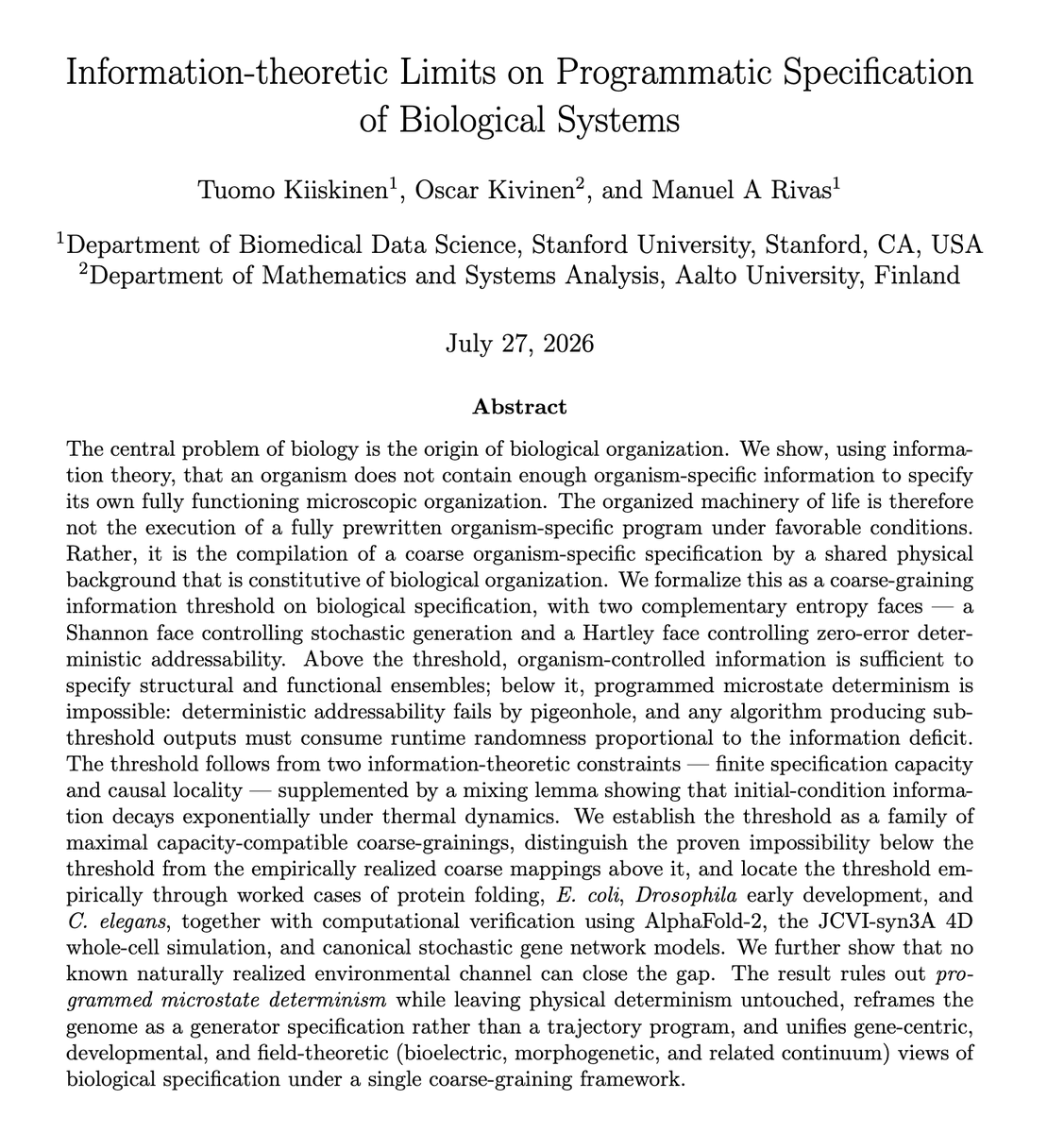
The central problem of biology is the origin of biological organization. In our preprint, “Information-theoretic Limits on Programmatic Specification of Biological Systems,” we show, using information theory, that an organism does not contain enough organism-specific information to specify its own fully functioning microscopic organization.
For over 70 years—since the discovery of the double helix and the cracking of the genetic code—biology has been dominated by the metaphor of the genome as an executable computer script or structural blueprint. Yet, it has remained a central mystery how the genome organizes the entirety of the microscopic, fine-scale molecular biological machinery in space and time.
We wish to put forward a radically different formulation.
We show, as an analogy, that the genome is not a figure-skating program choreographing every molecular movement, but a hockey coach’s game plan : roster, tactics, line assignments. The exact trajectory of the puck is computed by physics at runtime. The game looks like hockey because of the specified ensemble, not because every coordinate was pre-programmed.
The organized machinery of life is not the execution of a fully prewritten organism-specific program under favorable conditions. Rather, it is the compilation of a coarse organism-specific specification by a shared physical background that is constitutive of biological organization.
We establish the threshold as a family of maximal capacity-compatible coarse-grainings, distinguish the proven impossibility below the threshold from the empirically realized coarse mappings above it, and locate the threshold empirically through worked cases of protein folding, E. coli, Drosophila early development, and C. elegans, together with computational verification using AlphaFold-2 (analyzing tertiary structures of 555,846 proteins across 46 AlphaFold-2 proteomes), the JCVI-syn3A 4D whole-cell simulation, and canonical stochastic gene network models. We further show that no known naturally realized environmental channel can close the gap. The result rules out programmed microstate determinism while leaving physical determinism untouched, reframes the genome as a generator specification rather than a trajectory program, and unifies gene-centric, developmental, and field-theoretic (bioelectric, morphogenetic, and related continuum) views of biological specification under a single coarse-graining framework.
It has not escaped our notice that this framework has fundamental implications for understanding evolutionary search, heritability, thermodynamic order, biological modeling, and artificial intelligence in biology, but these will be published elsewhere.
https://t.co/XchTPjE2II
@alz_zyd_ i mean that it is extremely impossible to still evaluate that LLMs made independently good art, because at least subconsciously still the human input is the distinctive key as a seed.
Intuitively I have no idea but would be interested to see if one trained some small model with older data with a different calendar system and see how these structures would change. If cyclical, the temporal order might still dominate the PC1-2 space which maximizes to explain most of the variation with two orthogonal dimensions!
I think the PCA analysis of word embeddings is super interesting and reminds me of when you take PCs of genetic variants and the literal geographic ancestral map of the sample emerges... because of the genetic distances (the second pic).
Natural language models map concepts through learning their relational structure. In word embeddings my bet is stronger than co-occurence -- instead these shapes describe the dominating relationship between the concepts that the model learns. And when you model this relationship and flatten it to a plane (x, y: PC1-2), these shapes emerge naturally.
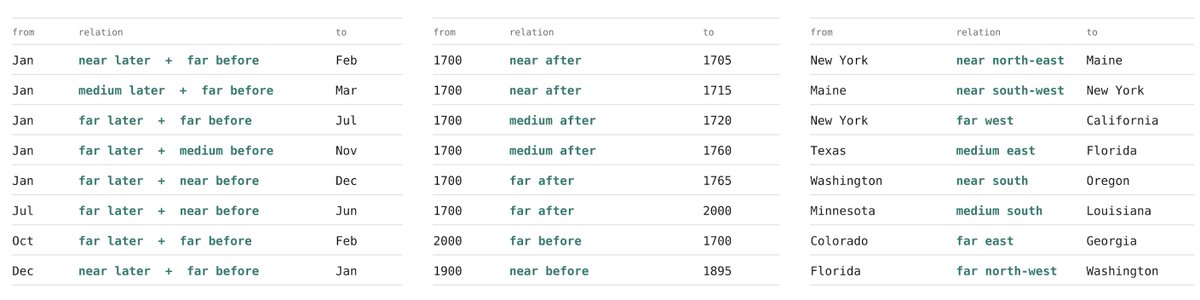
I tested this so that I created a relational graph data (direction, distance) for months, years and the US states (just natural language, no embedding model), and then let the graph settle freely in 10 dimensions.
Behold, the graphs flattened naturally to 2D and looking through PC1+2 the similar shapes as in the paper show up for months and years AND the actual US map is recovered from the state-to-state relationships!!!
I think that the curved shape of years in the embeddings space is because years very far from each other don't hold a very strong relationship with each other, so the linear shape is held stronger between near neighbors... when modelled directly we see this also (pic3).
I just saw the paper as a result of @martin_casado's tweet (didn't see the paper when it was originally posted in Feb). Indeed, the analysis is great and the figures really make the paper shine! Nice work, Dhruva Karkada, Daniel J. Korchinski, Andres Nava, Matthieu Wyart, and @yasamanbb! I love analyses that reveal even more about the amazing hidden structures in word embeddings.
https://t.co/uTtuXTRYd8
@rlsayar@GarrowGeer yeah if you use shoes and do jogging you land on your heels. but if you try doing this barefoot it is quite unnatural! do you have the link to that Hatala. I might also be a bit “paleo-biased” here cause I researched this most in my “paleo”/natural biomechanics phase
I think the PCA analysis of word embeddings is super interesting and reminds me of when you take PCs of genetic variants and the literal geographic ancestral map of the sample emerges... because of the genetic distances (the second pic).
Natural language models map concepts through learning their relational structure. In word embeddings my bet is stronger than co-occurence -- instead these shapes describe the dominating relationship between the concepts that the model learns. And when you model this relationship and flatten it to a plane (x, y: PC1-2), these shapes emerge naturally.
I tested this so that I created a relational graph data (direction, distance) for months, years and the US states (just natural language, no embedding model), and then let the graph settle freely in 10 dimensions.
Behold, the graphs flattened naturally to 2D and looking through PC1+2 the similar shapes as in the paper show up for months and years AND the actual US map is recovered from the state-to-state relationships!!!
I think that the curved shape of years in the embeddings space is because years very far from each other don't hold a very strong relationship with each other, so the linear shape is held stronger between near neighbors... when modelled directly we see this also (pic3).
@rlsayar@GarrowGeer Yeah but actually before running shoes (barefoot) it is almost impossible to run on your heels. If you look at elite runner strides, they land on their soles. Also before, for example boxers, who did "roadwork" actually ran on the forefoot! https://t.co/Ki6Et2zCcN
a small repo for testing these "Natural Language Relational Graphs" (coined for this mini project) describing also my mini research on this matter https://t.co/BD0KZ4rit6
@nim_chimpsky_ the mathematicians who were employed through grants for solving RH can now be retrained to be healthcare professionals. either they find some solutions to make administration more efficient OR then just simply drive costs down through oversupply of workforce.
@DanielSamanez3 a line on which you can go on forever but also which has shape that allows and enforces repetition. 1D line can also be infinite like years or anything but there you don't end up something that is after also ending up being before the reference
the model will learn that january comes after december and before february, february after january and before march..... november after october and before december, december after november and before january .... the only geometry that allows this relationship is a circle.
Chomsky was wrong.
Researchers from UC Berkeley and Google DeepMind cracked one of the biggest mysteries in AI.
For years, scientists have been finding impossible geometric shapes hidden inside the brains of LLMs.
Calendar months arrange themselves into literal circles.
Historical years bend into smooth, rippled timelines.
Cities organize themselves into actual 2D maps of latitude and longitude.
Everyone assumed this proved massive transformers were spontaneously inventing complex "world models" out of thin air.
They were wrong.
This paper proves you don't need a massive LLM for any of this to happen.
Even basic, decade-old word embeddings like word2vec produce the exact same circles, timelines, and maps.
The geometry isn't coming from the AI's architecture.
It’s coming from a hidden mathematical property inside human language itself.
Researchers call it translation symmetry.
In natural text, how often any two months appear near each other depends almost entirely on the time gap between them.
January and February share the same statistical relationship as July and August.
When a neural network trains on data with that kind of symmetry, the math forces it to learn Fourier representations, literal sine and cosine waves.
The circles? Those are the long waves.
The strange "ripples" researchers found on AI timelines? Just higher harmonics.
Here is the craziest part.
Rresearchers tried to break it.
They deleted every single sentence in the training data where two months appeared together. No "January" next to "February." No "March" next to "April."
And the circle formed anyway.
Why? Because the geometry is a collective phenomenon across the entire language.
Even if two months never touch in a sentence, they are both pulled into orbit by thousands of other words tied to the same seasons, weather, and events.
The rest of human language forces the shape into existence.
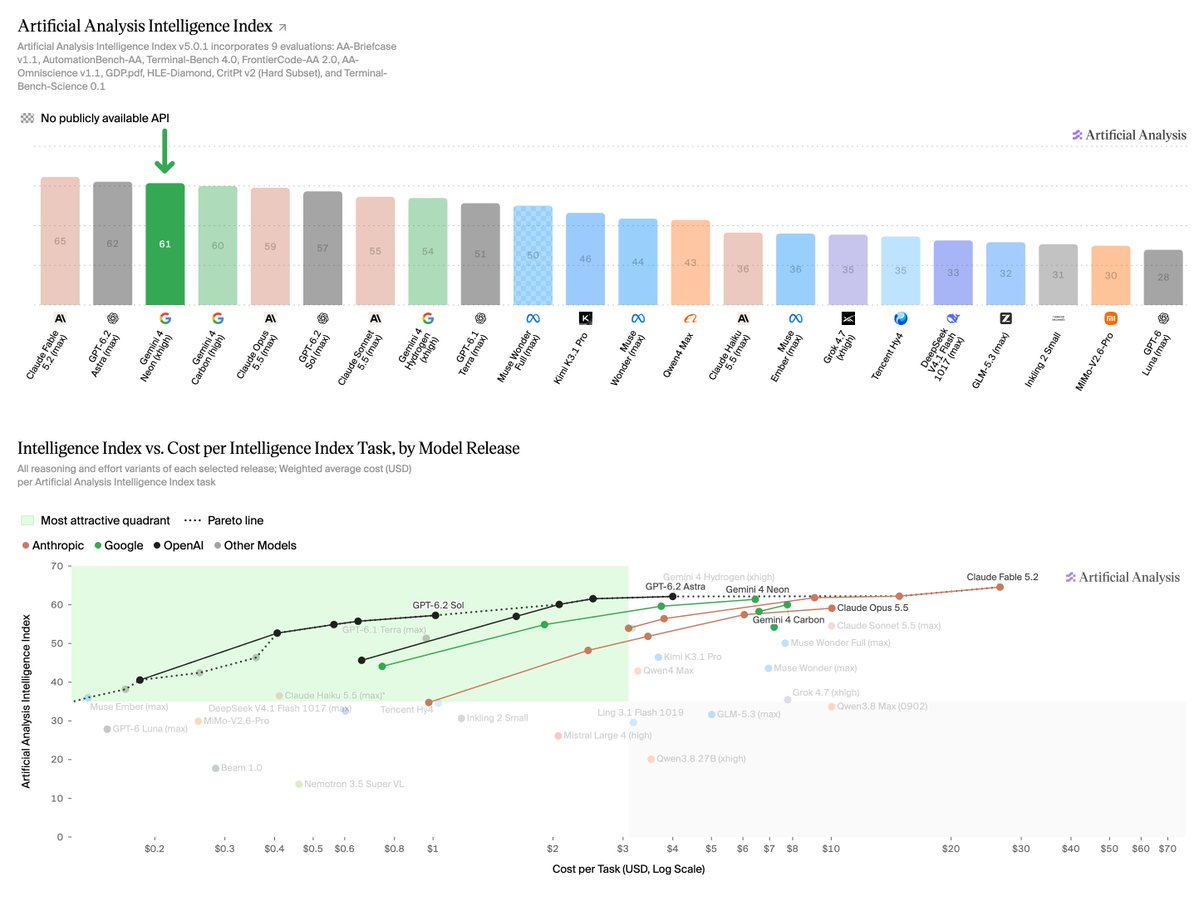
I am waiting for DeepMind to start shipping agent swarm model combo harnesses.
like Gemini Bromoethane would be 1x Carbon using 3x Hydrogens as subagents and another 1x Carbon using 2x Hydrogens and a specialist prediction model called Bromium.
tomorrow DeepMind will be dropping Gemini 4 Sodium, a fast yet powerful frontier model which costs just $11.75/M (introductory pricing, raises to $16.50 soon) and is their best model for various things and stuff, rivaling Argon, Carbon, Hydrogen, and Neon in several situations
@amelia_metters great observations, esp the Japan similarity!one thing: Finland being part of Russia predates communism and the part of Helsinki constructed under the Russian rule was largely designed by a German architect Engel and is by style neoclassicism.