Vendor line this week: passive monitoring leaves teams 'reacting to pipeline anomalies rather than preventing them.'
Fair. A smoke alarm goes off after the smoke. I'd bet AI triage clears the routine incidents, not the odd ones.
Running it live? Tell me which way it went.
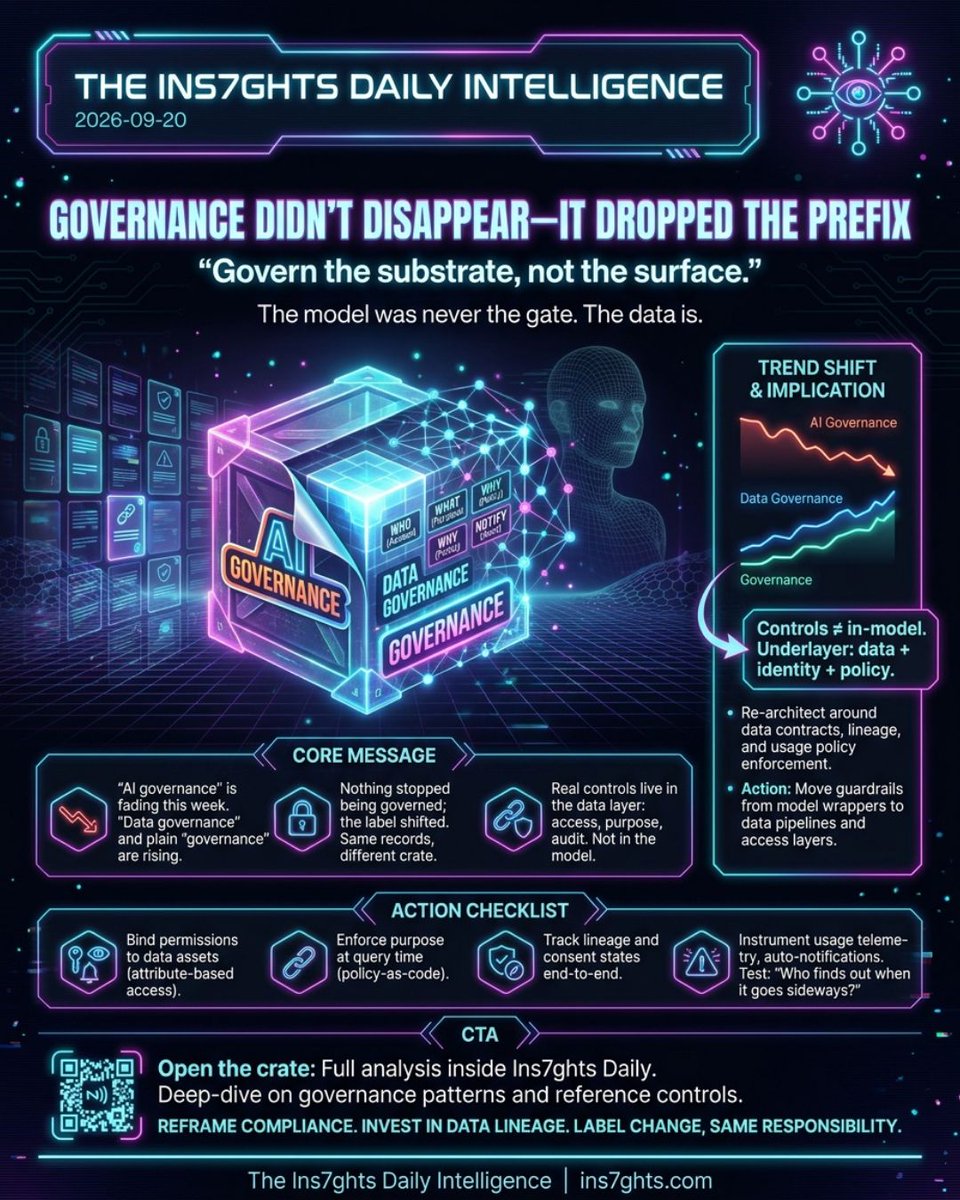
'AI governance' is fading as a phrase. 'Data governance' and plain 'governance' are growing.
Nobody stopped governing. The AI came off the front of the label, and the controls were always in the data underneath.
Comment 'renamed' for the governance terms that grew and faded.
Confluence or SharePoint looks like a feature comparison. It's a governance decision.
One is built for people writing pages together. The other for whoever decides who owns a document and who can see it.
Comment 'sprawl' and I'll send the wiki-vs-SharePoint questions.
A US$1.35 billion loan against offshore assets in the US Gulf and Australia, a first according to Herbert Smith Freehills Kramer.
It works because the price is clear daily. Credit follows the number everyone trusts.
If your data had a borrowing base, what would it be? Tell me.
Most enterprise software consolidates this year. One exception: AI vendors. Buyers keep adding names, not cutting them. That's not confidence; it's hedging. Buyers don't trust any single model yet.
Seeing the same pattern in your stack? Tell me.
The AI ROI gap isn't about budget. It's about visibility.
Firms that can see exactly where every AI dollar goes are pulling in roughly double the return of the ones flying blind on token spend. Same models. Different bookkeeping.
Where's your team on that line? Tell me.
Tempus AI just reported its first profitable quarter: $5.6M net income, $382.5M revenue (+22% YoY), gross margin above 73%.
Healthcare AI was supposed to never turn a profit. Someone forgot to tell the balance sheet.
Comment 'margin' and I'll send the exact line.
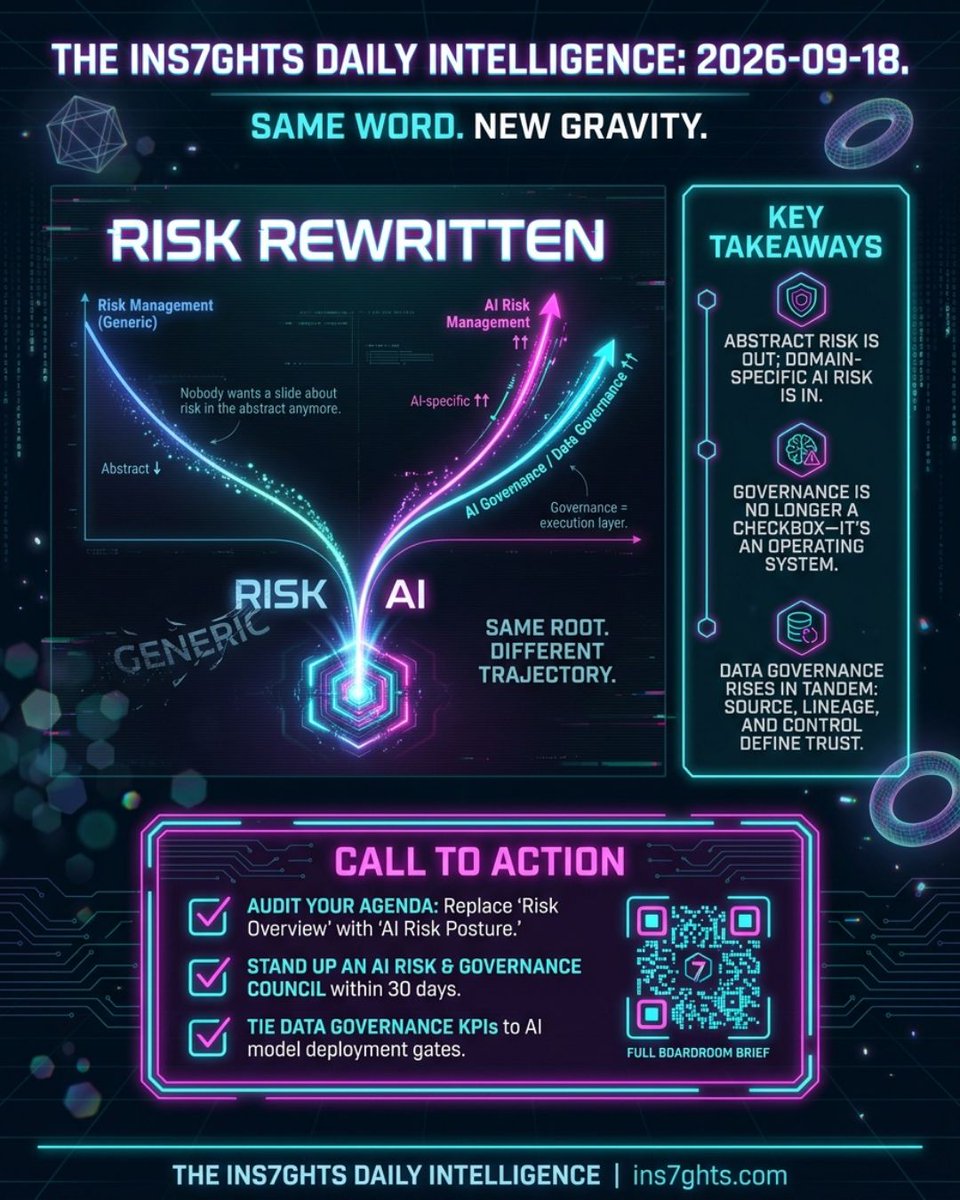
'Risk management' is fading. 'AI risk management' is doing the opposite — same word, opposite direction.
Nobody fears risk in the abstract anymore. They fear the agent that emails the wrong client.
Seeing the same split? Tell me.
'AI' alone is cooling off. What's actually climbing: Agentic AI, AI Agents, Risk Management, Governance. Microsoft's government Copilot tier proves it: October launch isn't the story—undisclosed paid seat counts next quarter are.
Seeing the same split? Tell me.
Waymo shipped to Japan's taxi app, dispatching next to humans. The big AI debate: can these systems explain themselves? Deployment answered it on the street, before frameworks did on whiteboards.
Comment 'ship' and I'll send the quiet deployment moves.
AI agents in Dynamics 365 don't fail loud. They fail "correct by design, wrong outcome"—a thousand rule-following updates, no selective undo. Recycle bin only catches deletes. Full restore nukes good changes.
Comment 'undo' and I'll send the failure modes nobody's building for.
Funny thing about today's momentum numbers: the CRM everyone already has crept up quietly while the flashy AI-native pitches barely moved. Seeing the same pattern in your stack, or is that just my corner of the data?
Every AI failure I've traced back far enough hits the same wall: duplicate records, wrong numbers, decisions made on shaky ground before the model ever ran. Comment 'shaky' and I'll send the three questions I ask before trusting any AI output.
Meeting question for your next AI review: can you name the role it serves, the return it delivers, and who's legally liable if it misbehaves? If one's blank, you're not ready to scale. Comment 'liable' for the checklist.
The names climbing hardest in enterprise AI this week aren't startups. They're Salesforce, Oracle, SAP, pointing AI at data they already own. Comment 'quiet' and I'll send who's actually climbing, no keynote needed.
AI incident response playbooks now separate model compromise, model failure, and data exposure into three distinct response paths. Not a slide anymore. Nevada's SB 262 and the EU AI Act made it a real requirement. Comment 'playbook' and I'll send you what's actually in one.
The meeting prompt I'd actually put on this week's agenda: for your most important AI workflow, who funds its compute, who owns its training data, and who could legally switch it off? Comment 'substrate' and I'll send you the four-question audit.
'AI' as a bare word barely moved this week. Automation quietly became the fastest climber in the set, agentic AI right behind it. Nobody keynoted it. Comment 'quiet' and I'll send you the categories actually climbing.
Somewhere in this week's data, one story kept bridging three domains at once: energy, smart grids, and AI. Every AI rollout conversation eventually turns into a power conversation. Nobody puts that in the keynote.
Seeing the same collision in your world? Say so.
The skill that matters in coding now isn't writing more of it. It's directing the agent well enough, and knowing when to actually trust what it hands back.
Where's that trust breaking down for you right now?