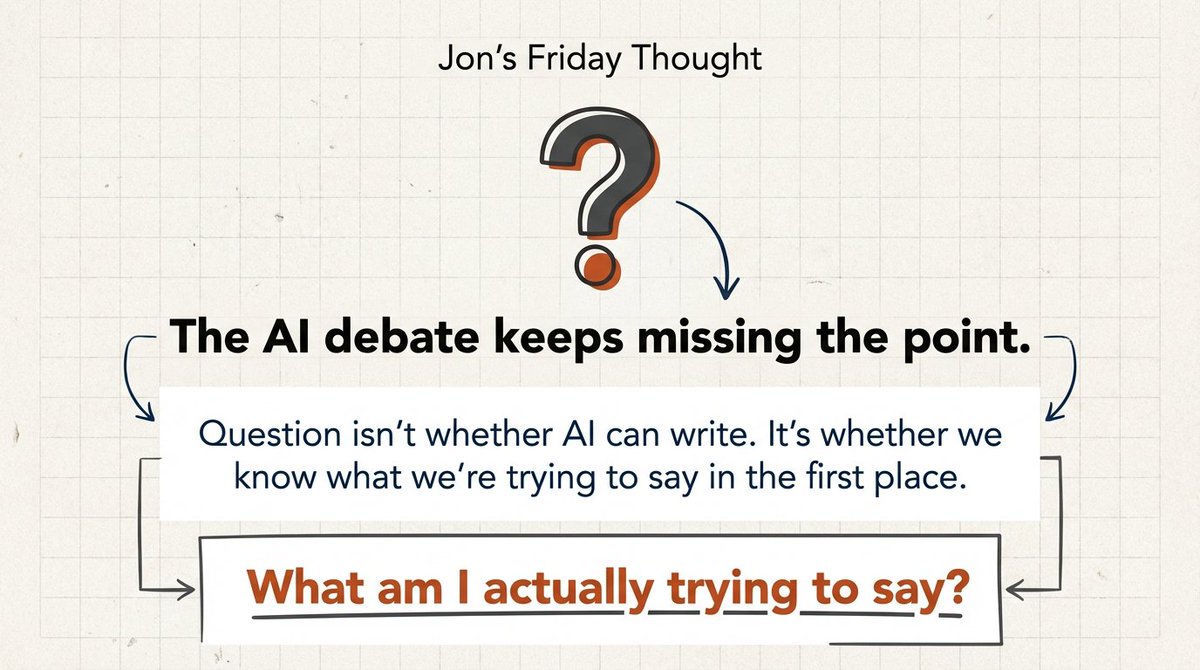
The AI debate keeps missing the point.
Question isn't whether AI can write.
It's whether we know what we're trying to say in the first place.
Most of us don't. That was true before ChatGPT existed.
We treat writing like output. Fill the feed. Post because it's Tuesday.
AI just makes that worse faster.
But the ones who treat AI like a thinking partner, not a content machine, end up writing better than before.
Because they're finally asking: "What am I actually trying to say?"
You can't prompt your way to meaning if you don't know what the meaning is yet.
That's the filter we lost.
Microsoft found hidden AI attacks in URLs.
You click "summarize." AI reads invisible instructions that change its behavior.
Every security framework assumes humans are the vulnerability. That assumption just expired.
Bain's research: human-centric AI delivers 2.3x returns.
Technical implementation is easy.
Getting people to trust it and use it? That's where programs die.
IBM's tripling junior hiring this year.
Not for grunt work. For AI experimentation.
They're betting people without legacy thinking move faster with new tools.
CEOs promise AI will give you three-day weeks.
Productivity's up 40% since 2000. Wages haven't moved.
Shorter weeks will come with shorter pay. That's what the data shows every time.
A Substack post moved £60 billion this week.
Not policy. Not earnings. Fiction about AI.
Markets don't price in reality anymore. They price in fear of what someone imagined.
Most experts think the work speaks for itself.
It can't.
Nobody hears it until AFTER they hire you.
Your competitor figured out they needed to speak BEFORE the sale.
That's the entire difference.
I'm 57.
Three kids, 19-26. Living their lives.
I worked 70-hour weeks thinking I was providing.
They visit rarely. They love me.
But I never built the relationship.
I gave them everything except me.
Don't make my mistake.