Its funny that you say that, when you were not even looking towards these levels and every step down you have said something similar, it’s like being ill prepared to where now you need to say these things to build inner confidence 🤦🏾♂️even after what you had called a technical bottom broke, well a lot of the bottoms you were saying were bottoms. You remember when you said solo and Coreum were showing strength the intellectual dishonesty🤦🏾♂️ ☠️
Many are still round-tripping today.
Time always reveals what people chose to learn and what they chose to ignore.
One of the biggest lessons from that first run wasn’t price appreciation, it was value management. Yet instead of learning how to manage assets, take profits, reduce risk, and reposition capital, many got caught up in riddles, narratives, and personalities that offered the illusion of insight without teaching any practical skills.
Years later, the results are easy to see. Many are still making the same mistakes, still waiting for someone else to validate their beliefs, still confusing conviction with strategy, and still round-tripping gains that could have been used to strengthen their position.
The market gives opportunities. What people do with those opportunities is what separates growth from repetition.
Time always reveals the difference.
One of the biggest reasons so many never took profit during that first real run from the .10–.18 range all the way above $3, is because they became round-trippers before they even realized it. And right when they should’ve been learning how to manage their value, the riddles started taking over the community.
It’s wild how those riddles turned into a kind of cult influence, creating “voices” that never actually taught anything practical, just distractions dressed up as insight. And what’s even more disturbing is how many people are still doing the same thing years later. Still round-tripping. Still not understanding value management. Still choosing nonsense over growth, even after all this time to actually learn.
The irony😂🤣, he’s calling out the “crypto is dead” crowd, but the same thing can be said about the constant “you must believe in something” crowd.
They’re two sides of the same coin.
Both are narrative-driven, both are emotional, and both tend to move with the same cycles they claim to be above.
This is why people need to live in reality and observe what is actually happening.
The funny part is watching people bounce between certainty, fear, conviction, euphoria. Sometimes the narratives are more volatile than the market itself.
Preparation is key, but how one prepares is even more important.
When observing in reality, the signs of when to hoist and when not to are always present for those who have trained themselves in the ways of that reality. The signals exist whether people acknowledge them or not.
The difference is that some learn to recognize what is actually there, while others become trapped in mental gymnastics, convincing themselves of what they want to see. At that point, it is no longer about understanding reality, it becomes about defending a belief.
Belief alone does not change reality. Understanding it does.
The goal of an investor is to protect capital first and grow it second. Which this account hasn’t been very good at, Somewhere along the way, many people start treating narratives, promises, and future projections as if they’re guarantees.
As investors, we don’t get paid for what might happen. We get paid for correctly assessing risk versus reward based on verifiable facts and execution.
Nothing in that post proves issuer adoption, marketplace liquidity, transaction volume, revenue generation, regulatory approvals, or an “immediate repricing.” Those are assumptions about the future, not evidence in the present.
A marketplace alone is not a use case. Plenty of marketplaces launch with little activity because liquidity, participation, incentives, and adoption still have to be earned.
The idea that there will be an “enormous amount of issuers ready to go on day one” is speculation until those issuers are publicly identified and committed.
Investing requires separating what is known from what is hoped for. Capital preservation comes from managing risk, not assuming best-case scenarios. Growth comes later if the execution actually matches the narrative.
tx:native 🔥🔥🔥
Refocusing on the Goal as an Investor
I want to explain something to the community about TX in case people lost their focus on the goal and the purpose of why you're in it as an investor
Why exactly this is going to pay off very well and stand out as one of the top ranking cryptos when the bull run starts VERY SOON 💰💲
👇
🔹TX will bridge traditional finance and blockchain technology together
🔹A solution that will allow issuers to buy, sell, trade and settle assets on chain
🔹Issuers will be able to streamline their services in a unified compliance focused marketplace to access a broader global reach of investors
🔹But Solotex will be the regulatory arm that helps settle everything onchain
🔹If you don't have a marketplace you don't have a use case
🔹The marketplace is absolutely foundational to the utility and its use case to the entire product, because it serves as the central hub for liquidity
🔹I wouldn't worry yet because we're not live yet and when we do see this launch, IT WILL LAUNCH WITH AN ENORMOUS AMOUNT OF ISSUERS READY TO GO DAY ONE, they're not going to launch an empty store
🔹This is why the price is more likely going to be a Nike Swoosh in nature and immediately, AN IMMEDIATE REPRICING
🔥 Which means that your pain of waiting and going through all of this agony and exhaustion will be well worth it
"Demand on Issuer Activation"
NFA
Charts are just records of past and present data, that’s where all analysis starts. The issue is when forecasting gets treated like proof instead of hypothesis.
Pattern analysis is only forward-looking when it actually emerges from the data. And if someone says their conclusions are primarily based on macroeconomics and monetary policy, then the same criticism applies, if the framework is genuinely driving the analysis, it shouldn’t require constantly generating new scenarios, recalculating outcomes, or shifting between explanations while maintaining the same conclusion. That behavior suggests the conclusion is being preserved first and the frameworks are being used to support it afterward.
Everyone has bias. The difference is whether you challenge it or keep reinterpreting the data every time it doesn’t fit. That’s where analysis breaks down, when invalidation turns into another framework shift instead of a reassessment of the conclusion.
Macroeconomics, monetary policy, indicators, they’re tools, not validation systems. If the data doesn’t lead the conclusion, it’s not analysis, it’s justification. Which time has revealed many times over with your takes from Solo to Coreum to now, even when you wasn’t planning on these levels till recently when the charts where already showing the data.💯💯💯💯🫡
Record of transactions, liquidity, participation, volatility, and price discovery is past or present looking
Pattern analysis is forward looking
Everyone on earth trades on their own bias unless you have no money in the game
I just try to do it based on macro economics and monetary policy
@MindOfRaemi They need ppl(demand) to be able to do anything. If their is no liquidity , their is no way out even for those who are providing the means like who Dom names as who are “They”. Telling ppl they are just naive when explaining it like that is just 🤦🏾♂️
That's actually part of the problem. Charts aren't pictionary. They're a record of transactions, liquidity, participation, volatility, and price discovery, not a canvas for subjective interpretation.
And that's exactly what happens with a lot of his takes. The goalposts keep moving, the comparisons keep changing, and multiple different scenarios get presented depending on what supports the latest conclusion. One day it's one analogy, the next day it's a completely different framework, and if neither fits, a new interpretation gets introduced. When the premise is constantly shifting, it's difficult to evaluate whether the analysis was ever correct in the first place because there's always another explanation waiting in the wings.
Pictionary is about guessing and interpretation. Charts are a record of transactions, liquidity, participation, volatility, and price discovery. The patterns aren't being drawn for us, they are a byproduct of market activity.
When people start treating charts like pictionary, they end up seeing whatever they want to see. One person sees a bull flag, another sees a bearish wedge, and a third sees a cup and handle. At that point they're analyzing their own bias more than the market.
The data should lead the conclusion. The conclusion shouldn't lead the interpretation of the chart.
Preparation is a process, but if you’re constantly approaching it with bias like this guy and using indicators only to validate a preconceived conclusion, you’re not preparing, you’re rationalizing.
That’s why so many people end up constantly moving the goalposts. Every time the market, data, or reality doesn’t align with their narrative, a new explanation appears, a new theory is created, or the criteria suddenly changes.
There is no need for all the word salad, mental gymnastics, or endless different takes. The information is already there. The purpose of indicators and data is to reveal what is happening, not to prove what you wanted to believe from the start.
When your analysis is built on confirmation rather than observation, your conclusions will always be unstable because they’re tied to your bias, not the actual conditions in front of you
Well the market bottomed on February 6th
I made that aware on April 1st
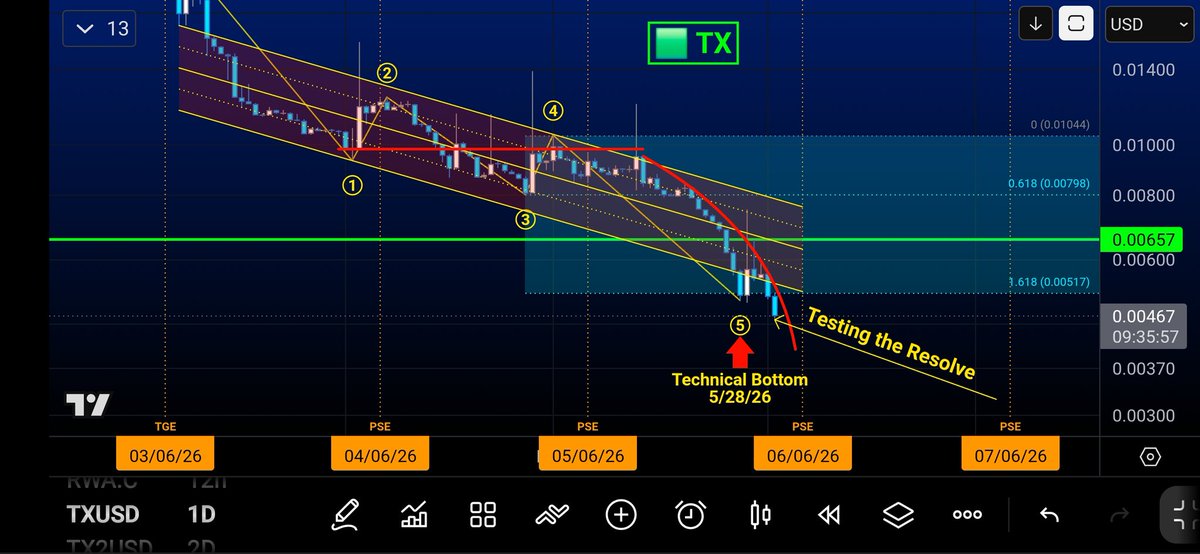
Regarding TX the technical bottom is $0.00517. That's the facts because it's 1.618
However, the market is "Testing the Resolve" meaning this is true manipulation at work by the market makers and for good reason
So therefore it can break the structure below that for several days, And it will do so temporary
This is why it's impossible to predict bottoms, and the word we should be using is "technical bottoms"
The technical bottom for TX is 1.618 at $0.00517 👇
Preparation is a process, but if you’re constantly approaching it with bias like this guy and using indicators only to validate a preconceived conclusion, you’re not preparing, you’re rationalizing.
That’s why so many people end up constantly moving the goalposts. Every time the market, data, or reality doesn’t align with their narrative, a new explanation appears, a new theory is created, or the criteria suddenly changes.
There is no need for all the word salad, mental gymnastics, or endless different takes. The information is already there. The purpose of indicators and data is to reveal what is happening, not to prove what you wanted to believe from the start.
When your analysis is built on confirmation rather than observation, your conclusions will always be unstable because they’re tied to your bias, not the actual conditions in front of you
Well the market bottomed on February 6th
I made that aware on April 1st
Regarding TX the technical bottom is $0.00517. That's the facts because it's 1.618
However, the market is "Testing the Resolve" meaning this is true manipulation at work by the market makers and for good reason
So therefore it can break the structure below that for several days, And it will do so temporary
This is why it's impossible to predict bottoms, and the word we should be using is "technical bottoms"
The technical bottom for TX is 1.618 at $0.00517 👇
Nice article. One thing worth clarifying is that “hot vs cold” is only one layer, there is also how assets are actually held and controlled, whether they are cold or hot.
There’s also a deeper distinction between custodial accounts and self-custody interfaces. Some platforms are essentially custodians, meaning they actually hold the private keys and you’re operating more like you would inside a traditional banking or brokerage account—your balance is represented to you, but the platform ultimately controls the underlying keys.
Others are non-custodial interfaces that simply act as a signed gateway to the blockchain. In that case, the assets never leave the chain, and the wallet is just a UI for you to manage and sign transactions directly with your own keys.
A good comparison here would be @UpholdInc versus @XamanWallet . Uphold operates more like a custodial exchange account where the platform retains control of the assets on your behalf. Xaman, on the other hand, is a non-custodial wallet interface where you hold your own keys and it simply helps you interact with the ledger. Even though both can appear “hot” in classification terms, the actual security model and ownership structure are fundamentally different.
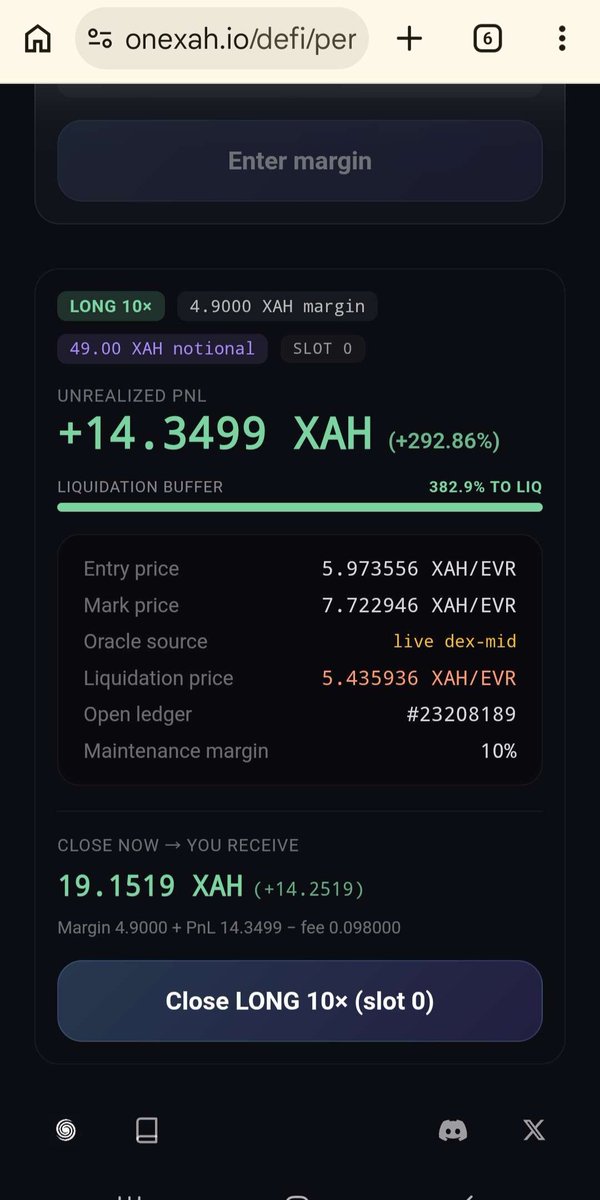
Check out this 10x Long I won on #Xahau 292%⛳️. It lived and was executed onchain in the perp hook. No exchange, no bank, no intermediary. Just the bazaar 👥
https://t.co/D8XcNoaqKC
#XRPL#Evernode $XRP $EVR