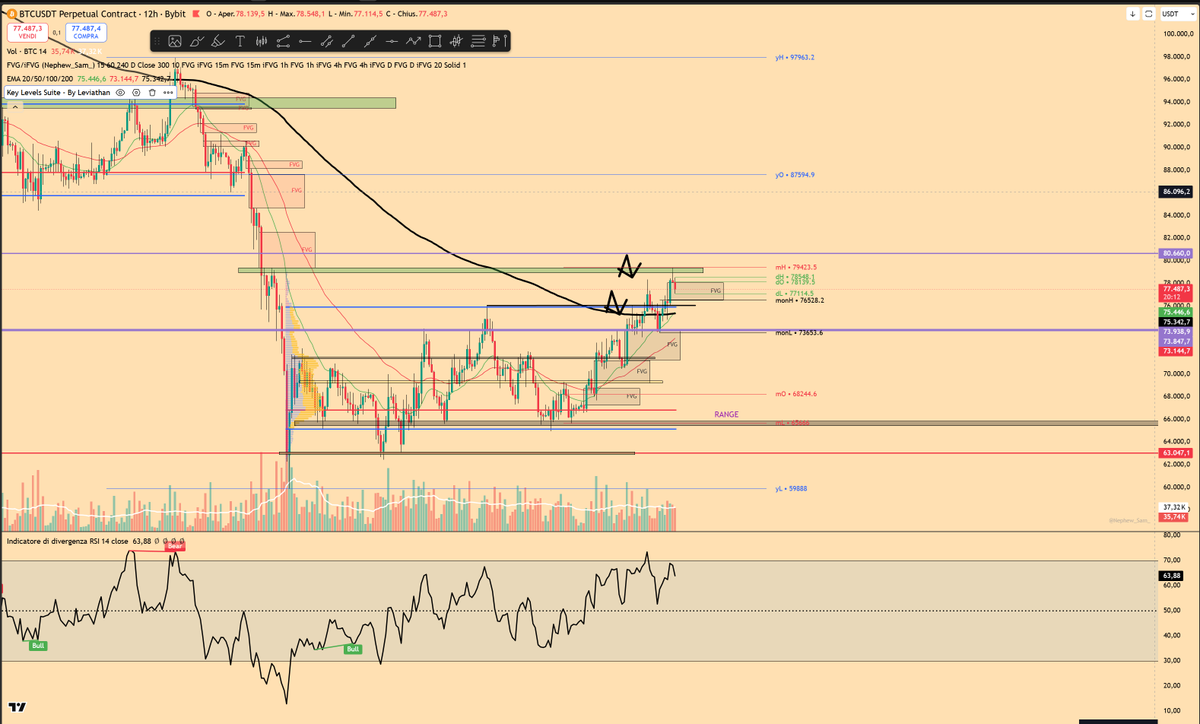
Most traders enter trades because the chart "looks good."
That is not an entry. That is an opinion.
This educational post is sponsored by @_WOO_X, where I trade crypto with zero fees on spot.
Every trade I take has to answer 3 questions before I pull the trigger: where is the context, where is the location, and where is the confirmation?
And the answers change completely depending on whether the market is trending or ranging.
Before anything else, you need to know what market you are in.
A trending market makes higher highs and higher lows (or the opposite).
A ranging market rotates between two clear levels.
Using trend rules in a range will chop you to pieces. Using range rules in a trend will get you run over.
Get this wrong and nothing else matters!
In a trend, I only trade with the trend. No counter-trend heroics.
In an uptrend, I only take longs at Higher Lows.
In a downtrend, I only take shorts at Lower Highs.
Where I look for these entries: key levels from prior structure, Fibonacci pullback zones (typically 0.5 to 0.75), and clear supply/demand areas.
What confirms the entry: an LTF structure shift in the direction of the trend, combined with RSI divergence at the HL or LH.
The Higher Low alone is not enough. Without LTF confirmation, there is no trade.
In a range, I only trade the extremes. Never the middle.
At range high, I only look for shorts, and only on a deviation — when price breaks above the high, sweeps liquidity, and closes back inside.
At range low, same logic in reverse — only longs on a fake-out below.
Where I look: key levels inside the range, the deviation itself, and the LTF market structure break.
What confirms: the deviation sweeps liquidity and closes back inside the range, an LTF MSB in the opposite direction of the sweep, and RSI divergence on the deviation.
Middle of the range? No trade. Ever.
Notice what is the same in both scenarios: LTF structure shift + RSI divergence.
That is the actual trigger.
The context (trend or range) tells me WHERE to look.
The LTF structure and divergence tell me WHEN to pull the trigger.
Without the trigger, I wait. I do not force. I do not "feel it out." I wait for the chart to tell me it is time.
This framework does one thing above all else: it keeps you out of bad trades.
It forces you to define context before entry.
It gives you specific locations to watch. It requires confirmation before you commit.
Most losing trades happen because the trader skipped one of these three steps.
They entered in the middle of a range.
They shorted in an uptrend.
They entered without a trigger and called it "conviction."
Conviction without structure is just hope.
3 entry triggers. 2 scenarios. 1 discipline.
Context → Location → Confirmation.
If your trade does not tick all three boxes, it is not a trade. It is a gamble.
All this free educational content is sponsored by my partner @_WOO_X. Zero fees on spot. If you trade, trade with me:
🔗 https://t.co/iWxTrgYsA3
@SailorManCrypto come riesci a trattenerti al non entrare anche se lo vedi andare giù, penso sia la cosa più difficile del mondo, il prezzo non ha raggiunto il tuo livello di retest e va giù, il cervello ti dice guarda hai ragione e stai perdendo il guadagno, dio santo quanto è difficile
@SailorManCrypto Utilizzi con il volume profile l oi e cvd spot e futures? Se lo utilizzi per dare conferme sarebbe davvero utile capire come ti muovi, grazie di cuore per quello che fai ❤️, mi dispiace che io non posso aiutarti in qualche modo, ma se hai bisogno di uno scanner allora si
@BullyDCrypto The trigger when the price hit important support or resistance, what tells me ok the price reverse and pushes the trigger, if the oi and cvd spot and cvd futures matter in these trigger points, thank u so much
@SailorManCrypto non riesco a scriverti, mi da questo problema, cmq io non sono uno scammer, non voglio nessun soldo non chiedo niente, solo che mi aiuti