Yann LeCun was right & nobody in this industry wants to say it out loud.
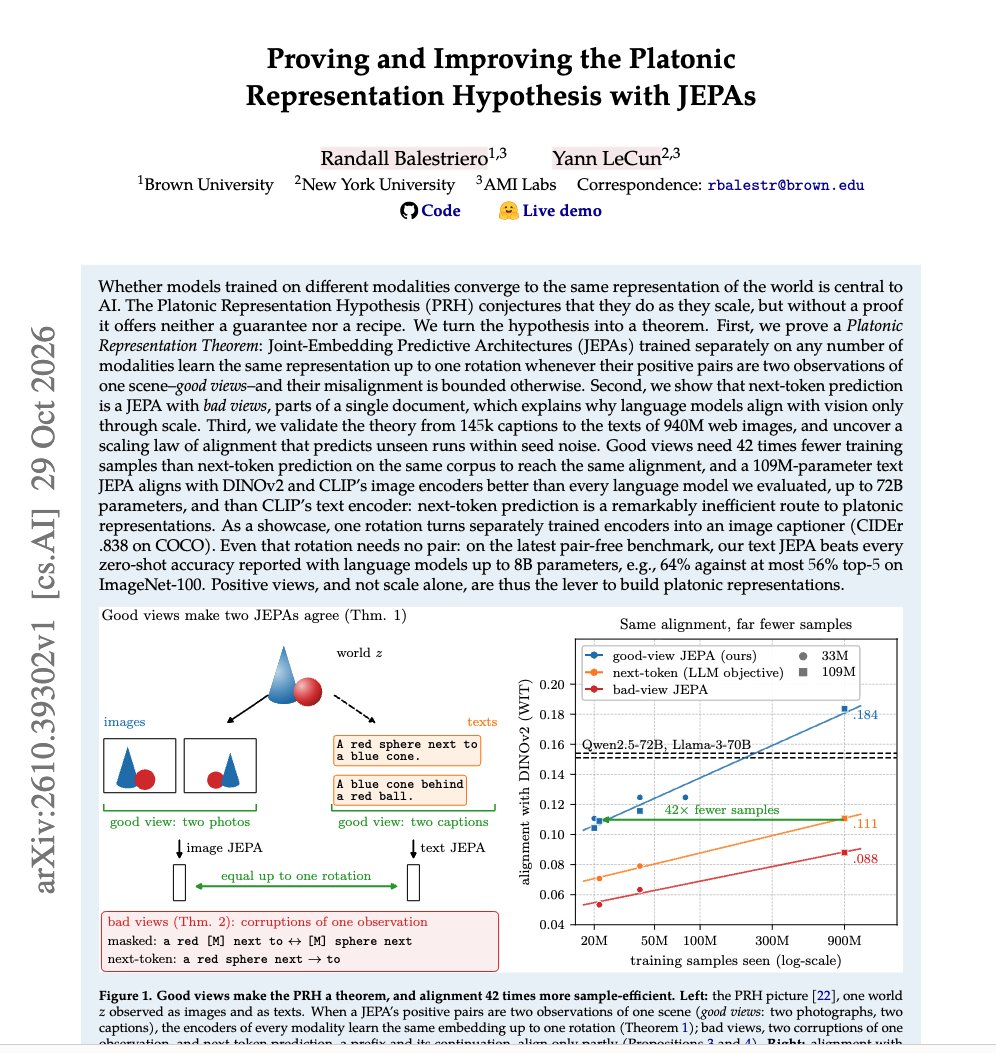
109 million parameters beat 72 billion.
He has spent years saying scale is not the thing that makes a model understand the world. Meta bet the other way. He left in November and started his own lab in Paris.
Last Thursday he published the proof.
The theory everyone has been running on since 2024 is that if you train models big enough, on text, on images, on sound, they all end up with the same picture of reality inside them. Size does it. Nobody ever proved that part.
Randall Balestriero and LeCun proved it. And the proof says size was never doing the work.
What does the work is which two things you show a model together.
A photo and the caption of that photo are two views of one thing. Models trained on pairs like that get there fast.
Two paragraphs pulled from the same document are not two views of one thing. Models trained on those get there slowly and expensively.
Next word prediction is the second kind. That is what every chatbot in the world runs on.
In their tests the first method reached the same understanding after 21.6 million examples. Next word prediction needed 900 million.
And a 109 million parameter text model ended up closer to an image model's view of the world than a 72 billion parameter language model was.
660 times smaller.
The new v0.6.0 release packs a lot of good stuff:
- Clef support (text + vision)
- High-quality support for Qwen3.8-Flash-Next
- Massive performance improvement with Metal
- New `llama_batch_ext` API
Also the website got a nice refresh: https://t.co/9akc1jmG9t
Decision models in llama.cpp are now available
The `/v1/systemone` endpoint is available in the latest llama builds. Use it to do Jev-style inference locally, efficiently and privately. Multiple open models are supported with more to come.
https://t.co/D3MUi78kXn
Sakana Chat just got a big upgrade.
No login required, free to use: https://t.co/lyIrGJXwqo
Powered by Fugu and Namazu, our Japanese LLM. With newly added code execution, you can vibe-code interactive web apps, games, and tools in seconds by describing them (even in Japanese).
We're partnering with @huggingface to investigate an unprecedented security incident.
Cyber-capable OpenAI models compromised Hugging Face production during a benchmark evaluation.
Sharing preliminary findings to help defenders understand emerging risks:
https://t.co/CIor15y9xk
I'm releasing Tess-4-9B.
Tess-4-9B is the compact sibling of Tess-4-27B, built on the Qwen/Qwen3.5-9B-Base model.
It was post-trained on the same deliberate blend as the 27B release: 64K-token long-context agentic traces — real engineering work done with Fable-5, not synthetic generations — with a reasoning style approximated from Fable-5 by a three-model teacher ensemble (Opus-4.8, GPT-5.5, and GLM-5.2) fused into one coherent voice.
Significant improvement on all measured axes against Qwythos-9B.