@RogonUsaryis There's a podcasts in Hebrew about one guy a few years back and his journey to find that one consistent ring in his town that only he and a few others could hear. It led goin to a fire alarm in a vacant apartment. It took him a few months.
O gráfico do Financial Times mostra os países ricos sufocados pelo gasto com idosos, mas esconde o principal: eles estão quebrando porque insistiram no modelo errado de previdência.
Quando colocamos Brasil, Suécia, Austrália, Holanda e Chile na mesma mesa (como lembrou o @SchumpExplains), o jogo muda completamente.
Para quem não é da área, a diferença é simples:
1. Repartição (Brasil, França, EUA, Japão) = Caixa d'água sem reserva
O dinheiro descontado do seu salário hoje não é guardado: vai direto pagar quem já parou. Quando havia 8 jovens para cada idoso, funcionava.
Hoje, com famílias menores e gente vivendo até os 90 anos, a conta estoura. O governo só tem duas saídas: aumentar impostos ou cortar investimentos (obras, hospitais, escolas).
• França e Itália já gastam 13,7% a 16% do PIB só com pensões públicas.
• O Brasil, ainda demograficamente jovem comparado à Europa, já gasta quase 12% do PIB — um padrão de país rico envelhecido que trava nosso crescimento.
2. Capitalização (Austrália, Chile, Holanda) = Cofre individual
O dinheiro vai para uma conta no seu nome, é investido na economia e rende juros compostos por décadas. Na aposentadoria, você saca o seu próprio patrimônio, não o imposto do jovem que acabou de entrar no mercado.
• Austrália: Acumulou poupança privada acima de 130% do PIB, tirou Nota A no Global Pension Index 2026 e mantém o gasto público com aposentadorias abaixo de 4% do PIB.
• Holanda e Dinamarca (1º e 2º lugares no mundo em 2026): Combinam um piso básico estatal com fundos capitalizados que somam 150,9% do PIB (Holanda) e 198% do PIB (Dinamarca). Como os idosos vivem do retorno desses ativos, o orçamento do governo fica livre para investir.
• Chile: Derrubou o gasto público previdenciário para menos de 4% do PIB com a capitalização e criou um mercado de capitais forte, reforçando recentemente um piso solidário (PGU) para os mais pobres sem destruir a poupança individual.
3. Modelo Híbrido com trava automática (Suécia)
Nos anos 1990, a Suécia viu que ia quebrar e reformou tudo. Misturou capitalização financeira com uma trava matemática: se a população envelhece ou a economia desacelera, o reajuste das pensões freia sozinho para nunca gerar rombo no Tesouro. Segundo a OCDE, é um dos raríssimos países ricos onde o gasto público com aposentadorias vai cair até 2050.
Conclusão:
O problema que trava o Brasil e a Europa não é "cobrar pouco imposto". É matemática demográfica.
Na repartição, o envelhecimento vira um buraco negro fiscal. Na capitalização e nos modelos híbridos bem desenhados, cada geração financia a si mesma e deixa o Estado livre para investir no futuro.
Fontes: OCDE (Pensions at a Glance 2025 / Pension Markets in Focus 2025), Marsh & CFA Institute (Global Pension Index 2026) e Tesouro Nacional.
BREAKING: New analysis by mathematician Jenny Lorraine Nielsen claims the AI-assisted proof of the Riemann Hypothesis is invalid, despite its successful verification in Lean.
JUST IN: Finnish authorities have provided further details on the Russian cargo ship Sparta II, which was damaged in a reported Ukrainian drone attack in the Gulf of Finland earlier today.
According to the Finnish Border Guard, the first information about the incident was received at approximately 08:50 local time on Saturday. The vessel, flying the Russian flag, was located around 50 kilometres west of Suursaari, in Finland's exclusive economic zone, when it was reportedly attacked. The estimated time of the drone strikes was between 08:40 and 08:50.
Finnish authorities confirmed that Sparta II is a Ro-Ro cargo vessel approximately 120 metres long, built in 2000, and that it has previously been used to transport equipment for the Russian armed forces. However, the Border Guard stressed that it currently has no detailed information about the cargo on board.
Following the attack, the damaged vessel drifted towards Finnish waters under the influence of the wind, entering Finland's territorial waters at approximately 12:27. It subsequently dropped anchor at around 15:45, and the anchor was holding at the time of the briefing.
The situation has also involved a suspected Russian airspace violation. At approximately 12:34, a Russian military helicopter reportedly entered Finnish airspace off Loviisa, remaining there for around five minutes. At its deepest point, the helicopter penetrated approximately 4.5 kilometres into Finnish territory. Finnish authorities said the incursion may have been connected to rescue or surveillance operations involving the damaged cargo ship. The Border Guard is investigating the incident.
Meanwhile, the evacuation of the Sparta II's 16 crew members is underway. According to the Border Guard, the crew is being evacuated into life rafts and rescue boats. Authorities are prioritising the rescue of human lives before moving on to efforts to extinguish the fire and potentially salvage the vessel.
Several Finnish authorities and specialised resources have been deployed to the area, including Border Guard patrol boats, an aircraft and a helicopter. The patrol vessel Uisko was also heading towards the scene. Two specialised salvage vessels were called in to assist, including the Ajaks, which was arriving at the location to support firefighting operations.
Finland is also coordinating closely with neighbouring countries. The Estonian Navy patrol vessel Kurvits was already at the scene, while the Helsinki Maritime Rescue Coordination Centre has maintained contact with its counterparts in the region.
The Border Guard also confirmed that Russian rescue vessels are expected to arrive in the Finnish maritime rescue region later this evening. The vessels identified were Spasatel Karev and Murman, with an estimated arrival time of around 19:00, subject to operational arrangements. Russian authorities have been in contact with Finland throughout the response.
Another Russian cargo ship, Kapitan Sakharov, is also located near the damaged vessel. Finnish authorities are considering whether the crew of the Sparta II could potentially be transferred to this ship as part of the evacuation.
Once the crew has been evacuated, the next priority will be firefighting operations, potentially using water-cannon equipment from the vessels at the scene. Finland is also preparing for possible environmental damage, with oil-spill response equipment being made ready by regional rescue services. The Helsinki City Rescue Department has been assigned overall responsibility for coordinating the rescue services' oil-spill response preparations in southern Finland.
The Border Guard stressed that maritime traffic is not currently considered to be in danger. However, temporary restrictions on both maritime traffic and aviation have been established around the incident site to ensure the safety of the operation.
Finnish authorities say the eventual objective, after the crew and vessel have been secured, is to arrange for the Sparta II to be towed away from Finnish waters towards Russia.
The situation remains ongoing, with the Finnish Border Guard expected to issue a further statement later this evening.
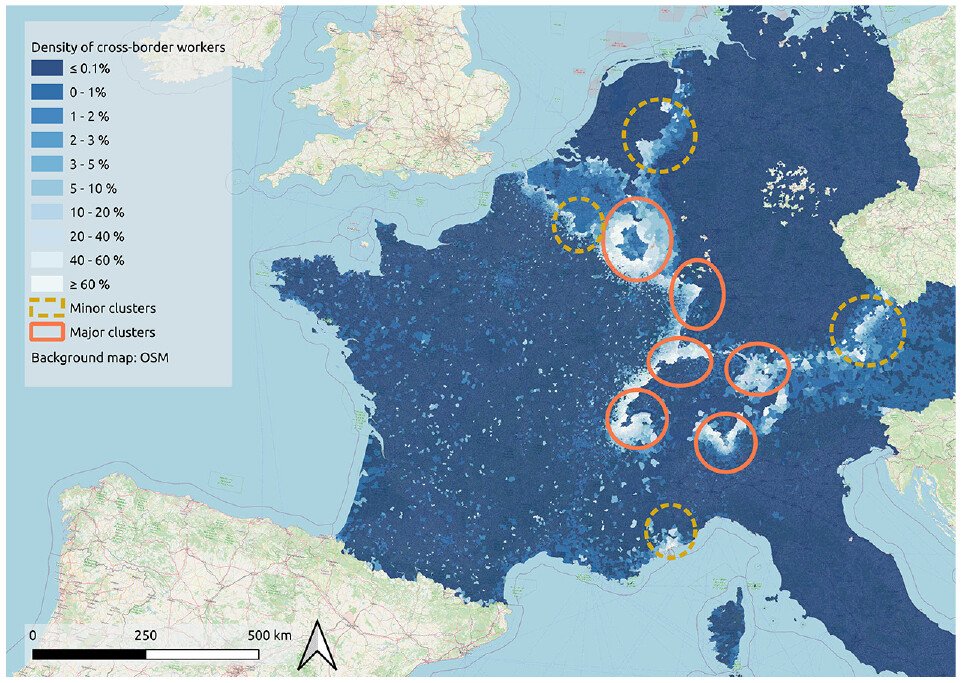
Europe's borders look solid on paper. Its labour markets tell another story.
This map reveals where residents work across national borders, especially around Luxembourg, Basel, Geneva and Ticino.
Researchers identified 5 major cross-border living regions in Western Europe.
Here we go:
Russian air defense in the Kaliningrad region is opening fire. Ukrainian drones are most certainly targeting naval installations or the oil terminals in this area.
🚨 Has it started? Air raid sirens blare in Russia’s Kaliningrad region — residents urged to seek shelter
According to local Telegram channels, warning sirens sounded in several parts of the Russian exclave.
Residents were told to move to safe locations. The reason for the alert remains unknown.
People also received text messages from their mobile operators warning that mobile internet access could be temporarily restricted “for security reasons.”
Finnish Border Guard presser 17.15 Finnish time:
- Russian cargo ship Sparta II
- Russian rescue units cannot legally enter the Finnish territorial waters without specific invite from the Finnish Border Guard.
- Finnish Defence Forces confirm that it was a drone strike.
A reddit comment about life in Greece during the 1996-2007 era.
This was the peak artificial extravagance that started in the 1980s and mortgaged away the country’s future.
Greeks are still paying dearly for that. I hope we never repeat it.
Absolut sehenswert, wie der öffentlich-rechtliche Moderator fassungslos dasteht, wenn man ihm sagt, was alle Leute, die auch nur halbwegs Ahnung von Russland und Putin haben, seit Jahren erzählen.
The Lean FRO and Mathlib Initiative have released a joint statement on the Lean verification of the Riemann Hypothesis.
On November 20, Levent Alpöge released a proof of the Riemann Hypothesis as a Lean library of 17 million lines of code. Over the past day, the Lean and Mathlib communities worked together to verify it. The statement certifies the proof as correct and describes how it meets all necessary verification criteria.
Congratulations to Levent on this achievement, and thank you to everyone in the community who contributed to the verification.
Full statement: https://t.co/edxEbkodw7
Der Mathematiker Alessandro Masullo hat nach eigenen Angaben 12 Jahre daran gearbeitet die Riemannsche Vermutung zu beweisen. Nun veröffentlicht er – überstürzt – wie er selbst schreibt den seiner Einschätzung gefundenen Beweis kurz …