I see a lot of you out there being way too hard on yourselves for making mistakes in your journeys.
But when you’re starting out, mistakes are required.
Every single person who's built something meaningful has made them.
If each failure feels like evidence you're not cut out for this, you’ll quit right before the breakthrough.
Expect the mistakes, learn from and keep going anyway.
Working while having a view like this… I used to dream of this moment.
But what people don’t see is what came before it —
The late nights, the silent overthinking, the constant testing and failing.
Hard work really does pay off… but only if you’re willing to stay patient long enough.
Today, I don’t just work for myself anymore.
I get to help founders, marketers, and companies scale their businesses using data, tech, and structure — from creative strategy to execution.
Every system I’ve built, from ScaleX to XIX and MOU, was meant to solve a real problem.
And now, I’d love to help solve yours too.
Let’s build something that lasts.
It’s how crazy China is.
I remember standing here at night — it was cold, noisy, overwhelming. But I wasn’t here for a vacation.
I flew in with one goal: ScaleX Digital’s expansion. Not to bring ads, but to bring efficiency — real AI-backed consulting for manufacturers, using data, systems, and process automation. To help factories cut waste, improve reporting, and scale their operations globally.
This wasn’t an idea I built alone.
Behind all of it was Junji Lim — the mentor who guided me through the real work behind business growth. He taught me to build not just one brand, but an entire operating ecosystem.
That’s where XIX Sync came in. Not just another agency — it became our lab. We tested marketing frameworks, refined automation flows, and optimized everything with real-time performance data.
And when things got too chaotic? We built MOU — the system that kept everything running smoothly. Processes. Teams. Ops. All under one clean structure.
People often ask, “What’s the hardest part of growing a business?” For me, it wasn’t the market. It was proving I could do this at 20 — before people even believed I was capable.
But standing here in China, a few years later — I realized: you don’t need to be the loudest in the room.
You just need to be the most prepared.
It’s hard to do business when you’re too young.
People doubt your experience, question your leadership, and sometimes… they just don’t take you seriously.
In the early days of ScaleX, I faced that more times than I could count. I was building a consulting firm focused on performance strategy and AI-backed data systems — and walking into rooms where I was often the youngest person by a decade.
But instead of trying to prove I knew everything, I focused on what I did know — how to ask better questions, listen faster than others execute, and build systems that made businesses more efficient through data.
ScaleX was never meant to be loud. It was meant to work. And as the results compounded, so did the trust.
Eventually, XIX Sync was born — taking everything we learned at ScaleX and turning it into growth marketing infrastructure that other brands could use. MOU followed, streamlining creative operations and content systems for businesses that want to scale fast, without chaos.
I still get underestimated sometimes. But I’ve learned:
Being young isn’t a weakness — if you know how to turn clarity, speed, and data into your edge.
I still remember what it felt like when everything was uncertain.
Trying to break into the tech space. Learning how to build systems that actually worked. Convincing clients to trust a young team with big ideas. It wasn’t smooth — most of the time, it felt like flying without a clear landing.
But we kept going. One problem at a time.
That’s how ScaleX was born. Then XIX. Then MOU. Not from luck — from figuring things out the hard way. From learning how to connect data with action, and turning AI from buzzword into results.
Looking out the window today, I’m reminded of how far things can move — not just when you dream big, but when you stay focused long enough to execute.
We’re just getting started.
When I first got into this space, I wasn’t building companies. I was just trying to understand how things work — how data turns into decisions, how psychology shapes conversions, and how small systems scale big impact.
It started with late-night experiments. Failed offers. Cold emails. Notes on how ad accounts behaved when we tweaked just one line.
Then came ScaleX. Then XIX. Then MOU.
Not because I had all the answers, but because I kept asking better questions. With people like Junji Lim showing me what it means to think beyond marketing — into infrastructure, decision engines, AI data analysis, and long-term operating systems.
Still walking the path. Still learning.
But every step now feels a little clearer than the last.
A few years back, I was still figuring things out — not sure if the path I was on would lead anywhere solid.
No team, no roadmap, no fancy title. Just late nights reading case studies, breaking down performance marketing funnels, and diving deep into how data really drives decisions.
Then came ScaleX. Then XIX. Then MOU.
Not overnight. It took months of testing, failing, rebuilding. And one of the biggest shifts came when I started learning from Junji Lim — someone who didn't just talk about growth, but actually showed me how to build systems that scale with data and psychology.
Now we’re building AI-powered systems that help businesses read patterns, optimize spend, and make smarter moves with performance data.
I’m still learning. Still obsessed with what data can do — when used right.
But I guess that’s the point.
You don’t need to be loud. You just need to move.
🚨BREAKING: New Python library for Bayesian Marketing Mix Modeling and Customer Lifetime Value
It's called PyMC Marketing.
This is what you need to know: 🧵
Interesting global survey just dropped:
2 out of 3 enterprise leaders now see AI & data sovereignty as non-negotiable.
Not just a “nice-to-have”… but mission critical.
Why?
Because enterprises are realizing...
👉 If you don’t control your data...
👉 You don’t control your AI outcomes…
👉 And soon… you won’t control your competitive edge.
Some cool data points from EDB’s 2025 report:
🌍 Germany, US & Saudi are leading the sovereignty race.
🏦 In banking/finance, over 50% already treat sovereignty as core to AI deployment.
🔓 Top drivers?
Breaking out of data silos
Shifting towards open-source AI stacks
Tight hybrid security + infra integration
It’s like… every company wants “Amazon-level AI agility”…
But the real question 👉 Do you OWN your data? Your AI pipeline? Your infrastructure path?
Curious:
For those building or leading AI teams right now...
👉 Are you pushing towards AI sovereignty?
👉 Or still fully dependent on third-party clouds and black-box models?
Where do you see your company on this curve?
#AIStrategy #DataSovereignty #EnterpriseAI #AIInfrastructure #HybridCloud #OpenSourceAI #CIOLeadership #AIandCloud #DataOwnership #AI2025 #AIandCompliance #EnterpriseArchitecture
We all love talking about GPUs, LLMs, and training runs...
But here’s a boring, ugly reality that’s coming fast:
AI’s hunger for electricity is breaking the grid.
Deloitte just dropped a new report:
By 2035… US AI data centers could consume 123 gigawatts of power.
(That’s up from just 4GW today… A 30x jump)
Some crazy highlights:
Some future data centers could need 5GW... enough to power 5 million homes.
In some states... it now takes 7 years just to get grid connection approval.
Residential electricity bills are already rising in major data center zones.
Shortages in skilled labor + rising costs for steel, copper, cement = bottlenecks on both grid and data center builds.
And here’s the kicker
72% of utility + data center executives say grid capacity is now their #1 blocker for AI expansion.
So here’s the big uncomfortable question for everyone in tech and infrastructure:
Are we racing towards an AI-driven energy crisis?
Or can renewables, storage, and infrastructure investment catch up in time?
If you’re in energy, infra, or AI—curious how your teams are thinking about this right now?
#AIInfrastructure #EnergyCrisis #GridCapacity #AIDataCenters #PowerGrid #DataCenterGrowth #AIandEnergy #InfrastructureChallenges #AI2035 #ElectricityDemand #DataCenterPlanning
AI isn’t just about algorithms anymore — it’s about land, power, and sovereignty.
What’s quietly happening behind the scenes:
– Amazon is building 30+ data centers in Indiana
– Power demand from AI is expected to surge 30x by 2035
– Deloitte says grid strain is now the #1 bottleneck
– Global execs say data sovereignty is no longer optional
We're watching the physical internet of AI being built — and the new economic empires rising with it.
Not many people are paying attention to this shift yet.
But this is where the next trillion-dollar advantage gets carved.
Everyone’s talking about models, LLMs, and GPU power lately…
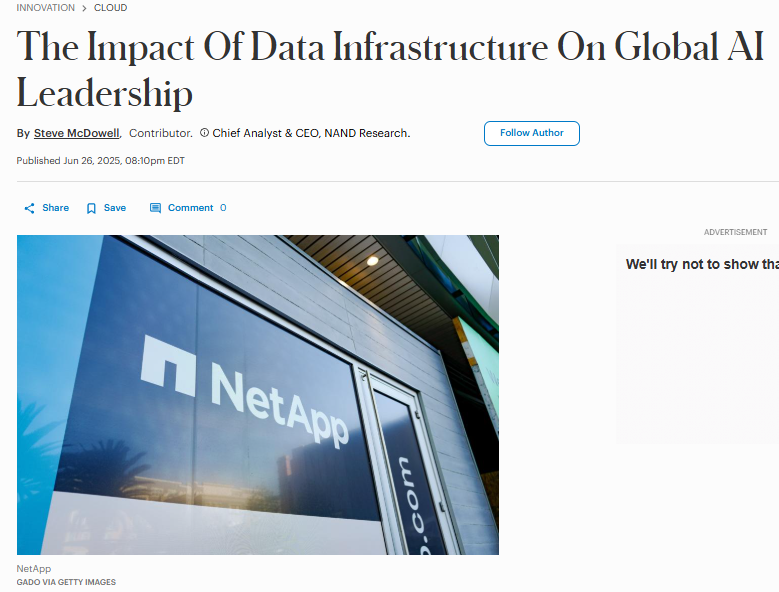
But there’s one boring-sounding topic quietly deciding who actually wins the AI race: Data Infrastructure.
NetApp just dropped their 2025 “AI Space Race” report.
800+ execs surveyed from US, UK, China, and India.
The big theme?
AI leadership isn’t just about ambition… it’s about operational readiness + infrastructure.
Some interesting findings:
88% of companies say they’re “ready for AI”... but many still lack scalable, secure data foundations.
The US and China both think they’ll lead AI globally (surprise 😂), but China shows a big gap between CEO optimism and IT reality.
79% of executives fear their AI models will fail or produce bias because of poor data infrastructure.
What I found most interesting 👉
China is sprinting with scalability…
The US and others are playing the long game with system integration + sustainability.
So here’s my question for you guys:
In this global AI race...
Is it better to scale fast and fix later (China style)?
Or build slow but strong foundations (US/UK/India style)?
Curious what you think.
For anyone building AI infrastructure, storage, or data pipelines... what’s YOUR biggest headache right now?
#AIInfrastructure #AILeadership #DataOps #AIBusiness #AIReadiness #NetApp #CloudAI #EnterpriseAI #AIExecution #TechRace #AIDataChallenges
Big moves coming from the US government...
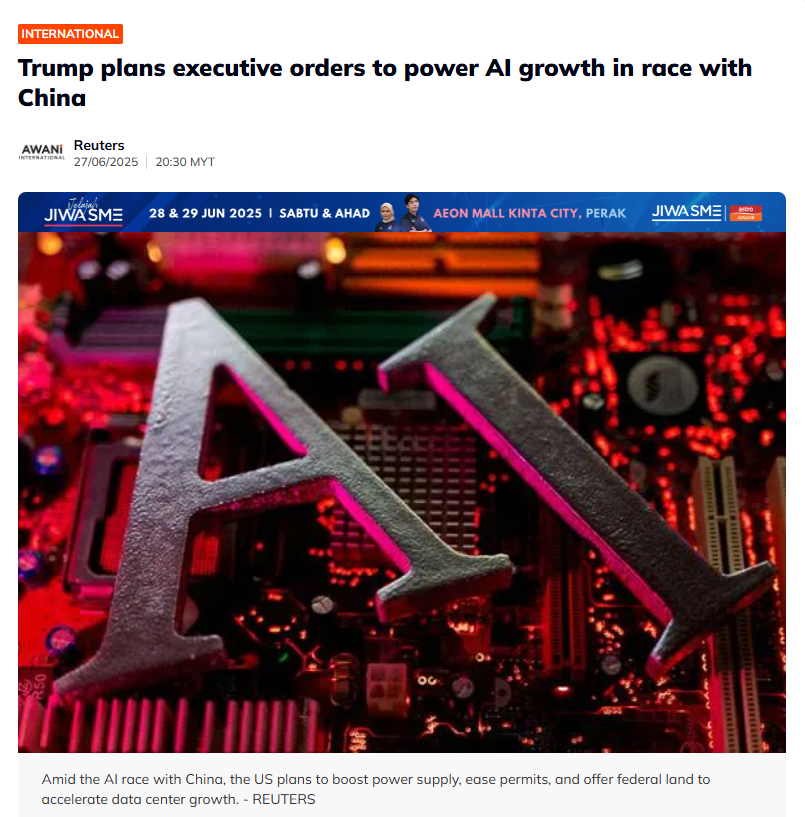
Trump’s administration is preparing a full-blown AI acceleration plan…
Not just investments... but executive orders.
👉 Easier grid connections
👉 Fast-tracked energy permits
👉 Freeing up federal land for AI data centers
👉 Even talking about making July 23 "AI Action Day"
All this... because the US is in a tech arms race with China.
AI = Economic edge + Military edge + Global influence.
But here’s the interesting part:
Behind the national headlines... this is about power. Literal power.
AI data centers are already pushing America’s energy grid to its limits.
Consultants are saying US electricity demand could grow 5x faster than expected...
And AI energy use alone could grow 30x by 2035. 😳
So here’s my question (genuine curiosity 👇):
Can AI scale without causing an energy crisis?
Or are we entering an era where speed > sustainability... just to win the AI race?
And for companies…
Will “who has the most data centers” become the new flex?
Or will it backfire on communities already struggling with energy bills?
Would love to hear your take.
#AI #Geopolitics #EnergyCrisis #AIInfrastructure #ChinaUS #DataCenters #AIActionDay #TechRace #AIandEnergy #SustainabilityVsSpeed
When we imagine the AI boom…
We think of ChatGPT…
Smart assistants…
Or viral AI tools on our phones.
But here’s something you don’t usually see on your feed 👇
In a small rural corner of Louisiana...
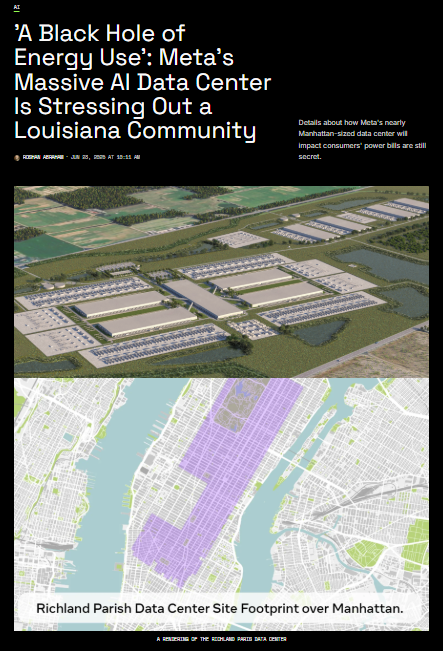
Meta (yes, Facebook / Instagram Meta) is building one of the largest AI data centers in the US.
📍 Over 4 million square feet
📍 2.3 gigawatts of power needed (that’s like adding a whole new small city to the grid overnight)
📍 3 new gas plants just to keep it running
And guess who’s helping foot the bill?
Local residents…
In one of the poorest regions in the state.
Where people already struggle with high energy costs.
The wild part?
Details about Meta’s energy deal are still secret.
And many Louisiana families may soon see their utility bills creep up... just to keep AI servers cool and running 24/7.
It’s like…
On one side: 🧠 “AI Innovation at scale”
On the other: 💸 “Higher monthly bills for people who may never use these AI tools at all.”
I get that AI infrastructure needs power…
But should rural communities be the ones paying the price for global tech giants?
Curious what you think:
Is this the price of progress?
Or is the system broken?
#AI #EnergyCrisis #TechEthics #MetaAI #DataCenter #ClimateImpact #DigitalDivide #InfrastructureCosts #BigTech #AIExpansion
Ever wondered... who actually feeds AI all the data it needs to work?
I used to imagine it was all automated.
But turns out... it’s rooms like this 👇
Hundreds of workers in Shenyang, China…
Clicking… dragging… boxing… dotting…
For hours… every day.
Drawing green dots around moving cars.
Labeling whether that blurry shape is a person or a pole.
Or… parked car vs moving car. Frame by frame.
Feels a bit like an AI version of factory work.
Monotonous… but mission-critical.
The city itself?
Once a steel and coal hub. Now… a global AI data factory.
And it makes me wonder...
When we talk about “AI changing the world”…
Do we ever think about the humans behind the scenes… making it all possible?
Who’s labeling the future we’re all hyped about?
Just curious.
#AI #DataWork #HiddenLabor #BehindTheScenesAI #TechAndPeople
The real AI race isn’t about ChatGPT anymore.
It’s about power grids, data centers, and who controls the infrastructure behind the scenes.
US demand for AI data centers is expected to grow 30x by 2035. Amazon’s pumping in $20B. Trump’s pushing executive orders to fast-track AI infrastructure builds.
And globally, C-suites are waking up:
Data sovereignty isn’t a luxury. It’s the new baseline.
It’s not just about building the best model, it’s about owning the pipeline.
This is the part of AI most people ignore… but where the long-term value will be decided.
The Data Supply Chain for AI Just Got Messy… Again
OpenAI has officially cut ties with Scale AI… just days after Meta announced its multi-billion dollar partnership with Scale and brought Alexandr Wang (Scale’s CEO) into Meta’s leadership circle.
A year ago?
Scale AI was one of OpenAI’s most important data labeling partners.
Now?
OpenAI is walking away… and Google is reportedly next.
What’s happening here isn’t just “a vendor switch.”
It’s a glimpse into the new AI power struggle:
✅ Model builders (OpenAI, Google, Meta)
✅ Data gatekeepers (Scale AI)
✅ Cloud & infra giants (Amazon, Microsoft)
Nobody wants to rely on a partner who’s now “part of the competition.”
Especially when the competition might soon control the data pipelines feeding your next-gen AI models.
Big question for all of us building in AI:
What happens when trust breaks inside the AI data supply chain?
And will we see a rush toward more neutral, decentralized, or open-source data providers next?
Full article 👉 https://t.co/8ISvJS14At
#AI #OpenAI #Meta #ScaleAI #DataWars #AIethics #AIecosystem #TrustInAI #AIrace #DataInfrastructure #FoundationalModels
The Hidden Crisis Behind AI's Rapid Expansion: Energy
While the world races to build more powerful AI models, an invisible constraint is looming — energy. According to Deloitte, power demand from AI data centers in the U.S. is expected to rise from 4 gigawatts in 2024 to 123 gigawatts by 2035. That’s a more than thirtyfold increase.
This isn’t just about servers or chips. It's about physical infrastructure: transmission lines, gas plants, grid capacity. And it's becoming clear — the next phase of AI dominance will be determined not just by talent or capital, but by who can power it.
In Louisiana, Meta is building a 4 million square foot data center, backed by three new gas plants. Residential customers will help foot the bill through utility rate increases, while key details of Meta’s contracts remain sealed. At the same time, the Trump administration is preparing executive actions to accelerate energy access for AI, including unlocking federal land for data centers and streamlining permits.
China, too, is scaling up its data labeling workforce and AI infrastructure, especially in less-developed cities that once depended on coal or steel. These areas are being quietly transformed into AI support hubs.
The energy race has begun — and it’s directly tied to AI leadership.
The question isn’t just who has the best model. It’s who has the power to train and deploy it at scale.
AI isn’t just a software story anymore. It’s an energy, infrastructure, and geopolitical one.
While the world obsesses over ChatGPT, Sora, Gemini, and the race between the U.S. and China in artificial intelligence…
There’s another story — one we don’t see on stage.
In cities like Shenyang, China, young workers sit for hours behind computers…
-Drawing boxes around objects
- Labeling videos frame by frame
- Teaching AI to distinguish between a car, a person, or a pole
This isn’t fiction — it’s real.
It’s how AI data labeling works.
And without this human effort, AI model training would collapse.
Think about it:
To make AI smarter, we still need real humans correcting, labeling, and cleaning every piece of data.
Behind the automation, it’s still human labor at scale — but largely invisible.
What is the cost of smarter machines?
The AI revolution isn’t just about code or chips.
It’s about infrastructure.
It’s about AI data centers, power grids, and manual data annotation — done in silence by tens of thousands globally.
Some call it “digital factory work.”
Others call it the foundation of artificial intelligence.
But here’s a better way to frame it:
Without clean data, there is no clean intelligence.
Let’s not forget the invisible hands behind AI.
If you’re building AI, scaling tech, or dreaming of the future start by asking: who’s training your AI, and how are they treated?
“The Quiet Battle Behind AI”
Somewhere in Shenyang, a room full of young people are
manually drawing boxes around cars.
Checking whether a green dot means a person or a pole.
It sounds simple.
But this is how AI “sees.”
We talk so much about ChatGPT, Gemini, Claude…
But forget that behind every “intelligent” response
is someone who quietly cleaned, labeled, and corrected the data.
It’s strange right?
AI is becoming our future.
But it’s still learning the basics — taught by real people with a mouse and keyboard.
Often in quiet cities. Often underpaid. Often unseen.
And yet... without them, none of this works.