Business Journal Weekly Series #4 | From My Research Desk
Welcome back to the fourth edition of the Business Journal Weekly Series.
This series is an attempt to share the businesses, opportunities, and interesting developments that caught my attention during the week - along with the key insights I gathered from my research.
And yes, I’m a little late to the party this time. I got quite involved with some other work, but don’t worry - I think this one will make up for the delay. :)
Today’s post is on Ramkrishna Forgings Ltd. (RKFL).
Ramkrishna Forgings Ltd is primarily engaged in manufacturing and selling forged components used in automobiles, railway wagons & coaches, and engineering applications. It is the second-largest forging player in India.
There are several growth triggers working together over the next 2–3 years. Here are the 7 that stood out to me:
1. Higher utilisation : the biggest near-term lever
RKFL's factories are currently running below their potential.
As utilisation moves from around 68% towards 80–85%, the same fixed-cost base gets spread across much higher production.
In simple terms: RKFL doesn't need to build everything from scratch to grow earnings. A meaningful part of the growth can come from getting more out of assets that are already in place.
At 68% utilisation, the company is already generating strong operating numbers.
Getting towards 80–85% can meaningfully increase EBITDA and cash generation.
This is probably the most important trigger because it also makes every other growth initiative more valuable.
2. Cold forging an underutilised asset waiting to be monetised
This one caught my attention. RKFL has around 25,000 MT of installed cold-forging capacity, but utilisation is currently only around 40%.
The company has already won orders from 2 large domestic PV manufacturers and 3 international customers.
As these customer approvals turn into regular production, utilisation can move towards 70–75%.
That could mean roughly ₹200–250 Cr of additional annual revenue.
And the interesting part? The capex has already been spent. So this isn't a story of "spend X first and then hope for revenue."
It's more about taking an existing asset that is currently underutilised and turning it into meaningful revenue.
3. Casting : A new growth engine
RKFL's casting capacity has expanded significantly.
Total capacity is now around 62,400 MT, while FY26 production was only about 26,000 MT.
The company is targeting much higher utilisation going forward, with the newer standalone facility also ramping up.
This could take casting revenue towards 800–900 Cr over time, compared with roughly ₹380 Cr from the existing business in FY26.
What I particularly like here is the cross-selling opportunity. Many casting customers already buy forgings from RKFL.
That means RKFL isn't starting from zero when it comes to customer relationships.
More products to the same customers can be a very powerful way to grow.
4. Export recovery : North America + Europe
North America was a drag on the business in FY26, mainly because of the Class 8 truck destocking cycle.
But that seems to be turning.
Q1 FY27 North American revenue was already higher YoY, and management has indicated that Class 8 demand is recovering strongly.
Then there is Europe.
If the India-EU FTA eventually removes the current duties on Indian forgings, RKFL could become more competitive against suppliers from Turkey and Eastern Europe.
The company already has relationships with major European commercial vehicle OEMs.
So an FTA wouldn't create a business from scratch - it could simply make an existing business more competitive.
The Mexico plant is another interesting piece here, especially for serving North American customers closer to their manufacturing base.
5. Rail wheels JV : potentially a very large opportunity
This could become one of RKFL's most interesting long-term growth drivers.
The Ramkrishna Titagarh Rail Wheels (RKTR) JV has a plant with 2.3 lakh wheels of annual capacity.
The initial contracted opportunity is around 40,000 wheels per year, with production expected to start scaling from FY27.
Management has indicated roughly 400–450 Cr of JV revenue in the first year, with volumes expected to increase further.
And there is potentially a much bigger opportunity beyond the initial domestic requirement.
The remaining capacity can potentially be used for exports, with discussions already underway with overseas railway operators.
One important point: The JV revenue won't simply be added to RKFL's consolidated revenue like a normal subsidiary. The benefit will largely come through RKFL's share of the JV's profits.
So I see this more as a future earnings kicker rather than something that completely changes the reported revenue numbers immediately.
6. Debt reduction the boring trigger that can quietly matter a lot
This isn't as exciting as cold forging or rail wheels, but I think it matters.
RKFL ended Q1 FY27 with net debt of around ₹1,900 Cr . Management is targeting around ₹500 Cr of debt reduction during FY27.
That can directly reduce interest costs and leave more cash available for shareholders and future growth.
More importantly, if EBITDA grows at the same time while debt comes down, the balance sheet can improve much faster.
7. Aluminium + Aerospace : the long-term option value
This is where things get interesting beyond the next couple of years.
RKFL has already started bulk production of aluminium forgings for global EV customers.
Aluminium has a much higher realisation per kg (400 per kg) compared with steel forgings, so even relatively modest volumes can become meaningful over time.
Then there is aerospace. RKFL has installed titanium and Inconel forging capabilities and is already quoting for aerospace RFQs.
There is no meaningful aerospace order book yet, so I'm not treating this as part of the current thesis.
But if RKFL wins meaningful aerospace programmes, the economics and the market perception of the company could change considerably.
That's the option value.
So, what is the overall thesis?
For me, RKFL is interesting because the next phase of growth doesn't depend on one single event. You have:
1. Existing plants moving towards higher utilisation ( capex to monetization phase)
2. Cold forging capacity getting monetised
3. Casting becoming a larger business
4. North American exports recovering
5. Potential benefit from the India-EU FTA
6. Rail wheels becoming a new business
7. Debt coming down
8. Aluminium and aerospace providing longer-term optionality
And importantly, several of these initiatives are already in motion.
That's what makes the story more interesting to me.
The biggest question, of course, is execution.
RKFL has alreday added capacity, entered new segments and taken on new opportunities. The next 2–3 years will tell us how efficiently the company can convert all of this into revenue, cash flow and returns.
That’s the part I’ll be watching closely.
Disclaimer: This is my personal research and not a recommendation to buy or sell any security.
Please do your own research.
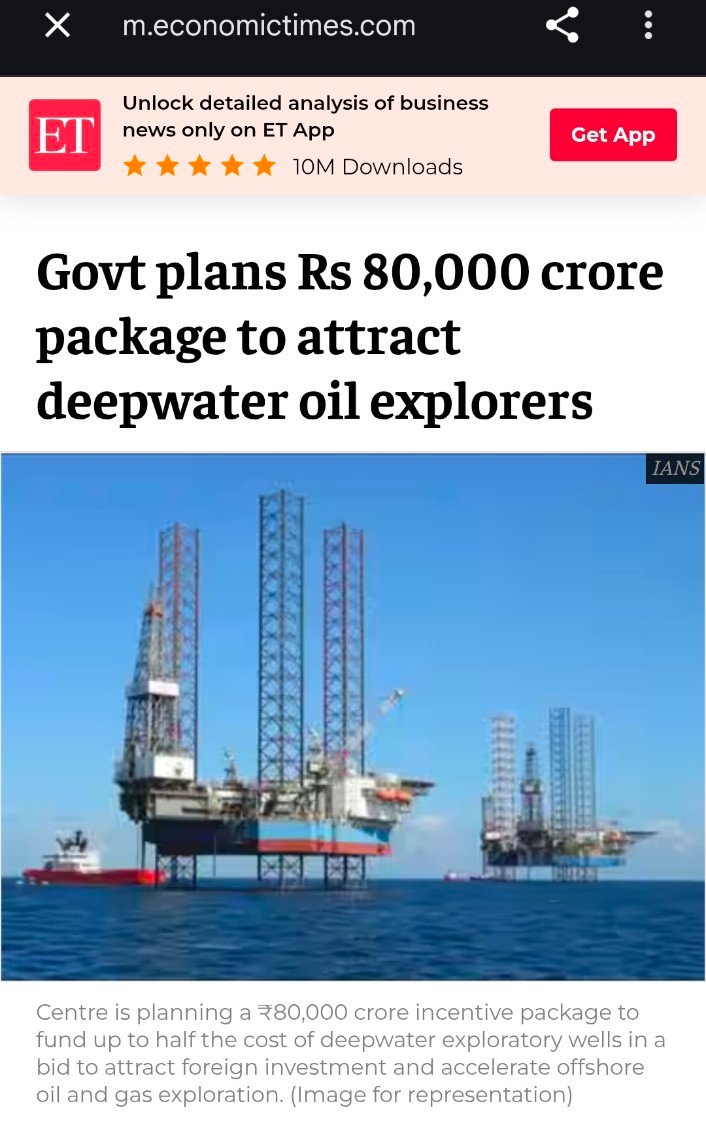
🔥 India could be sitting at the beginning of a massive Deepwater Oil & Gas capex cycle.
The Government is reportedly considering an ~₹80,000 crore package to support deepwater exploration, potentially funding up to 50% of exploratory well costs.
But the biggest opportunity may NOT be in oil producers.
The real opportunity could be hidden across the entire ecosystem.
A deepwater well can cost ₹1,000+ crore.
And before a single barrel reaches the surface, money flows through:
Seismic & Geophysical Surveys
Drilling Rigs & Drillships
Casing & Tubulars
Drilling Tools & Consumables
Oilfield Chemicals
Logging & Well Testing
Subsea Wellheads & Trees
ROVs & Underwater Robotics
Specialised Offshore Vessels
Platforms & FPSOs
Subsea Pipelines
Electrical & Automation
Inspection & Maintenance
Well Intervention
Production Enhancement
And finally Oil & Gas Production.
🔥 This is where the story gets interesting.
Some companies earn only when a field is discovered.
Others get paid even if the exploration well fails.
And some can keep earning for 15–20 years after production begins.
That is why the real research question isn't:
"Which company produces oil?"
It is:
"Who gets paid every time India drills another deepwater well?"
🔥 Exploration
ONGC
Oil India
Reliance
Vedanta/Cairn
They own the geological upside.
But they also carry the exploration risk.
Government sharing part of the exploration cost could improve the economics of drilling more wells.
🔥 Seismic
Before a ₹1,000+ crore well is drilled, explorers need to understand what lies beneath the seabed.
This creates opportunities in seismic acquisition, processing and interpretation.
Alphageo
Asian Energy Services
This could be one of the earliest layers to see activity if exploration accelerates.
🔥 Offshore Drilling
Then come the rigs.
Deepwater requires highly specialised semi-submersibles and drillships.
The economics can be powerful:
Higher day rates + higher utilisation = operating leverage.
Jindal Drilling and Aban Offshore enter the broader offshore drilling ecosystem.
But not every offshore rig can operate in deepwater.
Rig specifications and actual tender wins matter.
🔥 Drilling Equipment & Import Substitution
Every additional well requires casing, connectors, drilling tools and specialised equipment.
United Drilling Tools is interesting here because it already supplies the Indian upstream ecosystem.
The bigger opportunity?
Import substitution.
Deepwater equipment has high technical and qualification barriers.
A domestic company successfully replacing imported equipment could capture more value than a basic fabricator.
🔥 Subsea: Possibly the most underappreciated layer
Once hydrocarbons are discovered, an entirely new capex cycle starts.
Subsea trees
Wellheads
Manifolds
Umbilicals
Flowlines
Risers
ROVs
Control systems
Much of the sophisticated technology is still dominated by global players.
This could become one of India's biggest localisation opportunities over time.
🔥 Offshore Vessels
Someone must install, inspect and maintain all this equipment underwater.
That requires specialised vessels, ROVs and subsea capabilities.
SEAMEC
Dolphin Offshore
This layer is interesting because specialist assets are scarce and expensive.
When utilisation rises, operating leverage can be significant.
And unlike exploration, maintenance doesn't end after the first well.
🔥 Offshore EPC
A commercial discovery eventually requires billions of rupees of infrastructure.
Platforms
Processing facilities
Subsea pipelines
Compression systems
Offshore structures
This is where L&T becomes important.
Exploration may create the discovery.
But development of that discovery can create a much larger EPC opportunity.
🔥 The hidden recurring-revenue opportunity
Inspection
Repair
Maintenance
Corrosion protection
ROV services
Well intervention
Production enhancement
An offshore platform may operate for decades.
Building it generates revenue once.
Maintaining it can generate revenue repeatedly.
This is why subsea maintenance and offshore services could become one of the most underappreciated parts of the entire theme.
🔥 Think about the cycle like this:
Government Support
Exploration
Seismic
Drilling
Equipment & Consumables
Discovery
Appraisal
Subsea Infrastructure
Platforms & Pipelines
Production
Inspection & Maintenance
Well Intervention
And eventually Decommissioning.
One successful discovery can potentially create years of spending across this chain.
🔥 The companies worth researching are therefore not just ONGC and Oil India.
Direct Exploration:
ONGC, Oil India, Reliance, Vedanta
Seismic:
Alphageo, Asian Energy Services
Drilling:
Jindal Drilling, Aban Offshore
Oilfield Equipment:
United Drilling Tools
Offshore/Subsea Services:
Deep Industries, Dolphin Offshore, SEAMEC
Offshore EPC:
Larsen & Toubro
And there could be another layer of future beneficiaries across specialised pipes, chemicals, automation, corrosion protection and underwater technology if localisation increases.
🔥 The biggest value migration could happen where India currently depends on imports.
High-spec subsea equipment.
Specialised drilling technology.
Premium connectors.
ROVs and underwater robotics.
Sensors and control systems.
Inspection and aftermarket services.
These are difficult to replicate and qualification-heavy businesses.
That is where margins and moats could eventually be stronger.
🔥 What could turn this from a theme into an earnings cycle?
Policy approval
More offshore blocks
More seismic tenders
More wells drilled
Rig and vessel contracts
Equipment orders
Commercial discoveries
Field Development Plans
Large offshore EPC orders
Higher asset utilisation
That is the sequence to track.
🔥 Biggest risk?
₹80,000 crore of incentives cannot guarantee ₹80,000 crore of value creation.
Deepwater geology is brutal.
A ₹1,000+ crore well can still be dry.
And expensive rigs and vessels become liabilities when utilisation falls.
So don't track only the headline.
Track wells drilled, discoveries, order books, utilisation, day rates, capacity additions and cash flows.
🔥 The ₹80,000 crore headline may only be the starting point.
If India enters a sustained deepwater exploration cycle, the bigger opportunity could be the ecosystem that gets paid to find, drill, build, connect and maintain every offshore field.
The winners may not necessarily be the companies selling the oil.
They could be the companies selling the picks and shovels.
#ONGC #OIL #DeepIndustries #DolphinOffshore #SEAMEC #JindalDrilling #UnitedDrillingTools #Alphageo #AsianEnergyServices #LarsenToubro #Reliance #Vedanta
Disclaimer: This post is purely for educational and research purposes. It is NOT a buy/sell recommendation or investment advice. Please do your own research.
🚨Big Breaking
My PMO-based sources have confirmed that Dharmendra Pradhan will be kicked out from the Education Ministry, Nirmala Sitharaman will no longer be the Finance Minister and the man of the hour, Lord Gadkari ji, will be removed from his ministry ♥️
In this Cabinet Reshuffle, major changes are underway. Stay tuned! 🇮🇳
Midcap Mutual Funds: Suitable for aggressive investors with 7+ year horizons who can tolerate volatility.
Advice: Choose based on fund manager consistency, expense ratio, and track record across cycles.
Midcaps offer a "sweet spot" for growth but require patience during volatile periods. They often outperform large-cap funds over 5+ year horizons, but can lag or correct sharply in shorter terms or bear markets.
Disclaimer: Viral Shah - AMFI Registered Mutual Fund Distributor | ARN-[328071, ZFunds] Mutual Fund investments are subject to market risks. Read all scheme-related documents carefully. Past performance is not necessarily indicative of future performance. The content shared is for educational and informational purposes only and does not constitute investment advice or a recommendation to buy or sell any scheme.
Source: Outlook Money
Returns as of May 18, 2026
I went through 75+ concalls so you wouldn't have to.
The full FY27 guidance map across 15 Indian sectors.
Renewables & Clean Energy
🔹Premier Energies: 3 to 4x revenue growth over 3 years
🔹Inox Wind: 1,500 to 2,000 MW annual execution in FY27 to FY28
🔹Sarda Energy & Minerals: 20%+ growth over 3 years
🔹Waaree Renewable Tech: 30 to 40% growth
🔹Suzlon Energy: 4,000+ MW order book
🔹JSW Energy: targeting 20 GW by 2030
🔹Waaree Energies: targeting 20+ GW
Data Centers
🔹KRN Heat Exchanger: 60% growth in FY27
🔹Aeroflex Industries: 35% growth in FY27
🔹Netweb Technologies: 35 to 40% revenue growth, 13 to 14% EBITDA margin over next 2 years
Pharma & Healthcare
🔹Poly Medicure: 25% revenue growth, ₹2,300 to 2,400 Cr in FY27
🔹Senores Pharma: 50 to 60% PAT growth in FY27
🔹Sai Life Sciences: 15 to 20% revenue growth in FY27
🔹Cupid: 70% PAT growth in FY27
🔹Beta Drugs: 20 to 25% revenue growth in FY27
🔹Kwality Pharma: 50% PAT growth in FY27
Power Transformers
🔹Transformers and Rectifiers India: 40%+ growth over 3 years
🔹Danish Power: 20 to 25% growth over 3 years
🔹Supreme Power Equipment: 50% growth over 2 years
🔹Hitachi Energy India: strong multi-year HVDC and grid modernisation opportunity
🔹Atlanta Electricals: 40% growth over 2 years
🔹Shilchar Technologies: 20%+ growth over 2 to 3 years
🔹TD Power Systems: 30% growth in FY27
EMS & Electronics
🔹Aimtron Electronics: 40 to 50% revenue growth in FY27
🔹Netweb Technologies: 30 to 35% growth in FY27
🔹Rashi Peripherals: 20% revenue growth in FY27
🔹Avalon Technologies: 24 to 27% growth in FY27
🔹Kaynes Technology: strong multi-year growth opportunity
🔹GNG Electronics: 25% revenue growth in FY27
🔹E2E Networks: hyper growth phase, no specific guidance
Power Capital Goods
🔹Yash Highvoltage: 50 to 70% in FY27, 40 to 42% CAGR over 4 to 5 years
🔹Quality Power Electrical Equipments: 15 to 20% in FY27, 50% in FY28
🔹Genus Power Infrastructures: 33%+ growth in FY27
🔹Apar Industries: 15 to 20% CAGR over 3 to 5 years
🔹Synergy Green Industries: 33% revenue growth in FY27
🔹Skipper: 30% PAT growth in FY27
Defence
🔹Data Patterns India: 20 to 25% revenue growth, order book ~₹1,868 Cr
🔹Krishna Defence and Allied: 30 to 40% growth over next few years
🔹Solar Industries: 42% revenue growth in FY27
🔹Zen Technologies: 50%+ growth over 2 years
🔹MTAR Technologies: 80% ±5% growth in FY27
Recycling & Waste Management
🔹Gravita India: 35% revenue growth in FY27
🔹Namo eWaste: 40 to 50% growth
🔹Tinna Rubber: 25%+ growth
🔹Baheti Recycling: 30 to 35% growth
🔹Antony Waste: 20%+ growth
🔹Sunlite Recycling: 20%+ growth
Cables, Wires & Pipes
🔹Man Industries: 40 to 55% revenue growth, ₹5,000 to 5,500 Cr in FY27
🔹RR Kabel: 16 to 18% volume growth in FY27
🔹KEI Industries: 20%+ growth in FY27 and over 3 to 5 years
🔹HFCL: 20 to 25% growth in FY27
🔹Welspun Corp: 20% revenue growth, ₹20,000 Cr in FY27
🔹V-Marc India: 40%+ growth in FY27 and over 2 to 3 years
FMCG & Consumption
🔹ADF Foods: 35 to 50% revenue growth, ₹925 to 1,000 Cr in FY27
🔹Bazaar Style Retail: 25% revenue growth in FY27
🔹Hindustan Foods: 35 to 50% PAT growth, ₹200 to 220 Cr PAT in FY27
Aerospace
🔹Rossell Techsys: 80 to 90% revenue growth in FY27
🔹PTC Industries: long-term aerospace and defence alloy growth opportunity
🔹Azad Engineering: 25 to 30% growth over next few years
Finance & Digital Platforms
🔹Pine Labs: 21 to 23.5% revenue growth in FY27
🔹Anand Rathi Wealth: 25% growth
🔹Northern Arc Capital: 22 to 25% growth
Chemicals & Specialty
🔹Acutaas Chemicals: 25% growth in FY27 and over 3 years
🔹Neogen Chemicals: 40%+ growth over 3 to 4 years
🔹Pondy Oxides and Chemicals: 20%+ growth over 4 years
🔹Krishana Phoschem: 35 to 40% growth in FY27
🔹Stallion India Fluorochemicals: 30 to 35% growth in FY27
Railways
🔹Ramkrishna Forgings: 80 to 85% capacity utilisation in FY27
🔹Airfloa Rail Technology: 50% growth over 2 years
🔹RITES: 15 to 20% steady growth
🔹Frontier Springs: 30%+ growth over 2 years
Logistics
🔹Shadowfax Technologies: 27 to 30% growth
🔹Zinka Logistics: 30%+ growth
Water Management
🔹Enviro Infra Engineers: 35 to 40% growth
🔹VA Tech Wabag: 20%+ growth
🔖Bookmark it. Earnings season will tell you who delivers and who blinks.
📌Disclaimer: The above data should not be considered as a Buy or Sell recommendation. The analysis has been done for educational and learning purposes only.
Q4 FY26 Opportunities list till 22-5-2026 .
JNK, Cupid, Syrma, Sansera, GEVernova, NGL Fine,
Apollo micro, FCL, Sakar, KPL, Fujiyama, Tdpower, Shadow fax, Senores, KRN heat, Vidya wires, Ideaforge, Mtar, Rossel Techsys, Privi, Manorama, yash hv,
Atlanta electric, Paisalo, Vmarc
Suryoday, Ujjivan , Satin, Spandana
Lloyd metals, cartrade, Avalon
SJS,Bse, Aeroflex
GNG Electronics, Nam India
Sterlite/ Hfcl, Acutaas, Netweb
Maha bk, Rrkabel, Cemindia,
Au small, Ather energy, Capri global
SgFinserv
Ps note: Some of the concalls, i have yet to listen.
Do study and comment if u hold any.
The eleventh fund in our new #FinAlphaKYF - Know Your Fund series is #Invesco Midcap Fund.
Highly requested by our community, it has delivered standout wealth creation and returns over the long term.
📈 Steady Performer: The fund has beaten the benchmark 81% of the time on a 5-year rolling returns basis (1,387/1,719 days).
While historically struggling against peers, it has secured a spot in the top quartile 2 times and finished in the top half for 2 out of the last 5 years, with its latest 2025 rank standing at a strong 3/31.
Alpha: The fund generated an Alpha of 3.2%, completely crushing the category average of -0.0%.
💰 SIP Wealth Builder: The 5-year SIP XIRR stands at an excellent 21.3%, comfortably outperforming the benchmark's 17.1%.
Check out the full infographic below for a deeper look at its risk ratios, market cap allocation, and recent portfolio changes!
Please share your feedback and repost if you like my work :)
#FinAlpha #MutualFunds #FinAlpha1Pager #Invesco
How has the recovery been for #MutualFunds after the recent fall ?
I compiled a single-page view for most top #AMCs and the top categories I could fit here, from 30th March bottom to 20th April.
A sharp recovery.
I've included respective #TRI benchmarks as well.
Lesson: stay invested.
A repost would be awesome if you like such data ;)
#MutualFunds #Investing #FinAlpha #Flexicap #Midcap #Smallcap







![viralbshah's tweet photo. Midcap Mutual Funds: Suitable for aggressive investors with 7+ year horizons who can tolerate volatility.
Advice: Choose based on fund manager consistency, expense ratio, and track record across cycles.
Midcaps offer a "sweet spot" for growth but require patience during volatile periods. They often outperform large-cap funds over 5+ year horizons, but can lag or correct sharply in shorter terms or bear markets.
Disclaimer: Viral Shah - AMFI Registered Mutual Fund Distributor | ARN-[328071, ZFunds] Mutual Fund investments are subject to market risks. Read all scheme-related documents carefully. Past performance is not necessarily indicative of future performance. The content shared is for educational and informational purposes only and does not constitute investment advice or a recommendation to buy or sell any scheme.
Source: Outlook Money
Returns as of May 18, 2026](https://pbs.twimg.com/media/HLF0f7QbQAAKJFY.jpg)


