4am-7am are Dad hours
3 hours to build yourself for the other 21
Early, before anyone needs you
Your kids, your wife, your job
3 hours yours to be spent how you want
Hours you can be selfish with
Hours you can spend building a stronger version of you so you can be stronger for everyone else who needs you the rest of the day
August is the month when the effects of summer have accumulated. There was an ancient warning attached the danger of the dog days. By the end of summer, people were prone to bad judgment if they were not careful.
"A scientist in Japan demonstrated that the air inside a forest strengthens your immune system for a full month"
Just yesterday, a visitor from Chennai told me "I feel tired often in Chennai and I feel a lot less tired past 2 days, even after doing a lot of work".
We need to live closer to nature and in harmony with nature.
The Joker once said:
"When we understand that each day isn't one more day, but one less, we start giving more value to what truly matters and that hit hard"
Ben Affleck shares how he overcame his alcohol addiction. Says it is not “overpriced rehabs”.
“I hate to say it but the cure for addiction and the only cure I’ve seen is not these overpriced rehabs or these fraudulent fixes that are sold to people”
“The cure for addiction is suffering”
“You suffer enough and then something inside you goes ‘I’m done’”
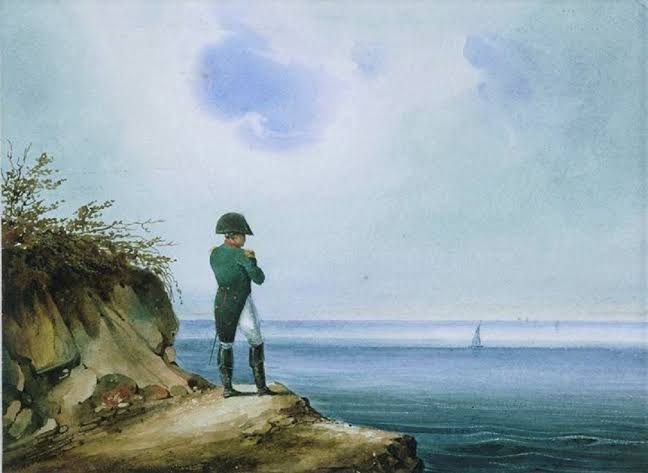
Napoleon on How He Thinks:
"Different subjects and different affairs are arranged in my head as in a cupboard.
When I wish to interrupt one train of thought, I shut that drawer and open another.
Do I wish to sleep?
I simply close all the drawers, and there I am – asleep."
Nobody is coming to save you.
Not your parents.
Not your partner.
Not the AI.
Not the universe.
The moment you stop waiting for permission to become who you actually are, that's the moment everything changes.
Stop waiting. Start becoming.
being able to move on from things easily is healthy and attractive. abundance mindset. trust that anything can and will be restored 100x better. an angel breezily flowing with God
In 1997, a footballer accidentally proved a physics principle in a soccer game that had been invisible for 300 years.
Roberto Carlos lined up for a free kick about 40 yards from goal during a France versus Brazil friendly match in Paris.
The ball sat exactly where a free kick should sit, the French wall stood between him and the goal, and everyone in the stadium knew what was about to happen. Carlos was about to attempt something that shouldn't exist in physics.
He struck the ball with his left foot at an extreme angle, nearly perpendicular to where the goal actually was. The ball curved so dramatically through the air that French goalkeeper Fabien Barthez literally didn't move. He watched it arc impossibly wide, certain it was going nowhere, his body language screaming "that's out." Then the ball bent back toward goal like it was magnetized. It crossed the goal line before Barthez could process what his eyes had just witnessed. Goal.
The stadium went silent for a second.
Then chaos.
That moment became legendary not because it was a beautiful goal, though it was, but because it revealed something about physics that most people had never actually *seen* in real time before. The ball had broken the straight line. It had obeyed a force that existed entirely in the air, invisible to the naked eye, bending space itself through sheer rotation.
That force is called the Magnus effect, and it's been hiding in plain sight in sports for over a century. Every curveball in baseball, every spinning tennis serve, every banana kick in football, every slice shot in golf. They all ride on the Magnus effect. But Carlos's free kick was different. It was the perfect storm of velocity, spin rate, and distance that made the force so visually obvious that even people who'd never heard the word "Magnus" understood something supernatural had just occurred.
Here's what actually happened in the physics.
When you strike a spinning ball with enough velocity through the air, the rotation creates a pressure differential on either side of the ball. The side spinning with the direction of motion builds up a layer of fast moving air that stays attached to the ball's surface. The opposite side spinning against the direction of motion sheds that air layer and creates lower pressure. You end up with higher pressure on one side and lower pressure on the other. Bernoulli's principle then drags the ball toward the lower pressure region. The ball curves.
That's the Magnus effect in its purest form.
It's fluid dynamics.
But here's where most explanations stop and where most people fail to grasp the real picture. The Magnus effect is *proportional* to the spin. Double the spin rate and you approximately double the curvature. But it's also proportional to the surface area. A larger ball, all else equal, experiences more Magnus effect than a smaller one. And it's wildly proportional to velocity. Lower the speed too much and the curve becomes almost nonexistent. Add speed and the curve amplifies. This is why a baseball pitcher's curveball becomes more dramatic at higher velocities, why a tennis serve curves more than a lob, and why Carlos's free kick had to travel at a certain speed to work.
Carlos struck that ball at precisely the intersection point where spin and velocity aligned to produce maximum curve over that distance. Any slower and it lands straight in the wall. Any faster and it overcorrects and misses wide. The goal was practically a mathematical solution to an equation nobody needed to solve except his foot somehow did it perfectly.
The reason this moment matters beyond football is that it made visible something that had been operating invisibly in physics and engineering for centuries. The Magnus effect powers helicopter rotors. It's why airplanes have wings. It's why you can throw a frisbee and it actually stays airborne instead of just dropping like a stone. Every spinning object moving through air experiences it. Every sport that uses a ball depends on it.
Yet most people go their entire lives without consciously recognizing this force exists.
What Carlos did was compress a century of physics education into three seconds of visible reality. He created an experiment that couldn't be ignored or dismissed or explained away. The ball curved. The goalkeeper saw it. The universe didn't change. Nothing magical happened. Just matter responding to force across empty space in exactly the way the math predicted.
The interesting part isn't that it worked. The interesting part is that we'd organized the entire sport of football for decades without truly understanding why the ball did what it did. Strikers had developed intuition about how to make a ball curve, but that intuition was operating in the dark. They couldn't articulate the relationship between spin and speed and distance. They just knew that if you hit it a certain way, it would curve a certain amount.
Then Carlos made it visible.
What happened after was instructive. Within a few years, every serious free kick taker started studying the Magnus effect. Sports scientists began measuring spin rates with new technology. Training programs started including tutorials on precisely where to strike the ball, how much curve you could generate at different velocities, how wind affected the trajectory. The gap between top tier free kick takers and everyone else widened because now you could *understand* the phenomenon you were trying to exploit.
Science doesn't change physics. It just brings the invisible into focus.
That free kick lived in the gap between intuitive mastery and conscious understanding. Carlos had mastered the Magnus effect through pure repetition and feel. But once everyone else saw it work that clearly, you couldn't claim ignorance anymore. You had to reckon with what was actually happening in the air.
In some sense, that's what every great demonstration does. It takes something that was operating beneath the surface of our attention and makes it unavoidable. The double slit experiment did that for quantum mechanics. The Michelson Morley experiment did it for the aether. A free kick did it for aerodynamics, and most of the world never even realized they were watching physics.
The next time you watch a free kick curve perfectly into goal, understand that you're watching the Magnus effect in action. You're watching air pressure differentials, Bernoulli principles, and rotational velocity align perfectly. You're watching physics become soccer.
And somewhere, a physicist is probably jealous that a football player got to make it look more beautiful than any equation ever could.
Mesopotamia was never the cradle of civilisation. India was.
I spent forty years in international shipping, not academia. When I began researching the history of maritime trade, I had no orthodoxy to defend. I followed the evidence, and it kept arriving in the same place: the Indian subcontinent.
Nineteenth century archaeologists dug in Mesopotamia because the climate preserved artefacts, the biblical sources pointed them there, and the Ottomans allowed the excavations. That is the entire basis for the myth of Mesopotamia as "the cradle of civilisation."
Nobody applied the same rigour to India. Mohenjo-daro was not discovered until 1922. By then the narrative had already hardened.
What was actually there was the largest civilisation of the ancient world. Three hundred cities. Fifty thousand people in each, by 2600 BC. Two thirds of them stood on the banks of the Sarasvati, the central and greatest of the seven rivers described in the Rig Veda, flowing down from the Himalayas before the river vanished entirely by 1900 BC. The Vedic kings claimed territory stretching "sea to sea," from Afghanistan to Maharashtra, some 1.5 million square miles, against Egypt's 13,000. A dock at Lothal built to handle thirty ships of sixty tons, unmatched in Europe for four thousand years. When it was first excavated, it was recorded as a bathing pool.
When the scale became impossible to dismiss, the theory was not corrected. It was replaced with a story of pale-skinned nomads from the steppe who supposedly arrived around 1500 BC and brought civilisation with them. There is no evidence. The chronology doesn't work. The Vedas describe no invasion.
In 2019 a Harvard-led genetic study revived the claim, and the press reported it as confirmation. It was not. The same study found the builders of these cities were indigenous. The Sarasvati river that the Rig Veda described had already dried up before these newcomers arrived. What the study also found is that a small group of men, arriving after the Sarasvati had already dried up, interbred with the existing population and left a genetic signature. That is all.
So, where they chose to dig was mostly an accident of climate and access. The Aryan invasion theory was constructed because an Indian civilisation that owed nothing to Caucasians was a fact the late nineteenth century could not accommodate.
Link to full Substack essay with sources in the comments below.
The good news is, I am not always right. That's just hype. While my intuition believes what I said will happen in 2030s, more than my intuition, what 1.4 billion imagine and believe shapes the collective future.
So if the govt wants to keep continuing, providing political stability, it is imperative they take social media and media psyops by adversaries programming our people's thoughts and imagination very seriously.
And start acting to curtail, control, and counter it. Right away. Start today.
The Irish once called themselves the Tuatha de Danaan.
Children of Danu.
The same Danu appears in the Rig Veda as the mother goddess of the flowing waters. She is where the Danube gets its name. And the Dniester, the Dnieper, the Don and the Donau. And Denmark. And Greek Demeter. Northern Greeks called themselves Dannuni.
Two hills in southwest Ireland are still known as the Paps of Danu. At Beltane, fires were lit around them and cattle driven between the flames for protection and good harvest. The same ritual is described in the Vedas.
The oldest surviving Irish text, the Book of Invasions, records a tribe called Erainn, from Arya, arriving from the south by sea and making its way inland to the Hill of Tara. The Persians took the same name for themselves. Iran means the land of the Aryas.
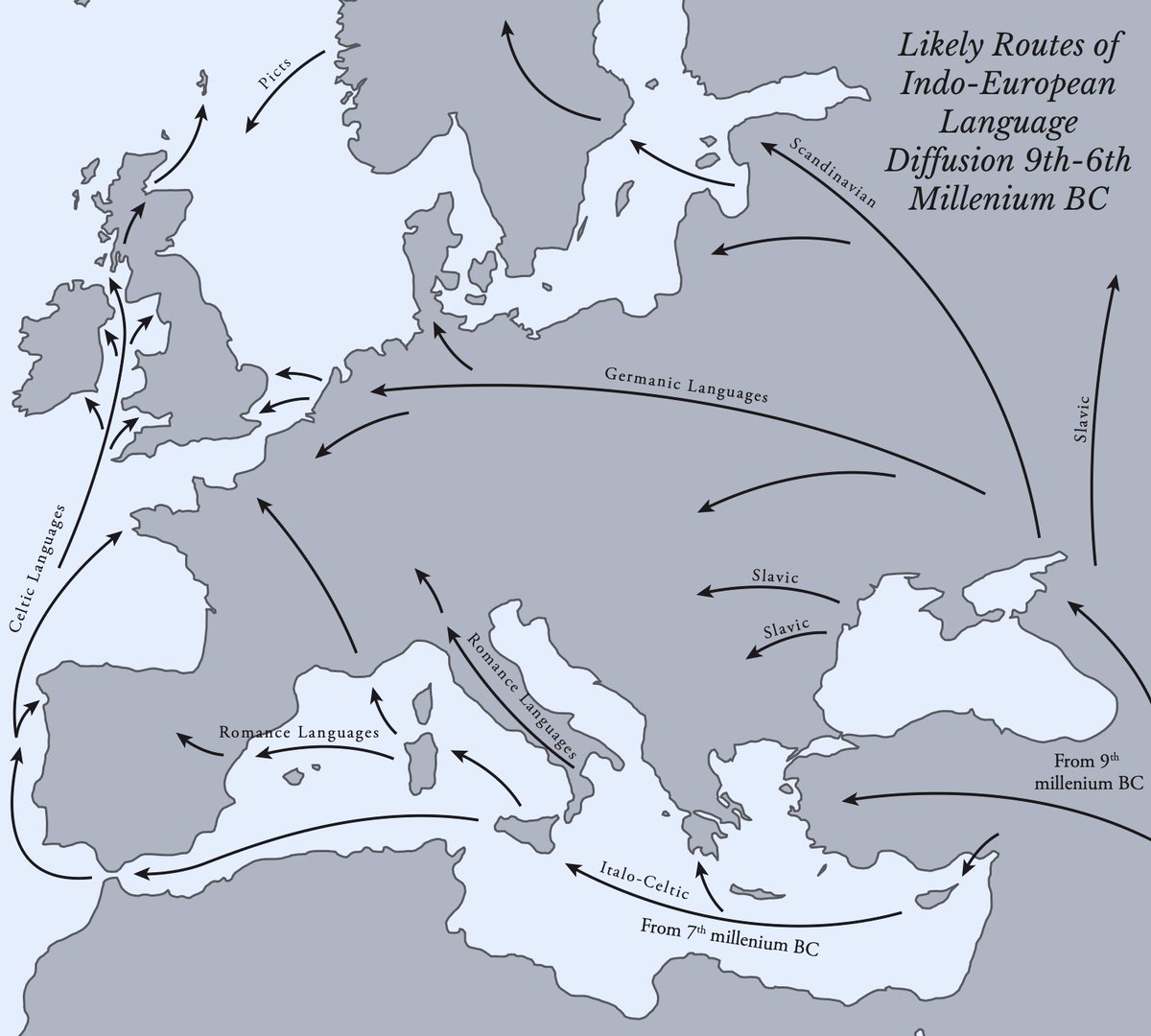
These Vedic influences arrived in pulses. The Iranian is the oldest. A landward pulse followed the river valleys of the Dniester, the Dnieper, the Donau and on into Denmark, leaving the mother goddess's name behind at each stage.
The Celtic pulse came after 5,600 BC. The Celtic branch had by then separated from Italo-Celtic in the Mediterranean and continued up the Atlantic seaboard. The route is still readable on the map. Portugal. Galicia. Gaul. Pays de Galles. Cornwall. Galloway. Galway. The "gal" names trace the coast.
Ireland remembered its origin.
The old story of Aryan nomads riding into India from the steppe has no DNA support. Michel Danino reviewed nine large-sample genetic studies from 1999 to 2006 and found no invasion signal. The archaeological record shows no cultural break from prehistory. The outstanding character of ancient India is continuity.
The trails from Iran and from Ireland both lead back to India.
I set the full case out in "How Maritime Trade and the Indian Subcontinent Shaped the World."