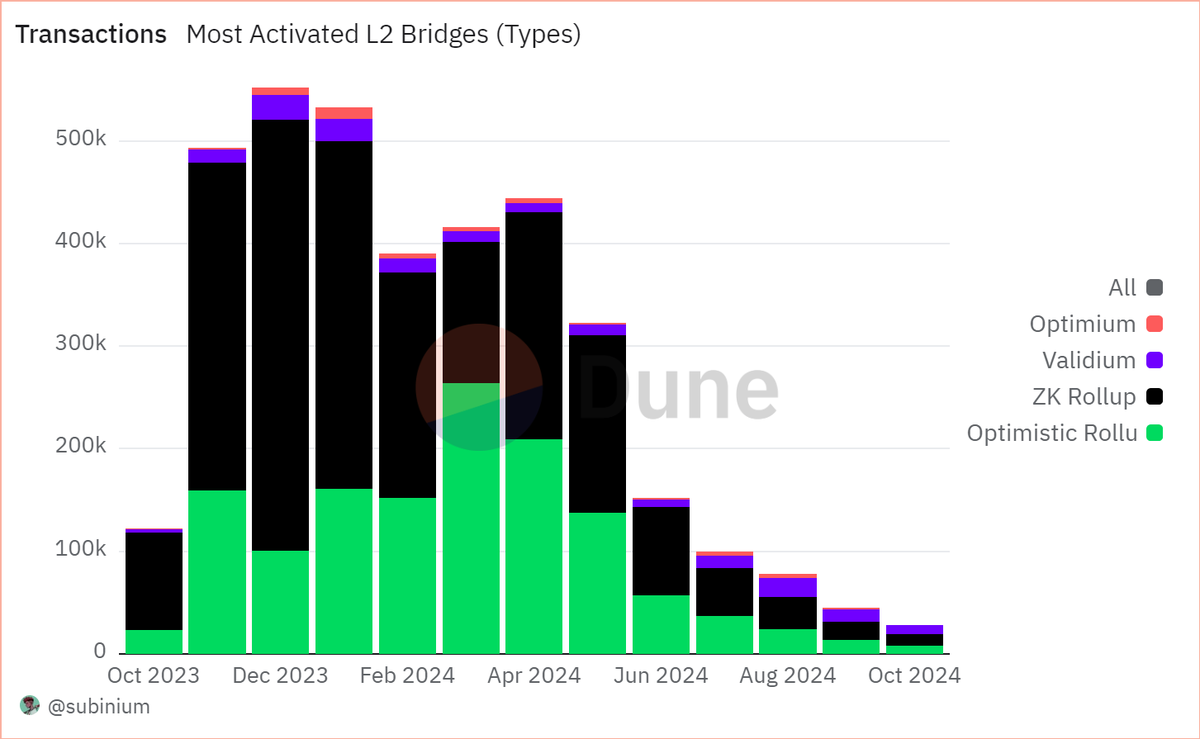
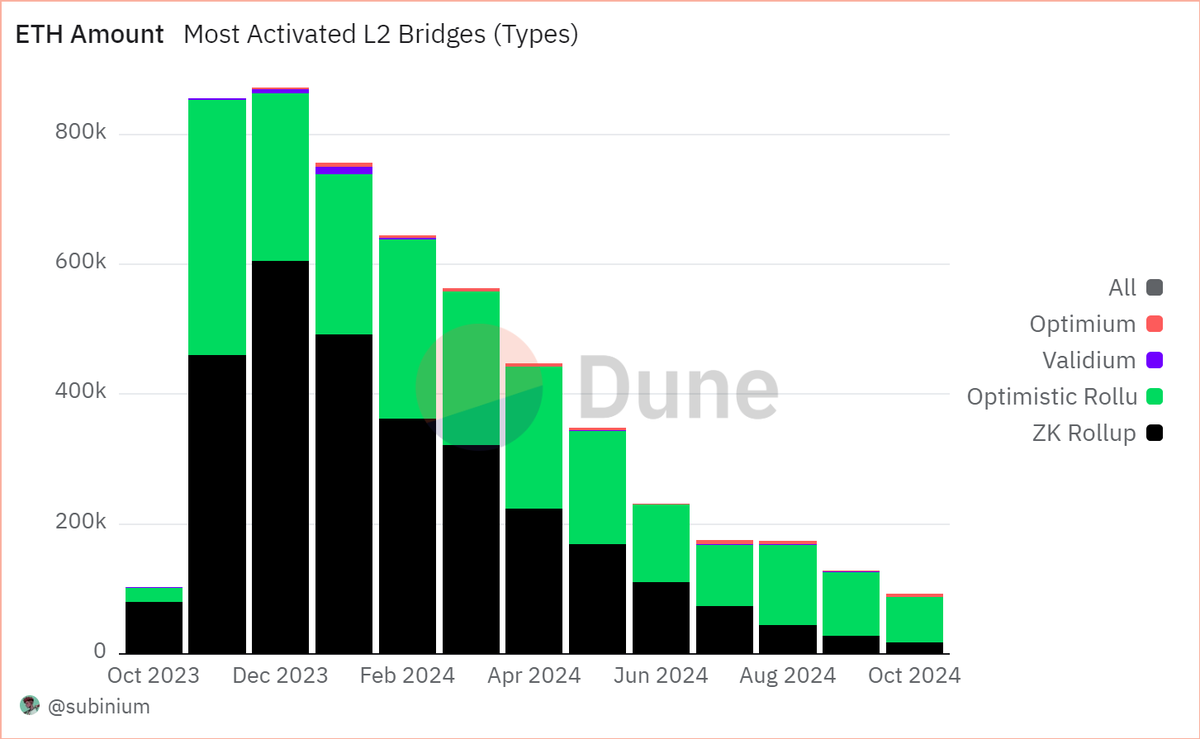
Transactions vs. funds: Here’s the kicker.
zk rollups lead in transaction numbers this month with 11,035 transactions, but when it comes to ETH volume, Optimistic rollups crush it with 70k ETH bridged.
What does that tell us?
ZK bridges are more secure & offer fast finality (vs. Optimistic's 7-day withdrawal). This is ideal for smaller, frequent txs; possibly driven by zkSync/Scroll airdrops.
Optimistic rollups hold 55% of Ethereum's TVL. Larger ETH volumes flow through them as whales prefer their mature ecosystem, where long-term capital parking makes sense.
August 2023 hit an all-time high with 1.076M users bridging from Ethereum to L2s.
But fast forward to October 2024 - only 23,791 users.
That’s a brutal drop.
What’s driving users away? Are L2s losing their appeal, or are we facing temporary market hesitations?
Meanwhile, Optimistic rollups are quietly taking the lead.
@base, @arbitrum, @optimism - they are consistent.
And in October 2024, more funds were bridged to Optimistic rollups (70,112 ETH) than any other L2.
Are we seeing a preference shift?
@zksync saw an incredible $793M USD bridged from Ethereum at its peak this year.
Huge, right? But what’s happened since?
We’re down to a measly $26k this month.
That’s not just a dip, that’s a freefall.
What went wrong?
L2 adoption is surging, but there's a lot more beneath the surface.
We’re seeing major funds flowing to L2s, especially ZK and Optimistic rollups.
But despite the excitement, the data tells a mixed story.
Let’s look at the numbers.
Still, atomic swaps are a great tool for cross-chain trades in DeFi, offering deeper liquidity, lower costs, and the assurance that you'll always get what you agreed upon.
Liked the thread?
Make sure to RT & comment down what we should cover next.
Downsides?
Atomic swaps can be a bit complex, especially for new users, and they require both blockchains to support the same hashing algorithm.
Plus, the process isn’t always the fastest or most private.
The big advantage?
No need for a middleman, which means lower fees and reduced counterparty risks.
You get guaranteed outcomes: either the swap happens as agreed, or everyone gets their tokens back.
https://t.co/LipvCdjrtL
To claim my tokens, you reveal a private key.
This lets me unlock your tokens.
If either party doesn’t complete the swap within a set time, both get their tokens back.
Everything is secure and automated by the contract.
Source: https://t.co/z5ZvahVEA7
Here’s how it works: suppose you and I agree to swap tokens.
You lock your tokens in an HTLC and share a cryptographic hash with me.
I verify it and lock my tokens in another contract linked to yours.
The key tech behind atomic swaps is the hash timelock contract (HTLC).
It’s like a virtual vault, holding both parties' tokens until each side fulfills their part of the deal.
If one side flakes, tokens go back to their owners.
https://t.co/23qjwBxNj6
New day, new edition of syUNIVERISTY!
In today's piece, we will explore what atomic swaps are & how it works.
In short, atomic swaps allow people to trade crypto directly between different blockchains, peer-to-peer, without needing a middleman.
Sounds awesome, right?
🚀 Big ups to everyone ramping up their syCREDITS real FAST! ⚡️
🟢 EA role: sweet 2X boost
🟢 syTIZEN role: MEGA 4X boost
Competition continues to heat up, anon! 🔥
#SYNTHR#DeFi