At Axis Robotics, our vision is to build a compounding data engine—one that connects large-scale pretraining data, corrective post-training data, model deployment, and failure feedback in a continuously improving loop.
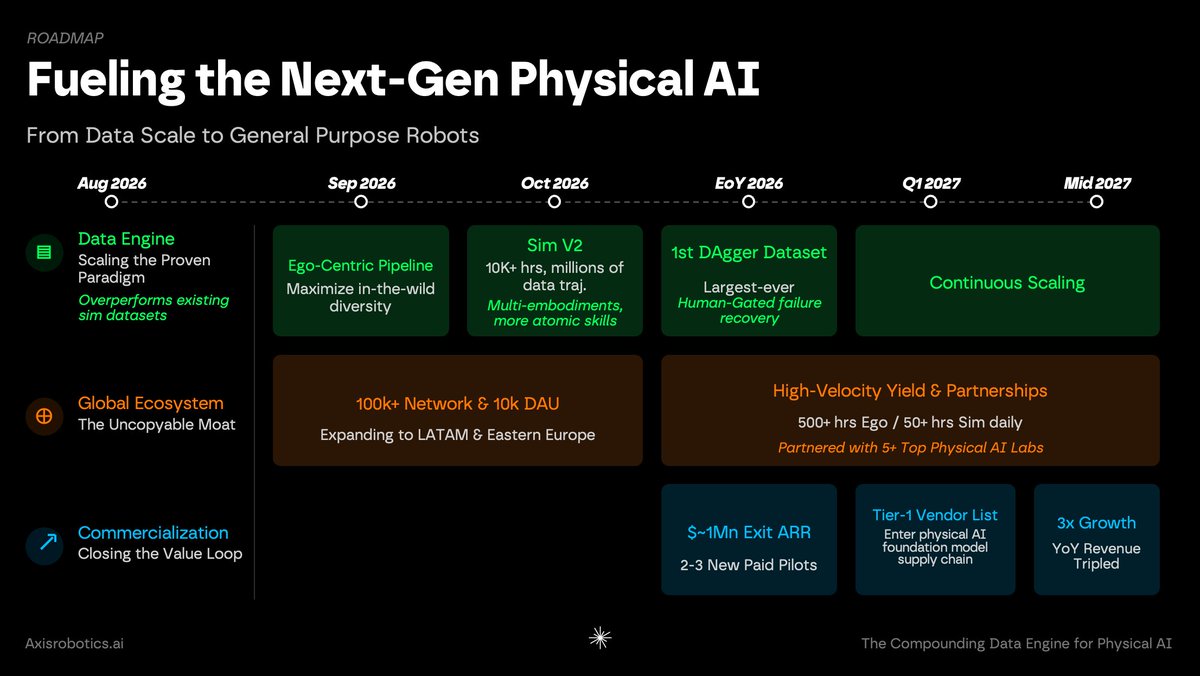
Over the next 6–12 months, we will advance this vision across three connected fronts.
On the product side, we plan to scale our egocentric data pipeline in September, with tens of thousands of hours already collected and product requirements being shaped with frontier labs. In October, we will expand our simulation data across more robot embodiments and atomic capabilities. By year-end, we plan to release a large-scale post-training dataset built through human-gated DAgger (HG-DAgger), where the policy acts autonomously and contributors intervene only when it needs correction.
On the network side, we will expand our contributor ecosystem into Latin America and Eastern Europe, strengthen our 100K+ contributor network and grow toward 10K DAU. This expansion is designed to support the production of more than 500 hours of egocentric data and 50 hours of simulation data per day while building capacity for corrective post-training data.
On the commercialization side, we plan to complete two to three new paid pilots by year-end and work toward becoming a preferred vendor for foundation model companies in Q1 next year. The longer-term goal is to embed the data engine directly into the training and deployment workflows of robot hardware companies, model developers, and industrial operators.
These are not separate tracks. They reinforce the same flywheel: broader data coverage produces stronger models; stronger models reach new states; and new failures reveal what data should be collected next.
That is the future we are building toward:
Scale to produce data continuously.
Diversity to reflect the complexity of the physical world.
A closed loop to turn deployment feedback and failures into the next round of model improvement.
Our north star is not simply more data. It is faster model evolution.
So what are we actually building at Axis Robotics?
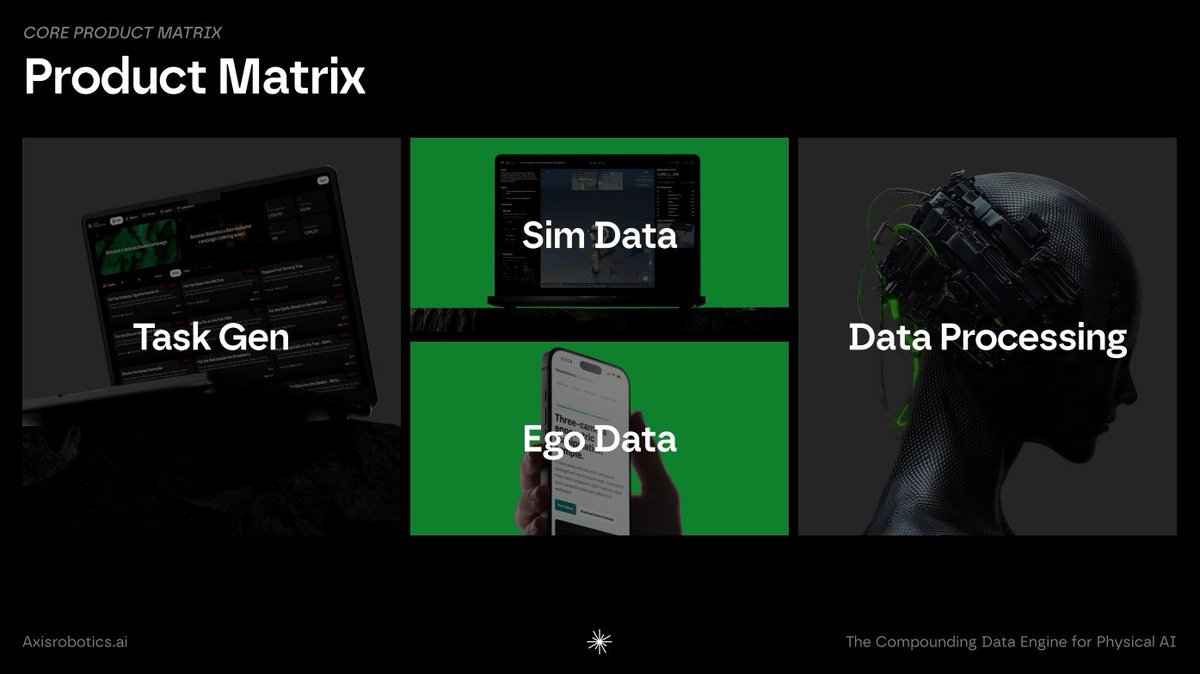
Four products, one compounding loop:
1. Task Generation Engine (live)
Give it a prompt like:
“A study desk with a pour-over kettle, a hand-crank coffee grinder, a coffee mug, a notebook, and a pen.”
The engine turns that single description into a scalable family of ready-to-teleoperate simulation tasks—automatically selecting assets, composing scenes, sampling layouts and object positions, and configuring physical conditions.
The same process systematically expands diversity across scenes, object types, spatial layouts, robot embodiments, semantic variations, and visual conditions.
2. Simulation Data Collection Platform (live)
Our browser-based platform lets contributors teleoperate simulated robots without installing a local simulator or owning specialized hardware. Tasks can be distributed across a global contributor network, turning sequential lab collection into a massively parallel data stream.
The platform supports two complementary workflows:
- Full human demonstrations for large-scale pretraining
- Human-gated corrections during policy rollouts for post-training
Simulation provides synchronized observations, robot states, actions, and success signals—creating structured supervision that can be validated and processed for policy training and evaluation.
3. Mobile Egocentric App (coming soon)
The app is designed to capture first-person human activity across everyday routines and specialized industries. Collection setups are modular, ranging from smartphones to multi-camera headbands, with optional wrist cameras and grippers.
Our pipeline reconstructs 4D hand motion and pairs it with language and subtask annotations, producing model-ready data.
4. Data Processing Pipeline (live)
For simulation data, the pipeline validates task success, filters corrupted episodes, removes idle segments, smooths motion, and resamples trajectories to consistent control frequencies.
Clean trajectories can then be replayed with randomized cameras, lighting, textures, layouts, object poses, mass, and friction—producing diverse multimodal data with aligned observations, states, actions, language, and success labels.
For egocentric data, the pipeline supports video segmentation, 4D hand-pose reconstruction, and aligned language and subtask annotations.
These are not four standalone products.
- Task generation turns data requirements into scalable task families.
- Simulation and egocentric collection produce complementary forms of data.
- Processing makes them training-ready.
- Model deployment and failure feedback reveal what should be collected next.
Together, they form the Axis compounding data engine—a full-lifecycle data infrastructure for pretraining, corrective post-training, and continuous policy improvement.
Axis V2 is live—and gas is on us!
To celebrate the launch of V2 and thank our community for the incredible support, we’re covering up to $5,000 in gas fees over the next 7 days.
🗓️ July 17, 12:00 PM–July 24, 12:00 PM (UTC+8)
Complete tasks during the campaign, sign, and we’ll take care of the gas.
Available while the gas pool lasts. Rules below ↓
Excited to build robotics on @base.
Real energy at SuperAI with @baseapac.
We’re just getting started bringing robots, AI, and onchain coordination together.
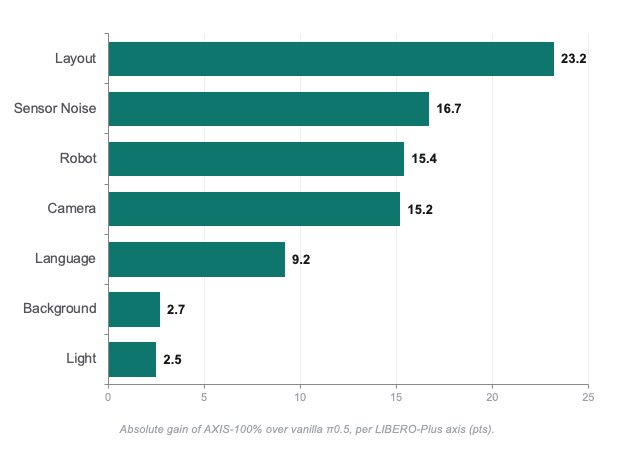
The largest gain comes from Layout, the axis where structured scene diversity matters most.
LIBERO-Plus evaluates robustness across seven perturbation axes: Camera, Light, Sensor Noise, Background, Layout, Language, and Robot.
The largest absolute gain from AXIS-100% appears on Layout: +23.2 points over vanilla π0.5.
This directly validates one of the core AXIS data augmentation methods of layout randomization.
AXIS also improves more than visual robustness.
Beyond Layout, AXIS-100% also improves several other LIBERO-Plus axes. These axes measure different kinds of distribution shift.
The result shows that AXIS also improves robustness to viewpoint shifts, degraded visual observations, robot initial-state changes, and task wording variation.
On the model side, we finished the first round of fine-tuning, evaluation, and benchmarking, and are now adjusting the data recipe for better performance.
The π0.5 evaluation pipeline has been merged into the real-world stack, while web policy inference can now load model checkpoints for online deployment.
We also completed the dataset’s conference submission and are now improving experimental results for the upcoming release.
Next, we will continue batch ablations, generate checkpoints and failure tasks at scale, and land model visualization in the hub.
We are also starting to connect the stack to new real-world embodiments. More on this soon.
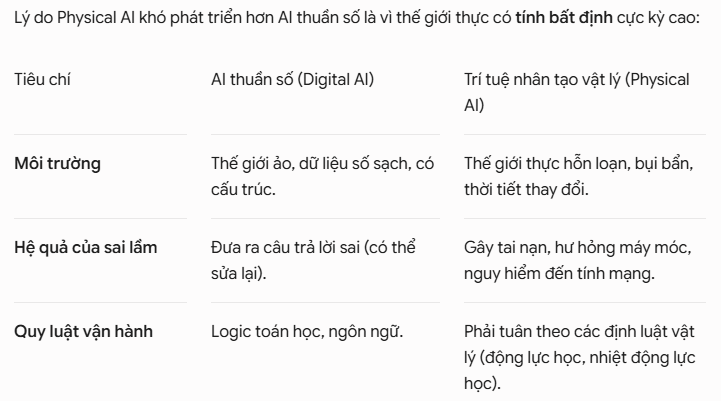
(Physical AI) là bước tiến tiếp theo của AI, nơi các thuật toán thông minh không còn chỉ nằm trong thế giới số (như ChatGPT hay Midjourney) mà được tích hợp trực tiếp vào thế giới thực để cảm nhận, suy luận và tương tác với môi trường vật lý.@axisrobotics
hiệm vụ đa hình thái (Multi Embodiment). Những nhiệm vụ này bao gồm điều khiển từ xa bằng hai tay và thích ứng nhiệm vụ trên các hình thái robot khác nhau. đang được thêm vào các nv hàng ngày.. thêm 1 bước tiến của @axisrobotics
axisrobotics đã bắt tay với BitRobotNetwork
để ra mắt các nhiệm vụ mới ae có role x trở lên lấy code vào cầy nhé. mình thì sẽ phấn đấu để sớm có role x để dc cày như ae...@axisrobotics
Mengumumkan kolaborasi kami dengan @BitRobotNetwork !
Axis meluncurkan SN/04 di BitRobot, laboratorium robotika terbuka di Solana yang mengkoordinasikan kontributor terdistribusi untuk mempercepat penelitian Physical AI.
SN/04 adalah misi teleop di simulasi di mana kontributor menyelesaikan tugas simulasi robotika berbasis web, menghasilkan data pelatihan yang berharga, dan memperoleh hadiah dari kedua ekosistem. Bersama-sama, kami sedang menskalakan demonstrasi manusia untuk Physical AI didukung oleh semua orang.
Aturan dan detail di bawah ini ↓