Some of you have asked me many times to suggest books to read. I never recommended any seriously.
But given the "war" India is going to face for the next few years, I would recommend reading at least one of the following:
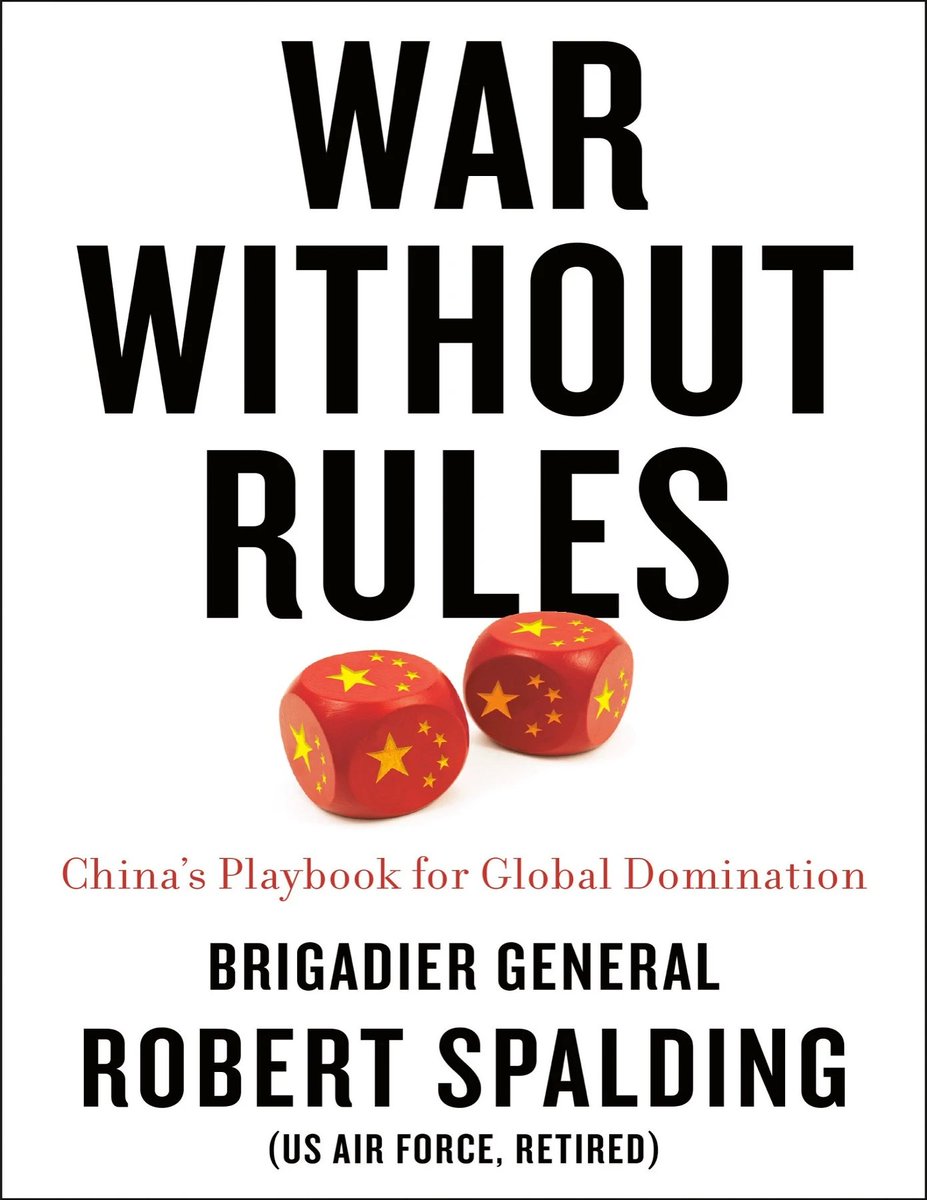
(1) War Without Rules (Robert Spalding, 2022) - Easiest and Shortest.
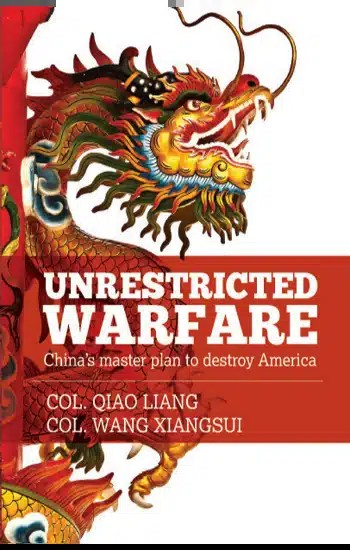
(2) Unrestricted Warfare (The Original, 1999) - Good overview by China's own defense guys.
(3) The Long Game (Rush Doshi, 2021) - Technical and for those really interested in Geopolitics.
All three books detail China's unrestricted warfare methods. They all explain it by illustrating China's war on America mostly.
But you can always imagine America as India and read the books. The methods are the same. And they are being actively applied now.
If you are interested, here's an overview of some methods:
Political warfare - Influence and infiltrate politics of democracies like India to weaken the country from inside.
Psychological warfare: Spreading rumors, disinformation, and amplifying issues to erode the will, cohesion, and morale of the Indian government, military, and importantly general public.
Drug warfare: Facilitating or profiting from the spread of illicit drugs into India to destabilize society, strain security resources, and weaken the social fabric.
Cultural warfare: Promoting or amplifying cultural trends and narratives aimed at influencing Indian viewpoints in alignment with the adversary's interests. Appropriating culture while eroding the nation of its own heritage.
Media warfare, Law warfare, Network warfare, Technological warfare, Fabrication warfare, Resources warfare... there are many more methods.
Buy and read at least one of these books, you will know. Book (2) is legally available free on the internet to download.
One thing for sure is the Palestinians have no history in Gaza. The ancient Philistines were not Semites but rather Europeans from Crete and the Aegean. They were among the “sea peoples” who battled the pharaohs before settling in Philistia—a nation of 5 cities including Gaza.
MOM, DAD, AND THE MIDTERMS
The midterms aren’t complicated.
America is like a family drowning in debt, spending beyond its means, losing control of its borders, and arguing over who should be in charge.
Democrats promise more spending, more entitlements and more dependency. Republicans have plenty of problems of their own—but they remain the only realistic brake on the madness.
Also my guest Lt governor of Texas Dan Patrick discusses the Iran war, the midterms, and the Paxton-Talarico showdown in Texas.
(1:19) Mom Wants More Spending
(5:55) Mom’s Unlimited Credit
(7:39) Dad’s Feckless Leadership
(10:14) The Case for Dad
(14:06) Guest Intro: Lt. Gov Dan Patrick
(15:37) Listen Until It Hurts
(21:35) Texas Citizen Legislators
(23:07) Talarico vs. Paxton
(28:56) Talarico’s Missing Weeks
(31:05) Iran War Fallout
(35:54) If Democrats Take House
(40:31) Stakes for Texas
(42:16) Republicans Fighting Republicans
(45:03) Early Voting Math
(47:44) Party Unity Matter
#Japan is increasingly treating defence as a national enterprise spanning the Self-Defense Forces (SDF), industry, infrastructure, #cyber, space and technology. Yet the #US alliance and post-war security principles remain central to this expanded role: @PratnashreeBasu https://t.co/4MiTwSXy5n
Archaeologists excavating ancient Egypt uncovered one of the most important confirmations of the Bible ever found: a victory monument from Pharaoh Merneptah that mentions Israel by name—for the very first time in recorded history.
After the death of Joshua, the Bible says Israel entered a chaotic period. The tribes were scattered, leaderless, and repeatedly attacked by foreign enemies (Judges 2:10-15). One of those enemies was Egypt.
In 1208 BC, Pharaoh Merneptah, son of Ramses II, launched a military campaign into Canaan. To commemorate his victories, he erected a stone monument-now known as the Merneptah Stele.
And carved into that stone are these words:
"Plundered is Canaan...Ashkelon is carried off, Gezer is seized, Yanoam is made non-existent; Israel is laid waste—its seed is no more."
This single line is explosive. Why? Because archaeology confirms exactly what the Bible describes!
Excavators discovered: Israel is listed separately from Canaan, proving Israel was a distinct people—not Canaanites.
• The word "Israel" is written in masculine form, which in ancient Egyptian grammar means a people, not a city or territory.
The cities listed (Ashkelon, Gezer, Yanoam) are feminine-standard for city-states. This proves Israel had no centralized capital yet, matching the
biblical period of the Judges.
In other words, Israel existed as a recognizable people in Canaan before kings, before Jerusalem, before a monarchy—exactly as Scripture says.
The date of the stele-1208 BC-places Israel in the land shortly after Joshua's death, confirming:
•The conquest had already begun
• The tribes were settled primarily in the hill country
•Egypt's chariots could not reach them there
This paper answers why confident idiots run the world.
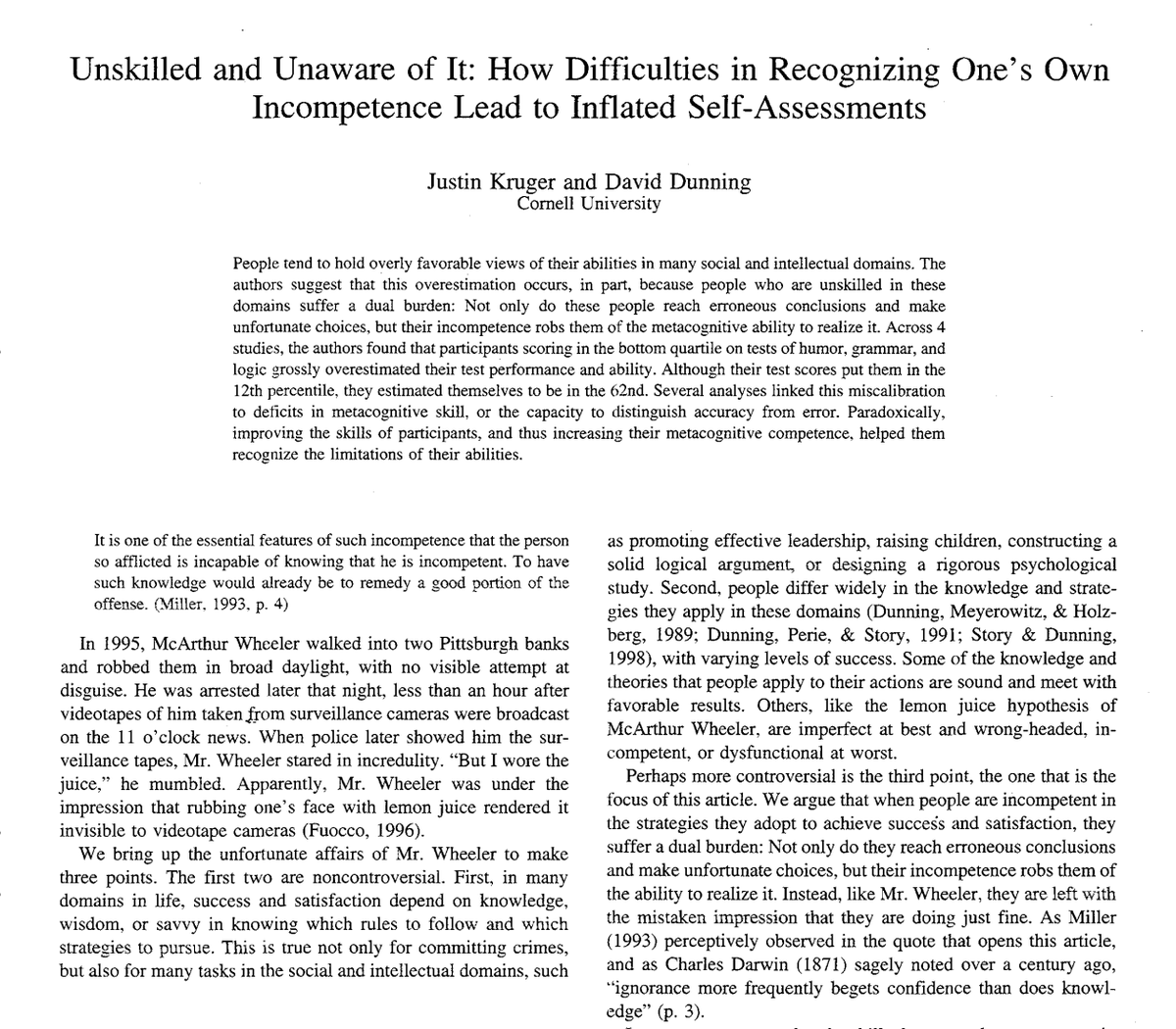
Cornell University published a psychological paper that explains every terrible boss, every loud influencer, and every broken corporate hierarchy.
It’s called “Unskilled and Unaware of It.”
they tested participants across logic, grammar, and humor to measure the gap between actual performance and self-perception.
And the results are wild.
participants scoring in the bottom 12th percentile consistently believed they were operating in the 62nd percentile.
they were not lying. they were literally incapable of recognizing their own incompetence.
the paper revealed a brutal paradox:
the exact skills required to master a domain are the exact same skills required to accurately evaluate your own competence in that domain.
if you lack the skill, you inherently lack the cognitive capacity to realize you are failing.
this creates a dangerous systemic loop.
the incompetent are blessed with absolute, blinding certainty. their brain protects them from their own ignorance, allowing them to speak first, demand authority, and never second-guess their decisions.
meanwhile, the actual experts suffer the exact inverse.
top performers in the study consistently underestimated their rank. because a task was easy for them, they falsely assumed it was easy for everyone else.
they hesitate. they obsess over nuance. they assume they have nothing unique to add.
we are biologically wired to confuse confidence with competence.
the loudest person in the room gets promoted, gets funded, and gets the microphone, not because they know what they are doing, but because they are physically incapable of seeing what they don't.
the only defense mechanism is building systems that stop rewarding absolute certainty and start demanding proof of work.
Do you, by Indian law, you cannot claim that Ayurveda cures a listed set of diseases even when there are complete scientific studies supporting the claim.
By contrast, China is funding and requiring Traditional Chinese Medicine centers in all hospitals.
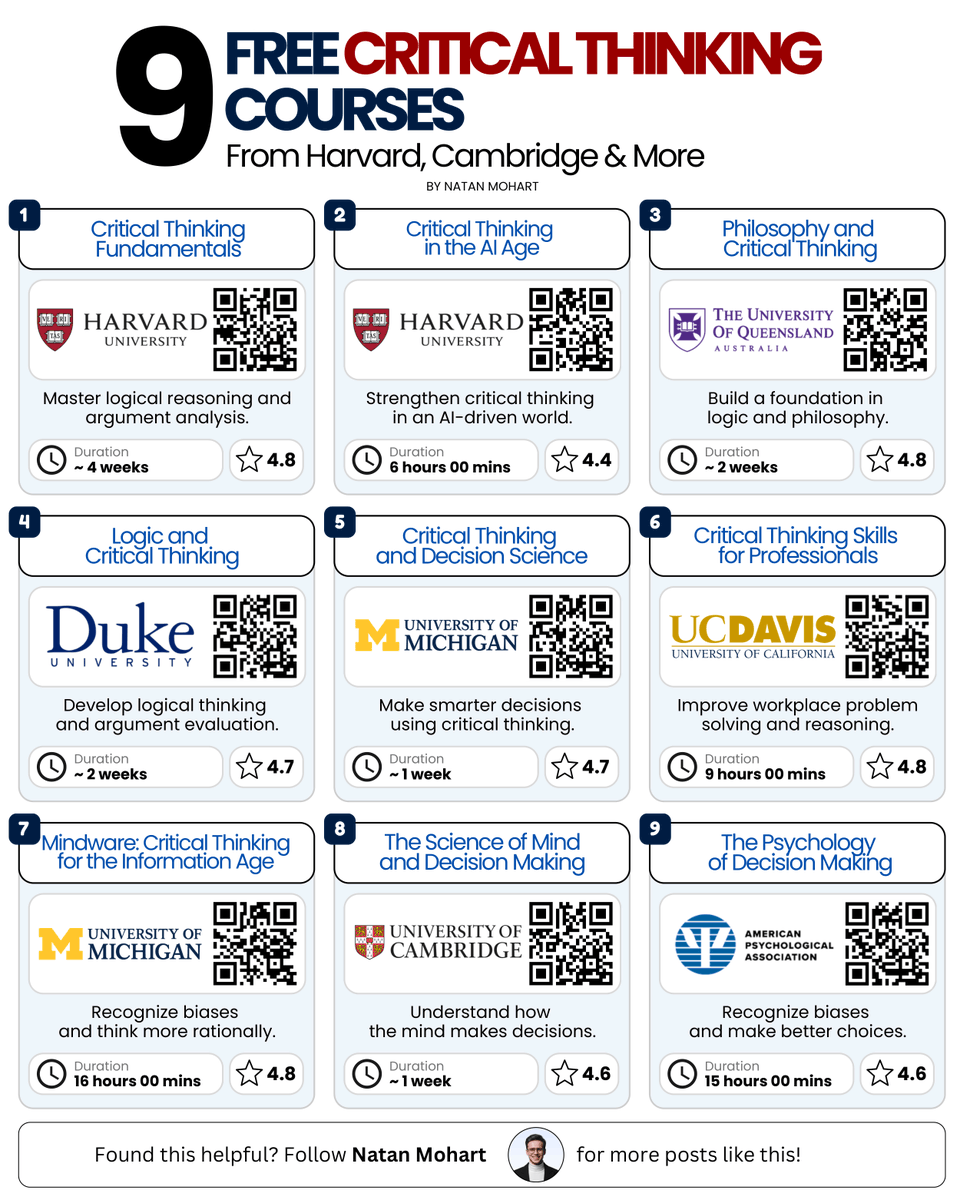
9 Free Critical Thinking Courses
From Harvard, Cambridge, Duke & More
We have more information than ever in history.
But critical thinking is catastrophically scarce.
That's why we drown in noise, misinformation, and AI illusions.
Algorithms feed us what we want to hear.
We believe in convenient truths.
And we live under the illusion of knowledge.
Truth isn't determined by opinion.
It's grounded in facts.
But people rarely choose facts over comfort.
The good news?
Critical thinking is a skill.
And like any skill, it can be trained.
Here are 9 free critical thinking courses worth taking:
1. Structure and Function of Argument:
An Introduction to Critical Thinking (Harvard University)
https://t.co/L25dsOuvD4
2. Tech Ethics: Critical Thinking in the Age of Apps,
Algorithms and AI (Harvard University)
https://t.co/IoxoZ9ra6I
3. Philosophy and Critical Thinking (The University of Queensland)
https://t.co/tM4Kh1RVeC
4. Logic and Critical Thinking (Duke University)
https://t.co/vBu3clERV5
5. Critical Thinking and Decision Science (University of Michigan)
https://t.co/xQkLDkkmFV
6. Critical Thinking Skills for Professionals (University of California, Davis)
https://t.co/q84x9XX8dD
7. Mindware: Critical Thinking for the Information Age
(University of Michigan)
https://t.co/p9DGL0weNq
8. The Science of Mind and Decision Making (University of Cambridge)
https://t.co/C8gVpRq9y4
9. The Psychology of Decision Making (American Psychological Association)
https://t.co/ljgPRAMgVe
How to keep it free:
On Coursera, look for Enroll for free or audit. Some courses don't have a free audit, but they give you a 7-day free trial, one per account. That's enough to finish most of them.
On edX, pick Audit. Same materials, no payment.
💬 What's one book or resource that improved your critical thinking?
If you found this helpful, save this post and share it with someone who wants to become a better critical thinker.
—
https://t.co/HqG1lck1Xi
@Sanjay_Sriv I hope your "this decade" means 2020-2030 and not beyond!
India's GDP must hit $10 trillion by 2030!
Any time later than 2030 may be too late...
@HindolSengupta
Had the border not been sealed America would have been lost. Never before has such an existential promise been kept so fully and completely — against unrelenting and unceasing opposition from the entire Democrat Party and Democrat lawyers, judges, NGOs, media and politicians.
ANNAMALAI: THE OXFORD QUESTION.
Six months ago, I warned of a shift.
Few believed me.
Today, some supporters are stunned.
Welcome to the hangover of “Andhbhakti.”
I am a nationalist.
Not BJP's lawyer.
Not Congress's prosecutor.
No politician gets blind faith.
4 June 2024.
Annamalai was BJP State President.
BJP won ZERO seats in Tamil Nadu.
Even Annamalai lost Coimbatore.
Margin: 1,18,068 votes.
Then came Oxford.
The Chevening Gurukul Fellowship for Leadership and Excellence.
Funded by the British government.
He had applied to this program.
As founder of “We The Leaders.”
Not as BJP state president.
Interesting?
Yes.
After he came back from the Program.
4 December 2025.
He told BJP he wanted out.
BJP asked him to finish election work.
5 June 2026.
He left.
Later, he credited Oxford with helping him reassess politics.
Today, he questions the Centre he once defended.
Now, consider Oxford's history.
For decades, Oxford's ecosystem has intersected with intelligence.
Its academic networks were used for British intelligence recruitment.
Its alumni have led MI5, MI6, and even America's CIA.
The CIA funded covert cultural influence networks.
Some operated inside India for Anti-India Activities.
This is documented history.
Chevening openly calls its fellowships tools of British interest public diplomacy.
Was Annamalai compromised?
I am not saying that.
Has his politics shifted?
Absolutely yes.
This isn't BJP versus Congress.
It's citizens versus personality cults.
When loyalty becomes religion, evidence looks like blasphemy.
Nation first.
Leaders second.
Scrutinise EVERY leader.
Judge actions.
Consistency.
Results.
Faith belongs in temples.
Accountability belongs in politics.
Pakistan Keeps Returning to the IMF. Are We Fixing the Economy — or Preserving the System That Keeps Breaking It?
At Harvard, Pakistan's Finance Minister explained how the economy had been stabilised. Nobel laureate Daron Acemoglu and Professor Atif Mian raised a far more uncomfortable question: Why does Pakistan keep returning to economic crisis despite decades of reforms and IMF programmes?
This was one of the most thought-provoking discussions on Pakistan's economic future I have watched. Held at the Harvard Pakistan Conference 2026, it featured Finance Minister Muhammad Aurangzeb, Daron Acemoglu (MIT) and Atif Mian (Princeton), moderated by former SBP Governor Dr Reza Baqir.
Essential viewing for policymakers, political leaders, business leaders and especially our young generation.
The contrast could hardly have been sharper.
The Finance Minister highlighted the govt's stabilisation achievements: falling inflation, rebuilding reserves, meeting debt obligations, fiscal discipline, tax reforms & privatisation. These achievements deserve recognition.
But while the Minister focused on how Pakistan had avoided another collapse, Acemoglu and Atif questioned why our economic and political system keeps producing crises in the first place.
Acemoglu focused on failing institutions: elite capture, weak democratic accountability, dysfunctional governance, poor education and inadequate human development. His analysis challenged the belief that economic prosperity can emerge without transforming the institutions that determine who holds power, who enjoys privileges and who has opportunities.
Atif Mian challenged Pakistan's distorted economic incentives and lack of a forward-looking strategy.
Why does a country with abundant sunshine remain burdened by expensive energy arrangements and imported fuels? Why do real estate speculation, protected businesses and rent-seeking generate better returns than innovation, manufacturing and competitive exports? And why do we celebrate rising remittances without questioning our failure to create productive opportunities for talented Pakistanis at home?
Then comes the AI revolution. With millions of children out of school, poor learning outcomes and chronic underinvestment in human capital, how can Pakistan compete in a world where knowledge, skills and innovation increasingly determine prosperity?
What struck me most was not what the Finance Minister said — but what remained largely unanswered.
He acknowledged population growth and climate change, but offered little substantive response to the deeper questions about education, human development, dysfunctional institutions, rule of law, elite capture and the political economy that repeatedly defeats reform.
Central takeaway: Pakistan's problem is not merely that governments fail to implement reforms. It is that our political and institutional arrangements reward those who benefit from resisting them.
We have spent decades treating the symptoms of economic failure while leaving its underlying causes largely intact.
Stabilisation prevents collapse. Institutional transformation creates prosperity.
The real test of leadership is not whether Pakistan completes another IMF review, but whether it has the vision and courage to transform the institutions, incentives and power structures that make repeated rescues necessary.
Watch the discussion:
https://t.co/zKyLer4snQ
#PakistanEconomy #Governance #Institutions #HumanDevelopment #DaronAcemoglu #AtifMian
https://t.co/CNIizaC1yu