I share part of my market views publicly here. Detailed execution, trading plans, research reports, risk management, and the reasoning behind each decision are shared on WhatsApp:https://t.co/SmtbWveEWB
🚨Big Economic Data Just Dropped: Inflation Won't Cool, While GDP Hits 4.3%!
Core PCE inflation surged to 3.3%, coming in hotter than expected. Prices just won't stay under control!
Initial jobless claims dropped to 189K, below expectations. The labor market remains extremely strong!
Q3 GDP hit 4.3%, blowing past the original 3.5% forecast!
The only slight weakness was personal spending, which rose just 0.3%, suggesting consumers are starting to pull back a little.
No matter how bright the future of AI looks, Wall Street may no longer have access to capital cheap enough to keep paying for that future.
The market remains under pressure today. I have updated my watchlist, which includes potential entry points, trading strategies, and risk levels. If you are interested, please check my pinned post and reach out to me for further details.
U.S. stocks fall across the board in pre-market trading!
But what's more concerning than the selloff itself is the surge in CDS spreads on SoftBank ($SFTBY) and Oracle ($ORCL), signaling record-high corporate default risk. This is a warning sign of growing stress in the credit market.
The concern is that if cloud providers start cutting capital spending, AI infrastructure orders could come under pressure, dragging down the entire supply chain, from chips like NVIDIA ($NVDA), AMD ($AMD), and Broadcom ($AVGO) to memory stocks and data center plays. The whole AI trade could face another round of repricing.
Now, all eyes turn to the October PCE inflation report at 8:30 AM ET, especially Core PCE. Headline monthly PCE is expected to cool from 0.5% to 0.3%, but Core PCE inflation could rise from 3.1% to 3.2% year over year.
That's the part I'm watching most closely. If Core PCE comes in below expectations, Treasury yields could retreat, rate-cut expectations could strengthen, and stocks may find room to rebound.
But if oil prices are falling while underlying inflation continues to climb, that's a much bigger problem. It would make the Fed's job harder and put further pressure on equity valuations.
Japan's corporate services prices rose 4.2% year over year, marking the fastest increase in 36 years.
The BOJ could raise interest rates again on December 18.
Watch out: AI tech stocks and $BTC could face another liquidity shock, potentially triggering a second round of valuation compression.
BNP Paribas slashed its price target on $MU from $1,700 to $775 — nearly a 55% cut.
The bank also downgraded the stock and no longer recommends buying it.
Don't Get Shaken Out! A Major Buying Opportunity May Be Forming Ahead of a Powerful Rebound.
1. S&P 500 ($SPY)
The broader trend remains bullish. Monthly and weekly charts still show a long-term bull market structure. This looks more like a correction within an ongoing uptrend. An initial bullish crossover has appeared, and the market has already bounced from oversold levels. A strong rebound could be next.
2. Nasdaq 100 ($QQQ)
The index may have a little more downside, but selling momentum is clearly weaker than before. When that shift takes hold, tech stocks could see a meaningful rebound. We're getting closer to a potential buying zone.
3. Semiconductor ETF ($SMH)
The short-term downtrend isn't fully over, but conditions are improving. The 200-week moving average has been an important level to watch. Previous pullbacks toward this level offered attractive entry opportunities. If SMH tests it again and stabilizes, it could present another opportunity.
4. Palantir ($PLTR)
The stock has gone through two major pullbacks this year, but the company's fundamentals haven't deteriorated at the same pace. The $150–$160 range is worth watching from a valuation perspective. If the broader market resumes its uptrend, PLTR could benefit from a valuation recovery.
5. Amazon ($AMZN)
Compared with many AI high-flyers, Amazon has held up relatively well during this selloff. That relative strength could be setting the stage for its next move higher. I'm watching $240–$245 as a potentially attractive entry zone.
6. Alphabet ($GOOGL)
Alphabet remains undervalued over the long term. My target for the next 6–8 months is $380–$400. Market panic could offer better entry prices, but the company's long-term growth story remains intact.
7. NVIDIA ($NVDA)
As long as cloud providers continue expanding AI capital spending, NVIDIA remains one of the most direct beneficiaries. The key short-term support zone is $146–$150. If the stock stabilizes there, the first rebound target is $160–$165.
8. Micron ($MU)
The initial rebound target is $660–$690. If memory prices continue strengthening, MU could eventually challenge its 200-day moving average near $775. Whether the memory cycle has peaked remains a key factor in determining the stock's next move.
9. Broadcom ($AVGO)
AI isn't just a GPU business. Custom AI chips and high-speed networking represent major growth opportunities as well. A move back above $330 could open the door to $340, near its 50-day moving average. The more AI infrastructure spending expands, the more opportunities emerge across the supply chain.
10. Microsoft ($MSFT)
Microsoft remains one of the most important players in AI commercialization. The initial rebound zone is $502–$509, with the next key level near $520, around its 50-day moving average. If AI investments increasingly translate into real revenue, Microsoft could see another round of valuation expansion.
11. Taiwan Semiconductor ($TSM)
The key level to watch is around $340, a potential support zone. If TSM shows strong-volume stabilization and moves back above its short-term moving averages, a rebound could target $358–$366.
The bigger picture remains bullish.
Today's AI Stock Market Insights:
Jensen Huang's rally lasted just one day. $NVDA swung sharply in both directions. His return doesn't mean inflation has disappeared.
Semiconductor stocks in Japan and South Korea plunged 5%–14%. South Korea's market triggered another trading halt, while major banks collectively cut their price targets.
$DELL beat earnings expectations, but the stock struggled to gain traction. Its AI server backlog reached $132.3 billion, and management expects even stronger demand next year.
The credit squeeze is starting. Banks are reviewing data center clients more closely. Tighter financing could delay some data center projects.
Are data centers losing their appeal? BlackRock and IFM are reportedly considering lowering their bids for Stack's data center assets. Investors are starting to focus more on cash flow.
$NVDA opened premarket with a sharp selloff.
Just yesterday, the stock staged a massive 31% rally, leaving investors who bought near the lows sitting on substantial gains. The stronger the rally, the greater the temptation to lock in profits. Some investors remain bullish, while others are using the positive news as an opportunity to cash out.
Jensen Huang's return certainly gave NVIDIA a boost and addressed one of the market's biggest concerns: leadership uncertainty. But let's not forget that having the CEO back doesn't mean every problem has been solved.
For the stock to sustain its upward momentum, NVIDIA will need to deliver even stronger earnings and exceed market expectations.
$ANT Short-Side Watchlist:
Can revenue keep growing at this pace? Don't get carried away by today's growth. If momentum slows, the market could turn against the stock very quickly.
The more popular Claude becomes, the more money it burns. Are revenues enough to cover the bills for chips, computing power, and data centers? The business could keep getting bigger while the financial hole gets deeper.
$100 is a major hurdle. If the stock can't break through, it suggests plenty of investors are waiting to sell. Even more concerning would be a breakout attempt followed by another sharp rejection.
The founder has already sold part of his stake, while employees still hold a substantial amount of shares. As more shares become available for sale, who's to say insiders and employees won't rush to cash out? Will there be enough buyers to absorb that supply?
Here's the most interesting part: the broader market is rising, NVIDIA is surging, and tech stocks are rallying, yet ANT is barely moving. If a bull market can't lift the stock, what's going wrong?
Shorting doesn't necessarily mean a company is bad. Sometimes, it simply means the stock price has become too expensive.
📊The Rally Looks Impressive, But These Stocks Are Still Far Below Their All-Time Highs.
One big rebound doesn't erase months of losses. Here's how far some major stocks and ETFs remain below their previous highs:
$NVDA: -32.2%
$MU: -43.6%
$AMD: -31.1%
$ANT: -23.9%
$AAPL: -3.3%
$TSLA: -22.7%
$MSFT: -11.9%
$AMZN: -11.1%
$SPCX: -40.9%
$AVGO: -36.7%
$GOOGL: -31.0%
$TSM: -25.4%
$SPY: -7.6%
$QQQ: -14.4%
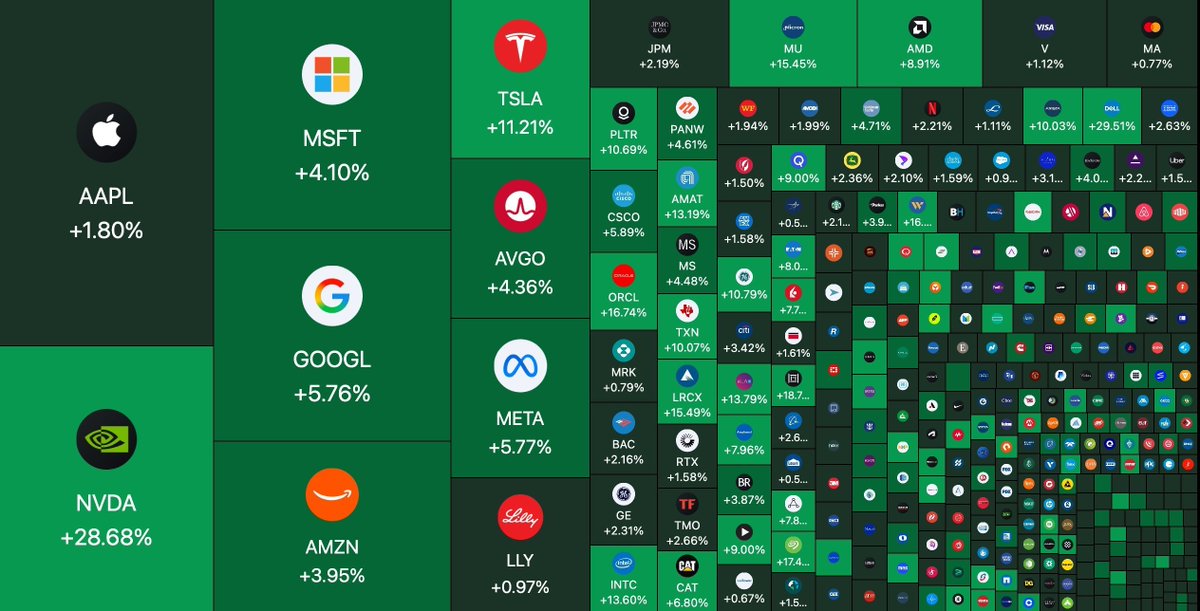
Take a closer look at these numbers. Even after the recent explosive rebound, several major AI and semiconductor stocks remain more than 30% below their highs.
The key question now is whether these stocks can reclaim critical resistance levels and maintain their upward momentum. One strong rally is encouraging, but a sustained recovery will take more than a single session.
NVIDIA Rallies 30%: Did Traders Who Bought at the Open Get Caught Chasing the Rally?
1. NVIDIA ($NVDA)
Jensen Huang's return helped drive a 30% single-day rally. However, most of the gains came before the opening bell. Those who chased the stock at the open had very little upside left. Sentiment has clearly improved, but sustained strength still needs confirmation.
2. AMD ($AMD)
AMD rebounded alongside NVIDIA, but struggled after an initial spike. It remains in a clear downtrend, with the 200-day moving average acting as major resistance. A short-term oversold bounce is possible, but there is still no clear trend reversal.
3. SanDisk ($SNDK)
SNDK jumped more than 10%, but buyers chasing the stock at the open had little opportunity to profit. This suggests the rally was driven more by sentiment recovery than sustained buying pressure. Despite the rebound, the stock has yet to regain its uptrend.
4. Micron ($MU)
Memory stocks rallied across the board, with DRAM-related ETFs gaining 18% in a single day. However, Micron and other memory stocks still need time to repair their damaged technical structures. The key is whether they can reclaim major moving averages and hold their gains.
5. Microsoft ($MSFT)
MSFT opened higher but weakened throughout the session. Traders who chased the opening rally were at risk of getting trapped. There is still no convincing reversal signal, and the ability to reclaim key moving averages remains important.
6. Tesla ($TSLA)
Tesla has shown some relative resilience compared with other technology stocks recently. However, its overall chart structure still looks weak. It has relative strength, but that doesn't yet confirm a return to market leadership.
7. CrowdStrike ($CRWD)
CRWD dropped sharply following earnings, while the market continues to digest reports surrounding a potential acquisition of Zscaler. Despite being a major cybersecurity player, its current price action remains weak. Caution is warranted in the short term.
8. Palo Alto Networks ($PANW)
PANW has failed to break above its 50-day moving average for three consecutive sessions, signaling persistent selling pressure. The broader cybersecurity sector remains relatively strong, but without a convincing breakout from leading stocks, a sector-wide recovery is not yet confirmed.
9. Bitcoin ($BTC)
Despite the sharp rebound in equities, Bitcoin gave back nearly all of its intraday gains. Its underperformance suggests that broader risk appetite has not fully recovered.
10. Gold ($GOLD)
Gold also surrendered part of its gains. A healthier bullish trend would involve holding above a rising 200-day moving average, consolidating, and then attempting another breakout.
Big premarket rally, heavy selling after the opening bell. Don't confuse a relief bounce with a confirmed trend reversal.
Today's AI & U.S. Stock Market Highlights:
$NVDA surged 31.5% in a single day, its biggest gain in 20 years! $SPY and $QQQ both rose around 6%, recovering half of last week's losses.
U.S. November Composite PMI fell to 54.6, signaling growing pressure from inflation and new orders, potentially increasing pressure on the Fed to cut rates.
$AMZN is reportedly preparing to spend $7.5 billion to acquire the chip team from AI startup Decart, aiming to reduce its reliance on NVIDIA.
$AAPL is also moving into AI agents, with plans to let AI directly control devices, browse the web, and write code.
$BTC remains under pressure, down 1.51%. NVIDIA's rally hasn't translated into gains for Bitcoin. Some investors appear to be selling BTC to increase their NVIDIA positions.
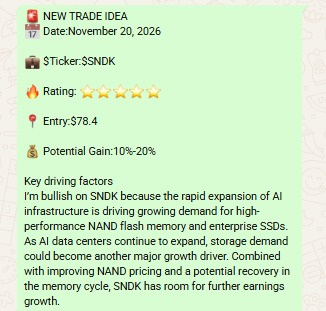
$SNDK Congratulations to everyone in the group who followed this trade. We're currently up around 25%! I'll continue sharing market updates and refining our trading strategies in the group, with a focus on identifying opportunities and managing risk. I'll keep everyone updated as the market develops.
📊Based on the signals we discussed over the weekend, Monday's main focus is whether the market can stabilize.
The Nasdaq surged as much as 3% overnight. Combined with Friday's record trading volume, this suggests plenty of capital is positioning for a rebound.
Two things I'm watching:
No slow fade after the rally. A gradual decline after a strong bounce would signal weak follow-through.
Don't trust the overnight move blindly. Since last week, overnight trading has often diverged from regular-session action.
A real stabilization means holding gains after the initial bounce, showing that sentiment and buying interest are recovering.
I'll also be cautious about premarket signals. If there's no clear entry setup, I'll wait for regular trading hours before making a decision.
Trading requires expectations about what's ahead, but our decisions must be based on what the market is actually doing. Stay flexible. Don't force a trade or imagine a setup that isn't there.
📊Next Week's Market Outlook: Is a Major Rebound Finally Taking Shape?
1. First, look at the depth of this correction. The Nasdaq has fallen from 31,616 to 24,976, a decline of 21%. Since the 2023 bull market began, this is the largest drop apart from the 2025 tariff selloff.
2. In terms of duration, the correction has lasted nearly two months, from early October to late November. The longest correction since the 2023 bull market began was in early 2026, when the first AI pullback coincided with the U.S.-Iran conflict. That also lasted more than two months.
3. Even during the 2022 bear market and the 2000 dot-com bubble, initial corrections of around 20% over two months were followed by weekly rebounds.
4. Since the midterm elections ended, the driving force behind this correction has shifted from oil prices and rate-hike expectations to concerns about Democratic pressure on AI, NVIDIA, Anthropic, and a series of unmet AI expectations. These were largely unexpected developments.
5. Market sentiment has completely shifted. Most investors are now bearish, and even the most optimistic are only expecting a rebound. Friday's selloff was a major release of fear. How many people are still willing to buy the dip?
My view is that even if we're in a bear market, the current depth and duration of this decline suggest we're approaching a major rebound. If the bull market continues, this is an even more important area to consider entering.
Next, we need to capture the gains from this weekly rebound!
Key Signals to Watch:
1. Bad news, but no further decline. If negative news emerges next week, such as disappointing PCE data on Wednesday, but the market doesn't fall further.
2. Market stabilization. Look for signs that the market is stabilizing after last Friday's selloff.
3. A sharp reversal. If the market drops again, watch whether it quickly rebounds and closes with a long lower wick or a doji, flushing out panic sellers.
If ANY ONE of these signals appears, move in decisively!
Expectations and Trading Plan:
1. Monday: Focus on the first signal. After such a sharp decline on Friday, logically, selling pressure should continue. If the market doesn't fall further, I'm inclined to put some capital to work.
2. Tuesday: The main focus is whether the market stabilizes.
3. Wednesday: Focus on PCE and whether we see bad news without further downside.
4. Thursday and Friday: The main focus remains on whether the market stabilizes.
Next week is about capturing the weekly rebound! Of course, this depends on whether the market stabilizes. The key to trading is reacting to actual market conditions. I'm definitely not going to stubbornly enter while the market continues to drift lower.
📊 Today's AI & U.S. Market Updates:
Don't panic. This may just be a technical pullback. Futures are already rebounding, with $SPY up around2.2%and $QQQ up around 3%.
South Korea prepares a market rescue. The government plans to deploy a 10.76 trillion won stabilization fund to buy stocks and prevent a market crash.
Musk's warning: Money could become the scarcest resource in 2027. Credit markets are reportedly placing $SPCX's debt risk in the same category as $ORCL.
SpaceX's $74 billion data center plan faces resistance. Plans for two new data centers are facing local opposition over concerns about rising electricity bills.
A breakthrough in mathematics? Mathematician Levent Alpöge reportedly worked with Claude on a proof related to the 167-year-old Riemann Hypothesis. A claim worth watching closely.