@will_90900@LukeD21 There's an obvious difference in the weight we are giving to the recent developments. I think the technology speaks for itself and now it is up to the DPLS team to produce results that generate revenue from the pieces they lined up.
Again, time will tell; I will take my chances
@will_90900@LukeD21 Were any of those from the timeframe I said I was enthusiastic about?
Will you really sit here and argue that locking in EPLAs with two branches of the US military*, and the UMBRA PTLA aren't potential catalysts for revenue growth?
@LukeD21@will_90900 Dec 18, 2025: Patent and Trademark License Agreement with UMBRA
Jan 7, 2026: Formation of Darkpulse Portugal
Jan 20, 2026: Reduced Authorized Shares by 10B
May 7, 2026: Exclusive Patent License Agreement granted by the US Navy
Oct 1, 2026: EPLA granted by the US Air Force
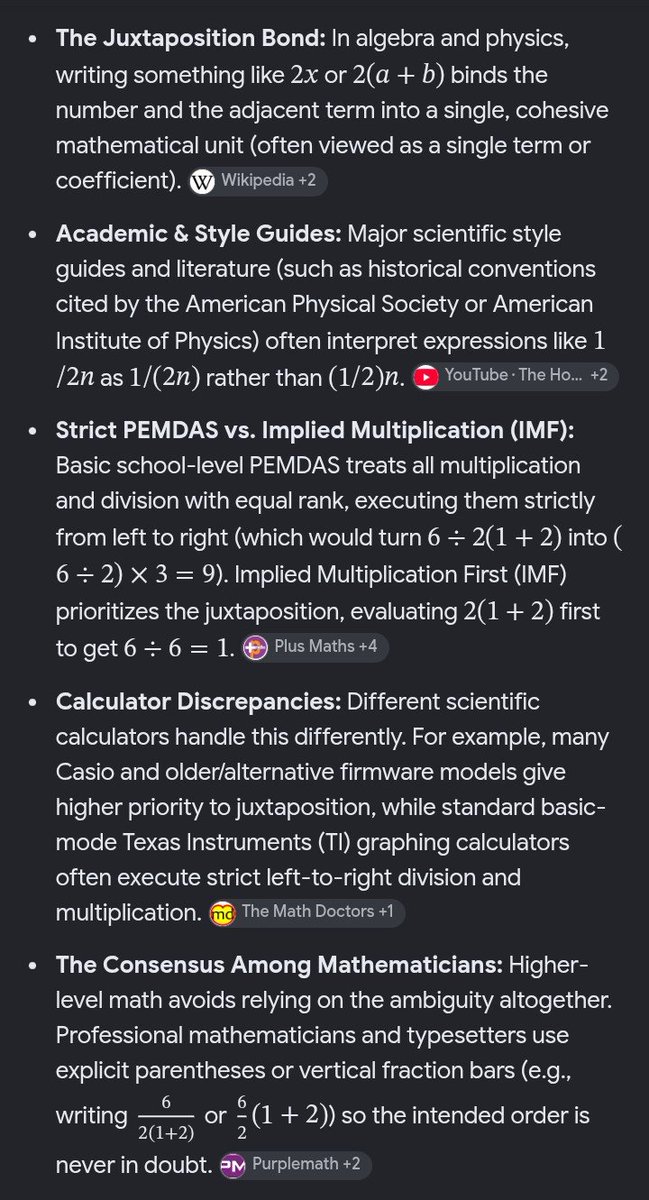
@cianchetto4 The concept of IMF instead of strict-order PEMDAS is used in higher mathematics. The people who work with complex mathematical equations for their job use IMF, so to say that the basic grade-level application of PEMDAS is more correct than IMF is an interesting position to hold
@Critter02469@CSavatie@hepimizolecegiz@stats_feed Whew, it may be time to self-reflect. Only one of us is arguing and flexing an ego.
If you aren't coming up with the same answer "professional mathematicians", then I'm not sure how you can say you are right.
@cianchetto4@CSavatie@hepimizolecegiz@stats_feed We disagree on whether juxtaposition has a higher priority than strict order of left-to-right or not.
Higher level mathematics tend to lean towards an implicit priority for juxtaposed numbers, but, the original equation is intentionally ambiguous and needs more notation
@cianchetto4 This is where clarity through additional notation in the equation is needed.
Since it is written as "2(1+2)", it would stand to reason that the entirety of "2(1+2)" is the denominator.
If it were written "2 * (1+2)", then it would suggest that "2" could be the denominator.
@cianchetto4@CSavatie@hepimizolecegiz@stats_feed It does when determining what 6 is being divided by. The equation needs additional notation.
The equation is 6 ÷ 2(1+2)
Division works in fractions.
6 is the numerator
÷ draws the fraction bar
The remainder is written as "2(1+2)".
What portion of that is the denominator?
@CSavatie@hepimizolecegiz@stats_feed This is where clarity through additional notation in the equation is needed.
Since it is written as "2(1+2)", it would stand to reason that the entirety of "2(1+2)" is the denominator.
If it were written "2 * (1+2)", then it would suggest that "2" could be the denominator.
@CSavatie@hepimizolecegiz@stats_feed Yes, I agree there is an order. The question is about what 6 is being divided by.
6 ÷ 2(1+2) is the equation.
Division works in fractions.
6 is the numerator.
÷ draws the fraction bar
The remaining portion of the equation is "2(1+2)". What portion of that is the denominator?