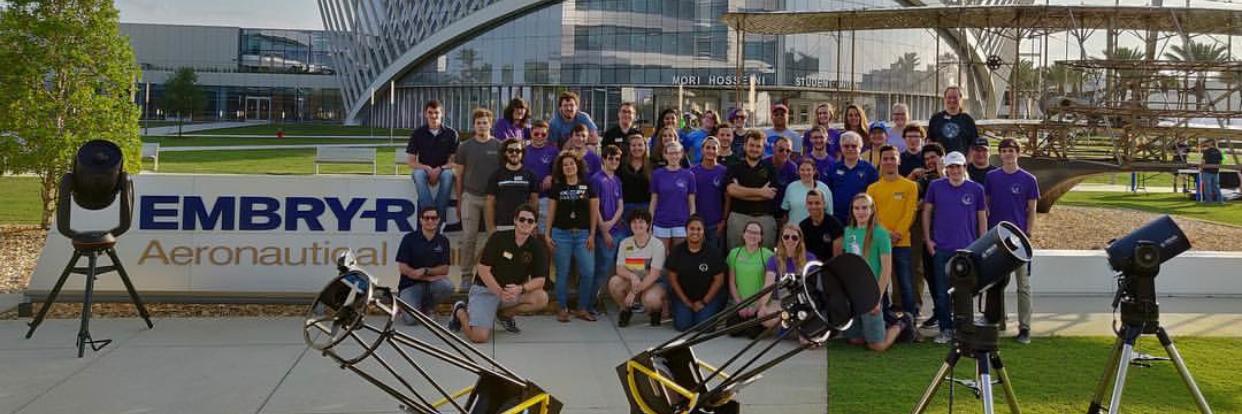
The Amateur Astronomy Club is a group of students at ERAU who share a passion for astronomy and love to share that passion with other students and the community
Happy Pluto Day everyone!! Don't forget to attend our weekly meeting tomorrow from 8-9pm in COAS 207. As a reminder, this meeting is mandatory for everyone going camping with us this weekend.
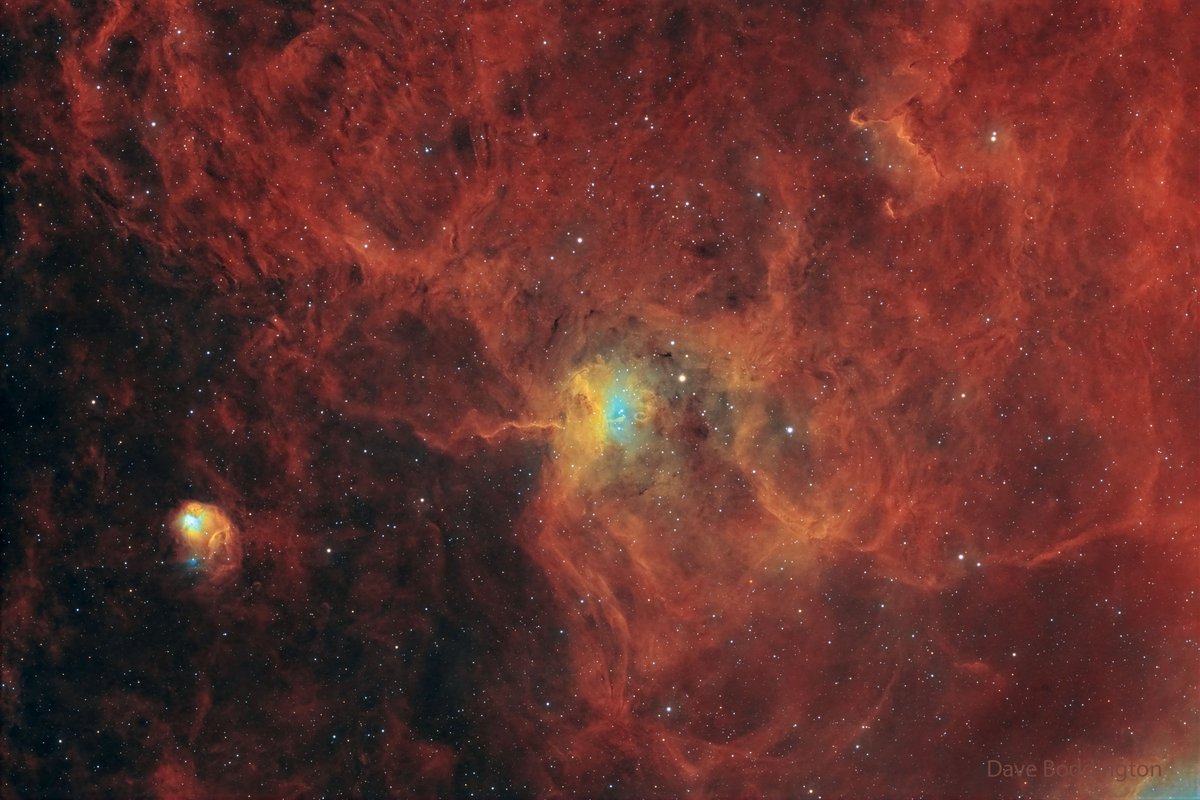
Will the spider ever catch the fly? Not if both are large emission nebulas toward the constellation of the Charioteer (Auriga). The spider-shaped gas cloud in the image center is actually an emission nebula labelled IC 417, while the smaller fly-shaped cloud on the left is dubbed NGC 1931 and is both an emission nebula and a reflection nebula. About 10,000 light-years distant, both nebulas harbor young star clusters. For scale, the more compact NGC 1931 (Fly) is about 10 light-years across. The featured deep image, captured over 20 hours during late January in Berkshire UK, also shows more diffuse and red-glowing interstellar gas and dust.
Image Credit & Copyright: Dave Boddington
The misconception that there is no sound in space originates because most space is a ~vacuum, providing no way for sound waves to travel. A galaxy cluster has so much gas that we've picked up actual sound. Here it's amplified, and mixed with other data, to hear a black hole!
Dear astronomers at star parties: Do *NOT* insult the quality of another astronomer's equipment. Ever. The night sky is for everyone. I don't care if someone sets up next to you with a literal cardboard tube on a stick. You say "Welcome to the star party!"
Starship at our launch facility in Cameron County, Texas. Watch as @elonmusk gives an update on the vehicle today at ~7:00 p.m. CDT → https://t.co/gtC39uBC7z