Need a Phase 1 Environmental report for your commercial real estate transaction? AAI has highly competitive prices and the fastest turnaround times in the industry. https://t.co/Tyoqy3VSYO
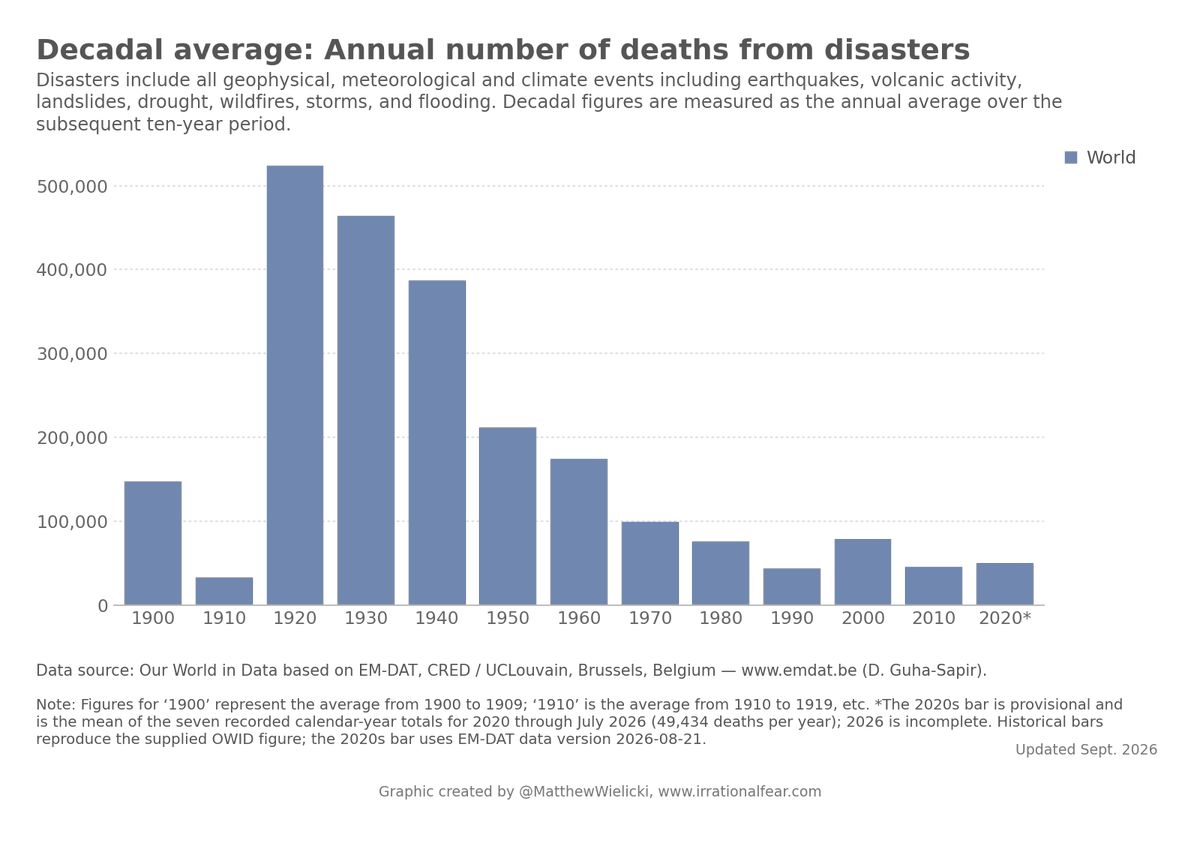
The next time ambulance chasers and climate grifters exploit a natural disaster to scream that the “climate crisis is killing us” and we have only moments left to act... show them this graph.
Global deaths from recorded natural disasters have plummeted over the past century.
The hazards didn’t disappear. Human resilience improved: better infrastructure, forecasting, emergency response, technology, and access to reliable energy.
Stop exploiting tragedy. Start acknowledging the data.
The top 10 leading climate and environment predictions, that failed
Ice-Free Arctic: In the 2000s, former US Vice President Al Gore predicted the Arctic Ocean would be completely ice-free in the summer of 2013–2014.
Vanishing Nations by 2000: In 1989, a UN official claimed entire island nations would be wiped off the map by sea-level rise if global warming wasn't reversed by 2000.
1970s Global Cooling Scare: News outlets and selective scientific papers in the 1970s warned an imminent ice age was coming due to aerosol pollution.
Mass Famine (1968): Paul Ehrlich’s The Population Bomb claimed hundreds of millions would starve in the 70s and 80s.
Running Out of Metals (1972): The Club of Rome warned the world would run completely out of copper, gold and zinc by 2000.
Forest Collapse from Acid Rain: 1980s forecasts predicted acid rain would destroy Central Europe's forests within a decade.
Extinction of Coral Reefs by 2020: Activists warned 90% of tropical reefs would disappear by 2020.
Immediate Peak Oil (1970s–2000s): Experts routinely declared cheap oil would run out by the 1990s or 2010s.
Methane 'Bomb': Early fears warned permafrost thaw would trigger a massive, overnight methane release causing runaway warming.
Net Zero & RCP8.5 Overreach: Net Zero policy largely relied on RCP8.5—an extreme worst-case scenario assuming massive coal growth leading to ~4.5°C warming. Scientists have sidelined this pathway as unrealistic.
The United Nations worst case global warming scenario collapsed a few months ago after admissions the modellers got it wrong.
The world is no longer facing a 5.5°C warming trajectory by 2100 at all. That target has been removed as 'implausible'. Yet this was the chief driving reason for a global transition away from fossil fuels, and replacing them with energy from wind turbines and solar panels.
This effort to harness wind and sunlight could become one of the greatest economic disasters in modern history, costing $275 trillion by the time a new fully developed infrastructure is in place by 2050. This would include a second global power grid costing $21 trillion.
The UN explanation—'We are on track for a 5°C apocalypse if we don't immediately upend the global economy'—is dead.
Removing its extreme scenario creates a distinct institutional challenge for a climate bureaucracy that spent 25 years leveraging fear. We are left with a blighted rural landscape, trillions of dollars spent on a gigantic physical overbuild and the likelihood that this will become a self-fulfilling, replacement loop every 20 to 30 years.
The scientific community has acknowledged that the catastrophic, upper-end predictions were built on flawed, outdated economic models, because early modelers failed to understand real-world market trends.
First made available in 2011 to drive global climate policy, this extreme scenario—known widely as RCP8.5 (and later SSP5-8.5)—served as the primary engine for the media's terrifying 'business-as-usual' headlines for over a decade.
It was built on assumptions that humanity would aggressively abandon clean tech, undergo an unprecedented five-fold increase in coal use, and even resort to converting coal to oil to run vehicles. Those apocalyptic projections simply didn't occur and fossil fuels produce 81% of global primary energy; wind-solar 6.5%.
With the retirement of the extreme 5C baseline for the upcoming 7th Assessment Report (AR7), the ceiling for projected global warming has dropped significantly. The newly proposed high-emissions baseline has been downgraded to a maximum of 3.3°C by 2100.
The climate narrative has now officially shifted from an existential struggle of 'apocalypse versus survival' to a standard problem of risk management.
Developed in the early 2010s, RCP8.5 was intended to reflect its worst-case scenario available at the time, according to an analysis by Carbon Brief. It modeled a future with rapid population growth and massive, unchecked coal expansion where global coal use would increase multifold by 2100.
Media outlets, advocacy groups, and financial regulators defaulted to RCP8.5, creating a vision of unchecked coal expansion. Yet while real-world coal production did rise—driven by China and India to roughly 9 billion tons annually—it never approached the absurd 5x multiplier required by the UN’s old models.
John, the MacIntosh was my introduction to personal computers in 1984. Dozens of Apple computers later, five albums, numerous singles, 30 music videos, and I have recently finished my first feature film. Current stock: Mac Mini M2 Pro Max, Macbook Air M5, Mac Pro & iPhone 17 Pro Max. The current ones were used to make my film, including an underwater scene w/ my iPhone. Thanks for the tools!
Fauci’s 'performance' today made me sick. Smug arrogance. Zero remorse. Zero accountability. He refused to answer a single question.
Sharing this again as a reminder: He used your tax dollars to fund the coronavirus lab research in Wuhan—and worked with the IC to cover it up. We deserve the truth and accountability.
AAI Environmental conducts Phase I Environmental Site Assessments nationwide. If you need an ESA for your transaction, you can find out more about our Phase 1 Environmental Assessments here:
https://t.co/Tyoqy3VSYO
Do you need an environmental due diligence report for your real estate transaction? Our Environmental Screen Desktop Review may be sufficient for your commercial office, residential or other lower risk sites. This costs less than the Phase 1 ESA report.
https://t.co/0VWWHg5GqE
AAI Environmental conducts Phase I Environmental Site Assessments nationwide. If you need an ESA for your transaction, you can find out more about our Phase 1 Environmental Assessments here:
https://t.co/Tyoqy3VSYO