Christopher Nolan's vandalism and desecration of the Greek epic, Odyssey, serves as an unfortunate but apt reminder of the adage, 'What Goes Around Comes Around'.
For decades a billion Hindus were told and taught that it was the right and tradition of academic freedom to interpret Hindu texts, even if those interpretations were distortions and gross misrepresentations that would have been rightly called out for their extreme racism in any other context.
• Romila Thapar stating that Ashoka preceded Yudhishthira was the acme of scholarship, not garbage three levels below WhatsApp level 'facts'.
• Wendy Doniger calling Krishna a bloodthirsty and false god was academic freedom and not execrable racism.
• Sheldon Pollock infamously writing that 'Brahminism' was the progenitor of Nazism was supposedly groundbreaking research.
• Arshia Sattar mistranslating 'trivarga' as 'the three upper castes' was kosher because she was part of the in-club.
• Diana Eck claiming that no expert believed that any temple had ever existed at the site of the Babri Masjid was gospel, despite overwhelming evidence available even at that time that such an assertion was a complete lie.
• Audrey Truschke calling Rama a 'pig' was her God-given academic right.
The right to desecrate the holy and sacred texts of a civilization, a religion, a people is fundamental to supremacism. In the case of Indology, it didn't stop there. Denialism was Stage 2. Elimination is Stage 3.
Nolan believes he has the right to 'interpret' because he knows more.
Lacking the wisdom or the empathy to understand a millenia old text, he takes it upon himself to distort it, desecrating it to further his propaganda and warped understanding of how society should function.
When western 'scholars' did that to Hindu texts for decades, even centuries, it was all for the Hindus' own good, for it was 'academic freedom'. After all, what did the unlettered, uncivilized, dark-skinned, colonized Hindu know?
Now that one of their own has done it to perhaps the greatest western epic, the irony is inescapable.
The chickens have come home to roost.
Or, as Kabir said centuries ago, 'boye beej babool ke, amiya kahaan se hoye'.
@antasthaH Another is Áśvakranda- 12(23), if it is interpreted as "horse-caller" (a functionary) with Pāṇinian (but not according to the Vedic pattern) accent by 6.2.75 "अणि नियुक्ते". But this is VERY forced.
(accented on initial syllable; probably generalised from vocatives which are common for words referring to servants, etc.) that happen to not be found so accented in Vedic texts (all examples in accented Vedic texts seem to go against Pāṇini's rule),
@antasthaH On a quick look through, I found none.
The closest was Somapālá- 11(22), 13(26), but here the expected Vedic accent and Pāṇinian accent are both Somapālá-, so no evidence either way.
These words have to be a part of post-Vedic accented language that Pāṇini was describing and as such an accented proto-Mahābhārata (with the accent of the title explicitly taught by Pāṇini) being known to him is not so strange.
but many of them are found in our MBh (obviously unaccented) and some are even exclusively found in MBh. For example, tantipāla at MBh 4.9.9 "तेषां गोसंख्य आसं वै तन्तिपालेति मां विदुः" (See Pāṇini 6.2.78 "गोतन्तियवं पाले").
Regarding his speculation about accented Mahābhārata (immediately following the passage in your screenshot), it is worth noting that in §6.2 Pāṇini teaches some anomalous tatpuruṣa accents for words referring to servants and workers/artisans and such +
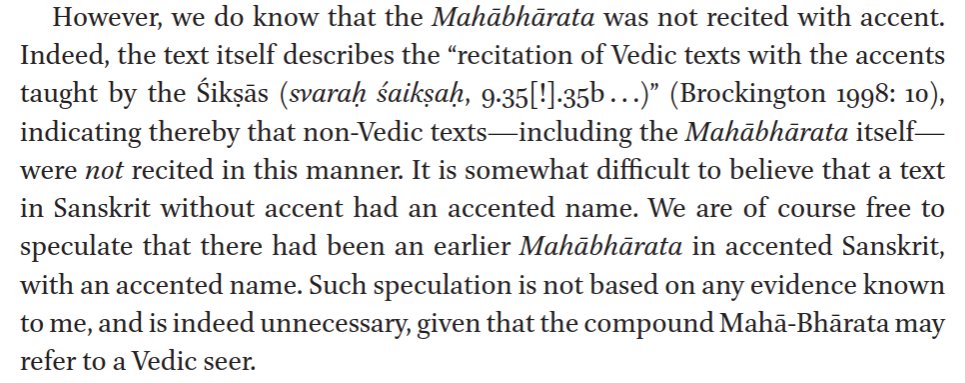
It's rather amusing how some Indologists go to absurd lengths to deny awareness of a Mahābhārata Epic prior to the 4th century BC.
"The word Bhārata can refer to various things, as any dictionary will tell. It can, for example, refer to the author of two ṚgVedic hymns. Mahā-Bhārata might then conceivably be a designation of the "great Bhārata", a eulogistic expression for this Ṛṣi."
@Ugrashravas@ApparaoDhillon@Saatvata If it is aṇ, then we get āṅgirasa (s.), āṅgirasas (pl.). If it is añ, then we get āṅgirasa (s.), aṅgirases (pl.). Not sure what the suffix is
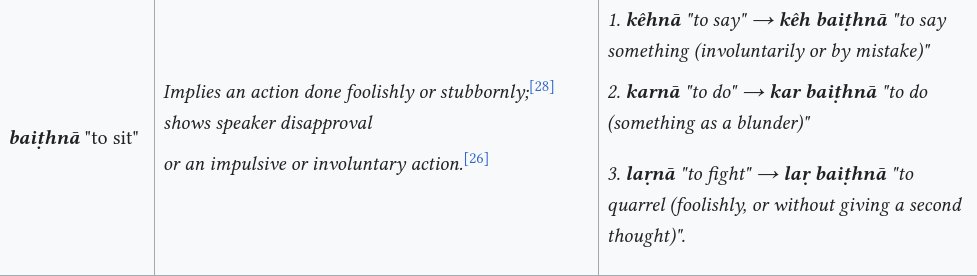
lālapata āsate - speak (intensive, present participle, nominative plural), sit (present, 3rd person plural)
Reminds one of the Hindi light verb baiṭhnā:
jyāyāṃś ca kanīyāṃś ca snuṣā ca śvaśuraś ca surām pītvā saha lālapata āsate (KS XII 12)
An older and a younger person, a daughter-in-law and a father-in-law, having drunk alcohol, are wont to chat.
@sharmasatyan Nice. Egs of pratyakṣa-
tasmād ācakṣāṇam āhur adrāg iti sa yady adarśam ity āhāthāsya śraddadhāti yady u vai svayam paśyati na bahūnāṃ canānyeṣāṃ śraddadhāti AB I 6
ya eva brūyād aham adarśam iti tasmā eva śraddadhyāma ŚB I 3
satyaṃ vai cakṣur neva vāce śraddadhāti MS III