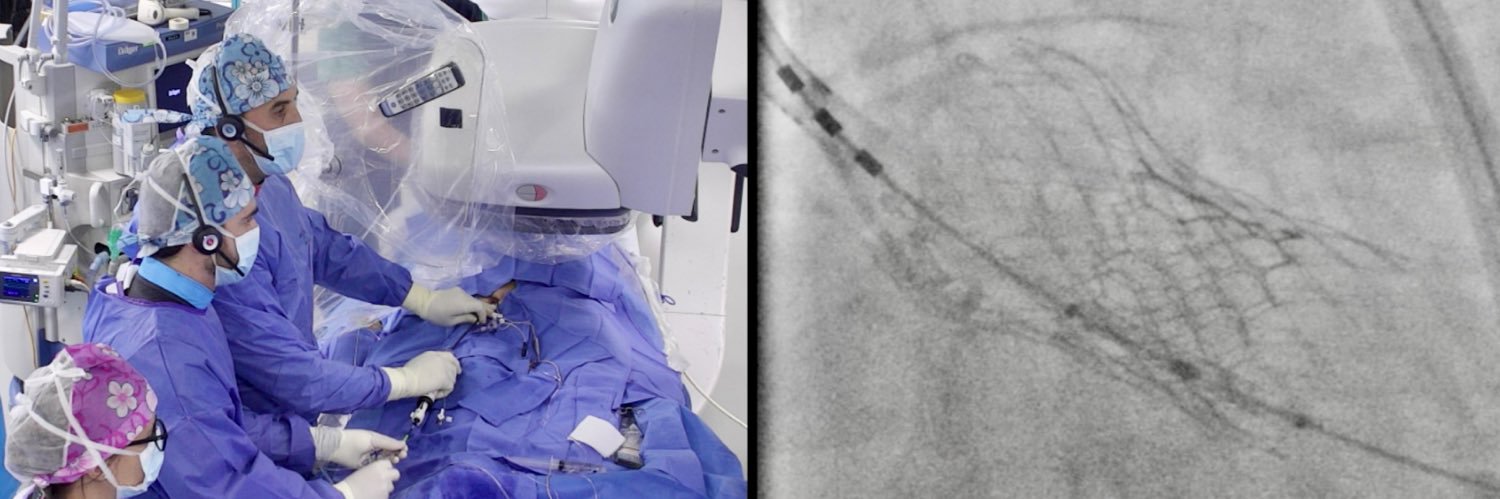
My #interventionalcardiology Toolkit 🧰⚙️🪛 No-reflow: distal drug delivery with standard #PCI equipment
🔗https://t.co/xP0J8ewMix
No-reflow is one of the most critical peri-procedural complications and the development of no-reflow can rapidly trigger cardiogenic shock. Emrullah Kiziltunc, Ender Ornek, Adnan Abaci and Mustafa Cetin from 🇹🇷 provide a step-by-step methodology to manage this situation.
Reviewed by Manel Sabate.
.
#CardioEd #Cathlab
@kiadeb87@fjsawaya@sbrugaletta
Protruding aorto-ostial stents can preclude safe TAVR. The RASE technique, integrating reverse hairpin re-entry, intentional fracture & snare extraction, offers a out-of-the-box controlled solution.
Honored to contribute to this work in @JACCJournals Case Reports with @RaghavG_MD et al.
https://t.co/gcZmfJeTha
This is one of the most impactful mechanistic papers in advanced structural heart in 2026
And it’s not just about leaflet modification, second implant type and position affects functional splay area with implication on sinus flow and re-re-do ViV
@ABeneduceMD@KKoulogiannis@PhilGenereuxMD@PedroMDMSc
BASILICA and BA-BASILICA create similar sized vertical splays in the leaflet neoskirt for TAV-in-TAV, whereas UNICORN generates larger functional splay areas but only when intraleaflet deployment is feasible https://t.co/hcbp8SsRBp @JACCJournals
Great. So everything I taught my students about heart failure this year is officially obsolete. Just when I’d mastered saying HFrEF, HFmrEF, and HFpEF without spraining my tongue, here comes the next wave: Pre-HF, remHF, recHF, impHF. Looking forward to HFxyz next year. https://t.co/ahv9ujJzW5
#TAVI is no longer just about procedural success.
As indications expand, heart teams must increasingly anticipate coronary access, valve durability, redo interventions, and lifetime management.
Explore The Essentials of TAVI, led by Ole De Backer, Christian Frerker and Alper Öner:
https://t.co/t4kU95TFf5
This special report on TAVI is available thanks to the support of @AbbottCardio.
PCR develops independent educational content.
#StructuralHeart #InterventionalCardiology #CardioEd #CardioTwitter
Leaflet modification showed high technical feasibility but notable early clinical risk, supporting its use as an adjunctive strategy in carefully selected #TAVR patients. https://t.co/N9R8pSU8JA
#JACCINT@drgocchipinti@LaudaniClaudio@AnderRegueiro
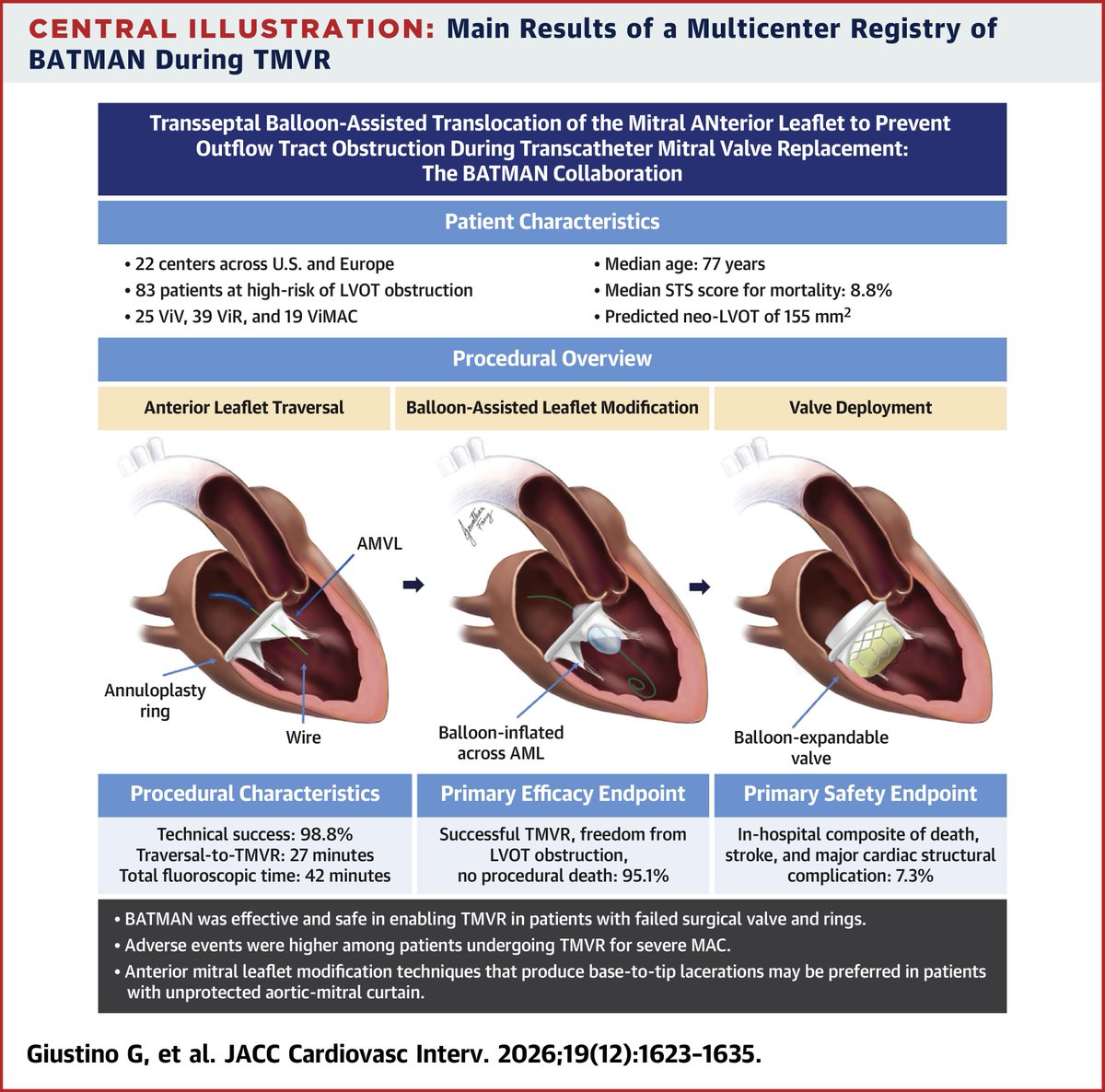
BATMAN was associated with high technical success and effectiveness in preventing #LVOT obstruction and appeared to be safe in ViR and ViV procedures. Adverse events were higher in ViMAC. https://t.co/GooSIkbKxz #JACCINT#TMVR
Welcome to our JUNE 24 issue of #JACCCaseReports@JACCJournals
https://t.co/HEW4oV2zlw with a mini-focus on leaflet modification to coincide with the #JACCINT special issue and to celebrate the 10-year anniversary of leaflet modification (LAMPOON). We are also promoting a mini-focus issue on valvular heart disease to coincide #NYValves2026.
Thank you @CraigBasman@TagliariPaula @KarlPoonMD for authoring the Editor’s Page:
Valvular Heart Disease: From Guidelines to the Bedside
https://t.co/BTcet8kvps
Full PDF here:
https://t.co/ZYLTHnBvny
@minnowwalsh@hmkyale@Justine_Turco
LEAFLET MODIFICATION
Transcatheter Electrosurgery for Coronary Access After TAVI-in-TAVI
https://t.co/LKpnzAoXZw
Editorial Comment
Innovative Electrosurgery Application in the Era of TAVR-in-TAVR: A Step Forward in Regaining Coronary Access
https://t.co/cMkjcOmcKH
UNICORN TAVR in Native Complex Congenital Aortic Stenosis at High Risk of Coronary Obstruction
https://t.co/CyWEBdGqzn
Novel Use of Radiofrequency Guidewire in Leaflet Modification: The BABICORN and ROBIN Procedures
https://t.co/ugWDZbzU2b
Double LLAMACORN: Bilateral Leaflet Modification Technique to Prevent Coronary Obstruction
https://t.co/0LFQlRr0Fm
Editorial Comment
Variations and Evolution in Balloon-Based Leaflet Modification: Ensuring Procedural Success
https://t.co/qX7VifTAMY
Balloon-Assisted Leaflet Laceration Using Modified UNICORN Technique in Native Valve TAVR
https://t.co/S8oNrn4Tau
Simplified UNICORN for Transcatheter Aortic Valve Replacement
https://t.co/kWQhaEkgJW
First Report of Anchoring Via Trans-Leaflet Apposition Stent (ATLAS): Leaflet Modification for Failing Noncalcified Valves
https://t.co/x8L5d6cmow
Editorial Comment
Securing the Anchor in Pure Native Aortic Regurgitation: Innovations, Techniques, or Dedicated Devices?
https://t.co/rQt2bNHjLw
Transcatheter Mitral Valve-in-Valve Replacement: Overcoming an Obstacle Race
https://t.co/THFXXn9rE3
Editorial Comment
Expanding the Toolbox for Mitral Valve-in-Valve Therapy: Innovation Demands Evidence
https://t.co/P5ED8hQrB5
VALVULAR HEART DISEASE
Robotic Mitral Valve Repair With Severe Pectus Excavatum
https://t.co/3oaIy3Ljcv
Aortic Valve Neocuspidization in Libman-Sacks Endocarditis
https://t.co/PxIfz1ENBj
Temporary Mechanical Support as a Bridge to Transcatheter Aortic Valve Replacement in Cardiogenic Shock
https://t.co/zcJByCOyo0
Tricuspid Transcatheter Edge-to-Edge Repair in Orthotopic Heart Transplantation Recipients
https://t.co/VhtFrSu69W
Frozen Leaflet During Transcatheter Balloon-Expandable Aortic Valve Implantation: Early Recognition and Safe Management
https://t.co/58LPWYhHsp
Editorial Comment
Intraprocedural Leaflet Dysfunction and the Importance of Device Planning in Contemporary Transcatheter Aortic Valve Replacements
https://t.co/jV8BqWRlhi
Transcatheter Edge-To-Edge Repair After Patent Foramen Ovale and Atrial Septal Defect Closure
https://t.co/Ekk3Kkwx52
Transcatheter Edge-to-Edge Repair in a Patient With Severe Degenerative Mitral Regurgitation and Mirror-Image Dextrocardia
https://t.co/DbWkKwXWW5
Mitral Edge-to-Edge Repair Resolves Hemolytic Anemia After Surgical Mitral Valve Repair
https://t.co/kffngcheoL
Valve-in-Valve Transcatheter Aortic Valve Replacement After a Valve-in-Valve Transcatheter Mitral Valve Replacement
https://t.co/AvDOcVY4jI
Unprecedented Complication of Left Bundle Branch Pacing: Ventricular Septal Defect With Mitral Valve Injury
https://t.co/c8jdB0pqcd
Combined Snare and Buddy-Balloon Strategy for Failed Valve Crossing in Valve-in-Valve Transcatheter Aortic Valve Replacement
https://t.co/9eZ7loEd2X
Aortic Root Abscess With Left Atrial Fistula: A Rare and Life-Threatening Complication of Infective Endocarditis
https://t.co/1Ftyn5lyx5
Platypnea-Orthodeoxia After TAVI for Severe Aortic Regurgitation: A Breathless Surprise
https://t.co/Aap0t5hBC7
Long-Term Follow-Up After Dual Transcatheter Valve-in-Valve Implantation Under VA-ECMO Support
https://t.co/iQd8jhnNON
Recurrence of Prosthetic Aortic Valve Endocarditis After Percutaneous Mechanical Aspiration
https://t.co/xNNwc1UXqU
4-Dimensional Intracardiac Echocardiography-Guided Antegrade TAVR Using a Novel CABLE-TAVR Technique
https://t.co/aH0FWC4eQA
Delayed Repair of an Iatrogenic Perimembranous VSD After Redo Aortic Valve Replacement: Timing Over Urgency
https://t.co/QJAJ0oo6L5
Infective Endocarditis Mimicking Reactive Arthritis: A Diagnostic Detour
Recurrent Prosthetic Valve Endocarditis With Aortomitral Curtain Destruction in an Elderly Patient
https://t.co/gusw2oFv1p
Dedicated Transcatheter Valve for Pure Aortic Regurgitation in a Failed Stentless Bioprosthesis
https://t.co/hdKB8TwmRs
Protected Mitral TEER With Temporary Ventricular Circulatory Support in Severe Left Ventricular Dysfunction for Heart Failure Management
https://t.co/vPpKjgTwiB
Editorial Comment
Mitral Transcatheter Edge-to-Edge Repair in Severe Left Ventricular Dysfunction: Beyond Procedural Success
https://t.co/7tH88KbGzy
Organizing Hematoma Involving a Native Tricuspid Valve: Fatal Case of Cardiac Behçet Disease–Hughes-Stovin Syndrome Overlap
https://t.co/UqHSlV3cac
Endocarditis Masquerading As Malignancy: Native Valve HACEK Infection
https://t.co/Y01e8Af21a
High-Risk Valve-in-Valve TAVR With Chronic Type B Aortic Dissection
https://t.co/w1EUaeo53N
Severe Calcific Bicuspid Aortic Valve Stenosis Presenting as Reversible Complete Heart Block
https://t.co/CTYBpR6NcB
Prosthetic Aortic Valve Vegetation: A Percutaneous Mechanical Aspiration Approach
https://t.co/8YMVwXRPud
Heyde Syndrome in Moderate Bioprosthetic Aortic Valve Stenosis: A Twist in the Valve
https://t.co/kekGtGSWPA
TAVR in a Small Surgical Bioprosthesis With a Kinked Aortic Graft Using an Intra-Annular Self-Expanding Valve
https://t.co/xjkrpQ3aL3
Step-by-Step Femoral–Femoral Percutaneous Mechanical Aspiration Debulking of Anterior Tricuspid Valve Vegetation
https://t.co/KPCeElUJ5C
Transcatheter Aortic Valve Replacement in Aortic Regurgitation Secondary to Aortic Valvulitis
https://t.co/n0JBARgalb
Redo Transcatheter Aortic Valve Replacement for Degenerated Valve With High-Risk Coronary Anatomy
https://t.co/EVDhU5sSig
Mitral Valve Endocarditis by Micrococcus luteus: First European Case
https://t.co/UI74WObyHz
@aroniskn
@JACabreraCardio@MiChen__@aabha_divya@sarano_maurice@MarcEngels7@Miho_Fukui_@ErikaHuttce@Nishaki1@MMarinCuartas
@ChrissyMD2000f
@ACHDocTMoe@PanjrathG@jsaef1@Kentso987@m_taramasso@SyedZaidMD
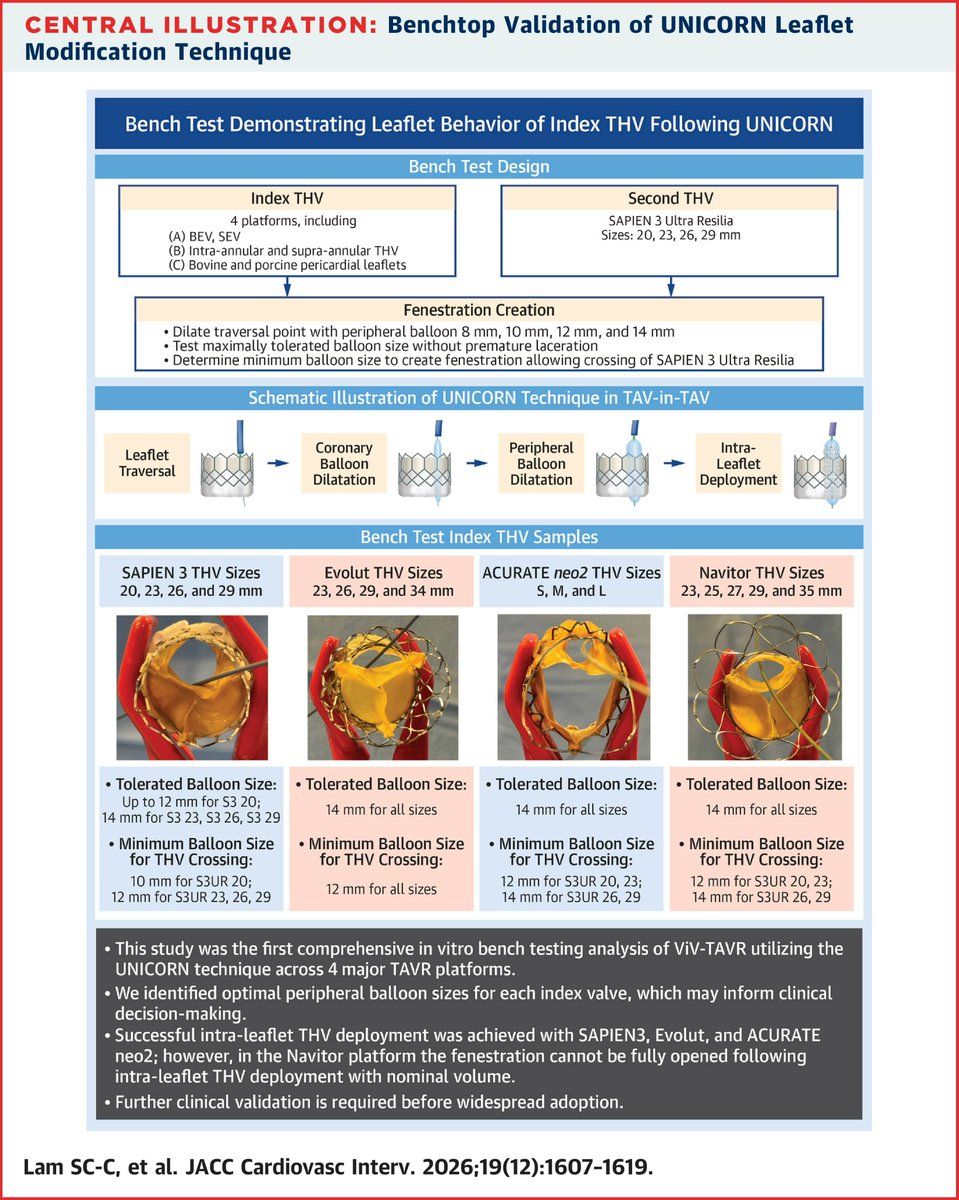
This bench study defines optimal balloon sizing for UNICORN across common #THV platforms and confirms coronary clearance. It was determined that one index valve resisted intraleaflet deployment. Further clinical validation is required https://t.co/I2lcVblJdc #JACCINT#TAVR
Proud to have helped curate the 2-part landmark special issue on LEAFLET MODIFICATION (LM) in #JACCINT@JACCJournals with Editor-in-Chief David Moliterno and Vasilis Babaliaros to celebrate the 10-anniversary of the 1st leaflet modification done in the world (LAMPOON)! Grateful to be a senior author and co-author of several papers.
https://t.co/BfuHHMYn6B
https://t.co/opVuDDe44D
Congrats to all the authors from around the world who have contributed to this seminal effort!
Key highlights:
Leaflet modification algorithms:
https://t.co/CnBv8MP8js
AORTIC Leaflet Modification
BASILICA step-by-step review:
https://t.co/LTKQA9kLpL
UNICORN step-by-step review:
https://t.co/xvLJhnqVkg
"Split-line" Concept in LM in Redo-TAVR:
https://t.co/jmonmoxsuE
UNICORN benchtop validation in redo-TAVR: works better with failed Sapien, Evolut, Acurate than Navitor:
https://t.co/mLX8u0iEmI
UNICORN registry:
https://t.co/Xz1eWwpiKZ
Bench testing showing UNICORN more effective than (BA)BASILICA in Redo-TAVR:
https://t.co/snsi2oMtPI
Bench testing showing LM in redo-TAVR dependent on TAV type, constraint, 2nd TAV implant. BASILICA no effect on Navitor and BA-BASILICA better with failed Evolut + Acurate
https://t.co/p6LBcvQ6jV
HALT reduction with leaflet modification in VIV #TAVR:
https://t.co/RkqkHRBdv4
Bench testing on LM of calcified native and SAV leaflets showed higher Ca burden increased laceration difficulty, leaflet tears and embolic debris; less spray with shorter leaflet length
https://t.co/2jjGfol5c0
LOFTER-TAVR registry:
https://t.co/nYrXz5NZAa
CT simulation of LM impact on Redo-TAVR Feasibility:
https://t.co/1s4zmf15uv
Fluoro Left-Main Frame Alignment View to Evaluate coronary obstruction in redo-TAVR:
https://t.co/RplVZPEQxY
FIH wire anchoring-assisted BASILICA/UNICORN:
https://t.co/NjzGYtFyuY
FIH tricupsidization of bicuspid native #TAVR
https://t.co/P3HZIDRSFP
Mitral Leaflet Modification
LAMPOON/BATMAN step-by-step:
https://t.co/1gtedQXmP8
BATMAN registry
https://t.co/30rWokpCE2
TRICUSPID Leaflet Modification
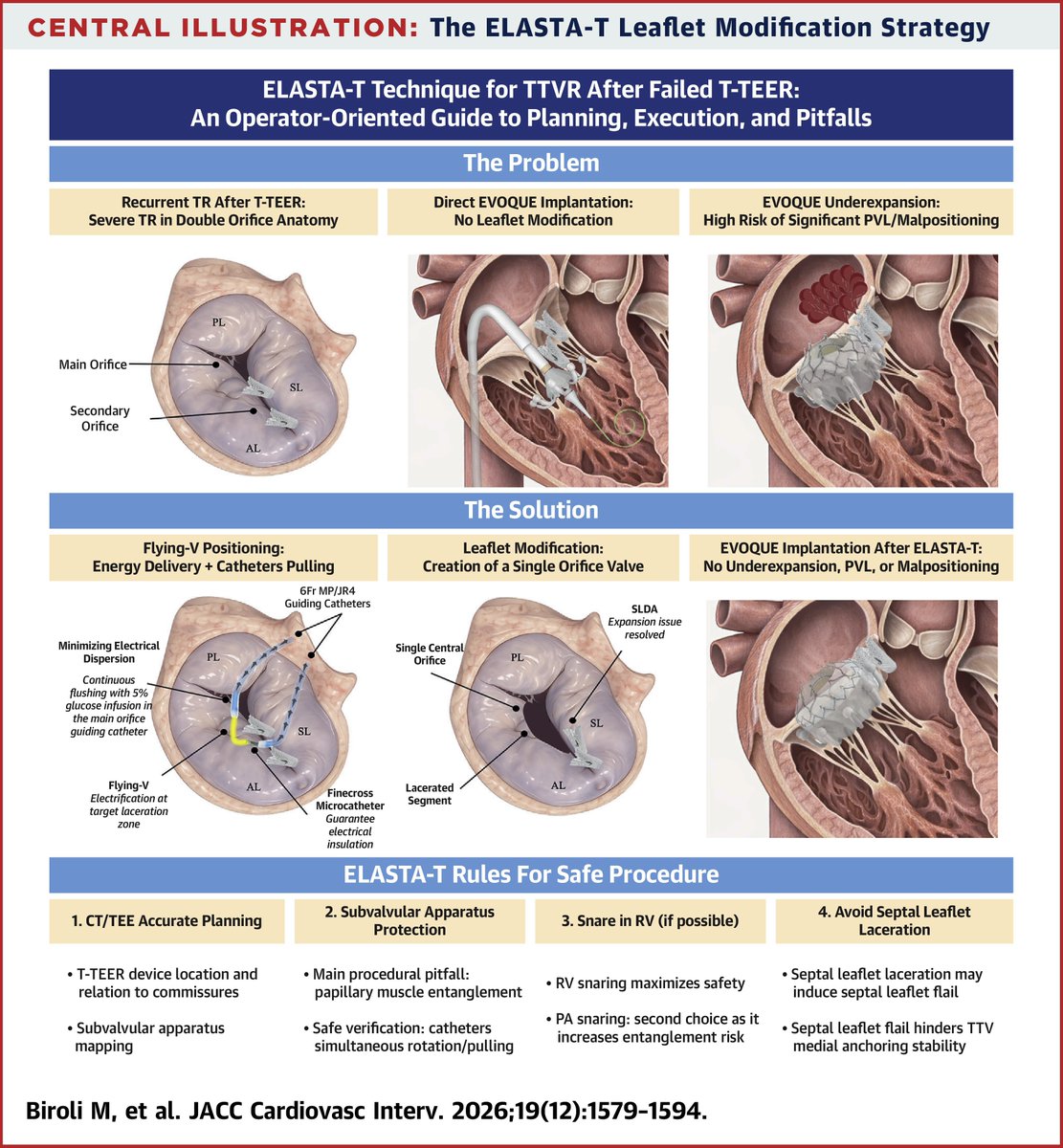
ELASTA-T for failed T-TEER to facilitate TTVR step-by-step:
https://t.co/0TIECD3yus
Mechanisms of failed BASILICA/LAMPOON/SEASAME:
https://t.co/oqH9okmTPw
This year I am particularly pleased, because confirmations are harder than breakthroughs, and this result covers a two-year period in which we had no tailwind from guidelines. It is a genuine expression of where EuroIntervention stands today in the broader landscape — as reflected also by the 5-year impact factor, which has been growing for several years now and is a more reliable indicator of trajectory than any single data point.
Other technical metrics I follow closely, because they tell a richer story than the impact factor alone and weigh heavily on authors' choices, are the quartile (Q1), the percentile (91.4), the cited half-life of articles (5.3 years — notably long), the proportion of open-access articles (3.15% — very low, which authors tend to favour but which limits accessibility and possibly citability), and the self-citation rate (negligible, because it is something we have never actively managed).
So: 9.2 is entirely ours, and it is the result of the work of so many people that I would not know where to begin. Thank you.
This week, a team of researchers quietly published in @JACCJournals one of the most profound studies of valvular heart disease in recent memory.
The PREVUE-VALVE study used a decentralized, in-home echocardiography model to estimate the prevalence of valvular heart disease among U.S. adults aged 65–85. Importantly, this was not a clinic-based echo cohort; participants were recruited nationally and underwent comprehensive transthoracic echo in their homes, with studies interpreted by a core lab. That intentional design choice is critical: PREVUE-VALVE is a true prevalence study, accurately representing the true burden of valve disease in the U.S. population.
The findings are striking: 8.2% of older Americans have moderate or greater valvular heart disease, and 18.4% have “clinically significant” disease when mild-to-moderate regurgitation is included. TR was the most common lesion, followed by AS, MR, AR, and MS. The burden rises sharply with age, reaching nearly 15% among adults aged 80–85.
Extrapolated nationally, this means approximately 4.7 million Americans aged 65–85 currently have moderate or greater VHD, projected to increase to 6.5 million by 2060. Using the broader clinically significant definition, the number is already over 10 million and projected to approach 15 million.
For structural heart programs, health systems, and policymakers, the message is clear: the valve disease burden is large, growing, and will require thoughtful planning around screening, access, and treatment capacity.
Congratulations to @djc795, Michael 'Mickey' Brener MD MS, and all co-authors for a stunning glimpse into the present and future of valve disease!
https://t.co/t1lLdj71sv
Transcatheter papillary muscle approximation (or "percutaneous papillary muscle banding") targets left ventricular geometry rather than contractility. A 58-year-old man with advanced ischaemic heart failure and a severely dilated, spherical left ventricle due to adverse remodelling underwent first-in-human implantation using the VSling system. Via transfemoral access, a steerable catheter encircled both papillary muscles and deployed an adjustable band, reducing interpapillary distance from 27 to 12 mm. https://t.co/pkAIxltLg1
Can chimney stenting reliably protect the coronaries during redo-TAVI?
Using patient-specific models, this study highlighted how valve design, commissural alignment, and implant depth may influence stent integrity and the feasibility of future coronary access.
https://t.co/wrW2quNH3L
@ABeneduceMD@DrArifK@fra_giannini1@ProfDDKardiolog
#TAVI #StructuralHeart