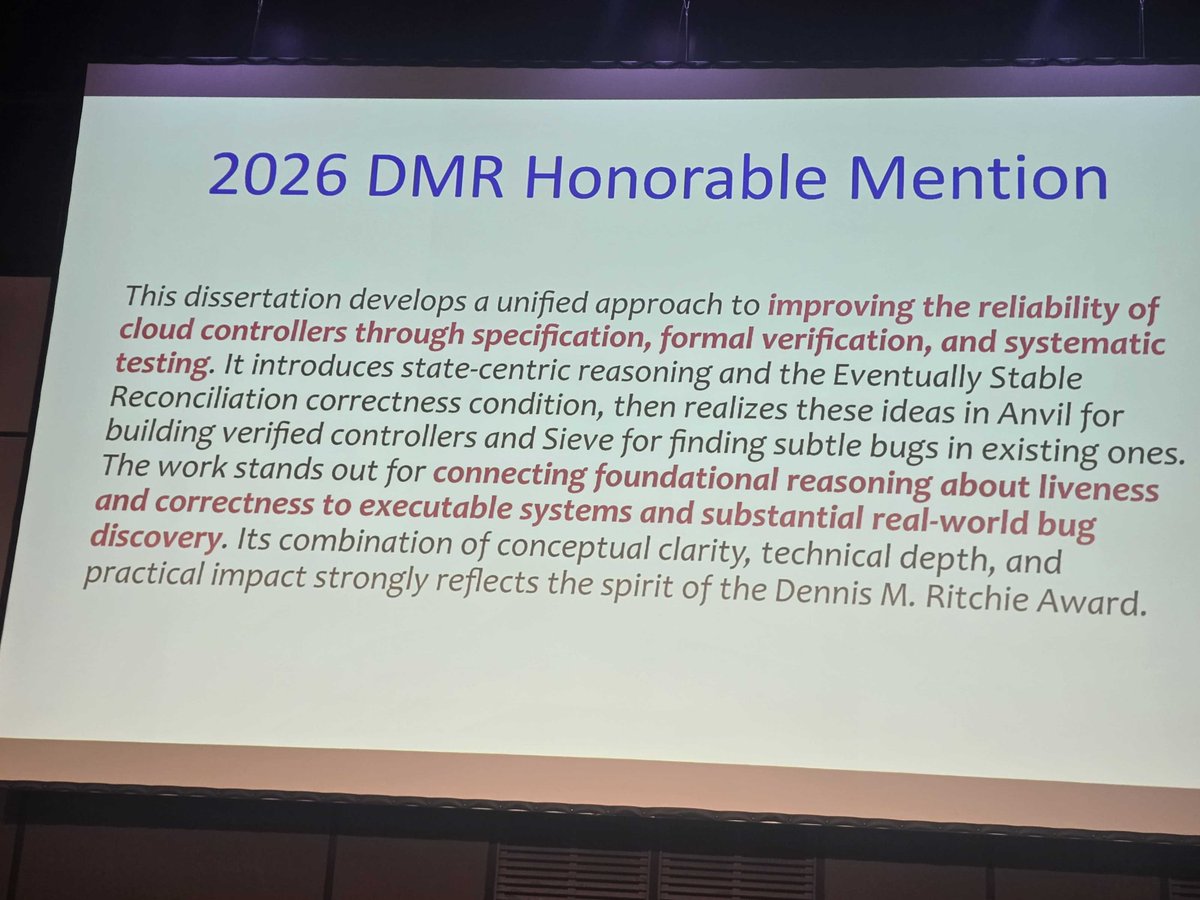
Xudong (@xu_dong_sun) received the 2026 Dennis M. Ritchie Doctoral Dissertation Award Honorable Mention. I wanted to write about his work, but cannot articulate better than the award committee (thank you!)
Big thanks to @AishwaryaGanlat@RamAlagappn and their students @KiranHomba73714 and @shreesha00 for taking pics and celebrating with Xudong in Prague #SOSP! Aishwarya and Ram are great mentors of Xudong throughout his PhD. Big thanks and congrats to the other members of Xudong's thesis committee, @_lalithsuresh@BrightenGodfrey Jon Howell, and Darko Marinov ! The thesis won't be possible without such an all-star team.
It take a village to raise a researcher. @UofIllinois@siebelschool is a very special one, especially for Systems Research. Congrats!
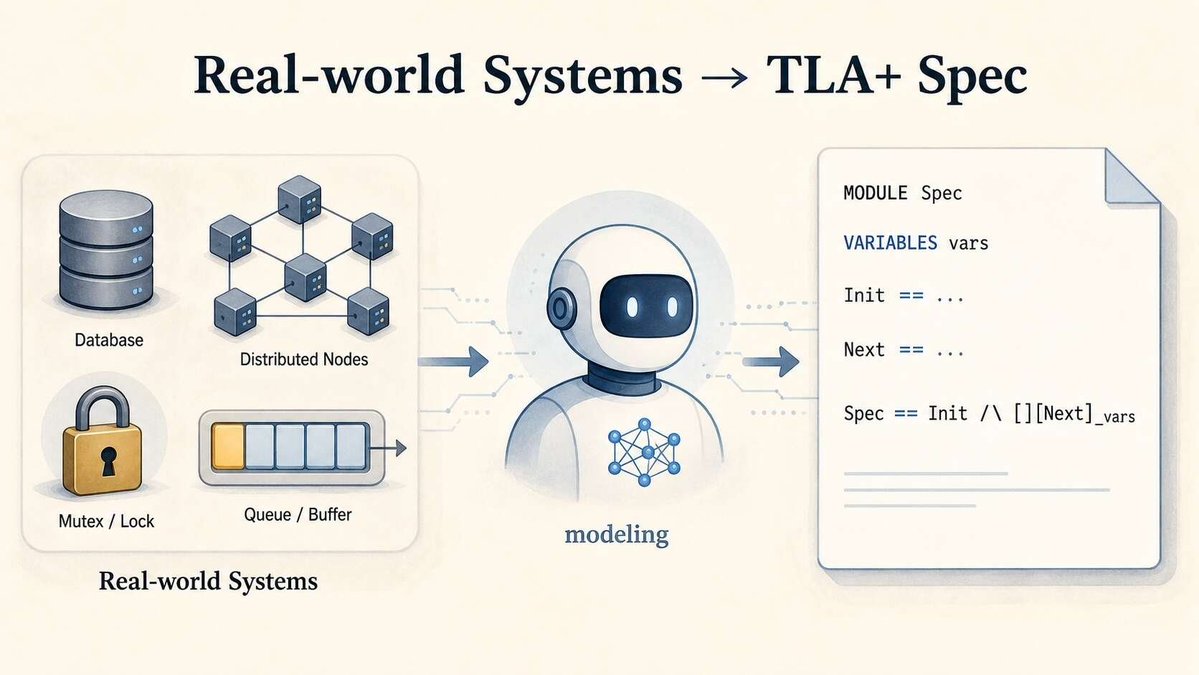
New SIGOPS Blog -- "Can LLMs model real-world systems in TLA+?" by Qian Cheng, Ruize Tang, Emilie Ma, Finn Hackett, Peiyang He, Yiming Su, Ivan Beschastnikh, Yu Huang, Xiaoxing Ma, and Tianyin Xu.
https://t.co/nCEUg3zFV2
New SIGOPS Blog -- "The Long Game: How Agents That Remember Resolve Operational Issues Faster" by Shihang (Vic) Li, Thomas Anderson, Ratul Mahajan, Simon Peter, Luke Zettlemoyer, and the SDS team.
https://t.co/mjYKGKWRf9
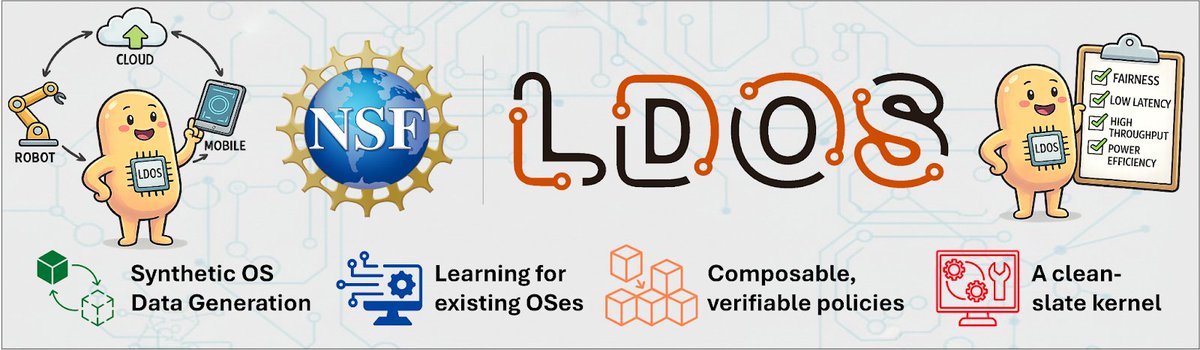
New SIGOPS Blog -- "LDOS: Toward A Learning-Directed Operating System" by by Divyanshu Saxena, Aneesh Durg, Sujay Yadalam, Jane Chen, Rohit Dwivedula, Chris Rossbach, and Aditya Akella.
https://t.co/GmbIaZLybs
How Over-Engineering Became the New Technical Debt in Distributed Systems
Over-engineered systems evolve through a series of reasonable decisions that can reflect past fears rather than current needs. https://t.co/bAOYCRzUgA
Great work from the Glia team led by Mohammad and Hari (@HariBalakrish20) at @MITCSAIL and @MITEECS.
The @SysIntelligenc team was defining the ladder of system intelligence based on the training process of PhD students in the last @ACMSIGOPS blog, and now we have Glia as a PhD-level AI for system design and optimization.
New SIGOPS Blog -- Glia: A Human-Inspired AI for Systems Design and Optimization from @MIT_CSAIL.
https://t.co/ailmyFtCfb
Glia is a PhD-level AI designed to autonomously architect and continuously optimize complex systems infrastructures.
@MITEECS@MIT
This's an incredibly exciting effort led by @FelxFeng with many colleagues @MSFTResearch and some of us @siebelschool. I truly believe AI can learn all the essential system capabilities and evolve into the envisioned System Intelligence.
But, this vision requires the entire system community to enable -- we need to teach AI how to think, reason, build, operate "systems" as how we teach our own graduate students and help them grow into systems researchers. AIs are great learners, but we are not great teachers for them yet.
I’m excited to introduce the System Intelligence project which aims to build a future where advanced AI can design, implement, and operate next-generation computing systems. To realize this vision, we must unlock AI's next stage of capabilities – reasoning about architectures and protocols, weighing tradeoffs, applying enduring principles, developing effective abstractions, and more – beyond coding and bug fixing.
We share our efforts on defining System Intelligence and our perspective on how to realize it in a recent SIGOPS Blog (https://t.co/NQkT1GhFnf). We regard benchmarks as an initial foundation, and have been developing a System Intelligence Benchmark.
We’d love to hear your feedback and look forward to your contributions!
🌐 Website: https://t.co/I0WzuJXRb6
🛠️ GitHub: https://t.co/piM8eCQiT9!
New @ACMSIGOPS Blog cross-referencing @sigarch :
From Theory to Practice: Introducing Architectural Prisms, an Experiment in AI-First Academic Dialogue
https://t.co/K68ZTMZhDx
This is a long overdue. If you are interested in Rex kernel extensions (https://t.co/44SMsWqjfx), @Jinghao_J gave a great talk at #OSS early this year.
The talk can be found here,
https://t.co/zbPykyqcq1
Jinghao (@Jinghao_J) gave a great remote guest lecture on Safe Kernel Extensions at CS 423 today, teaching eBPF and Rex. It's always special to have him in 423 which he put his heart in as a distinguished TA in the past 5 years. I captured his slide on Rex, which is the system we use for MP4 and is his own PhD thesis.
The Rex project: https://t.co/B2CZSwibIS
This's a brilliant article written by @luo_mai's team @EdinburghUni and @fanyang's team @MSFTResearch. It's a must to read for anyone interested in future AI hardware.
Wafer-scale chips are exciting. Today's AI software stack falls short in exploiting them to realize wafer-scale systems.
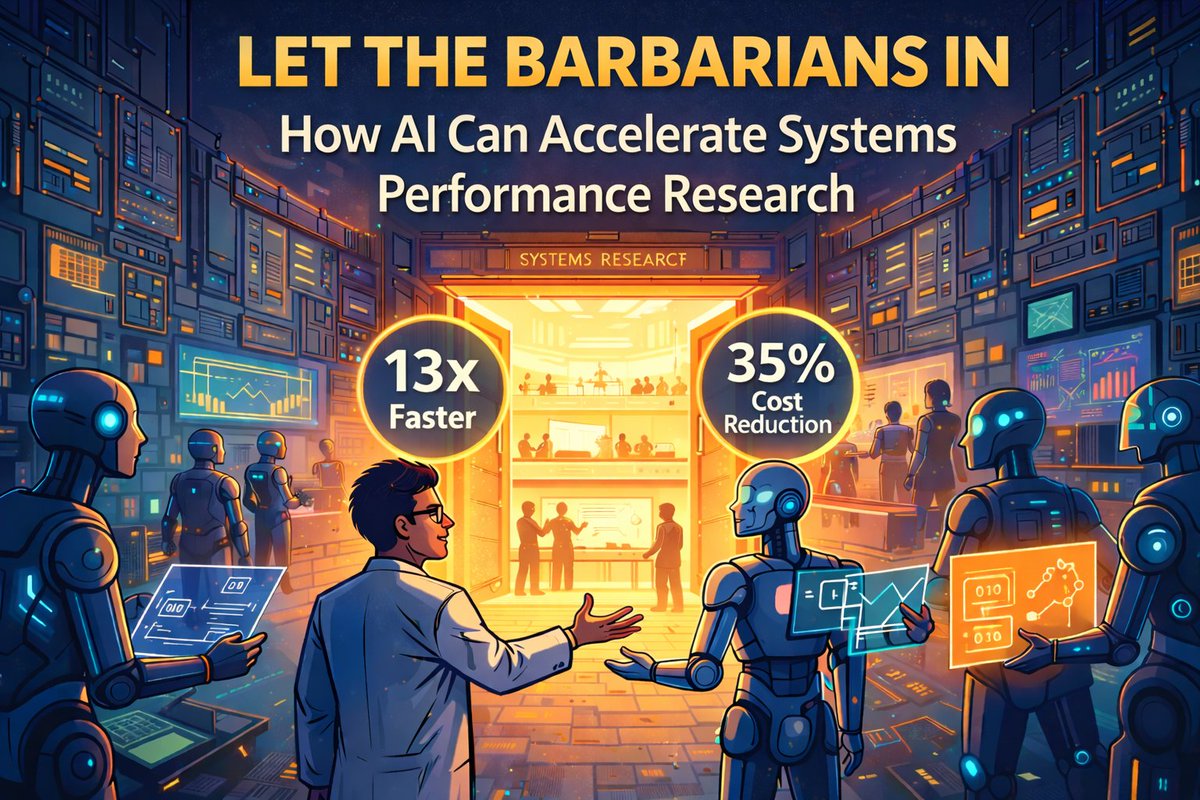
Barbarians at The Gate: How AI is Upending Systems Research by @audreyccheng, @LynnLiu41887950, @melissapan, @istoica05, and the @ai4research_ucb team,
https://t.co/b6vtMJN3Et
This's first article of the The Next Horizon of System Intelligence blog series.
A cross-posted article from @sigarch on "Ethical and Moral Fraying due to Intellectual Conflicts in Paper Reviews" by T. N. Vijaykumar at SIGOPS Blog.
https://t.co/pvXtSOevSh
🚨 "Lessons Learned from Five Years of Artifact Evaluations at EuroSys" with Thaleia Doudali (@ThaleiaDimitra), Miguel Matos, and Anjo Vahldiek-Oberwagner (@ovahldy) is available now!
🎧 Listen on Apple ➡️ https://t.co/02zfDQ6ggq
🎧 Listen on Spotify ➡️ https://t.co/05qq7w4ElY