NUS Bia-Echo Asia Centre for Reproductive Longevity and Equality (ACRLE) specialises in research for women’s #reproductive health, #ageing and digital medicine.
Celebrating Mother's Day today—and every day! 💐 As we dive into research enhancing women's reproductive longevity, we're inspired by the incredible strength of mothers who nurture life. Wishing all moms a day filled with love, gratitude, and the promise of brighter tomorrows.
Proud to see our white paper on menopause and workplace health, developed by ACRLE in collaboration with HeyVenus, featured in The Straits Times!
@straits_times@NUSMedicine@ZH0405@vani_khare
https://t.co/hH6xRT7LdY
Menopause is silently impacting your workplace.
We teamed up with @heyvenushealth & Dr. Jessherin Sidhu to talk symptoms, stigma—and why it’s costing companies top talent.
On Apr 23, we unveil the first APAC whitepaper on #MenopauseAtWork
Comment section for more details
The ACRLE team at Beyond Medicine Research Festival 2025! Raising awareness and offering exiting projects to 2nd year medical students on women’s reproductive health at @NUSMedicine
Thank you sponsors for goodies @Novogene_Global@novonordisk#womenreproductivehealth
🌼Today is World Menopause Day. We acknowledge the challenges many women face during this transition. Learn about innovative solutions to ensure happiness and healthy longevity in women here: https://t.co/4SqssZBImg
#WorldMenopauseDay#MenopauseAwareness
After several months of hard work and invaluable feedback from diverse market participants and users, our survey is now ready!
Let’s work together to champion women’s health and well-being.
👉 Participate here: https://t.co/Xaj8yzxRaI
@ZH0405@vani_khare
The full study and its findings, funded by ACRLE and National Research Foundation, was published in Nature Aging on 9 September 2024.
Read more here: https://t.co/kU7h0pJ8IT
#IVF#reproductivehealth#NewsandUpdates#InspiringInnovators
or immature egg cells. This breakthrough could pave the way for improved outcomes in assisted reproductive technologies, such as in-vitro fertilisation (IVF), for older women.
Dr Huang Zhongwei, Deputy Director of ACRLE, said of the findings: “Our published work presents compelling proof-of-concept demonstrating that the microenvironment in which an egg grows and develops is significantly influenced by unique biological factors.
Researchers from the NUS Bia-Echo Asia Centre for Reproductive Longevity and Equality (ACRLE), based at the @NUS Medicine and the @Mechanobiology Institute (MBI) at NUS, have developed an innovative technique that significantly enhances the reproductive potential of aged oocytes,
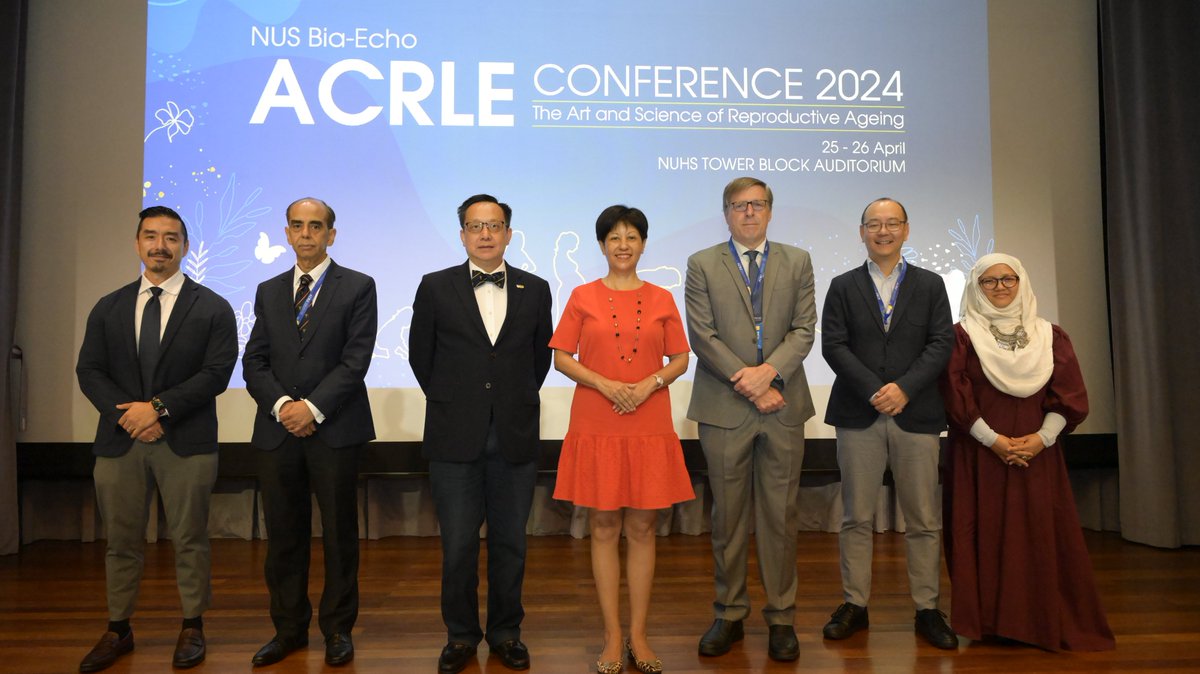
Thank you everyone who joined us at the NUS Bia-Echo Asia Centre for Reproductive Longevity and Equality (ACRLE) Conference 2024: 'The Art and Science of Reproductive Ageing'!