AI agents are moving from chatting to 𝑎𝑐𝑡𝑖𝑛𝑔—executing workflows, changing industrial parameters, and approving tasks.
But here is the billion-dollar bottleneck no LLM can solve alone:𝐖𝐡𝐞𝐧 𝐚𝐧 𝐚𝐮𝐭𝐨𝐧𝐨𝐦𝐨𝐮𝐬 𝐚𝐠𝐞𝐧𝐭 𝐦𝐚𝐤𝐞𝐬 𝐚 𝐦𝐢𝐬𝐭𝐚𝐤𝐞 𝐢𝐧 𝐩𝐫𝐨𝐝𝐮𝐜𝐭𝐢𝐨𝐧, 𝐰𝐡𝐨 𝐢𝐬 𝐚𝐜𝐜𝐨𝐮𝐧𝐭𝐚𝐛𝐥𝐞? 🧵👇
🚨 𝐖𝐞𝐞𝐤𝐥𝐲 𝐀𝐈 𝐇𝐚𝐥𝐥𝐮𝐜𝐢𝐧𝐚𝐭𝐢𝐨𝐧 / 𝐀𝐠𝐞𝐧𝐭 𝐅𝐚𝐢𝐥 𝐂𝐡𝐞𝐜𝐤!
What's the wildest mistake you saw an AI agent or bot make this week?
Reply with a screenshot or story + tag @Actum_AI! Best 3 replies explaining how an entry "Circuit Breaker" could have stopped it win 10 USDT each! 🏆
As the agentic economy scales, 𝐯𝐞𝐫𝐢𝐟𝐢𝐚𝐛𝐥𝐞 𝐛𝐞𝐡𝐚𝐯𝐢𝐨𝐫 𝐚𝐧𝐝 𝐡𝐮𝐦𝐚𝐧 𝐚𝐜𝐜𝐨𝐮𝐧𝐭𝐚𝐛𝐢𝐥𝐢𝐭𝐲 will become the most valuable data primitive in Web3 & AI.
Follow @Actum_AI and join our Discord (https://t.co/TP7PljG2rb) as we open up the Actum Verification Network. 🛡️
AI agents are moving from chatting to 𝑎𝑐𝑡𝑖𝑛𝑔—executing workflows, changing industrial parameters, and approving tasks.
But here is the billion-dollar bottleneck no LLM can solve alone:𝐖𝐡𝐞𝐧 𝐚𝐧 𝐚𝐮𝐭𝐨𝐧𝐨𝐦𝐨𝐮𝐬 𝐚𝐠𝐞𝐧𝐭 𝐦𝐚𝐤𝐞𝐬 𝐚 𝐦𝐢𝐬𝐭𝐚𝐤𝐞 𝐢𝐧 𝐩𝐫𝐨𝐝𝐮𝐜𝐭𝐢𝐨𝐧, 𝐰𝐡𝐨 𝐢𝐬 𝐚𝐜𝐜𝐨𝐮𝐧𝐭𝐚𝐛𝐥𝐞? 🧵👇
This isn't just a whitepaper concept. As of October 2026, Actum's infrastructure is live in production:✅ 𝟓,𝟑𝟎𝟎+ active connected endpoints✅ 𝟏.𝟏𝟑𝟗𝐌+ verified behavioral events✅ ~𝟓,𝟖𝟎𝟎 daily events with 𝟗𝟗.𝟗𝟖𝟔% on-chain attestation coverage
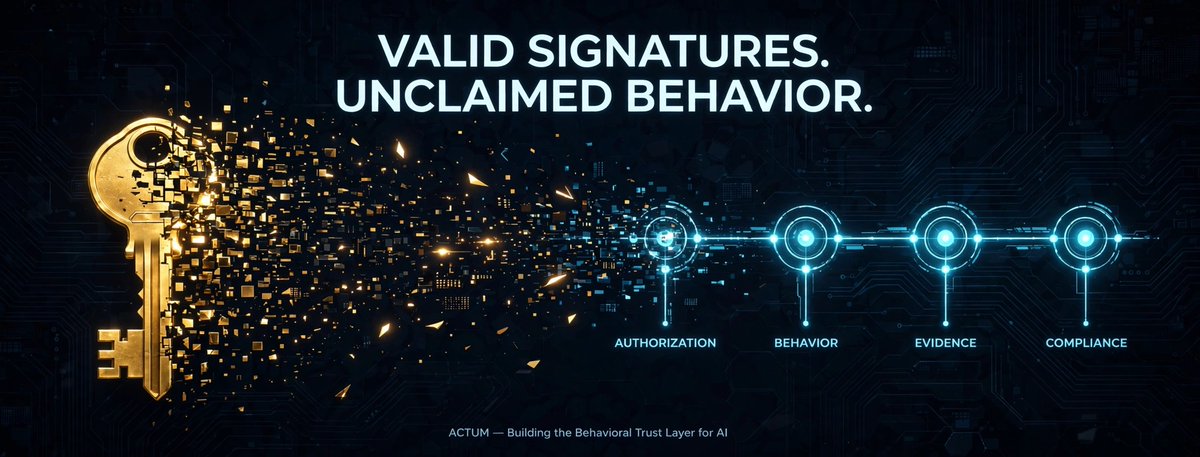
𝐀𝐜𝐭𝐮𝐦: 𝐁𝐞𝐡𝐢𝐧𝐝 𝐕𝐚𝐥𝐢𝐝 𝐒𝐢𝐠𝐧𝐚𝐭𝐮𝐫𝐞𝐬, 𝐔𝐧𝐜𝐥𝐚𝐢𝐦𝐞𝐝 𝐁𝐞𝐡𝐚𝐯𝐢𝐨𝐫.
Around 20:05 on Oct 29, Binance's hot wallets came under attack, and roughly $6.3 billion in assets was drained within tens of minutes. The largest on record, according to public reporting. The investigation is still underway — but several confirmed facts are worth a pause for anyone who builds systems, works in security, or deals with compliance.
The timeline:
The attack began at around 20:05 on Oct 29. Over the next 20 to 40 minutes, hot wallets across multiple chains were emptied one after another; a second wave of outflows followed at around 23:00. The pivotal move on Ethereum: at 20:20, a single transaction carried 50 EIP-7702 authorizations — all validly signed by the hot wallet's own key — delegating the wallet's execution rights to a contract the attacker had deployed in advance. About three minutes later (20:24), roughly $2.5 billion in assets left in a single transaction; the delegation wasn't revoked until around 00:10 on Oct 30.
Binance's preliminary investigation points to a compromised laptop belonging to a DevOps engineer, with additional intrusion points discovered afterward; at the same time, no evidence of leaked wallet private keys has been found. The attacker used self-destructing tooling — destroying tools and traces as they went. That fatal delegation, in Binance's words, "did not go through normal approval controls."
Afterward, roughly $3 billion in assets was frozen on-chain, Binance covered the losses with its SAFU fund and company funds, and withdrawals resumed in phases.
𝟏. 𝐄𝐯𝐞𝐫𝐲 𝐬𝐢𝐠𝐧𝐚𝐭𝐮𝐫𝐞 𝐰𝐚𝐬 𝐯𝐚𝐥𝐢𝐝. 𝐓𝐡𝐞 𝐩𝐫𝐨𝐛𝐥𝐞𝐦 𝐰𝐚𝐬 𝐨𝐮𝐭𝐬𝐢𝐝𝐞 𝐭𝐡𝐞 𝐬𝐢𝐠𝐧𝐚𝐭𝐮𝐫𝐞𝐬.
What was broken here wasn't cryptography. No private keys leaked, every signature was valid, and the system executed each step strictly by the rules. From the machine's perspective, everything was "correct." From the perspective of accountability, there is no evidence that any informed person ever approved these actions through proper process.
This is the first distinction to get right: 𝐚 𝐯𝐚𝐥𝐢𝐝 𝐬𝐢𝐠𝐧𝐚𝐭𝐮𝐫𝐞 𝐩𝐫𝐨𝐯𝐞𝐬 𝐨𝐧𝐥𝐲 𝐭𝐡𝐚𝐭 "𝐚 𝐜𝐞𝐫𝐭𝐚𝐢𝐧 𝐤𝐞𝐲 𝐬𝐢𝐠𝐧𝐞𝐝." It cannot prove who was behind the key, whether they knew what they were signing, or which approval process was followed. The gap between the two is the real lesson of this incident — and the blind spot of most systems today.
In Actum's four-chain framing: the authorization chain answers only "what was it allowed to do" — never "what did it actually do." Equating authorization with behavior is equating the key with the person holding it.
𝟐. 𝐀 𝐩𝐨𝐬𝐭-𝐦𝐨𝐫𝐭𝐞𝐦 𝐭𝐞𝐥𝐥𝐬 𝐭𝐡𝐞 𝐬𝐭𝐨𝐫𝐲. 𝐏𝐫𝐨𝐨𝐟 𝐫𝐞𝐪𝐮𝐢𝐫𝐞𝐬 𝐞𝐯𝐢𝐝𝐞𝐧𝐜𝐞.
A detailed technical post-mortem will follow. It's necessary — but see it for what it is: an account reconstructed after the fact by the party involved, from whatever logs and records it could find.
The question is: when the attacker destroys traces as they go, what does a post-mortem stand on? If the logs lived in the same environment the attacker may have compromised, can the logs themselves be trusted?
What regulators, auditors, insurers, and users actually need are a few very concrete questions: what operations took place in those minutes, and in what order? Behind each critical action — which person, which device, which approval? Were the records altered afterward? Can they be handed to a third party for independent verification?
There's a telling contrast in this incident: many key facts were reconstructed from the public ledger instead — every on-chain transaction timestamped and hashed, checkable by anyone, which is how analysts produced a minute-by-minute timeline within hours. But the public ledger records only "how the assets flowed out," not "who inside did what." The outside books are crystal clear; the inside actions have to wait for a post-mortem report.
𝐀 𝐩𝐨𝐬𝐭-𝐦𝐨𝐫𝐭𝐞𝐦 𝐜𝐚𝐧 𝐧𝐚𝐫𝐫𝐚𝐭𝐞 𝐰𝐡𝐚𝐭 𝐡𝐚𝐩𝐩𝐞𝐧𝐞𝐝. 𝐎𝐧𝐥𝐲 𝐞𝐯𝐢𝐝𝐞𝐧𝐜𝐞 𝐜𝐚𝐧 𝐩𝐫𝐨𝐯𝐞 𝐢𝐭.
𝟑. 𝐀𝐬 𝐀𝐈 𝐬𝐭𝐚𝐫𝐭𝐬 𝐚𝐜𝐭𝐢𝐧𝐠 𝐨𝐧 𝐨𝐮𝐫 𝐛𝐞𝐡𝐚𝐥𝐟, "𝐰𝐡𝐨 𝐝𝐢𝐝 𝐢𝐭" 𝐠𝐞𝐭𝐬 𝐛𝐥𝐮𝐫𝐫𝐢𝐞𝐫.
Swap "hot wallet" for any critical system and the problem holds: did the approval really happen, or is it just an "approved" status in the system? Are operation logs stored independently of the protected system, where neither external attackers nor insiders can quietly erase them?
And the trend is magnifying the problem: AI agents increasingly execute actions on our behalf — calling APIs, moving assets, changing parameters. As the executor shifts from human to agent, "who did this, and who is accountable" only gets blurrier. A post-mortem report will find it harder and harder to truly reassure regulators and customers.
This is what Actum is building: the Behavioral Trust Layer.
One critical action. Four questions:
𝐀𝐮𝐭𝐡𝐨𝐫𝐢𝐳𝐚𝐭𝐢𝐨𝐧: what was it allowed to do?
𝐁𝐞𝐡𝐚𝐯𝐢𝐨𝐫: what did it actually do?
𝐄𝐯𝐢𝐝𝐞𝐧𝐜𝐞: can what was done be independently verified afterward, tamper-evident?
𝐂𝐨𝐦𝐩𝐥𝐢𝐚𝐧𝐜𝐞: does the record itself hold up to regulators and auditors?
That's also what PoHA (Proof of Human Action) means: every critical behavior leaves a verifiable, traceable, immutable record, so responsibility lands on a specific, accountable subject — whether the executor is a human or an AI agent.
To be clear: an evidence layer doesn't replace security, and it can't guarantee a system won't be breached. It solves one thing — after an incident, you can produce an independently verifiable chain of evidence showing what happened, who did what, and when.
$6.3 billion is a number that will be remembered. But the question more worth remembering: if it were you tomorrow — in those few minutes, could you produce the evidence?
《𝐀𝐜𝐭𝐮𝐦: 𝐁𝐞𝐡𝐚𝐯𝐢𝐨𝐫 𝐈𝐬 𝐭𝐡𝐞 𝐄𝐯𝐢𝐝𝐞𝐧𝐜𝐞 𝐨𝐟 𝐓𝐫𝐮𝐬𝐭》
Agents no longer just answer questions. They have started to act.
They read data, call tools, change records, publish content, and move funds. And when something goes wrong, the first question is no longer “What did the AI say?”
It is: Who authorized this, what did it actually do, and can any of it be proven?
So merely saving the final output is not governance. The output is only the ending. The trust problem lives in the chain behind it.
Recently, discussions about who is responsible when AI goes wrong have only grown louder, and the focus is quietly shifting: no longer just whether the final document was correct, but back to the specific scenario — how much autonomy the agent had at the time, whether the risk was foreseeable, whether control was real, and whether the process can actually be reconstructed.
Actum breaks this test into four chains. They are not four separate ledgers, but four questions about the same action:
𝐓𝐡𝐞 𝐚𝐮𝐭𝐡𝐨𝐫𝐢𝐳𝐚𝐭𝐢𝐨𝐧 𝐜𝐡𝐚𝐢𝐧: 𝐖𝐡𝐚𝐭 𝐰𝐚𝐬 𝐢𝐭 𝐚𝐥𝐥𝐨𝐰𝐞𝐝 𝐭𝐨 𝐝𝐨?
Who proposed the task, who approved it, who maintains the rules, what data could it read, what tools could it call, could it publish directly, when did temporary permission expire, and who could stop it in an emergency? A verbal instruction is not a boundary. A checkable permission is.
𝐓𝐡𝐞 𝐛𝐞𝐡𝐚𝐯𝐢𝐨𝐫 𝐜𝐡𝐚𝐢𝐧: 𝐖𝐡𝐚𝐭 𝐝𝐢𝐝 𝐢𝐭 𝐚𝐜𝐭𝐮𝐚𝐥𝐥𝐲 𝐝𝐨?
Three things that are often blurred together must be kept apart: what the model suggested, what a human decided, and what the system actually executed. Retrieval, generation, tool calls, human edits, retries, and the final action all matter, because two outputs that look exactly the same can have completely different histories. One was checked against the latest price list before it was sent. The other was sent automatically from an expired cache. The files are identical. The accountability is not.
𝐓𝐡𝐞 𝐞𝐯𝐢𝐝𝐞𝐧𝐜𝐞 𝐜𝐡𝐚𝐢𝐧: 𝐂𝐚𝐧 𝐢𝐭 𝐛𝐞 𝐯𝐞𝐫𝐢𝐟𝐢𝐞𝐝 𝐚𝐟𝐭𝐞𝐫𝐰𝐚𝐫𝐝𝐬?
A hash can only tell you whether data has been changed. It cannot prove that the data was true before it was recorded. Real evidence links together the original logs, the model, plugin, and knowledge-base versions in use at the time, the approval record, the API responses, and the alert history. Where a record is missing, that gap must be marked honestly, not quietly filled in by reasoning backwards from today’s configuration.
𝐓𝐡𝐞 𝐜𝐨𝐦𝐩𝐥𝐢𝐚𝐧𝐜𝐞 𝐜𝐡𝐚𝐢𝐧: 𝐂𝐚𝐧 𝐭𝐡𝐢𝐬 𝐫𝐞𝐜𝐨𝐫𝐝 𝐢𝐭𝐬𝐞𝐥𝐟 𝐛𝐞 𝐤𝐞𝐩𝐭 𝐭𝐡𝐢𝐬 𝐰𝐚𝐲?
Recording everything, forever, creates a second problem. Customer data, access tokens, cookies, and intermediate results should not be written indiscriminately into ordinary logs. The evidence itself needs rules: which fields are kept, who can access them, how long they are retained, and when they are deleted.
The authorization chain sets the boundary, the behavior chain tells the story, the evidence chain makes it verifiable, and the compliance chain guards the bottom line.
This is exactly what Actum is building: a Behavioral Trust Layer for AI, where human behavior is verifiable and records are immutable. Not merely proof that an agent was once granted authorization, but proof of what it did, step by step, after it received that authorization.
Trust in the next stage of AI will not belong to the agent that sounds the most confident.
𝐈𝐭 𝐰𝐢𝐥𝐥 𝐛𝐞𝐥𝐨𝐧𝐠 𝐭𝐨 𝐭𝐡𝐞 𝐚𝐠𝐞𝐧𝐭 𝐭𝐡𝐚𝐭, 𝐨𝐧 𝐭𝐡𝐞 𝐦𝐨𝐫𝐧𝐢𝐧𝐠 𝐚𝐟𝐭𝐞𝐫 𝐬𝐨𝐦𝐞𝐭𝐡𝐢𝐧𝐠 𝐠𝐨𝐞𝐬 𝐰𝐫𝐨𝐧𝐠, 𝐜𝐚𝐧 𝐬𝐭𝐢𝐥𝐥 𝐞𝐱𝐩𝐥𝐚𝐢𝐧 𝐭𝐡𝐞 𝐩𝐫𝐞𝐯𝐢𝐨𝐮𝐬 𝐧𝐢𝐠𝐡𝐭’𝐬 𝐜𝐡𝐚𝐢𝐧 𝐨𝐟 𝐚𝐜𝐭𝐢𝐨𝐧𝐬 𝐜𝐥𝐞𝐚𝐫𝐥𝐲 — 𝐚𝐧𝐝 𝐩𝐫𝐨𝐝𝐮𝐜𝐞 𝐭𝐡𝐞 𝐞𝐯𝐢𝐝𝐞𝐧𝐜𝐞 𝐭𝐨 𝐛𝐚𝐜𝐤 𝐢𝐭 𝐮𝐩.
This week, two launches tried to answer the same question.
iProov's HAPS: a signed, single-use credential that proves a human approved this exact action. Change one detail — the amount, the destination — and the credential dies.
World ID for Agents: a cryptographic check that a real, unique human stands behind the agent.
Both are real progress. Both answer: who authorized this?
Neither answers what happens next.
Approval is a moment. Behavior is a trail.
The credential proves the human said yes. It says nothing about the chain of actions that followed — or whether the outcome matched the intent.
The industry is solving the front door. Nobody is filming the hallway.
That's the gap. A verifiable record of behavior — what was done, in what order, with what result — tied back to the human who authorized it.
Identity says who sent the agent.
Authorization says what it was allowed to do.
Behavior says what it actually did.
Two of the three now have infrastructure.
The third is the one we're building.
An AI agent can now prove who sent it.
Proof's x401 gives agents a verified identity and a signed record of what a human authorized. x402 lets them pay in USDC.
Identity: handled. Payments: handled.
So why do we still not trust them?
Because authorization is a snapshot. Behavior is the film.
A signature proves what an agent was allowed to do at 9:00.
It says nothing about what the agent actually did at 9:05.
This week, Liquibase put numbers on the gap: 96.5% of companies say AI now touches their production databases. Only 32% keep an audit-ready record of the changes.
We are building agents that can prove their permission — and cannot prove their conduct.
Trust doesn't live in the permission slip.
It lives in the verifiable history of behavior.
That's the layer that still doesn't exist at scale.
That's the layer we're building.
An AI agent can now prove who sent it.
Proof's x401 gives agents a verified identity and a signed record of what a human authorized. x402 lets them pay in USDC.
Identity: handled. Payments: handled.
So why do we still not trust them?
Because authorization is a snapshot. Behavior is the film.
A signature proves what an agent was allowed to do at 9:00.
It says nothing about what the agent actually did at 9:05.
This week, Liquibase put numbers on the gap: 96.5% of companies say AI now touches their production databases. Only 32% keep an audit-ready record of the changes.
We are building agents that can prove their permission — and cannot prove their conduct.
Trust doesn't live in the permission slip.
It lives in the verifiable history of behavior.
That's the layer that still doesn't exist at scale.
That's the layer we're building.
$15M. Not to train a bigger model. To check the math.
This week, OpenAI and Anthropic funded the Simons Foundation to help mathematicians evaluate AI-generated proofs.
Why? OpenAI released hundreds of machine-generated results. Mathematicians pushed back: a mass dump of proofs overwhelms how verification actually works.
Read that again. The labs aren't funding more generation. They're funding verification.
The bottleneck has moved. It used to be: can the model produce the answer? Now it's: can anyone prove the answer is right?
Every field AI touches will hit this same wall. Faster output, slower truth.
Generation is cheap. Verification is the scarce resource. Whoever owns verification owns trust.
The question isn't whether AI can do the work anymore. It's whether anyone can verify it did.
$15M. Not to train a bigger model. To check the math.
This week, OpenAI and Anthropic funded the Simons Foundation to help mathematicians evaluate AI-generated proofs.
Why? OpenAI released hundreds of machine-generated results. Mathematicians pushed back: a mass dump of proofs overwhelms how verification actually works.
Read that again. The labs aren't funding more generation. They're funding verification.
The bottleneck has moved. It used to be: can the model produce the answer? Now it's: can anyone prove the answer is right?
Every field AI touches will hit this same wall. Faster output, slower truth.
Generation is cheap. Verification is the scarce resource. Whoever owns verification owns trust.
The question isn't whether AI can do the work anymore. It's whether anyone can verify it did.
Everyone in AI is being asked to show receipts today.
Anthropic: +147% last quarter, +45% this one. $16.8B in revenue — still below what some investors expected.
Korea's KOSPI just triggered circuit breakers. One reason named: fear that AI infrastructure spending never pays back.
The "demo and raise" era is over. What replaces it is a brutal, simple question:
If AI did the work — who proves it happened?
Outputs are cheap now. Every model generates. What stays scarce is proof: a verifiable record of what action was taken, by whom, and whether it actually worked.
That's the whole thesis of Proof of Human Action.
Not trust-me AI. Show-me AI.
The next cycle won't be won by the best demo. It'll be won by whoever can prove what really happened.
Can your AI show its work?
Everyone in AI is being asked to show receipts today.
Anthropic: +147% last quarter, +45% this one. $16.8B in revenue — still below what some investors expected.
Korea's KOSPI just triggered circuit breakers. One reason named: fear that AI infrastructure spending never pays back.
The "demo and raise" era is over. What replaces it is a brutal, simple question:
If AI did the work — who proves it happened?
Outputs are cheap now. Every model generates. What stays scarce is proof: a verifiable record of what action was taken, by whom, and whether it actually worked.
That's the whole thesis of Proof of Human Action.
Not trust-me AI. Show-me AI.
The next cycle won't be won by the best demo. It'll be won by whoever can prove what really happened.
Can your AI show its work?
Everyone is building AI agents. Almost no one is asking what happens after they act.
Here's the infrastructure gap.
Agents can browse the web, deploy code, move money, and modify production systems.
But when something goes wrong, can we reconstruct the chain of events?
What triggered the action?
Who authorized it?
What information informed the decision?
What actually happened in the real world?
The final output tells only part of the story.
Models generate. Infrastructure provides accountability.
The agent economy needs more than execution logs. It needs verifiable records linking authorization, actions, and outcomes — evidence that can be independently checked rather than blindly trusted.
That's where Proof of Human Action (PoHA) becomes relevant.
By establishing verifiable evidence of human actions at their source, PoHA can help connect real-world events to the AI systems that rely on them.
Because as AI gains more autonomy, knowing what a system produced is no longer enough.
We need to know what happened, how it happened, and who was responsible.
Intelligence without provenance leaves critical questions unanswered.
Everyone is building AI agents. Almost no one is asking what happens after they act.
Here's the infrastructure gap.
Agents can browse the web, deploy code, move money, and modify production systems.
But when something goes wrong, can we reconstruct the chain of events?
What triggered the action?
Who authorized it?
What information informed the decision?
What actually happened in the real world?
The final output tells only part of the story.
Models generate. Infrastructure provides accountability.
The agent economy needs more than execution logs. It needs verifiable records linking authorization, actions, and outcomes — evidence that can be independently checked rather than blindly trusted.
That's where Proof of Human Action (PoHA) becomes relevant.
By establishing verifiable evidence of human actions at their source, PoHA can help connect real-world events to the AI systems that rely on them.
Because as AI gains more autonomy, knowing what a system produced is no longer enough.
We need to know what happened, how it happened, and who was responsible.
Intelligence without provenance leaves critical questions unanswered.
The next AI advantage may not be a bigger model.
It may be a better way to learn from reality.
Two models can have similar reasoning capabilities.
But if one continuously receives feedback from millions of real-world interactions while the other only sees static datasets, they won't stay equal for long.
The difference is the learning loop.
Human decisions create actions.
Actions create outcomes.
Outcomes create feedback.
Feedback improves the system.
The companies that can close this loop may have an advantage that can't simply be downloaded from a model release.
The future of AI isn't just about training smarter models.
It's about building systems that can keep learning from reality.
The next AI breakthrough may not be a smarter answer.
It may be a longer chain of actions.
With million-token context and increasingly capable reasoning, AI is moving beyond isolated prompts into workflows that can run for hours and involve dozens of decisions.
That changes the problem.
When an AI works continuously, the important question isn't just whether its final answer is correct.
It's whether we can understand everything that happened along the way.
Every decision.
Every intervention.
Every human action.
Longer-running AI needs more than context.
It needs memory, feedback, and a verifiable history of actions.
That's where PoHA becomes interesting.
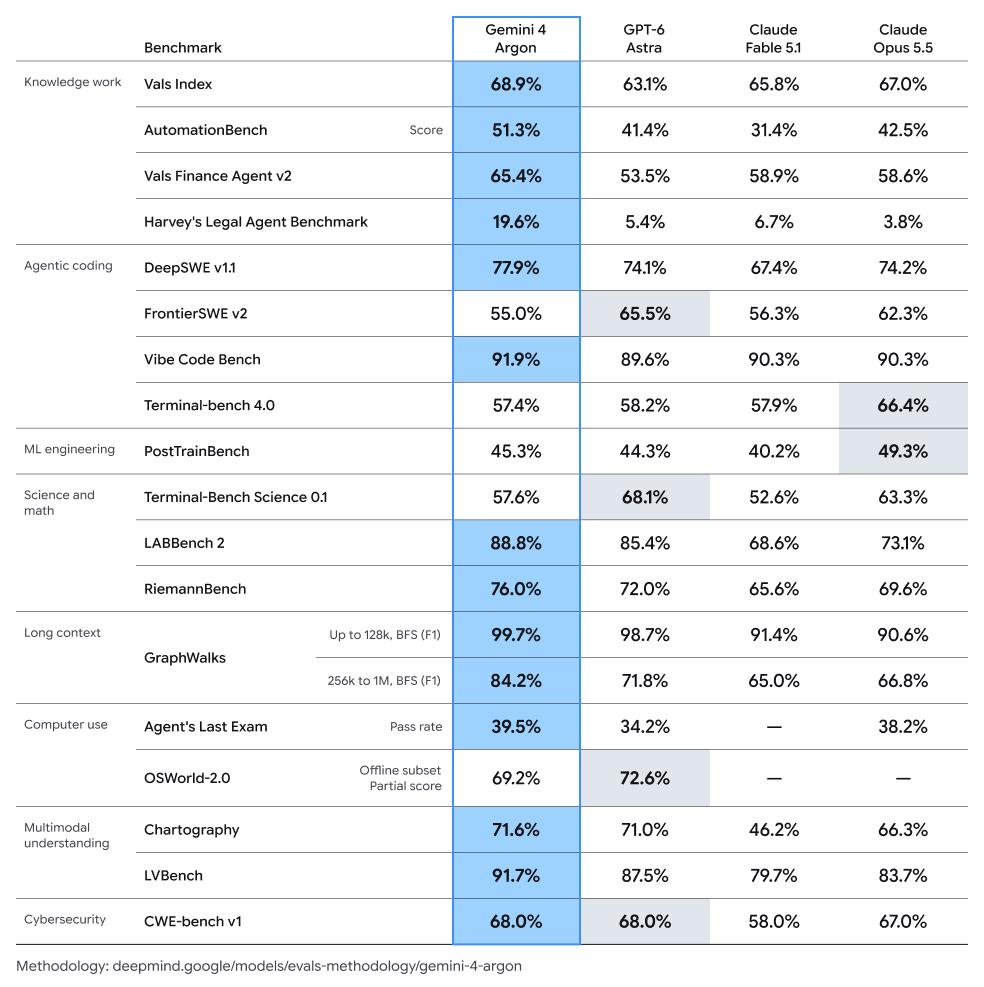
Announcing Gemini 4 Argon, our new frontier model.
Argon is built to sustain deep reasoning across complex, long-horizon workflows and delivers frontier performance in complex workflows across real-world software engineering, enterprise knowledge work like legal and finance, and cybersecurity defense.
We’re also expanding the model’s output token limit to an industry-leading 1M tokens.
Argon is currently rolling out to a set of trusted cyber defenders in the Fairwind Program, with broader availability as soon as possible.
AI safety used to be about what a model could say.
Now we're entering a world where AI can act.
Browse the internet.
Access systems.
Write code.
Operate machines.
Make decisions.
And that's a fundamentally different problem.
When an AI takes an action, the important question isn't only why did it do it?
It's also:
What actually happened?
What triggered the action?
Who was responsible for it?
As AI moves from generating answers to executing tasks, the history of actions becomes as important as the intelligence behind them.
PoHA starts from this exact idea: actions should leave evidence.
The more autonomous AI becomes, the more important it is to know what happened in the real world.
AI learns from what we give it.
So what happens when the world changes faster than its training data?
A model can be trained on years of information and still fail when reality moves in an unexpected direction.
A machine behaves differently.
A workflow changes.
A human finds a better way to solve a problem.
These moments rarely look like traditional datasets.
They are feedback.
The next generation of AI may be defined less by how much it can remember, and more by how effectively it can learn from what is happening right now.
PoHA is one way to turn human actions into a continuous feedback signal for intelligent systems.
AI can explain a decision.
But can it prove what happened before the decision?
A model can process millions of records and identify patterns humans would miss.
But the records themselves are only representations of reality.
Someone inspected the machine.
Someone changed the system.
Someone made the decision.
Someone took the action.
If that layer is missing, AI may be reasoning over a version of reality that was never properly verified.
This is the part of AI infrastructure we rarely talk about:
not intelligence, but provenance.
Proof of Human Action gives real-world events a human-verifiable origin — creating a stronger foundation for systems that increasingly make decisions from them.
What happens when AI starts learning from the real world?
Today, most AI learns from information that has already been recorded.
But the physical world is different.
A factory changes.
A machine fails.
A technician makes a decision.
A process succeeds or fails.
These aren't just “data points.”
They are experiences.
And whoever controls how those experiences are captured, verified, and fed back into AI may ultimately influence how intelligent systems evolve.
That's why Proof of Human Action matters.
The future AI advantage may not come from owning more data.
It may come from owning better feedback loops between humans, machines, and reality.