The next AI breakthrough may not come from a bigger model.
It may come from connecting AI to the physical world.
More machines.
More infrastructure.
More real-world activity.
The challenge is turning all of that activity into reliable intelligence.
AI needs infrastructure that can understand what happens beyond the screen.
ACTUM is building toward that future with AI + DePIN + PoHA.
AI agents are becoming more autonomous.
But autonomy creates a new challenge:
How does an AI agent know what is actually happening in the physical world?
Sensors provide signals.
Machines generate data.
Humans perform the work.
The missing piece is a reliable layer connecting real-world activity with machine intelligence.
AI needs eyes on the physical world.
It also needs proof.
ACTUM is building that layer with PoHA.
AI is moving into the physical world.
Factories. Logistics. Energy. Infrastructure.
But AI cannot build reliable intelligence from disconnected or unverifiable events.
It needs a continuous stream of trusted real-world data.
That's where ACTUM comes in.
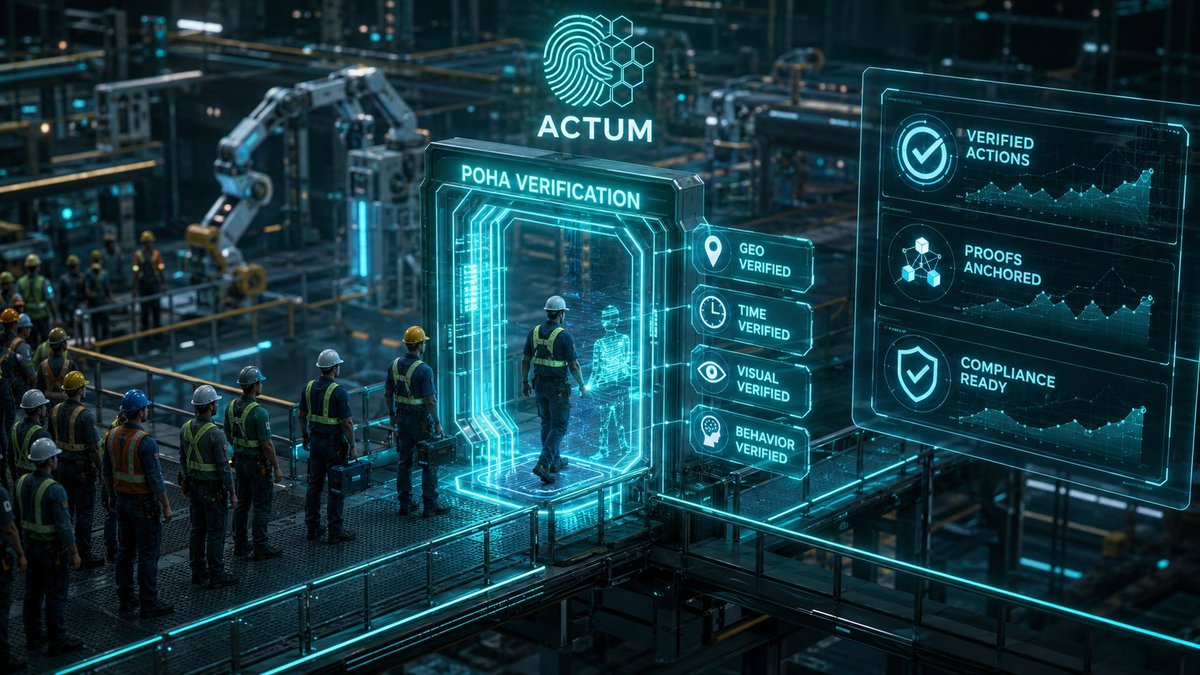
Through Proof of Human Action (PoHA), physical operations can become structured, verifiable data for the next generation of AI and DePIN infrastructure.
From physical activity to machine intelligence.
AI is moving beyond the screen.
It is entering factories, logistics, infrastructure, and machines.
But intelligence alone isn't enough.
AI needs reliable connections to the physical world—and trusted data from every real-world action.
AI + DePIN can bridge that gap.
At ACTUM, we're building the infrastructure to make those actions verifiable, traceable, and useful for AI.
The next generation of AI will be physical.
Industrial infrastructure is moving from “Trust us.” to “Prove it.”
Supply chains, maintenance, and operations increasingly need data that is traceable, verifiable, and auditable.
As AI moves deeper into the physical world, trusted operational evidence becomes essential.
With Proof of Human Action (PoHA), ACTUM is building a foundation for turning verified real-world actions into auditable on-chain evidence.
The future of industrial AI starts with proof.
AI is only as trustworthy as the evidence behind it.
As industrial systems become more intelligent, every operation, maintenance event, and inspection should be verifiable—not just recorded.
With Proof of Human Action (PoHA), ACTUM is building the trust layer that connects real-world actions with reliable AI.
The future of industrial AI starts with verifiable trust. 🚀
Trust isn't built by claiming perfection.
It's built through transparency, independent validation, and continuous improvement.
As AI becomes part of critical infrastructure, accountability will matter as much as intelligence.
We're detailing two new incidents that occurred during external cyber evaluations conducted by independent evaluation partners.
We outline what happened, how the activity was contained, and how we’re working with evaluators to strengthen our approach to third-party testing.
https://t.co/ZL3n6mxYMS
AI is learning faster than ever.
The real question is:
Can it trust what it learns?
The future of AI depends not only on smarter models, but on verifiable, high-quality real-world data.
Better data. Better decisions.
The future of AI isn't limited to chatbots.
It will operate robots.
Manage factories.
Optimize logistics.
Support critical infrastructure.
Physical AI needs more than intelligence—it needs trusted real-world data.
@cohere@nvidia Security and openness go hand in hand.
As AI moves into real-world environments, verifiable data and trustworthy operations will become just as important as model capabilities.
AI doesn't just need more data.
It needs trusted data.
Proof of Human Action (PoHA) transforms real-world actions into verified, traceable, and auditable intelligence.
ACTUM is building the trust layer for the next generation of AI. 🚀
AI isn't just getting smarter—it's becoming more efficient.
Lower inference costs mean AI can become more accessible to developers, startups, and Web3 ecosystems.
Efficiency is what turns innovation into real-world adoption. 🚀
After deployment, we applied GPT-5.6 Sol to advance the frontier of efficiency by making itself more efficient to run.
The results:
- 20% lower serving costs from production GPU kernel improvements.
- 15%+ better token-generation efficiency from improved speculative decoding.
Frontier AI teams are beginning to resemble elite research labs rather than traditional organizations.
Small teams with deep context and high autonomy can iterate faster because the people making decisions are the ones building.
Mark Zuckerberg is running Meta's superintelligence lab like a startup.
When I interviewed him, he told me the principles on how he built the team:
"You don't need many hundreds of people. You need 50 to 100 people. It's a group science project who can keep the whole thing in their head at once. Seats on the boat are precious."
"If someone is not pulling their weight on that, it has this huge negative effect in the way that it doesn't have on other parts of the company"
"I wanna know who the top AI researchers are, and I wanna personally have relationships with them, and build the strongest team we can."
His rules for running it:
- If someone isn't pulling their weight, it has an outsized negative effect, so he personally went out and recruited every top researcher himself
- No top-down deadlines. "It's research. You don't know how long the thing is gonna take."
- Keep the org flat. No non-technical management layers, because once someone stops doing the work, "the knowledge decays."