@fmomboisse et j'veux la retraite par répartition, parce que c'est aux autres de me donner leur argent ! et j'veux que les riches payent plus parce que c'est aux autre me donner leur argent ! et j'vote socialiste parce que c'est aux autres me donner leur argent !
Tout ça pour ça. L'avion de combat commun franco-allemand (SCAF) est enterré.
Beaucoup vont s'en lamenter. Regardons plutôt la vérité en face : ce n'est pas l'échec d'une coopération, c'est l'échec d'une méthode.
En 2017, la France tenait le leadership industriel. Nous l'avons nous-mêmes dilué en acceptant un montage où plus personne ne commandait, derrière le slogan creux du "best athlete". On ne construit pas un avion de chasse à plusieurs chefs.
Après l'abandon par l'Allemagne de la modernisation de l'hélicoptère Tigre (qu'elle remplace désormais par des appareils américains, laissant la France et l'Espagne poursuivre seules ) et après l'échec de l'avion de patrouille maritime commun, c'est le troisième grand programme franco-allemand qui échoue. On ne peut y voir qu'une absence de cap quand l'Allemagne, elle, développe une vraie volonté de puissance.
Elle entend se doter de "l'armée conventionnelle la plus puissante du continent" et se donne les moyens budgétaires pour cela.
Elle impose aussi progressivement ses standards et son industrie à ses partenaires, tel un rival stratégique qui assume sa puissance.
Nous devons donc en tirer les conséquences en refondant notre relation bilatérale, en cessant le récit commode du "couple" et de la coopération automatique, pour lui substituer une relation lucide, fondée sur des intérêts clairement définis.
Par ailleurs, et pour en revenir à l'échec du SCAF, la guerre moderne exige un système de combat complet, pas seulement un avion, aussi performant soit-il. Il faut un appareil, ses drones, son cloud de combat, ses capteurs, le tout connecté et intégré à notre dissuasion nucléaire. Cette ambition, nous en avons déjà les briques nationales : le Rafale F5 et son drone de combat furtif.
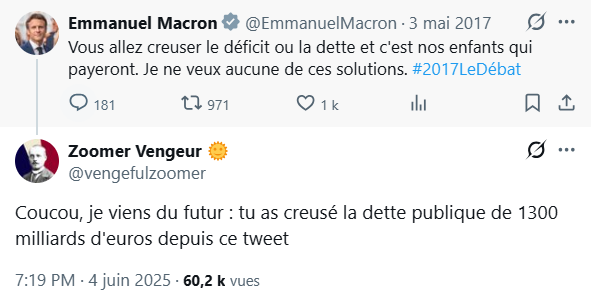
La priorité n'est donc pas de pleurer un programme mal conçu dès l'origine, mais d'assumer et de financer notre propre système de combat aérien souverain. Cela suppose de redresser nos comptes publics et de réindustrialiser. La puissance, la liberté et la souveraineté ne se décrètent pas : elles se financent.
Le #SCAF est mort, vive le #SCAF.
Et si on faisait un #withflags sur cette histoire quelque peu mouvementée, mais pas aussi unilatérale qu'on veut bien le croire.
Conclusion: le système par répartition actuel nous mène dans le mur.
Les actifs d’aujourd’hui et de demain ne pourront pas en supporter le poids.
Le déni démographique ne peut plus durer. Il est temps de changer de système.
@RafaelSereti Et, en toute logique, cette personne ira manifester pour la retraite par répartition...
🎶Le temps ne fait rien à l'affaire🎶 Quand on est con, on est con 🎶
When the President of France visited the United States in April 1960, he asked the FBI to help him find a man.
The man he was looking for was an American citizen. He was sixty-four years old. He had been awarded fifteen French military decorations and — six months earlier, in a ceremony in Paris — had been made a Knight of the Légion d'honneur, the highest civilian honor France can give. The medal had been pinned to his chest by the President himself, who had publicly called him un véritable héros français. A true French hero.
The FBI located the man within a few days.
He was operating an elevator at Rockefeller Center in New York City.
The elevator operator's name was Eugene Bullard. He had been born in Columbus, Georgia, in 1895, the son of a man whose own father had been a slave.
He had run away from Columbus at the age of eleven, after watching a white mob nearly lynch his father.
He spent the next several years drifting through the American South. At sixteen, he stowed away on a German freighter at Norfolk, Virginia. He landed in Aberdeen, Scotland. From there he made his way to London, where he learned to box. By 1913, at eighteen, he was prizefighting in Paris.
When Germany invaded France in August 1914, Bullard was nineteen years old. He had no legal obligation to fight. He had no French citizenship.
He went to the recruiting office on October 19, 1914, and signed up for the French Foreign Legion.
He spent the next eighteen months as an infantryman in some of the worst fighting of the war — at the Somme, at Champagne, at Verdun. He was wounded three times. The third wound, on March 5, 1916, tore open his thigh and left him with permanent damage to his leg.
He was twenty years old. The doctors told him he would not return to the infantry.
He decided he wanted to fly.
In a Paris café in the spring of 1916, while he was recovering, Bullard mentioned to three white American friends that he was thinking of joining the French air service. A Mississippian named Jeff Dickson laughed.
Gene, Dickson said, you know damn well there aren't any Negroes in aviation.
Bullard answered: Sure do. That's why I want to get into it. There has to be a first to everything, and I'm going to be the first.
Dickson bet him two thousand dollars he would not make it.
Bullard took the bet. He earned his pilot's license on May 5, 1917. He won the bet.
He reported to the front in August 1917 and flew approximately twenty combat missions over the next three months in a SPAD VII. The fuselage was painted with a bleeding heart pierced by a knife and the French phrase Tout le Sang qui Coule est Rouge — All Blood that Flows is Red.
He carried, on every combat flight, a small capuchin monkey named Jimmy in the front of his flight jacket.
The French press began calling him L'Hirondelle Noire — the Black Swallow.
When the United States entered the war in 1917, Bullard immediately applied to transfer to the U.S. Army Air Service.
His application was rejected.
The U.S. Army Air Service had a policy, in 1917, of not accepting Black pilots. The other American pilots flying for France in his unit, all of them white, were transferred to the U.S. Air Service.
He was the only one who was not.
For the next twenty years, he was one of the most familiar faces in the Montmartre nightlife of Paris between the wars. He owned a nightclub called L'Escadrille. He spoke fluent French, English, and German. Hemingway drank there. Fitzgerald drank there. Langston Hughes drank there. Josephine Baker performed there. Louis Armstrong was a personal friend.
When Germany invaded Poland in 1939, Bullard was forty-four. His fluent German and his ownership of a nightclub frequented by German officers made him useful to the French Resistance. He became an intelligence agent — eavesdropping in his own bar on conversations between German officers who did not know he understood every word.
When France fell in June 1940, friends in the Resistance smuggled him across the Spanish border before the Gestapo could arrest him.
He came back to the United States for the first time in twenty-eight years.
He arrived in New York with thirty dollars in his pocket and a permanent limp.
He did not return to a hero's welcome. He returned to a country that had no idea who he was.
He worked at a perfume counter. He worked as a security guard. He worked at the Staten Island shipyards. By the late 1940s, he had taken the job that he would hold for most of the rest of his life.
He operated the elevator at Rockefeller Center.
He was wearing the elevator uniform on the day a producer from NBC came down from the studios upstairs to ask if he was the man Charles de Gaulle had been looking for.
A few weeks later, NBC sent a film crew to interview him in the lobby. The studios where NBC produced The Today Show were on the floors above. He had operated the elevator that took the network executives up to those studios every morning for nearly ten years. He had not been recognized as he did it.
He went back to operating the elevator the following Monday.
He died of stomach cancer on October 12, 1961, three days after his sixty-sixth birthday.
He was buried in the French War Veterans' section of Flushing Cemetery, in Queens, in the uniform of the French Foreign Legion. The casket was draped with the French flag.
In 1994 — thirty-three years after his death — the United States Air Force formally commissioned Eugene Jacques Bullard as a Second Lieutenant, posthumously.
It was the first commission the U.S. military had ever offered him.
He had been the first Black combat pilot in American history.
The French had been calling him a hero since 1917.
The Americans got around to it in 1994.
Sur les formules de politesse, lire l'extraordinaire gradation de V.Hugo. (Variante altière de Richelieu : "Je suis votre serviteur très humble" - employé à l'oral pour signifier: "l'entretien est terminé"...
Si vous cherchez une alternative originale à « Bien Cordialement », on a la solution.
À l’occasion du 250ᵉ anniversaire de la Déclaration d’indépendance des États-Unis et à travers le parcours exceptionnel du marquis de La Fayette, les Archives Diplomatiques prêtent plusieurs documents à l’exposition « Lafayette entre France et Amérique. Histoire et légende » aux Archives nationales.
Plus d'événements 🇫🇷🇺🇸 : https://t.co/sQefk6TcgK
Les Français deviennent tellement pauvres qu’on doit expliquer à ceux qui gagnent 3500 € qu’ils sont riches et qu’ils devraient déjà être bien contents.
La phase 2, qui est le but (à peine) caché de l’opération, c’est quand on leur expliquera que comme ils sont riches, on va pouvoir augmenter leurs impôts, et qu’ils n’ont qu’à dire merci.
@BFMTV Après de tels manquements, dans n’importe quel pays, le ministre présenterait sa démission. En France, il présente ses excuses…. #afuera tous ces morbacs…
@_h16 L'État Français est débile ! C'est aussi le plus important et surtout le plus MAUVAIS employeur du pays. Mais il est bon pour tondre et endoctriner sa population, donc ça passe crème.
@BFMTV Nous remercions les personnels de la cuisine Municipale, les fournisseurs et les manutentionnaires des écoles qui vont travailler #gratuitement pour satisfaire aux caprices de ces bobos stupides !
@Cobra_FX_ La réponse est simple : il va taxer ! que ce soit intelligent ou pas, que ça rapporte ou pas, que ce soit productif ou pas, la seule et unique réponse de notre Etat pachydermique et ne nos homme politiques idiots et toujours, systématiquement, un nouveau prélèvement !
« Les vrais riches, dans leur villa de Gstaad ou Marbella, comment voulez-vous qu’ils ne rigolent pas, quand l’Observatoire des inégalités leur dit qu’on est riche à partir de 4292 euros par mois », @Manu_Lechypre .:)