@Lammyisback@Favwontmiss This was helpful for me too until one day the battery died and I didn't charge it.. I can see the toothbrush right now but don't have the will power to go charge it 😆
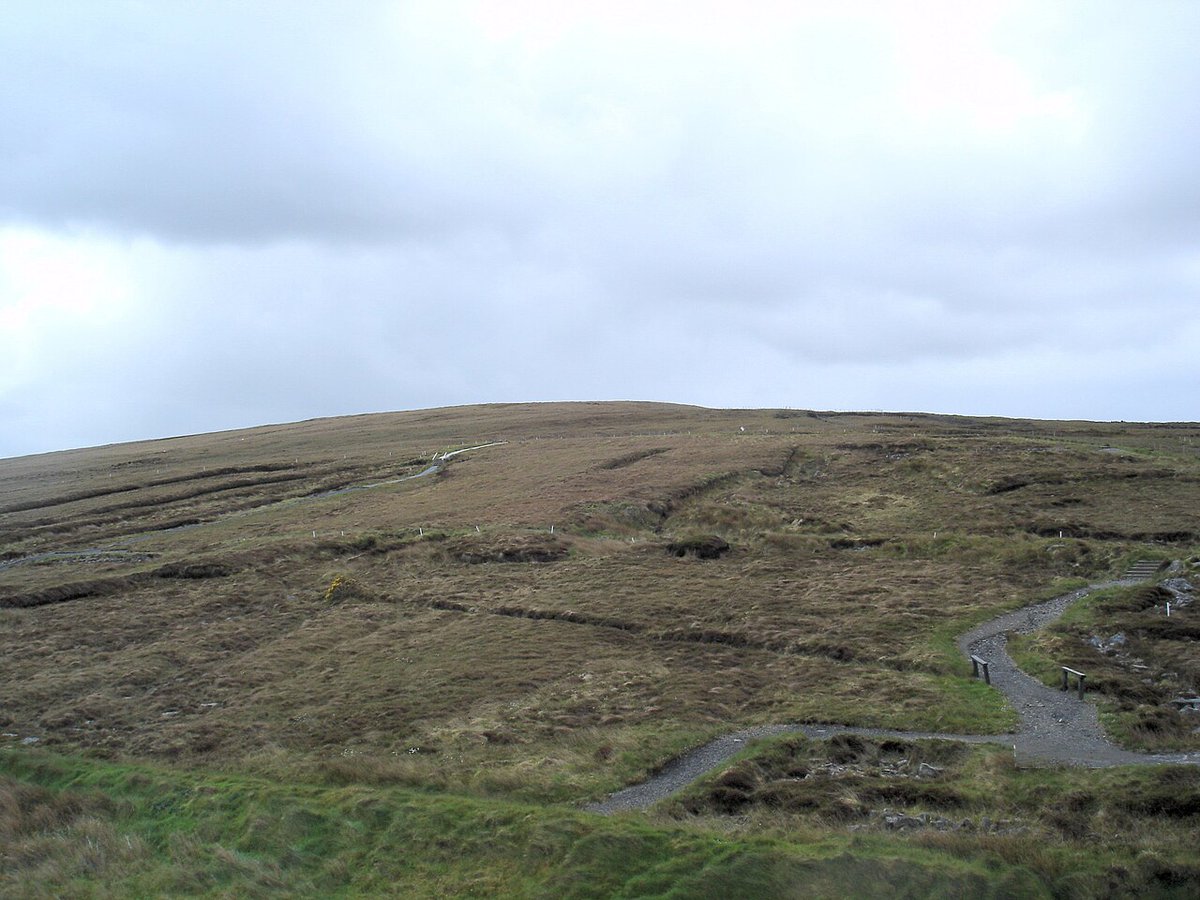
The most ancient fields on Earth, at about 5,500 years old, are in Mayo! The Céide Fields predate the Egyptian pyramids and similar agricultural systems anywhere in Europe by roughly 2,500 years. You would think theyd always been famous but it took a schoolteacher called Patrick Caulfield cutting turf in the 1930s to realise the miraculous heritage.
He recognised something in the strange linear piles of stones at the bottom of the bog. Firstly their configuration was not natural. But more importantly, they were underneath the peat, which meant they had been placed before the bog formed. And bogs take thousands of years. He told anyone who would listen that these layouts must be ancient, but nobody did feck all for 40 years!
Thankfully his son Seamus Caulfield came back, armed with an archaeology degree and a practical solution to analyse the blanket bog without destroying it. So Caulfield the younger developed a probing technique, pushing iron rods down through the peat to locate the hidden walls beneath. This painstaking, low-tech method was extraordinarily effective.
He mapped this ghost landscape of over a hundred kilometres of stone wall, two metres below the surface, preserved almost perfectly by the very bog that had buried them. The site in total covers around 12 square kilometres. Most of the walls are still underground and the bog is still growing.
The walls are long, parallel, some of them stretching over a mile and a half. They divide the land into rectangular plots ranging from four to ten hectares. Some authority measured this land, agreed on boundaries, and coordinated the labour to build them. The walls themselves ran between 90 centimetres and 150 centimetres wide and stood at least a metre high.
That kind of construction doesnt happen without rule of law, community organisation, and a shared idea of the future. Archaeologists estimate several hundred workers were involved. They cleared vast pine forests, oak, birch, hazel and alder, to open the land. They built the walls from the stone they cleared. They then kept cattle on the divided fields and, near what is now the visitor centre, appear to have grown emmer wheat in smaller enclosed plots.
Around 50 to 60 families lived here, perhaps 300 people in total, in round wooden gaffs about six metres across. They buried their dead in megalithic court tombs, the Behy court tomb still sitting within the complex. They made pottery comparable to finds across Stone Age western Europe. A primitive plough blade of stone, a saddle quern for grinding grain, a scattering of arrowheads.
Then over a century or two, the climate shifted and the land got wetter. The soil became waterlogged because an ironpan formed in the subsoil, sealing the moisture in. The people had to leave and blanket bog began to form across the hillside, smothering the walls and the houses and the tombs. The families moved a few miles south to the lower ground around Ballycastle and Killala Bay. They wouldve watched the bog creep over everything they had built, and there was nothing to be done about it. But that bog preserved their genius.
Seamus Caulfield spent years trying to get the site recognised, holding local fundraising meetings, encouraging communities across Mayo to contribute. Local children in Doohoma went door to door collecting money. Taoiseach Charles Haughey flew out to the site in 1990, but thankfully that aul hawk-faced-hoor didnt try to hock it stone by stone. His visit helped promote recognition and preservation.
The OPW came on board, money was found, and in 1993 the visitor centre opened. The building is pyramid-shaped, which is another matter I cant discuss. It houses a Scots pine recovered from the bog, around 4,000 years old and I highly recommend you visit this incredible site and contemplate how our ancient ancestors led such sophisticated lives which should rightly inspire pride.
Buy the Dublin Time Machine a pint and support the DTM Book
https://t.co/U7jtCrOTtb
This is Khalifa from Gaza, he came to Ireland twice, played football, met the President, charmed us all. He was a Palestine National Youth Team player. He was 20 when he was murdered by Israel, one of the 421 football players they killed. He is why the FAI must not play Israel.
Near death experience around Castlebellingham on the way back to Derry. Simultaneous undertaking and overtaking at speed.. so yeah one car was in the hard shoulder...
Seamus Coleman made it clear that "as a Dad as a Son as a Husband as a Brother" whose grown up "knowing what's right & wrong" he won't be playing for Ireland against Israel. Fair play Sheamie!
How many players will follow his good example & also boycott the match?