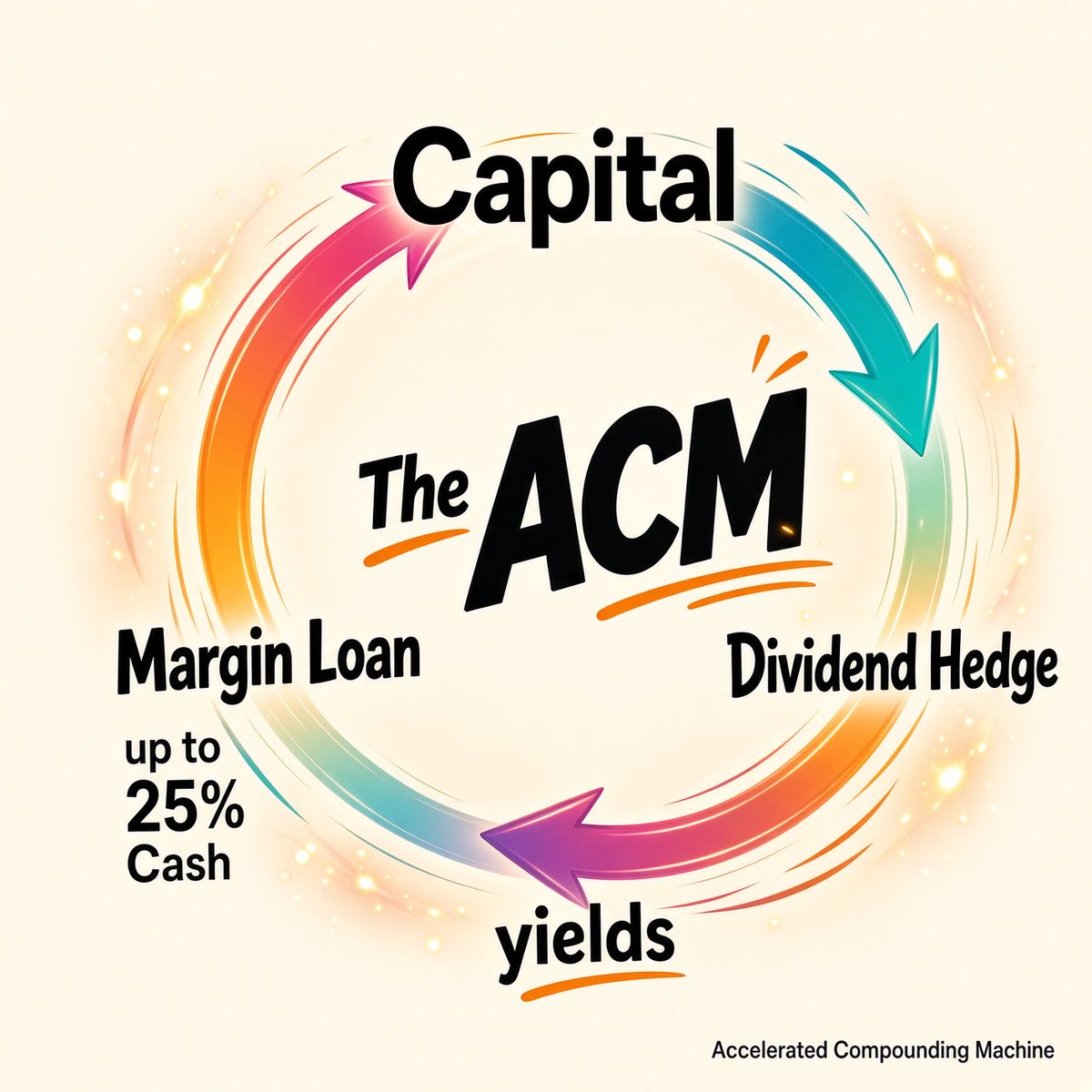
Borrowed liquidity earns its keep only when the ceiling is built before the storm arrives. Capping a margin loan at a quarter of cash keeps a steep repricing from turning an income engine into a forced liquidation.
A payout without downside shielding is just an advance on principal. Pairing yield harvesting with a dividend hedge lets you collect cash distributions while keeping sharp equity drops from hollowing out the base that pays them.
Real momentum comes from how fast harvested yield is re-anchored into working equity. Each payout that clears loan carry and returns to the core pool widens the base for the next cycle without asking the market for heroics.
Modest leverage still tests nerve when screens turn red for weeks. Staying calm in a drawdown depends on sizing the credit line so time stays on your side rather than forcing decisions at the worst possible price.
Single trades create stories, closed loops build net worth. When core capital, hedged distributions, and a strictly bounded cash line feed one another year after year, compounding stops relying on luck and starts running on design.
Compounding is not the automatic reward of patience; it is the selective reinvestment of free cash into the subset of opportunities whose incremental returns still exceed the rising cost of capital. Everything else is just accumulation.
Most permanent losses begin as temporary discomfort that is misread as conviction. The investor who treats every drawdown as a test of character rather than a test of assumptions will eventually discover that character cannot compensate for a broken model. @nvidia
Discipline is not the refusal to change a thesis; it is the pre-commitment to the exact evidence that would force the change, written down before the evidence arrives so that the decision is made by the process rather than by the latest narrative.
Price is the market’s temporary vote; value is the cash the asset can still produce under conditions the current owners have not yet priced. The gap between them is not a signal to act, it is a claim that must be stress-tested against the specific risks that could close it permanently.
@xinxianhub When the cash that position, puts off ceases or is below my cost the service any debt capital I may have. Also since my positions are calibrated to be bets neutral, if that calibration fails, so this the reason to be invested.
The real cost of a position is not the price paid but the capital that remains immobilized while superior opportunities emerge elsewhere; opportunity cost is the silent tax on every decision that stays open too long.
The costliest behavioral leak is not the belief that one is right, but the unexamined premise that other holders will remain solvent and patient on the same timetable as the thesis.
Compounding requires that each reinvestment decision be subjected to the identical skepticism that governed the original allocation; otherwise the mechanism simply multiplies earlier mistakes.
Process discipline means the criteria for revising a thesis are identical to the criteria that would have been required to initiate it, applied under the same information standard.