Our new article (https://t.co/g6fcre4xWT...), a
@GMU_COS collab betweeen @MasonAOES and @GGSDepartment led by PhD student
@FatemehJanat and @aermagun, uncovers potential network-wide impacts of extreme heat on passenger rail in the US.
Time flies when you do what you love! Grateful for six transformative years with the @NASEMTRB Women and Gender in Transportation (AME20) committee, my first TRB "home." I look forward to AME20's continued growth and impact.
@GMU_COS@MasonResearch
Our PhD student, Fatemeh Janatabadi, is talking about detecting spatial dependence and advancing geospatial data analytics in a packed room. Even the snowstorm couldn’t keep her away!
@GMU_COS@NASEMTRB@MasonResearch
Our research team at George Mason University is excited to present lectern and poster sessions at the
@NASEMTRB Annual Meeting. Join us to engage with our presenters and gain insights into our most recent findings.
@GMU_COS@VirginiaClimate@GMU_CRASC@MasonResearch
First-time experience at @theAGU Annual Meeting was a success! Our students showcased research on #climate change, community #resilience, and human #mobility in podium and poster sessions. A special thank you to the @NSF for their ongoing support!
@GMU_COS@MasonResearch
Considering your PhD in the high impact field of geoinformation systems? Come see localized disaster recovery and resilience experts @GeorgeMasonU@GGSDepartment researchers @theAGU
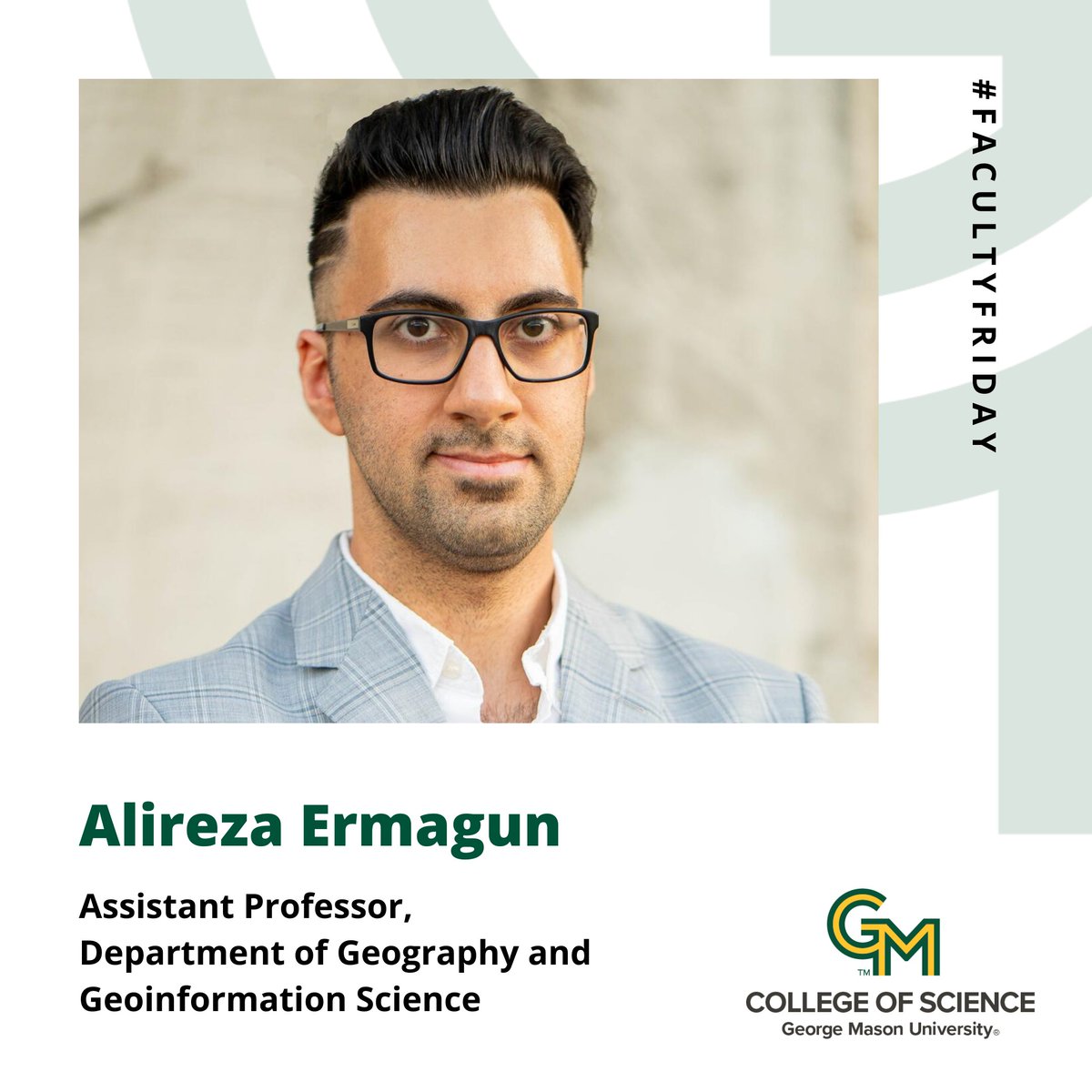
#FacultyFriday spotlights @aermagun, @GGSDepartment, who’s studying the impact of the Baltimore Key Bridge collapse on freight flow. His @NSF-backed research is shaping more resilient logistics networks.
Read more: https://t.co/LHEbFEv6et
Congratulations to our amazing rising high school students for completing their 8-week session! I am proud of their hard work and growth, and I loved building friendships and learning together—especially during those late-night deadline adventures!
@GMU_COS#STEMeducation
What is the Access Weight Matrix (AWM)? We introduce a weight matrix with elements that are a function of (i) the spatial distribution of places, (ii) the number of places, and (iii) the travel-time threshold to reach places.
@GMU_COS@GeogAnalysis
https://t.co/6T4zc3vZv6
Which indicator should we use to measure #transit#effectiveness? We propose an #access-oriented indicator for American cities and put it to the test across the 50 most populated Metropolitan Areas.
@GMU_COS@Transport_ELS
https://t.co/nwSiqwxWEj
@aermagun of @GGSDepartment spearheads a project to fortify vulnerable regions in California against wildfires. With a $397,365 @NSF grant, the team is crafting an interactive map to optimize shelter access during disasters.
Learn more about the project: https://t.co/X261h6rqVs
Do areas with low access to opportunities suffer from a lack of transit service, lack of opportunities, or both? We propose a four-step framework to dissect the elements of place and mobility in access through the lens of equality.
@GMU_COS@Transport_ELS
https://t.co/4z1vAt5mYv
Certainly, here is the tweet: Even the first sentence of the article was overlooked by everyone involved: authors, reviewers, and the editor.
A truly "double-blind" process with a three-month lead time for publication.
@AcademicChatter@OpenAcademics
.@GGSDepartment researcher, Alireza Ermagun, leads a @NSF-supported project to optimize response to the growing menace of wildfires in Lake County, California. Learn more about Ermagun's work⬇️ #MasonNation@MasonResearch
https://t.co/LaBwXwQNaq