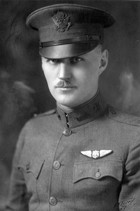
1954: Benjamin O. Davis, Jr., was promoted to Brigadier General, becoming the USAF’s first Black general officer. Lt. Gen. Benjamin O. Davis Jr. played a vital role in opening the skies for Black Airmen. Davis spent more than 35 years in the military, breaking barriers at every level. He served all over the world, fighting against segregation on and off the battlefield. See this article by Anthony Eley for an excellent biographical summary of his life. (USAF Image)
https://t.co/FxYnUECdUX
1925: Lt James H. Doolittle won the Schneider Cup Race at Baltimore Harbor in a Curtiss R3C-2 floatplane racer. He averaged 232.6 MPH.
The sleek Curtiss R3C represented the latest concepts in high-speed racing design. Wood monocoque construction, thin airfoil shapes, a close-fitting engine covering, corrugated brass radiators built into the wings, and minimal external bracing for the single-bay biplane wing reflected emerging methods in aerodynamic streamlining and drag reduction. The 610-horsepower Curtiss V-1400 engine and the Reed Duralumin propeller were the state-of-the-art in high-output propulsion technology. (US Army image, The R3C can be found at the National Air and Space Museum in Washington, DC)
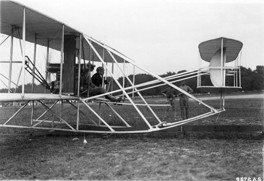
1909: Following the acceptance of the 1909 Flyer, Army aviation activities were moved to College Park, Md., where a larger flying field was available. On Oct. 8, Wilbur Wright began giving flying lessons to Lts. Frank Lahm and Frederick Humphreys. Lt. Humphreys soloed on Oct. 26, becoming the Army's first "pilot." Lt. Lahm (seen here with Wilbur Wright) soloed several minutes later. Within weeks, both officers were ordered to return to duty with their respective Army units. The Aeronautical Division was left with one airplane and a handful of airplane mechanics, but no pilot. (US Army image)
1955: The Republic YF-105A Thunderchief exceeded the speed of sound on its first flight at Edwards AFB. The Republic F-105 Thunderchief served with the USAF from 1958 to 1984. Capable of Mach 2, it was originally designed as a single-seat, nuclear-attack aircraft; a two-seat Wild Weasel version was later developed for the specialized Suppression of Enemy Air Defenses (SEAD) role against surface-to-air missile sites. The F-105 was commonly known as the "Thud" by its crews because of the sound it made when the afterburner lit. (USAF image)
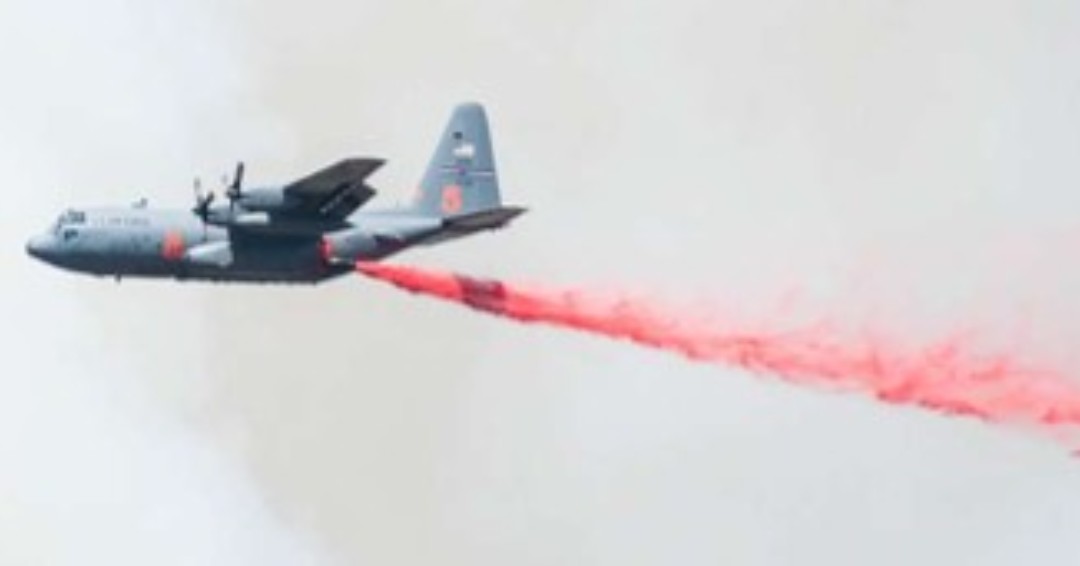
2003: Through 4 November, six ANG C-130s and two AFRC C-130s, equipped with Modular Air borne Fire Lighting Systems (MAFFS), flew 48 missions to drop 129,600 gallons of fire retardant on fires in Southern California’s Simi Valley. Ten wildfires in Southern California consumed more than 745,000 acres and destroyed over 3,400 homes in this period. (Colorado Guard C-130 using the MAFFS, USAF Photo)
1973: As a result of the Arab-Israeli War, the Arab nations imposed an oil embargo, which disrupted USAF flight training.
In October 1973, the members of the Organization of Petroleum Exporting Countries (OPEC), led by King Faisal of Saudi Arabia, proclaimed an oil embargo targeted at nations that had supported Israel during the Yom Kippur War. The initial nations targeted were Canada, Japan, the Netherlands, the United Kingdom and the United States, though the embargo also later extended to Portugal, Rhodesia and South Africa. By the end of the embargo in March 1974, the price of oil had risen nearly 300%, from US$3 per barrel to nearly $12 per barrel globally; US prices were significantly higher. The embargo caused an oil crisis, or "shock", with many short- and long-term effects on global politics and the global economy.
Know the Past…Shape the Future!
1999: Through 20 October, Northrop-Grumman’s RQ-4A Global Hawk flew a 24.8-hour mission from Edwards AFB to Alaska. The extended-range sortie included its first mission over water and its first flight beyond the CONUS. During the flight, the Global Hawk collected and relayed 193 ground images to ground stations.
From its first flight in 1998 to 9 September 2013, the combined Global Hawk fleet flew 100,000 hours. 88 percent of flights were conducted by USAF RQ-4s, while the remaining hours were flown by NASA Global Hawks, the EuroHawk, the Navy BAMS demonstrator, and the MQ-4C Triton. Approximately 75 percent of flights were in combat zones; RQ-4s flew in operations over Afghanistan, Iraq, and Libya; and supported disaster response efforts in Haiti, Japan, and California. (USAF Image)
Operation Greased Lightning
1963: Major Sidney J. Kubesch, Major John Barrett and Captain Gerard Williamson flew 8,028 miles from Tokyo, Japan, to London England, non-stop, in 8 hours, 35 minutes, 20.4 seconds. Their airplane was a Convair B-58A-20-CF Hustler, serial number 61-2059, named Greased Lightning. It was assigned to the 305th Bombardment Wing, 19th Air Division, at Bunker Hill Air Force Base, Indiana. The B-58 used five inflight refuelings and flew at an average speed of 938 MPH. Kubesch set two other records: speed from Tokyo to Anchorage, 3 hours 9 minutes 42 seconds at 1,093.4 MPH; and speed from Anchorage to London, 5 hours 24 minutes 54 seconds at 826.9 MPH. (USAF Images)
1937: Test pilot Eddie Allen flew the Boeing XB-15 on its first flight at Boeing Field, Seattle. The specification that produced the XB-15 began in mid-1933 as "Project A", a project exploring the possibility of flying a very large bomber with a range of 5,000 mi. In April 1934 the US Army Air Corps contracted with Boeing and Martin to design a bomber capable of carrying 2,000 lb. at 200 mph over 5,000 miles. (US Army Image)
October 8 – Bremen
October 9 – Marienburg and Anklam
October 10 – Munster
October 14 – Schweinfurt
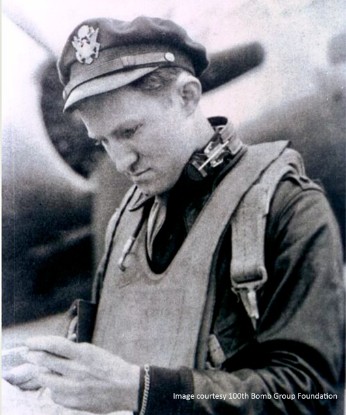
October 8-14, 1943, was a pivotal week for the fledgling 8th Air Force. Under the command of Lt. Gen. Ira Eaker, formations of heavy bombers were dispatched from England on daylight missions to destroy military and industrial targets. Eaker’s “maximum effort” series of bombing missions encountered waves of experienced Luftwaffe pilots and by week’s end, 150 bombers and nearly 1,500 Airmen were lost. The 100th Bomb Group, one of 40 groups, lost half its strength, along with many of its original pilots that had arrived on base just four months earlier. Group Navigator Harry Crosby’s Bremen Mission Report gives a harrowing first-hand account. (Photo: Harry Crosby, Group Navigator, 100th Bomb Group, Heavy)
Gen. Henry “Hap” Arnold was in England at 8th AF headquarters that week. In the coming days, replacement crews arrived from the U.S. to fill the void. Meanwhile, command and strategic changes were put into motion. By the first week of January 1944, P-51 Mustang fighters began arriving in significant numbers. By March, Lt. Gen. Jimmy Doolittle replaced Lt. Gen. Eaker who assumed command of the Mediterranean Air Forces. By D-Day, Allied ground troops landed along the Normandy coast and only a handful of enemy fighters were encountered.
1972: An F-4 weapon system officer, Capt Jeffrey S. Feinstein, shot down his fifth MiG-21 to become the third and final ace of the Vietnam War. For this feat, Feinstein shared the 1972 Mackay Trophy with Captains Richard S. “Steve” Ritchie and Charles B. DeBellevue. Feinstein used an AIM-7 missile to down his fifth North Vietnamese MiG-21.
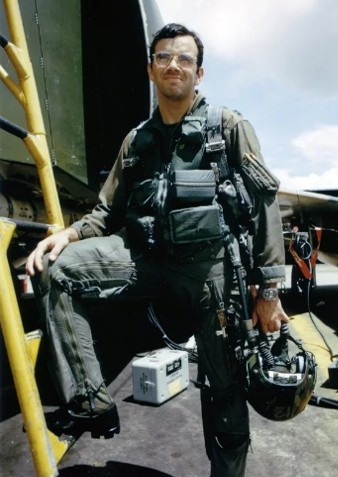
1944: Lt. Charles “Chuck” Yeager scored five confirmed kills over Bremen, Germany, becoming an “Ace” in one day. As group leader, Lt. Yeager was escorting B-24 bombers over Holland when his squadron spotted 22 Bf-109 aircraft. Lt. Yeager distracted one pilot who collided with another, sending both down in flames, continued to shoot down another at 600 yards, then rolled over behind his pursuer to take him out at less than 50 feet. The last pilot went into a steep dive as Lt. Yeager pursued the aircraft, but it could not recover and crashed. (USAF Image)
1925: Lt Cyrus Bettis, Air Service, set a world speed record of 249 MPH in the National Air Races at Mitchel Field using a Curtiss R3C-1. He was the winner of the 1924 Mitchell Trophy Race and won the 1925 Mackay Trophy. He was also a winner of the Pulitzer Trophy in October 1925, flying a Curtiss R3C-1 racer. In winning the trophy, he set a new airspeed record for a closed-circuit race. The record was broken shortly after by Lieutenant Jimmy Doolittle who was flying the same aircraft with pontoons installed.
1912: Lt Henry H. Arnold won the first Mackay Trophy (pronounced MACK’ee) competition for the most outstanding military flight of the year. Arnold and Lt Thomas Milling had been challenged to fly a triangular route between Fort Meyer, College Park, and Washington, D.C., and pinpoint a “troop concentration.” In winning the award, Arnold had completed the reconnaissance course and reported the simulated enemy troop concentrations to the event judges.
In one respect the “contest” was not a contest at all. Milling, the only other participant, had aircraft problems that kept him on the ground. The flight demonstrated one of the doctrinal missions for army aviation, something the Army air arm was still struggling to define. Perhaps because of these circumstances, Arnold did not take himself or his accomplishment too seriously. The young lieutenant wrote that, "It [the trophy] certainly is handsome. I figure that it will hold about four gallons so I cannot see how you can fill it with anything but beer.”
He was not far off. While cleaning the Mackay Trophy one day in 2006 (it is housed at the National and Space Museum) the curatorial staff tested the volume of the trophy using non-reactive Styrofoam balls. In fact, the Mackay Trophy cup holds a volume of five gallons (of Styrofoam balls anyway, images PD).
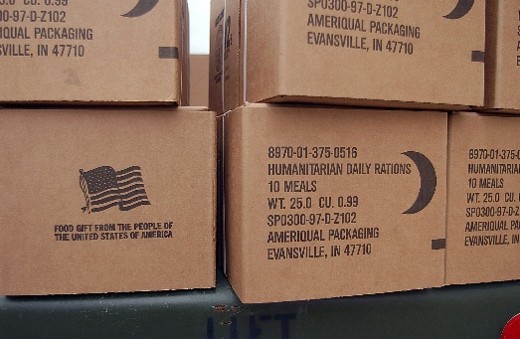
2001: Operation ENDURING FREEDOM. Two C-17s airdropped about 35,000 humanitarian rations over eastern and northern Afghanistan. The two airdrops were the C-17’s first combat missions, first combat airdrops, and first humanitarian airdrops of ENDURING FREEDOM. The C-17s flew from Ramstein AB more than 6,500 miles in a 22-hour round trip and were air refueled multiple times. (USAF Images)
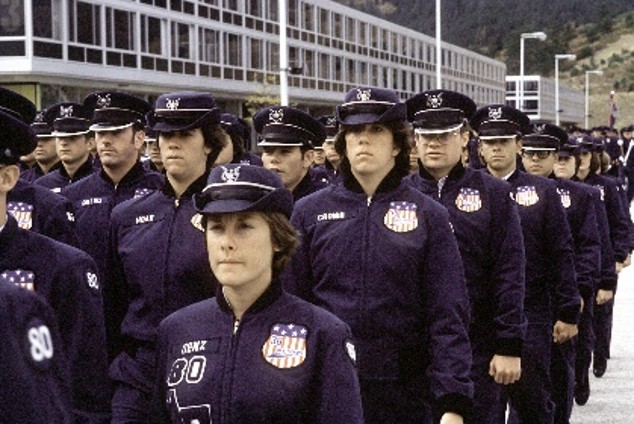
1975: President Gerald R. Ford signs legislation that will permit women to enter military service academies. The academy classes that will graduate in 1980 enter the following June. All service academy classes will include women from this point forward. This year marks the 50th anniversary of the first class of women entering the USAF Academy. (USAF Image)
The current issue of the Journal of the AFHF features an article by one of “80s Ladies,” Karen Wilhelm. You may find it at this link.
https://t.co/fsJJhYlprN
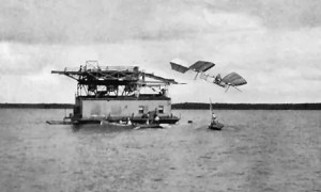
1902: Samuel P. Langley’s full-sized, 48-foot wingspan Aerodrome is launched unsuccessfully by catapult built on a houseboat in the Potomac River. (Image, PD)
1918: MEDALS OF HONOR. Near Binarivelle, France, 1Lt Harold E. Goettler (right) with the 50th Aero Squadron and 2Lt Erwin P. Bleckley (left), flying as an observer, tried to drop supplies to a surrounded US Army battalion in the Argonne Forest (the famous lost battalion). They flew as low as possible to deliver the supplies more precisely, but enemy ground fire brought their plane down. Lt Goettler died instantly. Both men received the Medal of Honor. (US Army images)
Erwin Russell Bleckley entered service as a member of the Kansas National Guard, was commissioned as an artillery officer, then volunteered for aviation training and duty. His was one of the four Medals of Honor awarded to members of the Air Service in World War I.
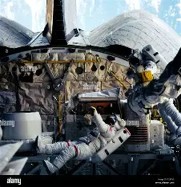
1984: During STS-41-G (formerly STS-17)—the 13th flight of NASA's Space Shuttle program and the sixth flight of Space Shuttle Challenger the sixth Challenger Space Shuttle mission--astronauts recorded several firsts before returning to earth on 13 October: first seven-member crew; first walk in space by an American woman (Kathryn D. Sullivan, Mission Specialist; above); first flight by a Canadian Astronaut (Marc Garneau, Payload Specialist); and first time orbit took shuttle over Chicago during its landing reentry. Other crewmembers included Robert L. Crippen, Commander; Jon A. McBride, Pilot; Sally K. Ride, Mission Specialist; above; David C. Leestma, Mission Specialist; and Paul D. Scully-Power, Payload Specialist. It was also the first flight to include two women. (NASA Images)
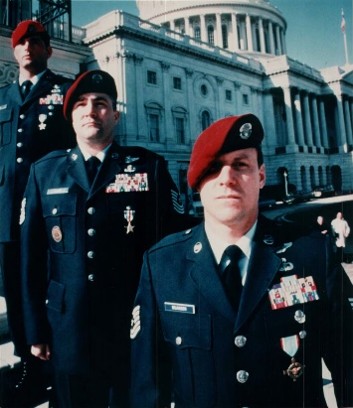
(Staff Sergeant Jeffery Bray, MSgt Scott Fales, and TSgt Timothy Wilkinson stand near the Capitol in Washington, D.C., following their medal ceremony on January 31, 1994. USAF Image)
1993: AIR FORCE CROSS. In response to Somali warlord Mohamed Farrah Aidid’s deadly attack on United Nations and US forces in 1993, a joint special operations task force was sent to Somalia to capture Aidid and his lieutenants. Task Force Ranger, composed of US Army, Navy, and Air Force Special Operations forces was formed.
On October 3, 1993, during a mission to capture two high value targets, Somali forces shot down an MH-60 Black Hawk helicopter, call sign Super-61. Receiving heavier than expected small arms fire and resistance, the mission quickly switched from extraction to rescue. Over the next fifteen hours, eighteen Americans were killed, eighty-four wounded, and two helicopters were destroyed, in what became the longest ground battle since the Vietnam War.
Enlisted Heroism Eleven enlisted pararescuemen and combat controllers from the 24th Special Tactics Squadron were attached to Task Force Ranger. Serving in all areas of operation including command and control, search and rescue, and Humvee drivers. All eleven Airmen were decorated for heroism, including two of the highest military awards for valor.
Technical Sergeant Timothy Wilkinson, a pararescueman, was awarded the Air Force Cross for repeatedly exposing himself to intense small arms fire and grenade explosions from three directions. He provided lifesaving medical treatment to the wounded while extracting the casualties from Super-61. He became the first enlisted Airman to receive the award since 1975.
Pararescueman MSgt Scott Fales and combat controller SSgt Jeffrey Bray were both awarded the Silver Star for their heroism during the firefight. MSgt Fales, having been shot through the leg, assisted TSgt Wilkinson with treating the wounded, while SSgt Bray radioed for nonstop air strikes to stop the enemy from overrunning their position. One other pararescueman and seven combat controllers also received the Bronze Star, three with Valor. The superb abilities displayed by these enlisted men demonstrated their selflessness and the skill and talent needed to perform their duties under extreme circumstances.



![AFHF's tweet photo. 1912: Lt Henry H. Arnold won the first Mackay Trophy (pronounced MACK’ee) competition for the most outstanding military flight of the year. Arnold and Lt Thomas Milling had been challenged to fly a triangular route between Fort Meyer, College Park, and Washington, D.C., and pinpoint a “troop concentration.” In winning the award, Arnold had completed the reconnaissance course and reported the simulated enemy troop concentrations to the event judges.
In one respect the “contest” was not a contest at all. Milling, the only other participant, had aircraft problems that kept him on the ground. The flight demonstrated one of the doctrinal missions for army aviation, something the Army air arm was still struggling to define. Perhaps because of these circumstances, Arnold did not take himself or his accomplishment too seriously. The young lieutenant wrote that, "It [the trophy] certainly is handsome. I figure that it will hold about four gallons so I cannot see how you can fill it with anything but beer.”
He was not far off. While cleaning the Mackay Trophy one day in 2006 (it is housed at the National and Space Museum) the curatorial staff tested the volume of the trophy using non-reactive Styrofoam balls. In fact, the Mackay Trophy cup holds a volume of five gallons (of Styrofoam balls anyway, images PD).](https://pbs.twimg.com/media/HUL4Ie9WQAAAWxm.jpg)













![AFHF's tweet photo. 1912: Lt Henry H. Arnold won the first Mackay Trophy (pronounced MACK’ee) competition for the most outstanding military flight of the year. Arnold and Lt Thomas Milling had been challenged to fly a triangular route between Fort Meyer, College Park, and Washington, D.C., and pinpoint a “troop concentration.” In winning the award, Arnold had completed the reconnaissance course and reported the simulated enemy troop concentrations to the event judges.
In one respect the “contest” was not a contest at all. Milling, the only other participant, had aircraft problems that kept him on the ground. The flight demonstrated one of the doctrinal missions for army aviation, something the Army air arm was still struggling to define. Perhaps because of these circumstances, Arnold did not take himself or his accomplishment too seriously. The young lieutenant wrote that, "It [the trophy] certainly is handsome. I figure that it will hold about four gallons so I cannot see how you can fill it with anything but beer.”
He was not far off. While cleaning the Mackay Trophy one day in 2006 (it is housed at the National and Space Museum) the curatorial staff tested the volume of the trophy using non-reactive Styrofoam balls. In fact, the Mackay Trophy cup holds a volume of five gallons (of Styrofoam balls anyway, images PD).](https://pbs.twimg.com/media/HUL4IfAXwAAz-S9.jpg)