Today, on Veterans Day, American Friends of Tel Aviv University honors the men and women who have served in the United States Armed Forces, including veterans in our own TAU community. Your courage, sacrifice, and commitment to others inspire us all. Thank you for your service.
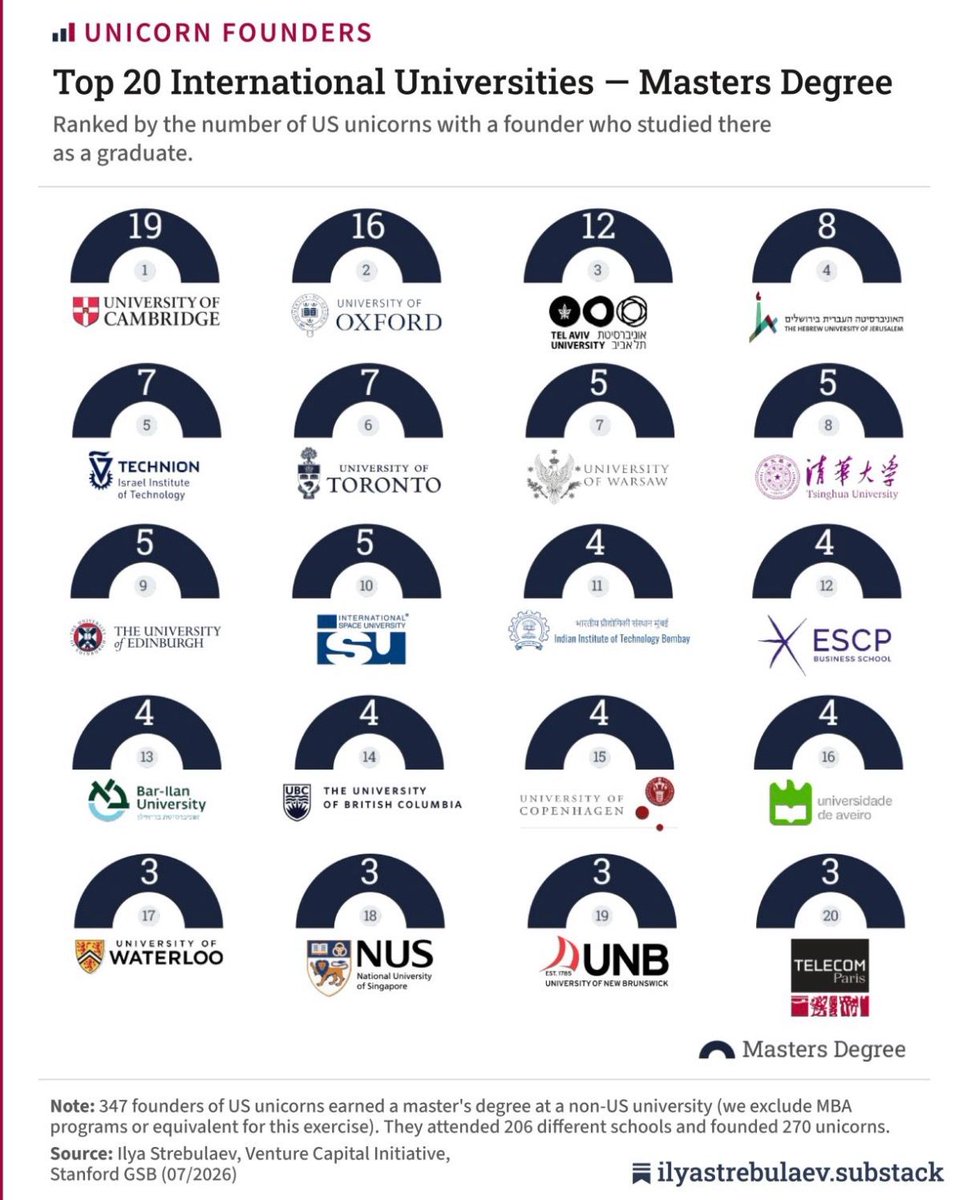
Proud to be home to a university ranked 3rd worldwide outside the US for research master’s graduates who went on to found unicorns. With Hebrew University and Technion also in the global top 10, Israel’s talent, ambition and innovation are clearly making an impact.
A simple blood test developed by Tel Aviv University researchers could help detect lung cancer at an earlier stage, potentially way before conventional diagnostic methods can identify it.
The test analyzes patterns in DNA fragments found in the blood, using a specially developed DNA chip and optical scanning technology.
Led by Prof. Yuval Ebenstein from TAU Faculty of Exact Sciences, the study was published in @Nature Precision Oncology.
More: https://t.co/P6GKB6LQYE
@Telavivuni is #3 in the world for producing unicorn founders with a master’s degree. New data from Stanford GSB’s Venture Capital Initiative found that 12 founders of U.S. unicorns earned their master’s degrees at TAU.
Top 30 in the World for AI: A new Global AI Production Capacity Index has ranked @telavivuni #28 worldwide. The ranking recognizes universities for their ability to cultivate exceptional AI talent, produce influential research, and drive entrepreneurship.
@TelAvivUni has once again been ranked Israel's #1 research university in the prestigious 2026 National Taiwan University (NTU) Ranking, climbing to 206th globally and leading every other Israeli institution. Read more here: https://t.co/HZ4UUKP3eW
A new breakthrough may point to an entirely new way to treat cancer. Researchers @Telavivuni uncovered how tumors can flip the body’s defenders into accomplices: https://t.co/tukMtL9K2E
Researchers at Tel Aviv University have uncovered a promising biological mechanism that could one day lead to treatments capable of restoring hearing. Read more here: https://t.co/YLGtzfwIwv
@telavivuni@KarenAvraham
Researchers from Tel Aviv University and Sheba Medical Center have developed an AI system that detects anemia using a 10-second scan of blood vessels in the eye, without a blood test. The technology could make health screening faster, simpler and more accessible worldwide. 👁️🇮🇱
No needles, no lab! Just a quick eye scan.
Researchers from @TelAvivUni & @sheba_medical
are using AI to detect anemia and measure blood markers, redefining how we approach diagnostics. Read more: https://t.co/lxuRy2WtS0
Tel Aviv University has inaugurated its new Space Engineering Center (SEC), a cutting‑edge hub for research, development, and training in space and satellite technologies. https://t.co/Q3CB1V6wgS
New Faculty Scholars Choose to Return to Israel @AssafRamot@TelAvivUni
Although stress is widely known to influence learning, Assaf Ramot has long been interested in how stress reshapes neural circuits—the patterns of activity and interaction between networks of neurons. His PhD research in neurobiology at the Weizmann Institute of Science identified the cellular mechanisms by which chronic stress alters the circuits that regulate the hypothalamic-pituitary-adrenal axis, the brain’s central stress-response system.
For his postdoctoral training, two years of which were funded by a Zuckerman Postdoctoral Fellowship, Dr. Ramot sought to develop the tools to study behavior, learning, and adaptive plasticity at the level of neural populations and circuit dynamics. He therefore moved to the Department of Neuroscience at the University of California, San Diego. He was part of a lab known for pioneering in vivo imaging of neural circuits in awake, behaving animals. There, he studied the neural circuit mechanisms that allow practice to transform variable movements into skilled actions. He showed that during learned movements, the motor thalamus provides the strongest input to the primary motor cortex.
https://t.co/lt3lwxhOt2
A new treatment that significantly reduces nerve cell damage after spinal cord injury, and helps injured animals recover up to 80% of their motor function!
The breakthrough was led by a TAU team headed by Dr. Angela Ruban from TAU’s Stanley Steyer School of Health Professions and other researchers from Gray Faculty of Medical & Health Sciences and Sagol School of Neuroscience. It may also open new possibilities for treating traumatic brain injuries and stroke.
Read more: https://t.co/6CACWvEfIM
EXCELLENCE earned. U.S. News & World Report ranks TAU #2 top university in Israel and #199 top university globally.
https://t.co/UFrfTU05ij
@Telavivuni@usnews
Delayed by a month due to the war with Iran, the Spring semester opened Sunday IN PERSON at Tel Aviv University. We continue to make every effort to ensure that no students, including thousands of reservists, are left behind academically, psychologically, or financially. It is not an easy time in Israel, but no matter what the future holds, for now WE'RE BACK ( and we never left, really).