Foreign Capital May Not Return Soon: Protect Your Downside
1. 85% of India's capital outflows going to: Korea, Taiwan, China
2. Their 2026 Forward Earnings: 2X/3X of India
3. Their AI/Semicon Growth Supercycle vs. India’s IT Slump
4. Rupee fall erodes FII/FDI capital
DATA:
Where Is the Money Going?
a. Over ₹1 lakh crore FII capital exited India in 2026 (YTD).
b. 60% to Korea & Taiwan: AI/Semiconductor supply chain stocks
c. 25% to China: Bottom-fishing in undervalued tech stocks
d. 15% to “Safe Havens”: U.S. Treasuries and Gold
2025 Actual Earnings Growth
India (Nifty 50): 8.1%
Korea (Kospi): 76%
Taiwan (TWSE): 27%
China (CSI 300): 12%
2026 Earnings Growth (Est.)
India (Nifty 50): 9%
Korea (Kospi): 130%
Taiwan (TWSE): 22%
China (CSI 300): 13%
NOTE: Estimates are from Goldman Sachs, JP Morgan, Morgan Stanley, Bernstein reports.
2026 Forward P/E Comparison
India (Nifty 50): 18.1x
Korea (Kospi): 8.8x
Taiwan (TWSE): 19.7x
China (CSI 300): 13.9x
NOTES:
a. Even after the recent sell-off, India still remains one of the most expensive markets in Asia.
b. Korea has seen an earnings explosion in memory chips, but that market still offers deep value to investors at 8.8x forward P/E.
c. Taiwan is getting expensive, but AI/Semiconductor dominance of Taiwanese companies and TSMC’s pricing power is still a great attraction. Estimated earnings growth of Taiwan in 2026 is 2.5x of India.
d. China is no longer at “distressed” price levels of 2024, but it is still fundamentally 25% cheaper than India.
P/B Ratios March 2026
India (Nifty 50): 3.14x
Korea (Kospi): 0.90x
Taiwan (TWSE): 2.2x
China (CSI 300): 1.45x
NOTE: India is the world’s most expensive major market on P/B ratio basis. India’s price-to-book is 1.5x of Taiwan, 2.5x of China, and 3.5x of Korea. In other words, it is 3.5 times more expensive than Korea for every unit of net asset value as of March 2026.
KOREA
a. Landmark domestic corporate governance reforms combined with a global semiconductor growth supercycle have created a rare “double-alpha” opportunity for investors.
b. A stunning 130% earnings growth projected for KOSPI in 2026, led by Samsung and SK Hynix.
c. Korea’s forward P/E of 8.8x is half the valuation of Indian large caps as of today.
TAIWAN
a. Investors are moving away from AI software/LLM builders to AI hardware (semiconductors and server infrastructure) where Taiwan dominates.
b. TSMC alone controls 70% of the market share, with gross margins of 62%.
c. Taiwan 50 Index with an estimated earnings growth of 22% at a PEG ratio of just 0.9x makes it twice as attractive as Indian large caps on a growth-adjusted basis.
CHINA
a. China’s industrial output in Jan-Feb, 2026 jumped by 6.3%, beating estimates by far.
b. High-tech FDI increased by 20.4% following the government’s massive consumption stimulus package in late 2025.
c. As of March 2026, MSCI China trades at a forward P/E 11.9x, representing 48% discount compared to MSCI India’s 23x. This 48% valuation gap is at a decade-high, leading to an FII pivot towards China. (Foreign investors use MSCI benchmarks.)
INDIA
a. With 85% dependency on oil imports, current account deficit (CAD) widening, rupee getting weaker, and no tech exports hedge, India presents an asymmetric risk (from the viewpoint of foreign investors.)
b. China is energy-secure, while Korea & Taiwan’s high-margin tech exports effectively subsidize their increased oil import bills.
c. IT service exports, which is India’s solitary global competitive edge, is getting threatened by AI. Legacy coding tasks are getting automated.
ENDPIECE: Don’t Fight Mean Reversion
Don’t believe vested interests whose careers are built on the thesis of “Stocks Only Go Up.”
The world has shifted from the era of “Growth at Any Price” (GAP) to “Growth at a Reasonable Price” (GRP). That’s what has hit India.
Now either India delivers exceptional earnings growth in 2026 to justify its P/E multiples, OR the AI growth bubble bursts worldwide.
Until then, play defensive, avoid FOMO, and wait for the loose ball. Your time will come.
@arabicatrader
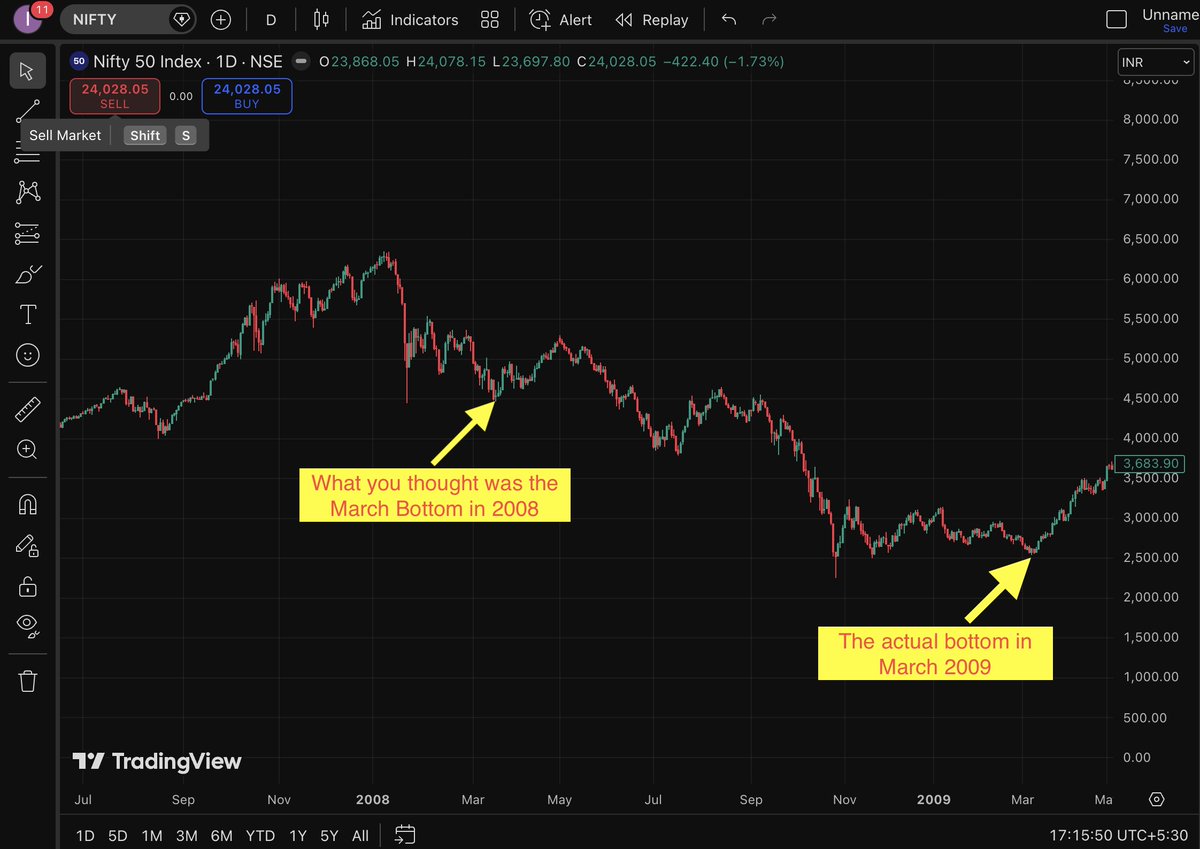
So you are telling me I should say the most sacred bank in India, HDFC Bank, and buy PSU banks with an excellent track record? - What am I not drinking that I do not get it? Investors are selling HDFC Bank relentlessly since the start of 2026 [see volumes] - something is wrong, or something is wrong.
How to Win When the Stock Market Is Down?
1. Rule # 1: You don’t have to make money back the way you lost it.
2. Billionaires worship this rule.
3. Retail investors get crushed in a bear market because they don’t even know this rule.
The Only Winning Move in a Bear Market:
Portfolios are Exposed When the Tide Goes Out
a. In a bull market, both the horse (good stocks) and the donkey (bad stocks) win. In a bear market, both get slaughtered.
b. You discover your donkeys only when your portfolio bleeds. Bear market is a great teacher.
c. Even the world's greatest investors make mistakes. But what moves they make to recover from those mistakes separates billionaires from others.
Steps to Take in a Bear Market
a. Examine the severely under-performing stocks in your portfolio.
b. If the company is great, but the stock is temporarily down due to market sentiment, hang on to it.
c. If the business has no moat (no unique competitive advantage), or if the stock is still overvalued even after heavy bleeding, it is time to spit out the poison.
d. Your stock is not your child. Examine it unemotionally and sell a donkey even if it is 50% down.
Selling a Bad Stock at 50% Capital Loss
a. Buffett’s guru Benjamin Graham famously said: “Mr. Market is not rational.” In a bear market, many horses too get slaughtered along with the donkeys.
b. Sell your donkey at 50% loss, and use the sale proceeds to buy a horse, which is also significantly down from its peak.
c. Suppose your original investment (purchase price) was ₹30 lakh. After 50% price damage, even if you keep hanging on to the donkey, your current net worth is only ₹15 lakh.
d. If you sell the donkey for ₹15 lakh, and buy a horse for ₹15 lakh, what difference does it make to your net worth? None. You remain at ₹15 lakh.
e. When the tide turns, the thoroughbred horse will rise from the ashes, and will race again. Your portfolio will recover. The donkey, on the other hand, will never come back to life. It was never meant to be a horse. It was always a donkey running in a bull market.
Buffett and Munger Taught This Rule
a. Exactly 30 years ago, at the 1995 Berkshire Hathaway AGM, Warren Buffett said: “A very important principle of investing is that you don’t have to make money back the way you lost it.”
b. Munger stepped in: “It’s the same reason gamblers are ruined. They get behind and then they feel like they have to get it back the way they lost it. It’s human nature. It’s very smart just to be willing to take a wound and lick it.
c. Buffett continued: “Your stock does not know that you own it. You have all those feelings about it. You remember what you paid. But your stock doesn’t give a damn about it.”
d. Buffett: “When you find yourself in a hole, the most important thing to do is to stop digging.”
e. Merely because you spent money on a stock does not mean you must continue to hold it. The hope, the emotion, and the money you spent on it are gone. Base your investing moves on tomorrow, not yesterday.
Why Billionaires Sell their Losers, Others Don’t
a. Average people keep hanging on to a toxic job or a negative relationship or a wrong stock because they don’t want to confront the pain of reality. By staying on with it, the pain remains buried underneath.
b. Retail investors will find every argument to “prove” their initial thesis on a bad stock, and hang on it in the belief that they are right and market is wrong.
c. Litmus Test for You: Let’s assume your stock is down from ₹30 lakh to ₹15 lakh. Now imagine if it wasn’t your stock, and you were a fresh investor in the market. Would you buy that stock for ₹15 lakh today? Or would you buy another stock?
d. Mental Accounting: Economist Richard Thaler says: Investors put their losing positions in a “To Recover” mental account. Selling feels like permanent defeat. If you keep holding the stock, the mental comfort of “hope” continues.
e. Money is finite. Billionaires respect that fact. At any given point, they will park their money in their best investment ideas. When you lose faith in a company, it is no longer one of your best ideas.
ENDQUOTE: Prune Your Garden (Portfolio)
Legendary investor Peter Lynch’s favourite story is about the phone-call he received unexpectedly from Warren Buffett on a Saturday in 1989.
Buffett said: “I want to use one line from your new book ‘One Upon Wall Street’ in my annual report. I have to have it.” “Sure. What’s the line?” Lynch asked.
Buffett: “Selling your winners and holding your losers is like cutting the flowers and watering the weeds.”
Lynch recounted the story on stage: “Buffett chose that one line from my book, which I had myself found extremely hard to practice in real life. That line still haunts me as a reminder of my greatest investing mistakes.”
@arabicatrader
Btc
Overall BTC positional structure -_
Is sideways to bearish for few weeks & months to target 65000/75000 while can retrace or correct up to 93000/100000/108000


![indiacharts's tweet photo. So you are telling me I should say the most sacred bank in India, HDFC Bank, and buy PSU banks with an excellent track record? - What am I not drinking that I do not get it? Investors are selling HDFC Bank relentlessly since the start of 2026 [see volumes] - something is wrong, or something is wrong.](https://pbs.twimg.com/media/HCJHosNa0AAXADm.jpg)