@Cuestor23 Verguenza dan los apologistas de la "democracia", "instituciones", "estabilidad", cuando en el fondo miran para otro lado con los escandálos de este sistema de casta de los políticos y sus contubernios.
Si los precios suben un 50% en pesos pero el dólar se mueve un 3%, las cosas en Argentina se encarecieron un 45% en dólares en términos reales.
Por eso terminás pagando la comida, la luz o una hamburguesa más caros que en Nueva York o Madrid, pero con sueldos Africanos.
El peso no se "fortaleció" porque la economía sea próspera o competitiva; el dólar está anestesiado artificialmente por la falta de liquidez y las restricciones e intervenciones komunistas que siguen vigentes.
Te festejan que el dólar no sube mientras el peso perdió la mitad de su valor de compra en la calle. Un espejismo financiero sostenido a costa de destruir la economía real. 💥
Steve Eisman of The Big Short is absolutely correct here, they're trying to convince the government to bail out the trillions wasted on attempting to achieve AI
Now they know it's impossible and the lending has run dry.
Sam Altman is a sociopath and LLMs only do what you tell them to. He's the perfect person to be blamed for the collapse of the financial system and imposition of digital IDs.
Understand what is happening with AI here and why it has more to do with amassing political power than it does computing power.
If you look back at the last 100 years in America, we have moved through 4 distinct eras of communication which each defined the types of politicians we elected.
The early 1900’s were still dominated by print, followed by radio, then broadcast television, followed by 24/7 cable news, and then the Internet and social media.
FDR was the quintessential radio president via his fireside chats. It is no accident that JFK was elected at the dawn of the broadcast television age. Desert Storm introduced us to the age of 24/7 cable news, which brought us Clinton and then Bush. Obama and Trump capitalized on the new world of the Internet and social media, which was also the only media vector which could have spread the COVID panic which elected Joe Biden.
So where are we right now? I would argue that the confluence of mass global censorship erected at the height of the COVID panic and the rise of AI have a created a new era of mass media: we have now entered the Algorithm era.
The print era gave us leaders who wrote well. The radio era gave us leaders who sounded strong. The TV era gave us leaders who looked good. The Internet and social media era gave us leaders who went viral.
The Algorithm era will give us something quite different: politicians who cater to the whims of the oligarchs who own the computing power and control the algorithm. This is why they freaked out when Elon Musk bought Twitter and turned it into X.
Elon broke the social media cartel and rendered it obsolete. Google’s censorship of search results and Facebook’s censorship of political commentary weren’t nearly as powerful in a world where you could say what you want and get paid for it on X.
Countries will now be ruled by whoever controls the Algorithm, because the person who controls the Algorithm controls everything you see. And with the rise of AI, control of the Algorithm will soon hinge on control of computing power and capacity.
Dario and his AI buddies want to be the only ones in control. They hate open source, because that is a threat to their control. The solution? Cook up doomsday AI scenarios, demand regulation, and watch as the government enforces an AI cartel run entirely by Dario and his friends. That is exactly what we are witnessing right now. Except it’s not just about control of AI. It’s about using AI to control the world. That is what’s at stake right now.
Another fascinating aspect of the various mass media eras is how much more compressed each new one is.
The world started with person to person oral communication. That lasted for thousands of years. The printing press and mass written media reigned for 400+ years. Radio dominated for 40 years. Broadcast TV and cable news controlled the conversation for 30 years. Then the Internet and social media were on top for maybe 20 years. And here we are now at the dawn of the AI Algorithm age.
How long will it last? And what will come next?
@BautiGilC Te recuerdo Bauti que la promesa de subirlo a 0.3 estaba en el programa de gobierno del Lacalle Pou de cara a la primera vuelta de 2019, es más, hizo campaña a favor.
La cual, como tantas otras promesas, optó por no cumplir con la misma.
“MIERDAS HUMANAS”, “SORETES”…
No lo escribió un adolescente enojado después de perder al FIFA.
Lo escribió el Presidente de la Nación.
Podrá tener razón en una denuncia. Podrán existir periodistas que mientan. Podrá desmentirlos con toda la dureza que quiera.
Pero hay algo que parece haberse olvidado:
no representa solamente a quienes lo votaron. Representa a la Argentina.
La investidura también se cuida.
Y cuando un Presidente necesita insultar para imponer un argumento, el problema ya dejó de ser el periodista.
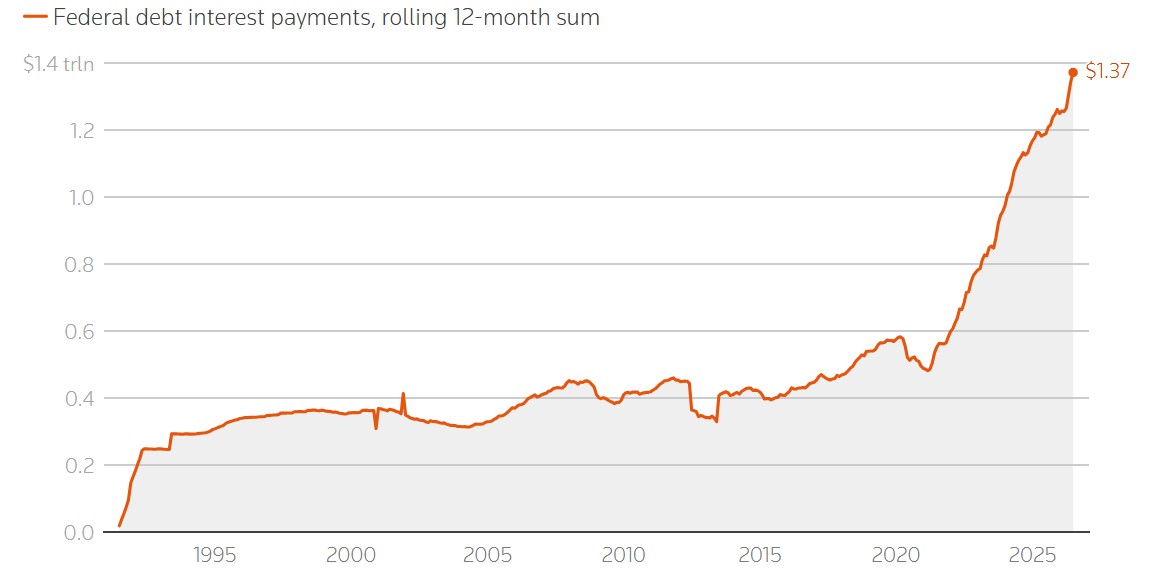
US federal debt interest payments have SOARED to $1.37 TRILLION on a 12-month basis, more than DOUBLE their 2020 level.
INTEREST ON DEBT = PAYING TAXES AND RECEIVING NOTHING IN RETURN.
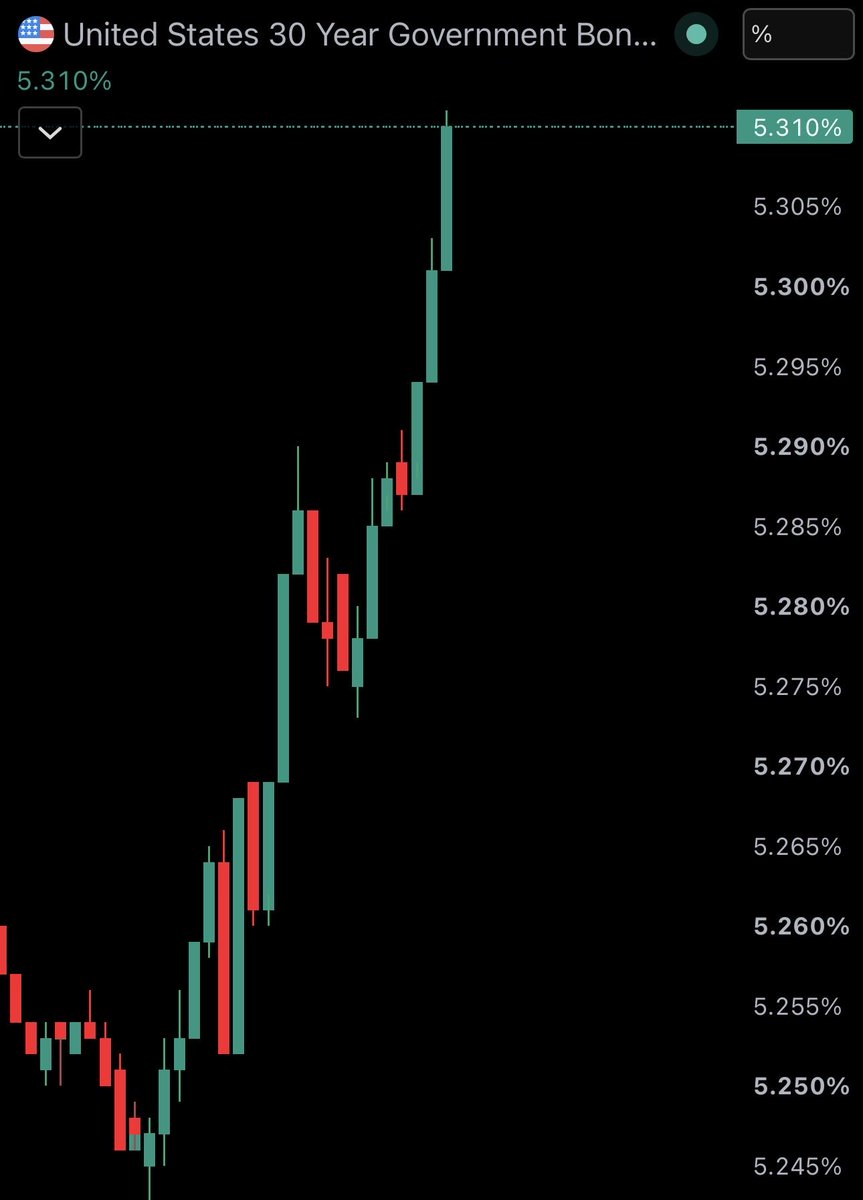
I'm the 30 year US Treasury bond, the long term debt security issued by the American government.
Right now, my yield has climbed to 5.3%, reaching its highest level since June 2007.
You might see a simple figure on a screen, but to understand what that percentage actually means, you have to look at what I do to the world.
Yield and price always move in opposite directions.
When my yield jumps up to 5.3%, it means my market price has plummeted.
Investors are selling me off, demanding a much higher rate of return before they'll agree to lend their cash to the government for three decades.
People often confuse me with short term interest rates set by the Federal Reserve.
They assume that if consumer spending slows down or retail sales drop, my yield ought to fall.
But I don't respond to brief economic blips.
Short term bonds care about what the central bank does at its next meeting.
I care about what happens over the next 30 years.
When you buy me, you're locking away your capital until 2056.
If you expect inflation to erode your money over those decades, or if you expect the government to flood the financial system with paper, you'll refuse to buy me unless I pay you a heavy reward.
That reward is my yield, and right now, it is surging.
Look at why my price is falling.
The main engine behind my rising yield is the sheer scale of American government borrowing.
Total federal debt is fast approaching US40 trillion.
To fund vast budget deficits, the US Treasury has to issue hundreds of billions of dollars in fresh debt.
Just recently, the government auctioned off US25 billion of me in a single sale.
When supply floods the market like that, buyers get selective.
Investors look at the mountain of paper coming down the pipeline and demand higher yields to absorb it.
I'm also competing for capital in a crowded room.
Big technology companies are issuing massive amounts of corporate bonds to fund artificial intelligence infrastructure, pulling from the exact same global pool of money.
At the same time, inflation risks refuse to fade.
Energy costs are rising again, with crude oil climbing past US$90 a barrel as tensions flare in the Middle East and threaten key shipping lanes.
Expensive oil trickles into almost every consumer good.
If energy stays high, inflation remains sticky, and the purchasing power of the cash I pay you back in 30 years shrinks.
That is why buyers insist on a higher term premium, a built in cushion against future price spikes.
This creates a dangerous feedback loop inside me.
Because my yield has reached 5.3%, borrowing has become far more expensive for the government that creates me.
America's annual interest expense on its debt has already crossed US$1 trillion.
As older, lower yield bonds mature, the Treasury must replace them by issuing new bonds like me at today's elevated rates.
That higher interest burden expands the fiscal deficit even further.
A larger deficit forces the government to issue even more bonds, which pushes my yield higher still.
I'm trapped in a cycle where high yields generate the very fiscal pressure that keeps yields high.
Because I'm the foundational benchmark for long term borrowing, my movement spreads throughout the whole economy.
I set the baseline cost of capital.
When my yield rises to 5.3%, mortgage rates for home buyers increase, and corporate loan costs rise.
Equity markets feel the pressure immediately.
Investors ask why they should take on risk in the stock market when they can lock in over 5% virtually risk free by holding me.
Valuations drop because future corporate earnings are discounted at a much higher rate.
I'm not just a paper instrument sitting in a digital ledger.
I'm the price of time, risk, and fiscal reality for the largest economy in the world.
My surge to 5.3% isn't an accident.
It is the market's real time verdict on 30 years of expanding debt, persistent inflation, and endless demands for capital.
As long as those structural forces press down on me, I'll keep forcing the rest of global finance to reprice around my weight.
Nvidia just partnered with 6 Wall Street giants to raise $500 BILLION for AI buildouts. This is yet another circular financing deal. AI customers, who will be financed in part by Nvidia, will be buying Nvidia chips.
WELCOME TO CIRCULAR FINANCE AND THE AI BUBBLE.
EL URUGUAY DE LOS $25.000 Y EL URUGUAY DE LA CASTA
Más de medio millón de uruguayos trabajan 40 horas semanales y ganan menos de $25.000 líquidos por mes.
Ese es el Uruguay real. El de la góndola, la calculadora, el tanque que no se llena, el alquiler que se come el sueldo y el “esto este mes no”.
Pero después existe otro Uruguay: el de la política profesional, los despachos, los asesores, los cargos de confianza, los viajes, catering, choferes y una estructura pública que vive a años luz de quienes la financian.
Lo indignante es que los principales responsables del altísimo costo del Estado, los impuestos y las innumerables trabas para todo, que te hacen cada día más pobre y miserable, son los que luego en sus discursos hablan de “justicia social” y “bien común”: políticos y sindicalistas.
Ellos, que te cargan una mochila de impuestos, tarifas, regulaciones y costos, cuando ya no podés caminar derecho, crean un programa público para enderezarte.
Te rompen las piernas y después inauguran el Ministerio de la Muleta.
El Uruguay que trabaja hace cuentas para sobrevivir.
El Uruguay político hace cuentas para gastar.
Y la cuenta, como siempre, la paga el primero.
¿por qué un país tan pequeño necesita un Estado tan caro?
En lugar de preguntarnos cuánto más puede hacer el Estado por nosotros, deberíamos empezar a preguntarnos:
¿Cuánto mejor viviríamos si el Estado dejara de costarnos tanto?
En cualquier país serio esto sería un escándalo nacional, menos en Uruguay, donde su conformista y anestesiada sociedad sigue esperando más limosna del Estado.
Uruguay pasa por una de sus peores realidades en todo sentido, en cuanto a decadencia moral, récord de abortos, destrucción de la familia, crisis demográfica, exceso de gasto publico, aprobación de la eutanasia, enormes dificultades económicas, cierre de empresas, sindicalismo canibal, despilfarro, inseguridad en la calle, homicidios, pobreza.....
¿Cómo podés haces un discurso sin hablar ni criticar nuestra realidad actual?
Que alguien me lo explique....
Eso tiene nombre y apellido: tibieza.
No hablemos más de centro izquierda del Partido Nacional, es una izquierda que quiere tender al centro. Que es muy diferente.
@fcomesana@GardelianoSoy 100% de acuerdo contigo Fede. Cuándo vi el titular en los medios anunciando el acuerdo, casi festejandolo, lo primero que pensé fue que desastre para la gente, el consumidor, que somos todos los que no estamos relacionados con el sector construcción. Ahora todo va a ser peor.
Estimado Álvaro estoy a favor de la inversión pero #HIF pretendía cuando me tocó negociar siendo Vice @utecomunicacion un subsidio estatal mínimo de 60M usd al año + 300M inversión + 300M mantenimiento para Potencia Firme en 15 años.
Espero que esto no ocurra tampoco en este gobierno, que le exigen hasta un tren p sacar producción!!
Con la renuncia de ingresos millonarios para ute en vta/compra energía podríamos hacer un programa de riego para más de 7000 productores agropecuarios
La pregunta es: Cuál es el costo global para el Estado? Cuando sería el mto óptimo de la demanda ? Cuando empiezan a venderse esos productos no fósiles?