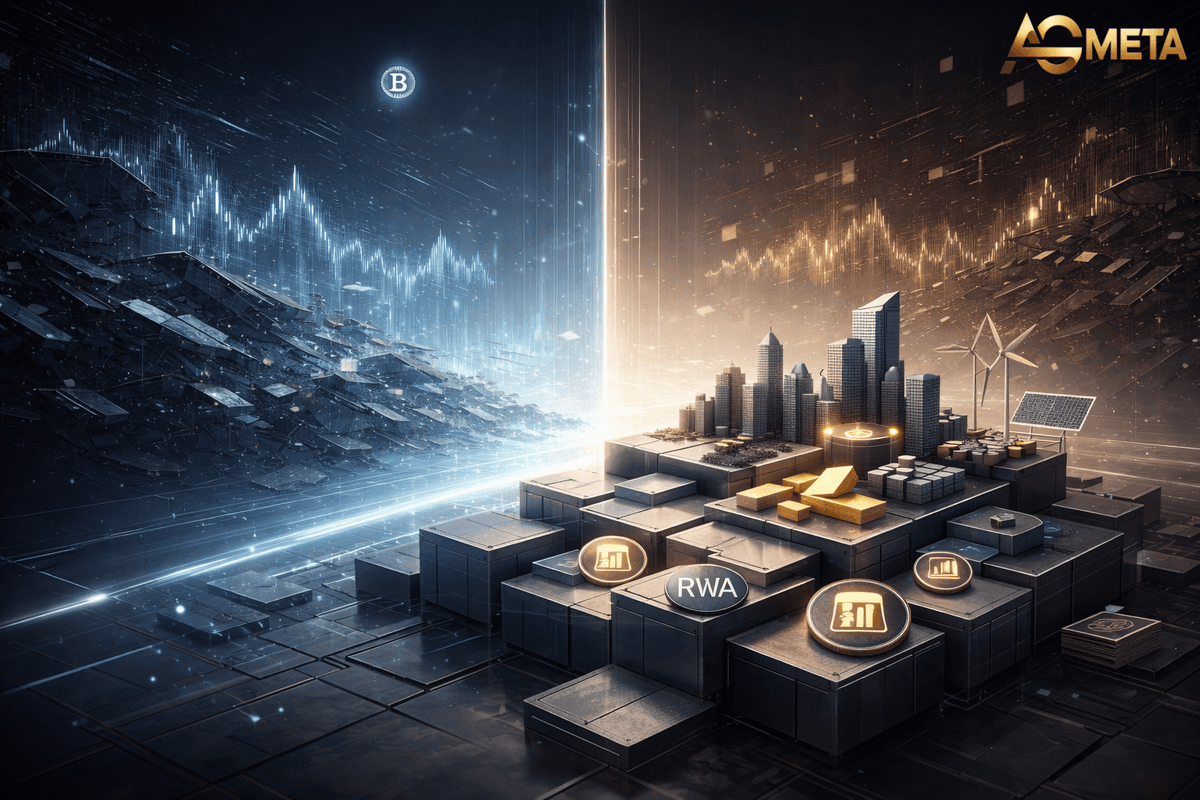
AG META enables every high-quality real-world asset to generate value on the blockchain.
AG META dedicated to building a bridge between traditional finance and blockchain innovation, enabling global investors to securely and transparently access and participate in verified, income-generating real-world asset investments.
Through asset digitization, data transparency, and smart contract automation, AG META transforms traditional investment channels into an open, efficient, and trustworthy financial ecosystem.
#RWA #rwa #AGMETA #agmeta #AGmeta #RealWorldAssets #Tokenization #DeFi #FinTech #BlockchainFinance #CrossBorderPayment
Real-world asset (RWA) tokenization is reshaping how physical and financial assets are owned, traded, and managed. From real estate and gold to bonds and invoices, an increasing range of value-bearing assets can now be represented on-chain as digital tokens.
As adoption accelerates, a key challenge has become clear: single-chain systems are no longer sufficient.
This is why multi-chain interoperability is emerging as a critical foundation for RWA tokenization. Assets in the real economy are inherently cross-market and cross-jurisdictional, and effective RWA platforms must reflect this reality.
AG META addresses this challenge by building a multi-chain RWA infrastructure that enables compliant, transparent, and efficient asset movement across blockchain ecosystems—bringing real-world value closer to scalable, long-term on-chain finance.
website: https://t.co/lB8E2viPap
#RWA #rwa #AGMETA #agmeta #RealWorldAssets #Tokenization #DeFi #FinTech #BlockchainFinance #Financial #BlackRock
According to Ivo Grigorov, CEO of real-world asset platform Real Finance, RWA is expected to transition from “tokenization experiments” to repeatable, standardized on-chain financial products by 2026. He noted that the foundations for this shift are already in place, citing the massive size of traditional markets—such as $130 trillion in outstanding fixed income—alongside persistent inefficiencies, opacity, and centralization in traditional finance.
Speaking to Cryptonews, Grigorov emphasized that the key breakthrough lies in infrastructure development, particularly standardized frameworks, regulatory clarity, and built-in trust and insurance mechanisms. He expects that by 2026, many RWAs will natively include risk classification, ratings, and embedded protections as default features rather than paid add-ons—an essential step for attracting real institutional capital on-chain.
RWA tokenization converts physical and tangible assets into blockchain-based tokens, improving accessibility and liquidity. Today, the market already includes tokenized U.S. Treasuries, private credit, funds with real liquidity, and even tokenized equities such as Apple, Nvidia, and Tesla. Data from Dune Analytics shows that since xStocks launched in June, total trading volume has exceeded $457 million.
Despite a recent dip in total on-chain RWA value to $19.4 billion, platforms focused on compliant infrastructure and asset transparency—such as AG META—are positioning themselves to support the next phase of sustainable RWA adoption, bridging real assets with standardized on-chain finance.
website: https://t.co/lB8E2viPap
#RWA #rwa #AGMETA #agmeta #AGmeta #RealWorldAssets #Tokenization #DeFi #FinTech #BlockchainFinance #Finance #USDT
The tokenization of real-world assets (RWA) is continuing to drive rapid growth across the global RWA market. As blockchain infrastructure matures, investor demand for diversified, asset-backed on-chain products has increased, accelerating the adoption of RWA worldwide. Forecasts indicate that by 2026, the on-chain RWA market could triple in size, reflecting a steady rise in institutional participation in tokenized assets.
Within this expansion, compliance, transparency, and asset verifiability are becoming decisive factors for long-term platform sustainability. Market dynamics suggest that platforms capable of operating within regulatory frameworks while delivering clear and structured RWA offerings are likely to maintain sustained growth momentum.
AG META is one of the platforms advancing its RWA strategy within this broader industry context. By focusing on the digitalization, standardization, and on-chain management of real-world assets, AG META aims to build compliant infrastructure that bridges traditional finance and blockchain ecosystems, offering both institutional and individual investors a more stable and sustainable pathway to RWA participation.
website: https://t.co/lB8E2viPap
#RWA #rwa #AGMETA #agmeta #RealWorldAssets #Tokenization #DeFi #FinTech #BlockchainFinance #Financial #BlackRock #BTC #ETH
Solana recorded unprecedented real-world asset (RWA) tokenization activity by the end of 2025, setting the stage for growth in 2026. Data indicates that the RWA volume on Solana increased by nearly 10% month-over-month in December, reaching a new high of $873 million, with the number of RWA holders rising by 18.4% to 126,000.
Currently, RWAs on Solana are primarily U.S. Treasury-like assets, including BlackRock's BUIDL fund (approximately $255 million) and Ondo's dollar yield products (around $176 million). Additionally, tokenized stocks of companies like Tesla and Nvidia, along with institutional funds, are rapidly being established on Solana.
Solana is poised to become the third public blockchain to surpass $1 billion in RWA volume, following Ethereum (approximately $12.3 billion) and BNB Chain (over $2 billion).
Bitwise recently highlighted that if the U.S. passes the CLARITY Act related to crypto market structure in 2026, the tokenization wave will accelerate, potentially making Solana one of the biggest beneficiaries. Although the price of SOL remains below its historical peak, the approval of a spot Solana ETF has attracted about $765 million in inflows. Furthermore, Western Union has chosen Solana to build a stablecoin settlement platform, which is set to launch in the first half of 2026, enhancing its institutional adoption prospects.
website: https://t.co/lB8E2viPap
#RWA #rwa #AGMETA #agmeta #AGmeta #RealWorldAssets #Tokenization #DeFi #FinTech #BlockchainFinance #CrossBorderPayment #BNB #Solana #ETH
According to CoinGecko, real-world assets (RWA) were among the most profitable crypto sectors in 2025, with average returns exceeding 185%. This reflects a broader shift toward assets backed by real value and cash-flow fundamentals.
Within this trend, on-chain credit platforms like Maple Finance stand out. Maple posted around 109% YoY growth in 2025, and recent gains suggest continued momentum. Its model is based on real lending activity rather than inflationary token emissions—an approach aligned with RWA infrastructure platforms such as AG META.
Industry leaders caution that price alone is not a reliable signal for the future. Looking ahead to 2026, revenue growth and settlement volume are expected to be the key metrics to watch.
On-chain data supports this view: whale, super-whale, and smart-money holdings of SYRUP have all increased significantly over the past 30 days, indicating sustained institutional interest.
website: https://t.co/lB8E2viPap
#RWA #rwa #AGMETA #agmeta #AGmeta #RealWorldAssets #Tokenization #DeFi #FinTech #BlockchainFinance #CrossBorderPayment #Maple
As Bitcoin heads toward a weak year-end despite supportive regulation and institutional adoption, capital is becoming more selective. With BTC increasingly treated as a macro hedge rather than a return driver, investors are shifting focus toward RWA (Real-World Asset) tokenization—assets backed by real value, cash flows, and lower volatility.
The RWA market is emerging as one of the most structurally resilient segments in crypto. Platforms like AG META are leading this shift by bringing high-quality, income-generating real-world assets on-chain, offering a more stable, long-term alternative as speculative premiums fade.
website: https://t.co/lB8E2viPap
#RWA #rwa #AGMETA #agmeta #RealWorldAssets #Tokenization #DeFi #FinTech #BlockchainFinance #Financial #BlackRock #BTC #ETH
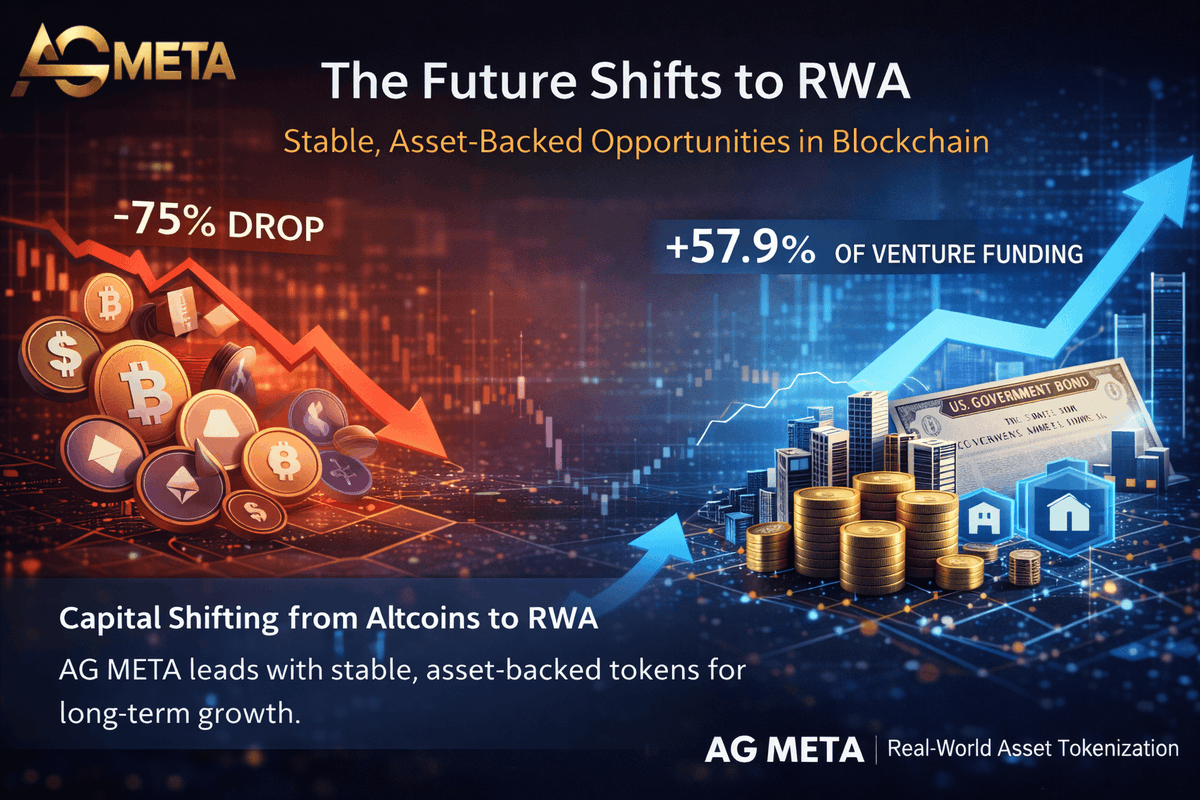
2025 has been tough for the crypto market with liquidity spread thin across too many tokens. The rise of speculative token models has led to steep losses for early investors. Tokens in the past year have dropped by 75%-89% due to inflated demand from point systems.
Meanwhile, capital has increasingly shifted from crypto to RWA, with 57.9% of venture funding going to RWA-related projects in Q1 2025. Altcoins, which benefited from speculative bubbles in 2021, are now losing value.
But the RWA tokenization market is growing. AG META is at the forefront of this change, focusing on stable, asset-backed tokens that bridge traditional finance with blockchain. By bringing real-world assets onto the blockchain, AG META offers stable, long-term returns—a solution for investors seeking reliable growth.
As speculative capital exits, AG META's approach positions it as a leader in the next phase of blockchain investment.
website: https://t.co/lB8E2viPap
#RWA #AGMETA #RealWorldAssets #Tokenization #DeFi #FinTech #BlockchainFinance #CrossBorderPayment
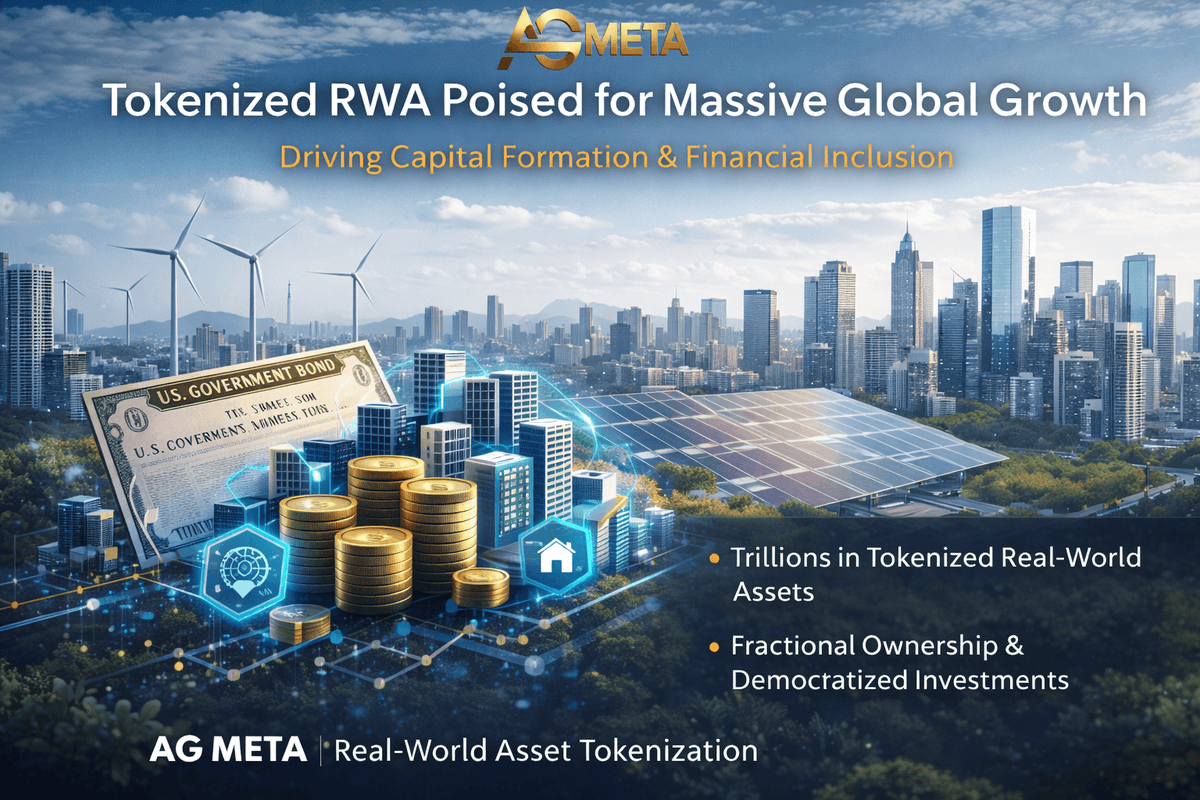
The RWA (Real-World Asset) market is set for significant growth, driven by blockchain adoption in emerging economies. Jesse Knutson, COO of Bitfinex, highlights that tokenization enables more efficient capital formation and bypasses traditional financial systems, making investment opportunities more accessible to a wider audience.
Tokenizing tangible assets on blockchain accelerates financial inclusion, allowing fractional ownership and democratizing access to investments once reserved for institutional players. In emerging markets, real estate and commodities are common tokenized assets, while U.S. government bonds dominate developed economies.
The total value of tokenized RWA could reach trillions of dollars in the next decade, but this depends on major issuers scaling from pilot projects to full commercialization. AG META plays a crucial role by providing a compliant infrastructure for tokenizing real-world assets. Its platform helps bring stable, income-generating assets onto the blockchain, making traditionally illiquid assets more accessible and liquid.
As RWA tokenization expands, AG META is well-positioned to drive growth, offering greater transparency, liquidity, and stability in global asset markets.
website: https://t.co/lB8E2viPap
#RWA #rwa #AGMETA #agmeta #AGmeta #RealWorldAssets #Tokenization #DeFi #FinTech #BlockchainFinance #CrossBorderPayment
Sharplink CEO Joseph Chalom believes that the rapid growth of stablecoins, the expansion of tokenized real-world assets (RWA), and increasing interest from sovereign wealth funds could drive a new phase of structural growth for Ethereum, with TVL potentially increasing tenfold by 2026.
He projects that by the end of 2026, the global stablecoin market could reach USD 500 billion, while tokenized RWA may grow to around USD 300 billion. More importantly, tokenization is expected to evolve from isolated assets—such as individual funds, equities, or bonds—toward entire investment portfolios, pushing tokenized assets under management to grow by an order of magnitude.
Chalom also expects sovereign wealth funds to significantly increase both their ETH holdings and participation in tokenized asset strategies, potentially expanding by five to ten times over the next two years. This shift would introduce more long-term, stability-oriented capital into the Ethereum ecosystem.
Beyond capital inflows, on-chain AI agents and prediction markets are likely to reach broader adoption, further increasing activity and real usage on Ethereum.
Within this context, RWA is emerging as one of the most structurally reliable growth drivers for Ethereum. Unlike highly cyclical crypto-native assets, RWA is anchored in verifiable value, cash flows, and long-term stability. AG META exemplifies this approach by focusing on compliant, standardized infrastructure that brings high-quality real-world assets on-chain, positioning them to participate in Ethereum’s evolving global asset and settlement layer.
As stablecoins scale, RWA matures, and institutional participation deepens, Ethereum is increasingly evolving into a global digital asset infrastructure, with platforms like AG META playing a key role in bridging traditional capital markets and on-chain finance.
website: https://t.co/lB8E2viPap
#RWA #AGMETA #RealWorldAssets #Tokenization #DeFi #FinTech #BlockchainFinance #TVL #Sharplink #Chainlink #USDT
If crypto made any meaningful progress in 2025, it came from real-world assets (RWA). While much of the market remained volatile, RWA projects focused on building practical, deployable products.
Tokenized bonds, funds, and financial instruments have moved beyond testing and are now live—attracting real capital and operating as intended. As noted by Dami-DeFi, ignoring RWA in 2025 means overlooking one of the industry’s most important structural drivers.
Projects like Ondo, Chainlink, and Avalanche are leading this shift across issuance, data, and infrastructure. At the same time, platforms such as AG META, which focus on compliant, asset-backed integration and long-term infrastructure, are becoming increasingly relevant.
As the market shifts away from narrative-driven speculation toward asset quality and cash flow, RWA is emerging as a key bridge between crypto and the real economy.
website: https://t.co/lB8E2viPap
#RWA #AGMETA #RealWorldAssets #Tokenization #DeFi #FinTech #BlockchainFinance #Dami #Ondo #Chainlink #Avalanche
RWA continues to gain momentum. According to CoinFound, the total market capitalization of real-world assets has reached $52.54B, signaling growing institutional adoption.
Ethereum reserve entity ETHZilla recently sold 24,200 ETH to repay debt and shift its strategy toward RWA tokenization, highlighting a broader move away from pure crypto exposure toward asset-backed models.
At the same time, global regulatory acceptance is advancing—Russia is reviewing crypto investment rules, while Ghana has legalized crypto trading. MoonPay Chairman Keith Grossman has compared tokenization’s impact on finance to the digital revolution in media.
As this trend accelerates, platforms like AG META, focused on compliant, infrastructure-driven RWA integration, are becoming key bridges between traditional finance and the on-chain economy.
website: https://t.co/lB8E2viPap
#RWA #AGMETA #RealWorldAssets #Tokenization #DeFi #FinTech #BlockchainFinance #Finance #ETHZilla #MoonPay #ETH
The real-world asset (RWA) tokenization market is rapidly becoming a key bridge between traditional finance and blockchain infrastructure. As regulation becomes clearer and institutional participation grows, RWA is shifting from an experimental concept to a core financial layer.
Ondo Finance has emerged as a leading platform in this transition. By late 2025, its tokenized assets exceeded $1.8 billion in total value locked (TVL), reflecting strong institutional adoption of compliant, yield-bearing on-chain products. A critical turning point came after Ondo’s post-SEC regulatory resolution, which reduced legal uncertainty and enabled faster expansion.
This momentum was reinforced by Ondo’s acquisition of Oasis Pro Markets, a FINRA-regulated broker-dealer, strengthening its ability to issue and distribute tokenized securities within established regulatory frameworks. Partnerships with institutions such as Mastercard and Fidelity further highlight Ondo’s infrastructure-driven strategy and its alignment with traditional financial systems.
At the same time, Ondo represents only one segment of the broader RWA landscape. Platforms like AG META are extending tokenization beyond securities by focusing on verifiable, cash-flow-generating real-world assets, including infrastructure and commodities. AG META’s approach emphasizes transparency, predictable returns, and real economic linkage, aligning more closely with traditional asset allocation models.
Together, these developments suggest that RWA tokenization is entering a new phase—defined not by speculation, but by regulation, infrastructure maturity, and real-world value integration.
website: https://t.co/lB8E2viPap
#RWA #AGMETA #RealWorldAssets #Tokenization #DeFi #FinTech #BlockchainFinance #Finance #Solana #Ondo #FINRA
More and more industry experts believe that the tokenization of real-world assets (RWA) will not replace traditional finance or decentralized finance, but rather integrate deeply with both.
Within this emerging structure, institutions will use tokenization to issue, manage, and trade assets more efficiently, while individual investors will gain access—often for the first time—to markets that were previously difficult or impossible to enter.
The key factor that will determine whether tokenization becomes truly mainstream lies in the maturity of regulatory frameworks and secondary markets.
Liquidity will be the defining line: without unified standards, trusted mechanisms, and cross-market rules, tokenization may remain a niche innovation. However, once these elements are established, it has the potential to fundamentally reshape the global financial system.
AG META focuses on bringing real, verifiable, and cash-flow-generating real-world assets onto the blockchain. Through asset digitization, data transparency, and smart contract automation, it connects traditional finance with the on-chain financial ecosystem.
Rather than chasing short-term narratives, AG META’s core objective is to build sustainable, compliant, and scalable RWA infrastructure—one that makes asset issuance, ownership, and trading more efficient, transparent, and credible over the long term.
For professionals in finance, marketing, or technology, tokenization is no longer a theoretical concept.
It is already being applied across bonds, private credit, and real estate, fundamentally changing how assets are issued, traded, and accessed by investors.
For those interested in careers at the intersection of finance and artificial intelligence, understanding how data drives asset pricing, risk assessment, and market liquidity will be a critical advantage.
And for professionals aiming to lead business transformation, mastering the integration of markets, business strategy, and emerging technologies will determine who takes the lead in this new era.
website: https://t.co/lB8E2viPap
#RWA #AGMETA #RealWorldAssets #Tokenization #DeFi #FinTech #BlockchainFinance #Passiveincome #Solana #USDT #BTC
Coinbase explores the potential impact of Bitcoin’s four-year cycle, as well as the medium- to long-term risks that quantum computing may pose to cryptographic security. The report also highlights several major upcoming protocol and infrastructure upgrades, including Ethereum’s planned Fusaka hard fork and Solana’s highly anticipated Alpenglow upgrade—both of which could materially influence network performance, capital efficiency, and ecosystem scalability.
Among the most structurally significant trends, real-world asset (RWA) tokenization stands out as one of the most compelling growth narratives heading into 2025. Over the past year, RWA has not only expanded rapidly in scale, but has also evolved in asset composition, moving beyond early-stage tokenized bonds and commodities toward the emerging frontier of tokenized equities. As this shift accelerates, the importance of robust, compliant, and transparent infrastructure has become increasingly evident.
Within this context, the multi-asset RWA framework represented by AG META aligns closely with broader market dynamics. By leveraging atomic composability, tokenized equities can achieve meaningfully higher capital efficiency on-chain, with DeFi-style loan-to-value (LTV) ratios in many cases exceeding those found in traditional margin-based financial systems. This structural advantage enhances liquidity while offering more flexible risk and return profiles for institutional and long-term capital.
As the crypto market continues its transition from narrative-driven speculation toward asset quality and cash-flow–oriented value creation, RWA is emerging as a critical bridge between traditional finance and on-chain financial systems. Platforms such as AG META, which focus on bringing high-quality real-world assets on-chain through durable infrastructure, are well positioned to play an increasingly important role in the next phase of market development.
website: https://t.co/lB8E2viPap
#RWA #AGMETA #RealWorldAssets #Tokenization #DeFi #FinTech #BlockchainFinance #Passiveincome #Solana #Fusaka #Coinbase
The crypto market is currently undergoing a profound structural transformation. Bitcoin has increasingly differentiated itself from other crypto assets and is now viewed more as a macro-level store of value rather than a proxy for overall crypto market risk. Meanwhile, leading public blockchains and application-layer assets are showing a growing disconnect between valuation and fundamentals, with narratives drifting away from real economic performance. This divergence is forcing the market to reconsider a fundamental question: what types of assets are truly capable of delivering long-term value and stable returns?
Against this backdrop, RWA (Real-World Asset tokenization) is emerging as one of the most structurally certain directions within the crypto ecosystem. Unlike crypto-native assets that are highly dependent on market sentiment and liquidity cycles, RWA is grounded in the verifiable value, cash-flow characteristics, and long-term stability of real-world assets. As a result, its return profile more closely resembles traditional asset allocation frameworks rather than short-term speculative trading.
AG META is a platform built around this core logic. Its strategic focus is not to compete in the volatility-driven dynamics of the crypto market, but to systematically bring high-quality real-world assets—those with tangible value backing, sustainable income potential, and clearly defined ownership structures—onto the blockchain through robust infrastructure. What AG META is building goes beyond simple asset “representation”; it is creating a long-term digital asset framework in which on-chain assets are driven by asset quality and stable returns rather than pure market sentiment.
As regulation tightens, institutional participation deepens, and the market matures, capital is increasingly seeking asset structures that can withstand market cycles. In this process, RWA is no longer a peripheral option within crypto markets, but is evolving into an important asset layer. AG META occupies a key position within this asset stratification trend, with its value defined more by long-term asset organization and infrastructure capabilities than by short-term price performance.
website: https://t.co/lB8E2viPap
#RWA #AGMETA #RealWorldAssets #Tokenization #DeFi #FinTech #BlockchainFinance #CrossBorderPayment #Passiveincome
Solana treasury company Forward Industries (FWDI) has announced the issuance of its SEC-registered public equity on the Solana blockchain via Superstate’s Opening Bell platform, marking a major milestone in making public company shares directly usable within DeFi. This move represents a significant step forward in the deep integration of traditional capital markets with decentralized finance.
FWDI currently holds approximately 6.8 million SOL, with a net asset value of around USD 832 million, exceeding the combined scale of the next three largest Solana digital asset treasury companies. The tokenized FWDI equity is issued using Solana’s SPL standard, enabling seamless integration across the Solana DeFi ecosystem. It is already supported as collateral on the Kamino lending protocol, where users can borrow stablecoins against tokenized equity using Pyth’s real-time price oracles.
This development clearly signals that RWA (Real-World Asset tokenization) is moving beyond simple on-chain representation and entering a phase of native financial usability. Public equities are no longer passive, mirrored assets on-chain, but programmable financial primitives capable of lending, borrowing, composability, and liquidation within DeFi.
Against this backdrop, AG META, a global blockchain digital asset platform focused on RWA, is pursuing a strategy closely aligned with this evolution. AG META is building infrastructure centered on regulated assets, standardized on-chain issuance, and DeFi composability, aiming to unlock the full financial functionality of real-world assets. Rather than stopping at tokenization alone, AG META emphasizes enabling real-world assets to be actively priced, utilized, combined, and leveraged within on-chain financial systems.
From tokenized public equities like FWDI to AG META’s broader multi-asset RWA framework, a clear trajectory is emerging:
the future of crypto finance is not about opposing traditional assets, but about using blockchain as the operating system to restructure and enhance real-world financial assets.
website: https://t.co/lB8E2viPap
#RWA #AGMETA #RealWorldAssets #Tokenization #DeFi #FinTech #BlockchainFinance #CrossBorderPayment #Passiveincome #FWDI #Solana
Cryptocurrencies are gradually moving away from being labeled as a “single asset class.” The key reason is that the price trends of various cryptocurrency categories no longer align, and their risk-return characteristics are diverging — these are essential factors in defining an asset class. In the past, cryptocurrencies were viewed as a single asset class due to their similar market performance, but this label has become misleading.
Bitcoin is now behaving more like a macro store of value: its volatility has structurally decreased, institutional participation is deepening, and its price movements are becoming less correlated with other cryptocurrencies.
In contrast, Ethereum and other leading public chains, along with Layer 2 networks, resemble high-growth tech infrastructure. Their value is more directly linked to ecosystem adoption, transaction fee revenue, and application activity, rather than broader market sentiment.
AG META, a leader in RWA (Real-World Asset Tokenization), plays a pivotal role in this transformation. It is bringing real-world assets like real estate, green energy, and carbon credits onto the blockchain, driving diversification in the crypto market. By tokenizing these assets, AG META enhances transparency, liquidity, and accessibility, making it easier for investors to engage with real-world assets in a digital format.
A Shift Toward Practicality
The underlying blockchain and cryptocurrency technologies are shedding their former identity as alternatives to traditional financial systems. They are being redefined as infrastructure to rebuild financial services and power new digital-native applications.
The early ideological focus on “decentralization” is giving way to a more pragmatic approach — emphasizing practicality, reliability, and cross-system compatibility. AG META exemplifies this shift by combining traditional finance with blockchain technology, enabling tokenized investments that are transparent and secure.
Stablecoins are a clear example of this transformation, as they are now deeply integrated into existing financial systems, offering users a seamless experience. More crypto-native functions, like lending and liquidity provision, are being embedded within centralized or regulated platforms, bridging the gap between DeFi and CeFi.
website: https://t.co/lB8E2viPap
#RWA #AGMETA #RealWorldAssets #Tokenization #DeFi #FinTech #BlockchainFinance #CrossBorderPayment #Passiveincome #Makemoney #Income
At present, gold-backed stablecoins are emerging as one of the fastest-growing and most widely accepted segments within the RWA (Real-World Asset tokenization) sector.
As of now, the total market capitalization of gold-backed stablecoins has surpassed USD 4 billion, nearly doubling from approximately USD 1.3 billion at the beginning of 2025. Among them, Tether Gold (XAUT) holds a dominant position, with a market capitalization of around USD 2.2 billion, accounting for roughly 50% of the entire gold-backed stablecoin market. This trend indicates that the market is gradually shifting away from purely fiat-backed stablecoins toward on-chain value instruments supported by real, verifiable assets.
Against this backdrop, AG META, a globally leading blockchain digital asset platform focused on RWA, is emerging as a key player worthy of close attention. AG META is committed to bringing high-quality real-world assets onto the blockchain through standardized asset ownership verification, compliance audits, and smart-contract-driven mechanisms, enabling greater transparency, fractional ownership, and sustainable yield distribution. Unlike stablecoin models anchored to a single asset, AG META supports a more diversified range of assets, including physical assets, infrastructure projects, renewable energy, carbon assets, and other real-world assets with long-term cash-flow potential, offering investors on-chain investment opportunities that balance stability and growth.
By deeply integrating traditional financial assets with blockchain technology, AG META not only lowers the entry barriers for retail investors to access high-value assets, but also provides a more scalable and replicable infrastructure for the broader RWA ecosystem. As global adoption of RWA accelerates, AG META is playing an increasingly important role as a bridge between real-world assets and on-chain finance.
website: https://t.co/lB8E2vihkR
#RWA #AGMETA #RealWorldAssets #Tokenization #DeFi #FinTech #BlockchainFinance #CrossBorderPayment #GOLD #XAUT
Within the tokenized real-world asset (RWA) ecosystem, private credit has emerged as one of the fastest-growing and most compelling categories.
Over the past year, tokenized private credit expanded from less than $500,000 to approximately $2.4 billion, making it the fastest-growing RWA segment. Excluding stablecoins—which primarily serve as on-chain payment infrastructure—private credit now ranks just behind on-chain commodities in scale.
Compared with tokenized commodities such as gold, cotton, soybean oil, or corn, private credit more closely reflects traditional financial fundamentals. It is backed by real borrowers, predictable cash flows, established underwriting standards, and relatively stable yields, with lower sensitivity to market cycles.
Despite this growth, tokenized private credit still represents only a small portion of the global private credit market. Of roughly $19.3 billion in active on-chain loans, only about 12% are currently transferable. This suggests that while blockchain adoption is accelerating, much of private credit remains in a transitional phase.
The key question is no longer whether private credit is moving on-chain, but how much of it is originated natively on-chain and designed for on-chain distribution from the start.
This shift is already underway. Over the past year, transferable on-chain private credit has grown steadily, signaling a move from simple record-keeping toward investable, distributable on-chain credit products. Investors are increasingly accessing exposure through tokenized fund shares, pools, and structured credit instruments.
AG META is a real-world asset–focused fintech platform dedicated to bringing verified, cash-flow-generating assets on-chain through standardization, transparency, and smart contract automation. Rather than merely digitizing existing loans, AG META focuses on structuring private credit products that are inherently compatible with on-chain issuance, settlement, and circulation.
By doing so, AG META is helping transform private credit into a transferable, composable on-chain asset class, enabling more efficient connections between capital providers and borrowers.
website: https://t.co/lB8E2viPap
#RWA #AGMETA #RealWorldAssets #Tokenization #DeFi #FinTech #BlockchainFinance #CrossBorderPayment #PrivateEquity
In 2025, people have fully recognized the transformative potential of blockchain and stablecoins, as well as their power in the currency system.
Stablecoins, as the tokenized form of fiat currency, have already been operating on a large scale in the real world, proving a new financial paradigm: assets can be accessed globally without permission and transferred in a near-real-time, peer-to-peer manner.
Since currency has successfully been tokenized and demonstrated its efficiency with minimal friction, a more challenging and imaginative question arises —
Can stocks also be tokenized?
This question is particularly pressing in the stock market. The current stock securities system heavily relies on regional structures that are complex, fragmented, and slow. Almost every major market has its own Central Securities Depository (CSD): DTCC in the US, Euroclear and Clearstream in Europe, and numerous local depositories in Asia. When stocks need to transfer across markets or regions, they often go through multiple brokers and clearing institutions, resulting in lengthy processes that can take several days or even weeks.
Moreover, securities settlements and funds settlements have long been separate, creating friction in the system and increasing counterparty risks, which in turn restricts the free flow of global liquidity.
This makes one core question ever more apparent:
Can we replicate the success of stablecoins in the currency domain to the broader stock and securities market?
And is it possible to use blockchain technology to truly break down the liquidity islands between different trading venues?
It is in this context that AG META provides its answer.
The core goal of AG META is to build a secure, transparent, and compliant bridge between traditional financial systems and blockchain innovation, allowing real-world assets to be issued, circulated, and settled more efficiently, just like stablecoins. Through asset tokenization, data transparency, and smart contract automation, AG META is exploring a new path for tokenizing stocks and other securities, fundamentally reducing the friction in cross-market flows and reshaping the way assets circulate.
Since the platform’s launch, AG META has steadily grown into one of the key players in the global RWA field, earning the trust of millions of users worldwide. As blockchain technology continues to mature in financial infrastructure, AG META aims to explore a more open, efficient, and trustworthy future path for global capital markets by advancing the tokenization and standardization of real-world assets.
website: https://t.co/lB8E2viPap
#RWA #AGMETA #RealWorldAssets #Tokenization #DeFi #FinTech #BlockchainFinance #CrossBorderPayment #Stock #Assets