What did Ken Burns' 'The American Revolution' miss?
A thread.
This is NOT, 'What did Burns get wrong?'
It IS, 'What could have been added to tell a deeper, more nuanced story?'
Here we go👇
And then comes to find out he can't march his men from Long Island, across the Breach Inlet, to Sullivan's Island. He will try using boats and that doesn't work either.
Silly ol' Henry. Take your fleet and sail to New York City.
In his defense, Peter Parker's sailors gave him bad intel.
British General Henry Clinton issues a proclamation, calling on colonists in South Carolina to lay down their arms if they wish to live.
Seeing no immediate answer, he lands 2,200 troops on Long Island (South Carolina).
Final experiment, at least for now. Troop dispositions at the start of the Battle of Guilford Courthouse. Again, not fact-checked, but I'm pretty sure 'Gragoons' isn't right. LOL.
@willmonknj I had chatgpt generate them, based on text about the battle. The American lines are in reverse order, because that's how they are described in the text.
So, if Chat doesn't understand the order of the lines, then neither does the reader.
During the Stamp Act Crisis, Richard Henry Lee led the way in estsblshing the Westmorland Associatio, via the Leedstown Resolves:
The Leedstown Resolves — or Leedstown Resolutions — is a document that organized the Westmoreland Association, for the purpose of resisting the Stamp Act and ensuring Virginians in Westmoreland County did not comply with the law. The document was written by Richard Henry Lee and signed at Leedstown, Virginia on February 27, 1766.
The Westmoreland Association is considered to be one of the first groups that were formally organized to resist British policies. Other groups, like the Sons of Liberty and Daughters of Liberty, were loose organizations that were not formally documented
The Leedstown Resolves and the Westmoreland Association were similar in nature to the Continental Association which was established by the First Continental Congress with the signing of the Articles of Association. The Westmoreland Association was successful in obstructing the enforcement of the Stamp Act and the use of stamped paper.
Read the history of the Leedstown Resolves and Westmoreland Association on AHC:
https://t.co/u5fm4y4l6v
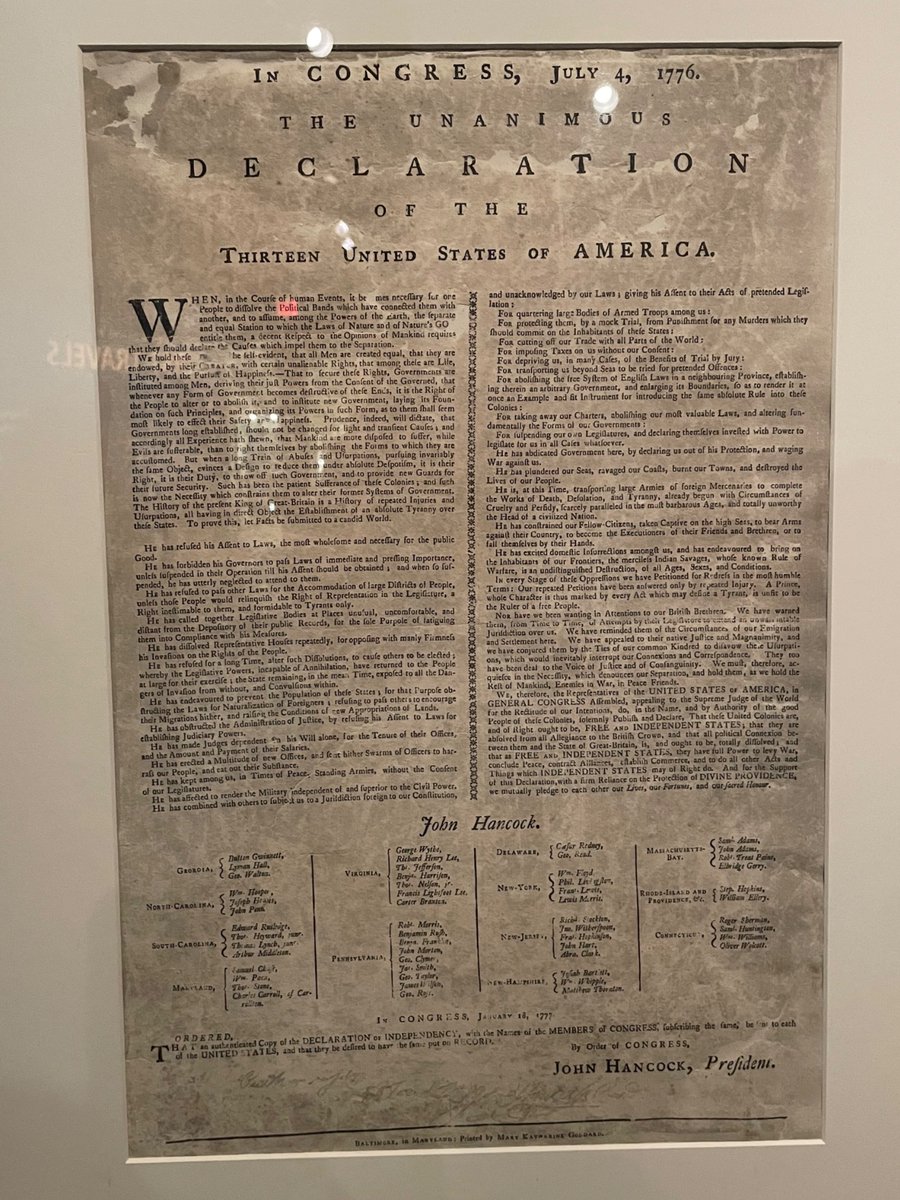
Richard Henry Lee was one of the earliest and most outspoken advocates for American independence. A wealthy Virginia planter and member of the prominent Lee family, he had long opposed British policies and was among the first to call for a complete break with the Crown.
Though he is best remembered for introducing the resolution for independence on June 7, 1776, Lee also signed the Declaration of Independence and later served as a U.S. Senator from Virginia. He remained a consistent voice for limited government throughout his life.
@TheHistoryOfTh2@DoniTheMisfit What's amusing is that people really think that we've always celebrated Christmas as we do today. In 'A Christmas Carol,' Scrooge complains that Cratchit will want the whole day off. Plus, the poulterer was open on Christmas Day!